If you make the most of your Sprout trial, the answer is a lot.
After a well-managed 30-day Sprout trial, you’ll have organized all of your social content, have everything scheduled and ready to publish, plus be able to track your performance across different networks every step of the way.
We understand nothing spurs fear of commitment quite like a binding vendor contract. Choosing the wrong social media management solution can be a pricey mistake—from the team inefficiencies to the cost of a product they never use.
Sprout’s 30-day trial eases those nerves by providing you and your team with a chance to try before you buy. Our intuitive platform is designed for immediate adoption, so you can get up and running in minutes. What’s more, you don’t need a large team or a technical set-up; Sprout fits in with what you’re already doing, enabling you to achieve results faster and more efficiently.
Once you activate your Sprout trial, follow the tips in this guide to go from setting up and managing your content calendar to tracking results and staying connected with your followers.
Get fully set up
To make the most of your Sprout trial, set clear success criteria right at the beginning of your 30-day period.
This is a good time to look back on why you started evaluating new tools in the first place. Do you want more in-depth reporting? Easier ways to manage socials across multiple networks? Or do you want to connect with your cross-team managers to identify key priorities and go from there?
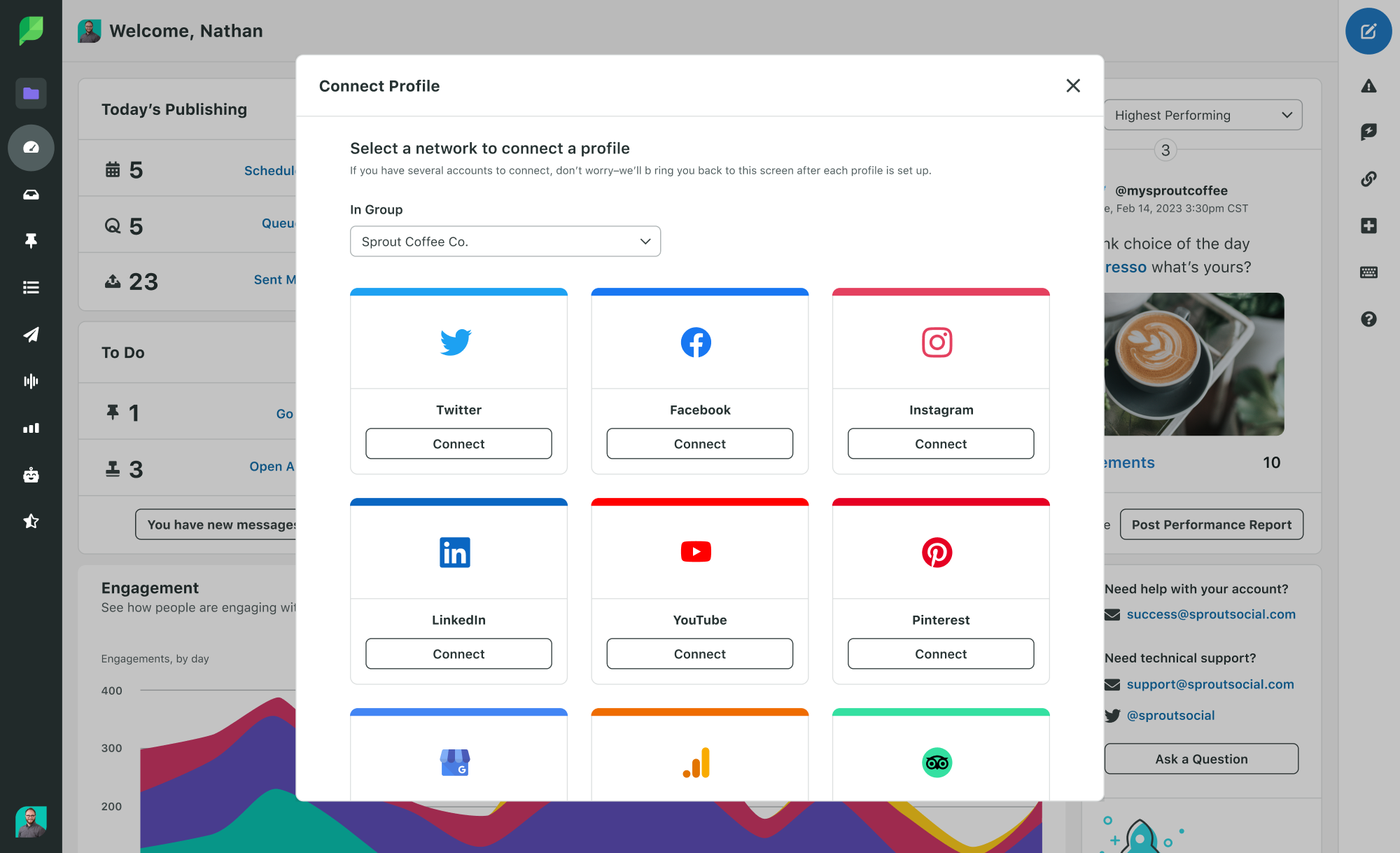
After aligning on your goals, you’ll need to connect your profiles. Sprout enables you to connect all your accounts across every major social media network and bring them together in a single interface. You can find a full list of Sprout’s integrations here.
You can start your Sprout trial by connecting just a single social profile, but you’ll get the most out of your 30 days by connecting all of them up front. By connecting all your profiles, you can streamline cross-network publishing and get deeper insights across profiles when you view your reports.
When first signing into Sprout, you’ll be prompted to connect your social media profile. Select whichever profile you’d like to get started with. You can add more profiles and networks later by clicking the + icon in the top right corner of the Sprout app.
The Publishing Calendar serves as the central hub for content scheduling in Sprout; it’s a holistic solution that simplifies creating, managing and reviewing your content output across all networks. Instead of juggling multiple spreadsheets and fiddly cross-posting across multiple apps, use the Sprout Calendar to simplify the entire content planning process.
First, we’ll introduce Sprout Calendar’s planning features, then we’ll explain how to streamline content creation and posting in Sprout directly by using Compose.
Meet your content calendar
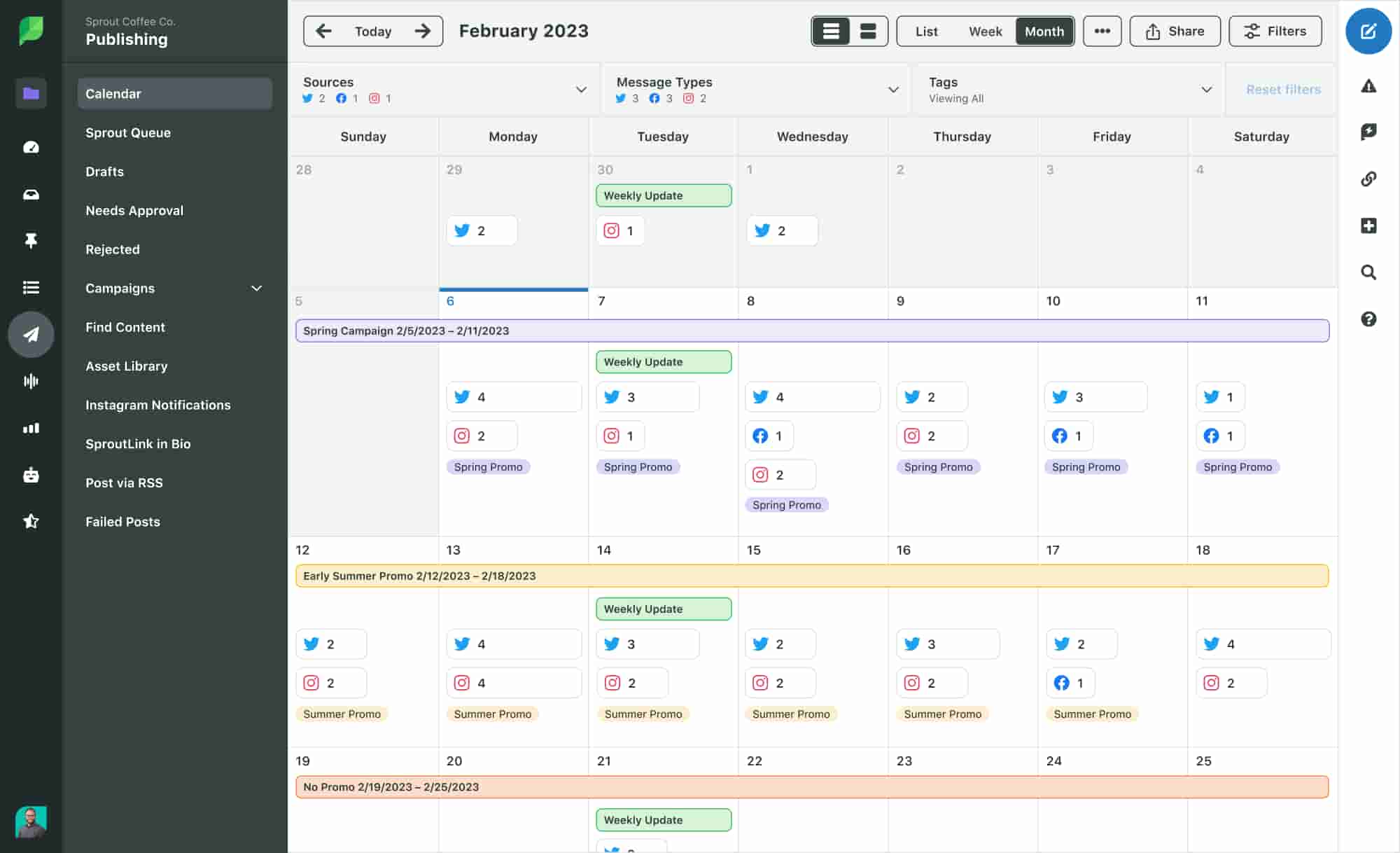
After connecting all your profiles to Sprout, you’ll be able to visualize all of your social posts at once in the Calendar. View posts you’ve already published, as well as any future posts you’ve scheduled or drafted in Sprout.
Alongside centralizing all of your posted and planned content, Sprout’s Calendar offers several useful collaborative and planning capabilities, including:
Calendar notes: You can create notes on the Calendar as references for your social strategy. These might include things like marketing campaigns and holidays that influence your posting schedule or the performance of your content.
Filling content gaps: Sprout makes it easier to identify and fill gaps in your calendar. Simply hover over an empty day to create a new post or draft right from the Calendar.
Shareable links: Create simple shareable links to your calendar, or export it as a PDF, so you can share your plan with other teams and stakeholders.
Now that you’re familiar with some of Sprout’s Calendar, think about how you’d create a 30-day content plan to fill your trial period.
Once you know what content you want to post, you’ll use Compose to input, schedule and customize your content directly in Sprout.
Craft posts in Compose
You’ve now seen how the Calendar gives you a complete picture of your social strategy in one view. When you’re ready to start crafting content, Compose gives you powerful tools to create posts that are tailored for each network. Using Sprout Compose, you can make sure everything you post is fully optimized and make the most of your Sprout trial.
To create a post, click the Compose button in the top right corner of the Sprout app. From the Compose window, you can:
Add images, GIFs and video to your post by uploading from your device, or via one of our integrations.
Expand to fullscreen view to preview posts on each network before publishing.
Tag locations, like your business address, to let customers know where you’re located.
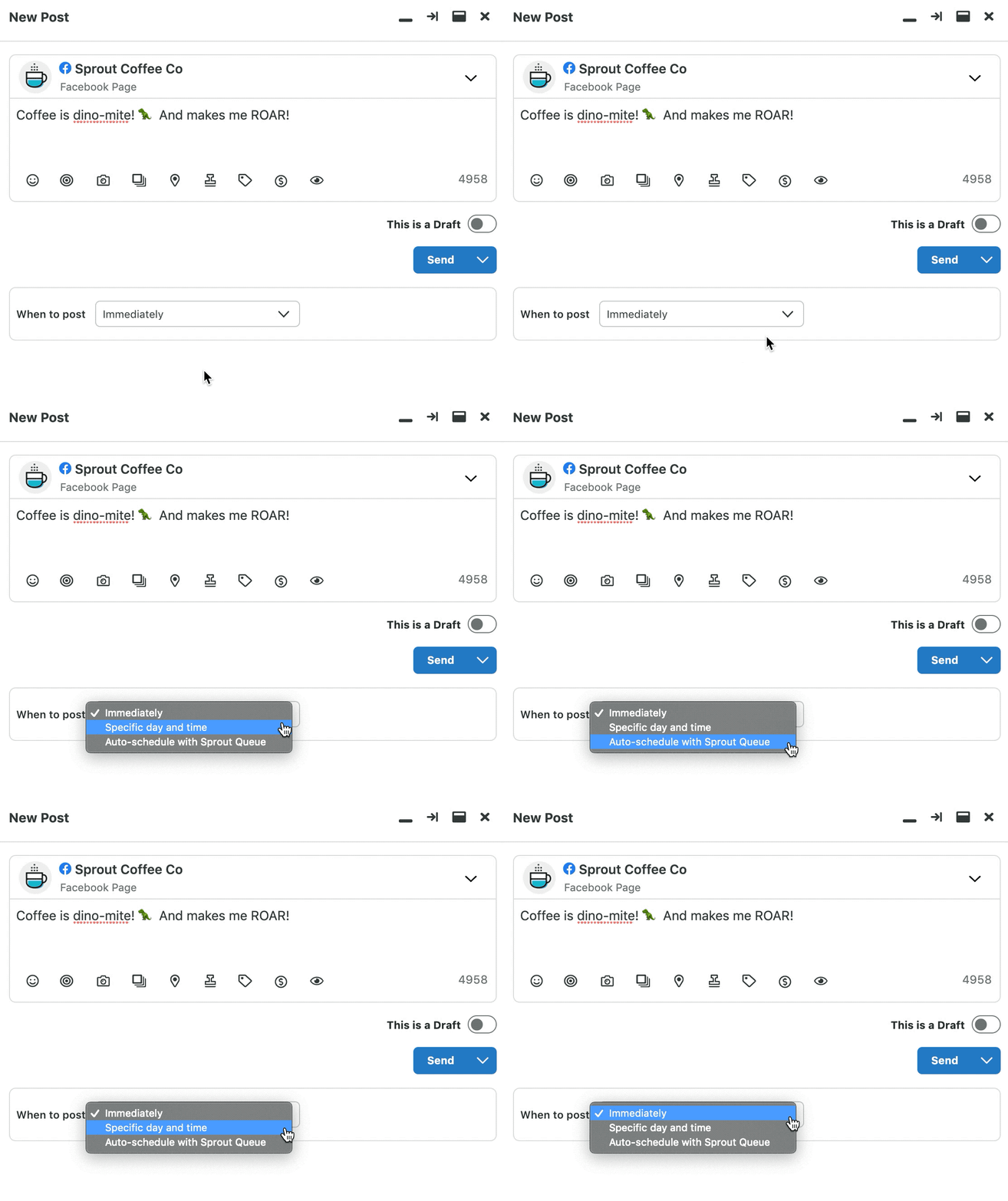
Publish your post immediately, schedule it for the future or add the post to your queue.
Learn more about posting and customizing in Sprout Compose in this Sprout Bites video:
Just like with the Calendar, Sprout Compose has tools that make it easier to optimize and publish across all social networks. Some of the main Compose features you’ll use during your 30-day trial period include:
Cross-network Publishing: Write once, tailor slightly, then post your content across all your connected profiles. Create your post in Compose, then use Sprout’s Profile Picker to select which profiles to publish on, and then proceed to post to all of those profiles at once.
Optimal Send Times: The best time to post on social media depends on the network you’re using and your audience. Take the guesswork out of your timing using Optimal Send Times. Select the Optimal Send Times dropdown, and you’ll be given a choice of suggested times based on different networks and your engagement data. Selecting one of these suggested times helps your content achieve superior reach across your different networks.
Draft Posts: Work on your content on your schedule using Compose’s drafting capability. Save any piece of content you’re working on, and revisit it later. Saving drafts also connects your content to the Calendar so it remains part of your wider content plan. And if you don’t have a posting date yet, you can find all of your drafts by navigating to Publishing > Drafts.
Sprout Queue. Schedule your content ahead of time using Sprout Queue. Designed for content that isn’t time-sensitive, Sprout Queue enables you to build out future posts for your content calendar.
You can also preview and customize posts for different networks. Use Compose’s built-in image editor to tweak your images, and Generate Alt Text by AI Assist to come up with quick captions and hashtag suggestions.
For a more in-depth guide to publishing in Sprout, take a look at the Introduction to Publishing course in Sprout Academy.
See what’s working with Reports
Once you have customized and scheduled your content, the next step is tracking its impact. Sprout’s Reports show you how your content is performing across different social networks.
Sprout has reports for individual posts, specific networks and across networks, so you can get insights to drive your social strategy at every level of detail. Filter and drill down in the Sprout app or download presentation-ready reports via PDF to share with stakeholders.
We start filing Reports with data as soon as you connect a profile, but some reports may take a day or two to pull in data. Connect all your profiles early in your trial to get a complete picture of your performance and to get the most value out of your trial.
Post Performance Report: Measure your content strategy
Sprout’s Post Performance Report ties your content strategy directly to measurable results. You can analyze how your content is performing down to individual posts, based on metrics like engagement, shares, clicks and more.
Customize your view to focus on specific content types, like Instagram videos or Facebook Ad posts. Or, drill down to boosted posts to track how your paid content is performing when compared with organic posts.
Use the data covered in the Post Performance Report to refine content strategies so you can focus on creating more top-performing posts. It also provides a granular level of detail on how well your specific campaigns are performing across different networks. For greater visibility, combine this report with a big picture view of each account using the Profile Performance Report.
Profile Performance Report: Measure the health of your social presence
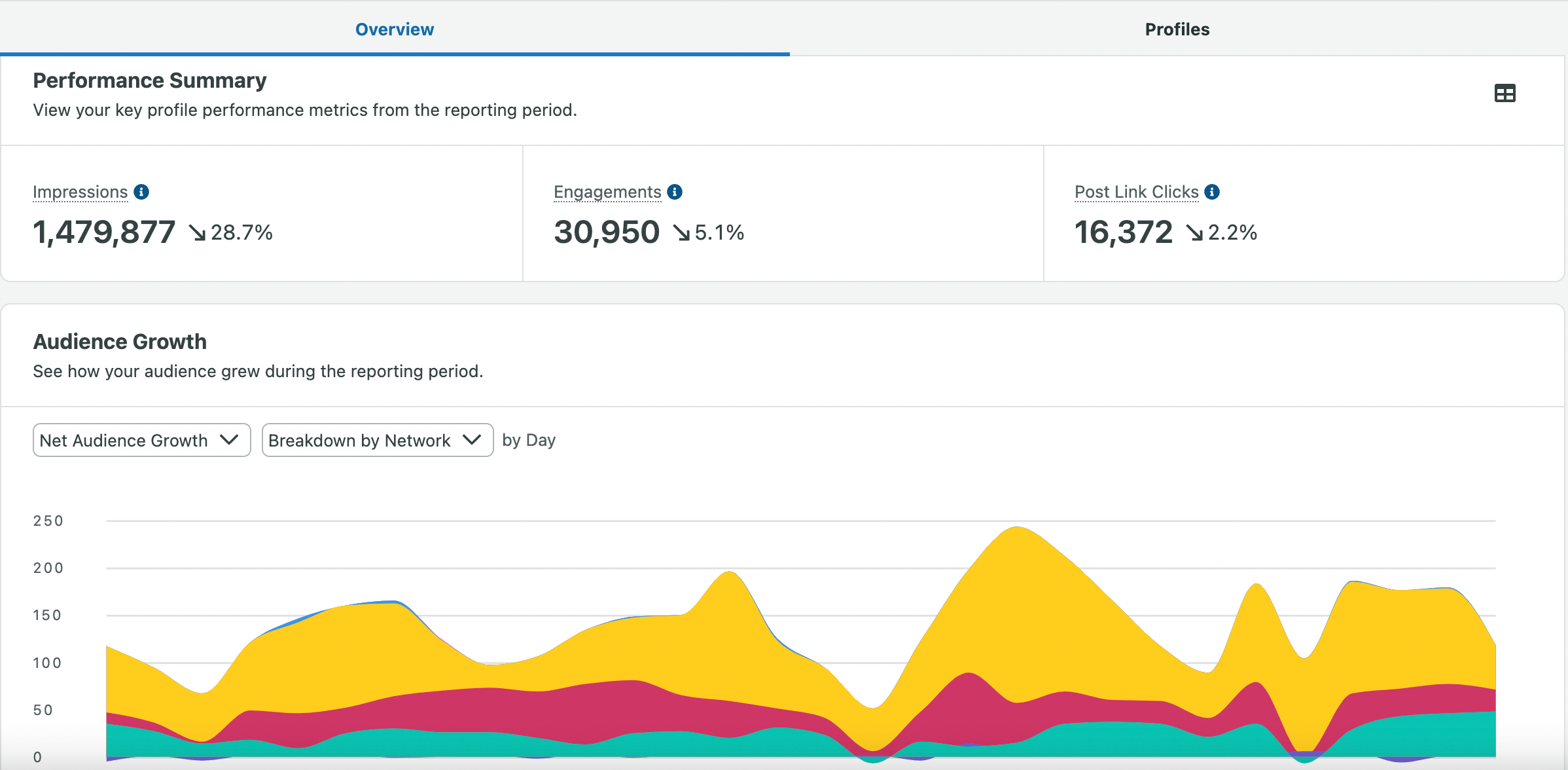
The Profile Performance Report tracks the performance of all your social accounts in one place. Use this report to visualize which profiles or networks are under- or overperforming, and refine your strategy going forward.
Compare networks against each other through specific metrics, like audience growth, message volume and impressions. These stats might reveal that a profile you thought was underperforming in impressions is actually more useful for driving follower messages. Accessing these insights can guide your priorities for each account.
Then, take these insights one step further with Sprout’s network specific reports.
Network specific reports: Dig deeper into profile performance
Sprout’s network specific reports are designed to give unique data for each social network. They provide a specialized layer of insight when compared with profile performance. This includes focusing on network-specific metrics that aren’t universal across every network.
Make the most of your Sprout trial by using these reports to further refine your approach to different networks, based on your prior performance.
Bonus: Stay connected to your audience with Smart Inbox
Sprout’s Smart Inbox is a more advanced inbox management feature that’s available for users on Standard, Professional and Advanced plans. If you’re on an Essential plan, don’t worry; you still have everything you need to manage Publishing in Sprout. If you’re on an Essential plan and find you’re receiving a lot of messages and comments on your content, you can easily upgrade your plan for free during your trial to start using Smart Inbox.
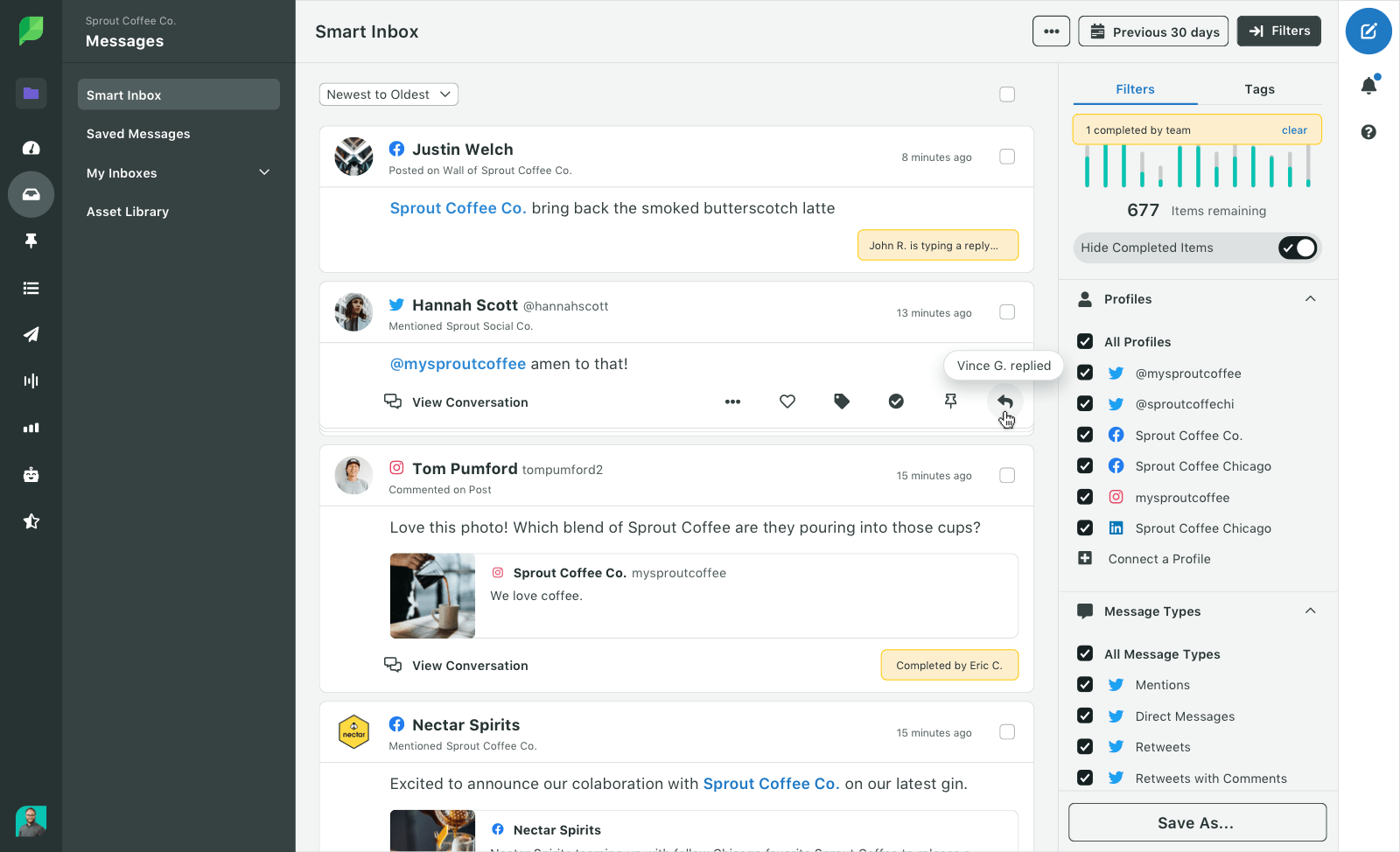
The Smart Inbox simplifies engagement and community management by unifying inbound messages and comments from X, Instagram, TikTok, Facebook, LinkedIn and YouTube into a single stream. From there, you can filter, sort and reply to messages all in one place.
Smart Inbox streamlines the process of managing your social inbox. It makes community management and direct engagement with your followers much easier by providing a centralized inbox and collaboration features.
Pro tip: When you’re starting out with Social Inbox, use the right sidebar to choose which social profiles are filtering into your inbox at any given time. To start fresh in the Smart Inbox, bulk complete messages from before your trial period or set the date filter to the start of your trial period. You can also select Hide Completed Items to remove messages that have already been addressed from your current view.
Key tips for success
If you want to make the most of your Sprout trial, bear in mind these more general tips for success:
Keep posting consistently during your trial. The more you’re able to post during your trial period, the more data your Reports will be able to draw from.
Check your calendar regularly. By frequently checking and optimizing your calendar, you’ll keep your content strategy organized and on track.
Connect as many profiles as you can. This will enable you to access more network comparison data, and means you’ll get better acquainted with how Sprout’s features work for specific networks.
Use the Sprout Academy. All of the courses in Sprout Academy are designed to be easily accessible, and give you a foundational understanding of how to make the most of Sprout’s core capabilities.
Bookmark our help center. If you ever encounter a problem, navigate to our help center first, as there might be a page there that can help.
Download theSprout mobile app. The mobile app brings the power of Sprout straight to your smartphone. Customize your push notification settings and get real-time updates to keep track of your socials on the go.
Join The Arboretum. The Arboretum is a member-driven virtual community powered by Sprout Social. It’s where social media professionals can meet and connect over their shared career goals.
Keep each of these tips in mind, and you should have no trouble making the most of your Sprout trial period.
Put Sprout to the test today
As long as you follow these steps, and tailor your tool use to the specific needs of your brand and your accounts, you’ll maximize the value of your 30-day trial period with Sprout Social.
By the end of your trial, you’ll have your content calendar built, your reports running and a clear picture of how Sprout can simplify your social strategy.
The creator economy has turned the tourism industry on its head.
Today, UK travel marketing runs on influencer partnerships. Travel influencers are destination advertising, travel agents and Lonely Planet guides all wrapped in one. They shape where people go and how they experience it.
The right influencer partnership can turn inspiration into bookings and long-term brand loyalty. The challenge? Finding the perfect influencer match and proving their impact. Here’s how to identify UK travel influencers who align with your brand values and build lasting, mutually beneficial relationships with them.
Why influencer marketing travel campaigns matter in the UK
Influencer marketing is everywhere, and travel is no exception.
From boutique hotels to national tourism boards, UK brands are partnering with creators to inspire visits and drive bookings. While older generations likely respond to traditional tourism marketing, younger audiences look almost exclusively to social media platforms for travel inspiration. They don’t want a glossy brochure; they want to see creators living the experience before they book tickets.
For these travellers, it all comes down to authenticity. In the UK, social media users prize authenticity above all else. This means traditional ads fall flat because they feel distant. But when someone they trust shares a genuine, unforgettable journey? That sparks action.
What travel influencers offer that ads can’t
Watching someone’s real travel experience sparks wanderlust in a way no ad ever could.
Travel influencers don’t just post polished shots of the Thames; they tell stories that make you feel London. From a hidden café in Shoreditch to a misty morning in the Highlands, they capture moments that traditional tourism campaigns can’t replicate.
Authentic creator content has emotional pull. The best short-form videos draw high engagement because followers aren’t just watching, they’re imagining themselves in the story. These videos build trust by sharing an experience, not by selling a package. And in today’s travel economy, trust drives bookings.
How to find UK travel influencers who drive bookings
Finding travel influencers is easy. Finding the right ones who can inspire travellers and turn content into conversation is where it gets challenging.
From audience insights to ethical standards, choosing the right partner requires data, context and intuition. Here’s what to look for.
Audience location
In most cases, where your influencer’s audience lives isn’t a dealbreaker. But there are times it matters:
Exchange rates: If most of an influencer’s audience is based in countries with weaker currencies than the pound sterling, their followers may love your content but not convert.
Target markets: When you’re running a geographically focused campaign, location matters.
Say you’re promoting a “Canada Day in London” festival. Even if your creator is Canadian, their followers might be spread across North America rather than living in the UK. Checking audience geography in advance ensures your influencer’s community actually aligns with your event goals.
Visa accessibility: Travel logistics can also affect performance. If a large portion of an influencer’s audience is from countries where obtaining a UK visa is complex or costly, the likelihood of those followers visiting drops sharply.
For instance, a countryside holiday park partnering with a creator whose audience is 60% based in regions requiring lengthy visa approvals will struggle to turn that visibility into bookings.
Most of the time, audience location isn’t a barrier, but awareness saves you from wasted spend.
Values alignment
Every great partnership starts with shared values. Consider a creator’s travel philosophy: are they passionate about luxury escapes and five-star design, or do they focus on eco-conscious travel and local culture? The difference shapes not only their content but the type of audience they attract.
For example, a sustainable travel brand works best with influencers who highlight train journeys over flights or showcase low-impact stays like eco-lodges in the Lake District. Meanwhile, a boutique hotel group benefits more from partnering with creators who curate experiences around design, wellness and culinary storytelling.
The key is alignment, not aesthetics. Audiences can tell when a collaboration feels forced. A creator who authentically lives the lifestyle your brand promotes will naturally communicate your story in a way that resonates.
Red flag behaviours
Even the most experienced marketers might be misled by surface-level metrics. An influencer might look successful at first glance, with high follower counts and thousands of likes per post. But those numbers don’t always tell the full story.
Watch for signs of inauthentic engagement:
Sudden follower spikes: A jump of several thousand followers overnight often signals purchased or bot-driven growth. For instance, if a travel creator gains 10,000 new followers in a week without a major viral post or campaign, that’s worth investigating.
Repetitive or irrelevant comments: Comments like “nice pic” or strings of emojis on every post often indicate automated engagement pods, not genuine interest.
Disproportionate ratios: If a creator has 100,000 followers but only a few hundred views or interactions on their videos, it suggests an inflated audience or inactive followers.
Beyond metrics, ethical travel behaviour matters just as much. Your brand’s credibility is tied to the creators you work with. Before partnering, review how they behave on the road:
Do they show respect for local cultures and communities?
Do they follow environmental guidelines, especially when visiting protected sites?
Have they been associated with controversies or behaviour that contradicts your brand’s values?
For example, a UK heritage tourism board might avoid partnering with a creator who’s filmed at restricted cultural landmarks or disregarded conservation rules. These missteps are likely to spark backlash and damage public brand trust.
What channels and niches work best for UK travel influencers?
Once you’ve found the right creators, it’s time to meet your audience where they are. Every social network plays a distinct role in the UK travel ecosystem, from sparking wanderlust to driving bookings. Understanding which platforms perform best for your niche will help you choose the right format, tone and metrics for success.
Here’s what to know.
Best-performing platforms for UK travel content
Not every platform performs the same way for UK travel content. Each one serves a different purpose in the traveller’s journey, from inspiration to planning to booking. Here’s where creators are seeing the strongest engagement and why.
TikTok
UK Gen Z and younger millennials turn to TikTok for authentic, first-person travel moments like packing hacks, budget itineraries or “24 hours in…” vlogs.
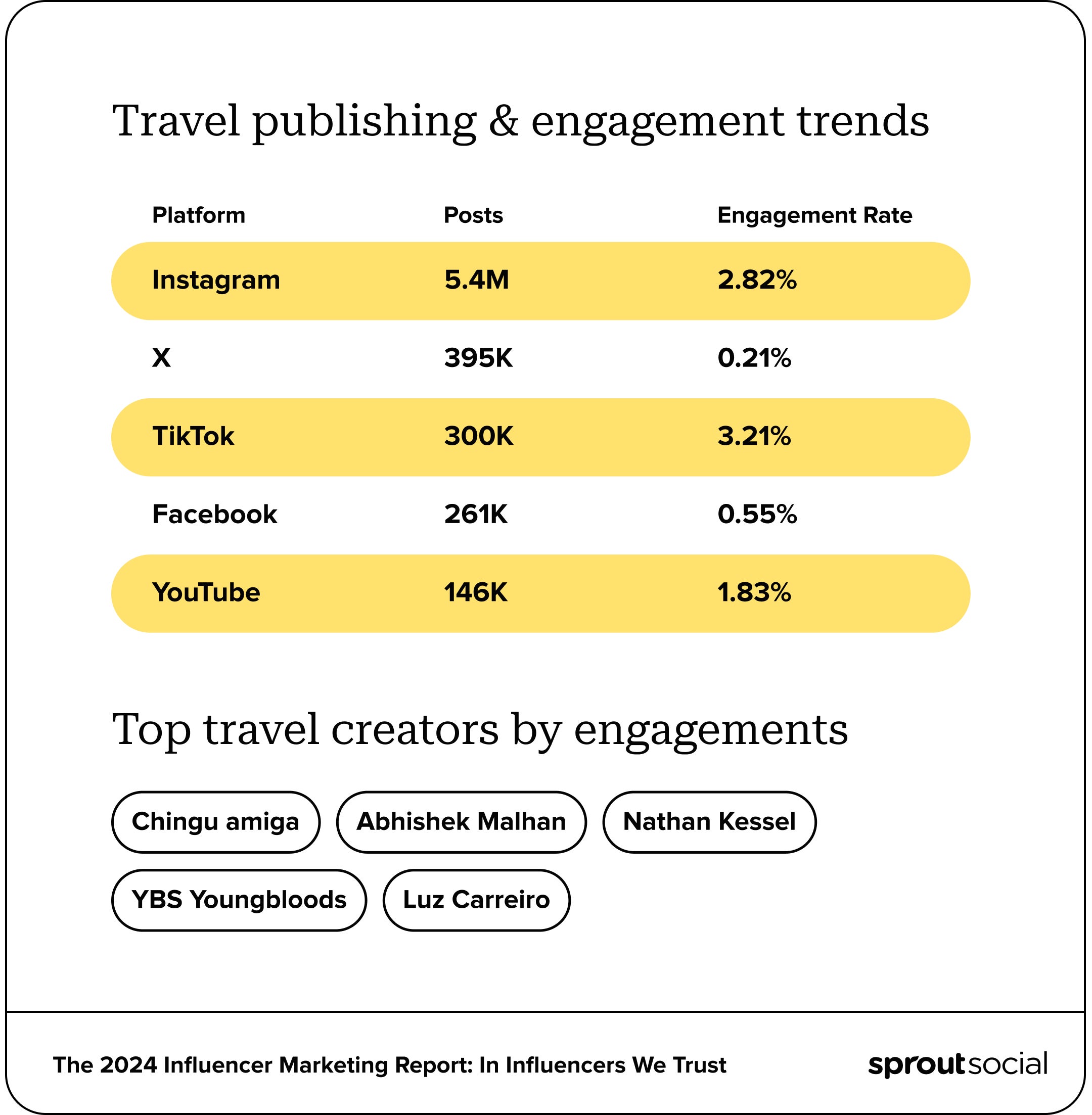
Sprout’s 2024 Influencer Marketing Benchmarks Report found that TikTok influencers drive the highest engagement rate out of top platforms, with the short-form video hub driving an average engagement rate of 3.2%. Quick cuts and trending sounds work best here, especially for adventure, budget and city-break niches.
Instagram
Creators use Reels and Carousels to blend aspirational photography with honest travel tips. With a 2.8% average engagement rate, Instagram excels at driving engagement for luxury, design-led and coastal content—think drone shots of the Cornish coastline or curated hotel reels in Bath.
YouTube
YouTube is the perfect platform for long-form visual storytelling. Influencers producing cinematic guides to the Scottish Highlands or detailed reviews of boutique stays perform exceptionally well with older millennials and Gen X travellers.
Facebook
While younger audiences have migrated elsewhere, Facebook remains key for regional tourism boards, like @visitwales, and family-oriented travel. Community groups and live video campaigns can drive interest in local events, festivals and family-friendly destinations.
Pins featuring “UK weekend breaks” or “romantic getaways in the Cotswolds” are enticing for users mapping out future trips. Pairing Pinterest content with Instagram visuals can extend reach and conversion.
Top UK travel influencer niches to explore
Every great travel influencer has a niche. The most successful UK creators build authority by owning a specific angle, whether it’s uncovering historic landmarks, chasing coastal views or spotlighting local food scenes. These are the niches shaping UK travel content right now.
Heritage and history tourism
Creators exploring castles, cathedrals and UNESCO sites like Stonehenge, Hadrian’s Wall and Edinburgh Castle appeal to culture seekers and international audiences.
This type of content works well on YouTube and Instagram, where historical context and visual storytelling shine.
Coastal escapes
Think seaside nostalgia meets modern adventure: Cornwall surf trips, Brighton’s creative scene or Whitby’s maritime charm. Short-form videos and vibrant Reels perform best here, especially on TikTok and Instagram.
Countryside and hiking
Perfect for mindfulness-driven audiences seeking digital detoxes. Influencers showcasing the Lake District, Peak District, Cotswolds and Scottish Highlands connect deeply on YouTube and Pinterest, where travellers plan longer, scenic getaways.
City breaks
Urban explorers love variety: London’s energy, Edinburgh’s architecture, Manchester’s nightlife and Bath’s Georgian elegance. Fast-paced TikToks and Instagram Reels capturing local food spots, markets and events drive high engagement and local business lift.
Top UK travel influencers on TikTok
From weekend itineraries to spontaneous road trips, these TikTok influencers are redefining how travellers discover new destinations.
Aytana Abbasli, better known as @uktravel, has become one of TikTok’s most engaging UK travel voices. After falling in love with London during a holiday, she made the move permanent and now blends the perspectives of both a local and a visitor.
Run by a Polish family who relocated to the UK, @herewegoagain_pl blends cultural commentary with travel storytelling. Their content follows life as Polish immigrants exploring the UK, from seaside towns to historic landmarks, making them uniquely relatable to both local and international audiences. They’re ideal partners for campaigns focused on multicultural tourism, expat life or destination discovery.
Top UK travel influencers on Instagram
Instagram remains the cornerstone of UK travel storytelling. With Reels, carousels and candid Stories, these creators are curating experiences that feel both aspirational and attainable.
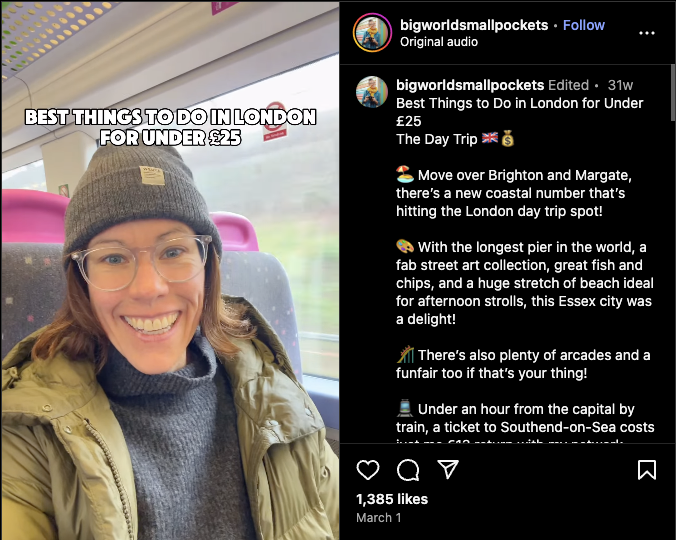
The name says it all. @bigworldsmallpockets champions budget-friendly adventures without sacrificing experience. Though this UK creator travels across Europe, they frequently visit domestic hotspots, like Cornwall, York and the Lake District. This makes them perfect for affordable travel or staycation campaigns targeting cost-conscious audiences.
Based in Sussex, @thetravelbunny offers a distinctly British take on luxury travel. This Instagram creator’s feed showcases Europe’s cultural capitals alongside the UK’s most photogenic escapes—think Bath’s Georgian architecture or Edinburgh’s cobblestone charm. Best suited for heritage, design and premium tourism brands looking to reach discerning travellers.
Top UK travel influencers on YouTube
YouTube is where UK travellers plan, not just dream. These YouTube creators pair authenticity with production value, making them invaluable for brands focused on storytelling and discovery.
A cult favourite for train enthusiasts, The Man in Seat 61 delivers immersive, first-person journeys across the UK and beyond. His POV videos capture everything from scenic regional routes to sleeper trains and luxury rail experiences. Ideal for train operators, eco-conscious travel campaigns or slow tourism brands aiming to highlight sustainable alternatives to flying.
Chelsea and James, the Gen Z duo behind Holiday Expert, bring a lighthearted, authentic energy to their weekend adventures across the UK and Europe. Their mix of reels and candid travel diaries appeals to younger travellers seeking short, shareable experiences. They’re a great match for Gen Z travel campaigns, boutique hotels and experience-based brands.
Family travel influencer campaigns for the UK
Family travel in the UK is evolving. Today’s parents aren’t just seeking convenience, they want experiences that bring everyone closer to nature, culture and community. The UK’s top family travel creators showcase just that, turning local festivals, heritage sites and countryside escapes into inspiring, family-first stories that drive meaningful engagement.
A go-to family travel account, @minitravellers documents adventures to UK festivals, landmarks and countryside retreats. Their approachable tone and family-first perspective make them ideal collaborators for family attractions, resorts or destination marketing organisations promoting domestic tourism.
Stacy and Heidi (The Slow Travels Family on YouTube)
As the name suggests, The Slow Travels Family prefers slow travel over sightseeing. Their content focuses on peaceful escapes, like historic cottages, small market towns and heritage trails, that appeal to audiences seeking mindfulness and connection. A perfect fit for heritage stays, wellness tourism and off-the-beaten-path destinations.
Influencer marketing examples for luxury travel in the UK
The UK’s leading creators are redefining what premium travel looks like, from curated city stays to countryside retreats that blend elegance with authenticity. These influencer partnerships show how the right voices can transform high-end hospitality into aspirational, story-driven campaigns that convert interest into bookings.
Run by Sara, @prettylittlelondon celebrates the capital’s most elegant experiences, from rooftop dining and boutique hotels to afternoon tea and hidden cocktail bars. Though primarily London-based, Sara occasionally travels beyond the city, making her a strong partner for luxury hospitality and urban travel campaigns across the UK.
Run by luxury travel creator Umit Yoruk, @iamtravlr blends refined aesthetics with immersive storytelling. Umit captures the quieter side of indulgence, including heritage hotels, countryside estates and architectural icons, through cinematic visuals and thoughtful narration. His content focuses on craftsmanship, design and culture, appealing to travellers who see luxury as an experience, not a price tag.
LGBTQ+ travel influencers in the UK
The UK’s LGBTQ+ travel scene is thriving, and its creators are leading the charge. These influencers highlight inclusive destinations, community-driven events and authentic local experiences, helping travellers see themselves represented in every journey.
Based in Edinburgh, Jenna of @thejennaway showcases inclusive travel through an LGBTQ+ and family lens. She highlights natural escapes, cultural landmarks and inclusive destinations with warmth and accessibility. Ideal for family-friendly, cultural and diversity-focused tourism campaigns.
London-based partners Lexie and Aisha are digital nomads blending festival energy with luxury escapism. Their content spans glamping retreats, Pride events and scenic city breaks, perfect for brands celebrating inclusivity, lifestyle travel or experience-led marketing.
Influencer collaboration examples for adults-only travel brands
Whether it’s a serene spa break in the Cotswolds or a luxury stay in the Scottish Highlands, these UK creators are showcasing adults-only spaces designed for rest, romance and reconnection.
The Hideaway Experience (@luxuryhideaways on Instagram)
Nestled in the Angus countryside, Luxury Hideaways offers adults-only escapes designed for rest and reconnection. The brand regularly partners with travel creators for immersive weekend content, offering a model example of influencer-led hospitality marketing done right.
Similarly, Warner Hotels embraced a creator-driven approach by inviting influencers to experience their properties firsthand. Their emphasis on personal storytelling and behind-the-scenes content demonstrates how heritage hospitality brands can modernise perception and engage new audiences through authentic influencer partnerships.
Best practices for travel and tourism influencer collaborations
Building long-term brand partnerships with the right creators takes more than great ideas. It takes trust, structure and transparent communication. These best practices will help you create efficient, lasting collaborations that benefit both your brand and your influencers.
Communicate expectations with total transparency
The best partnerships start with honesty. Be upfront about influencer rates, deliverables and timelines from day one. Many seasoned influencers have experienced unclear agreements before, so transparency immediately sets you apart as a professional, reliable partner.
Create a clear contract outlining deliverables, compensation, content usage rights and deadlines. It’s not just about protecting your business; it’s about showing respect for the creator’s work. That clarity builds the foundation for long-term collaboration and mutual trust.
Write detailed and inclusive creative briefs
High-quality content starts with clarity. Provide influencers with a clear outline of your objectives, target audience and key messages, but leave space for their creative flair.
If you’re collaborating with creators from outside the UK, remember that English may not be their first language. Keep your brief concise, use plain language and avoid jargon. Clear, inclusive communication ensures your message is consistent, accessible and aligned with your brand’s voice.
Track success with performance insights
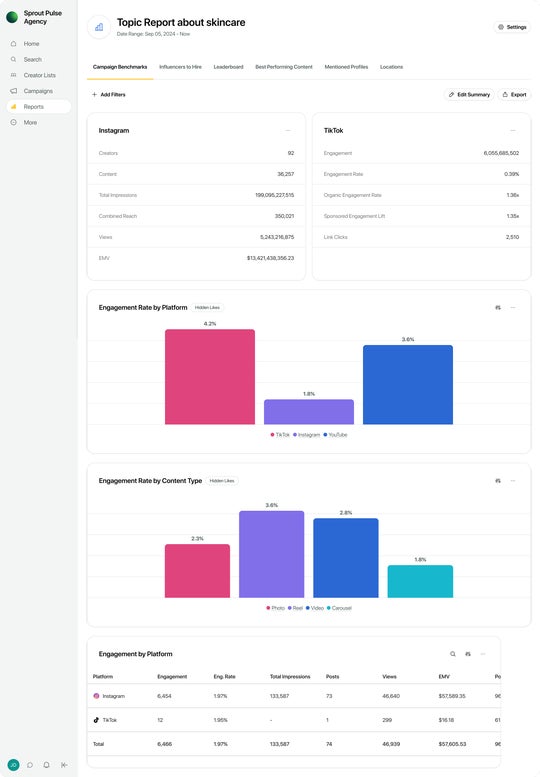
Throughout the process, use tools that help you easily monitor campaign results and prove influencer marketing ROI. Check which creators drive the strongest engagement and audience alignment, then use the data to refine your strategy for future collaborations.
Data turns good partnerships into great ones—empowering you to scale your influencer marketing with confidence.
How to manage your UK travel influencer strategy with Sprout Social
Finding, vetting, managing and proving the ROI of travel influencer partnerships requires a dedicated system. Instead of juggling spreadsheets, DMs and separate analytics tools, you can centralise your entire workflow with Sprout Social.
Find and vet authentic partners
An influencer’s ethics and audience are crucial. Sprout Social’s Influencer Marketing platform’s advanced filters and engagement authenticity checks make it easy to:
Detect suspicious follower activity and fake engagement in seconds.
Analyse creators’ historical content for tone, travel ethics and alignment with your brand values.
Build a shortlist of credible, value-driven influencers who will strengthen your reputation.
When trust drives every booking, working with creators who reflect your integrity isn’t optional, it’s essential.
Streamline creator communication
Instead of relying on spreadsheets and email chains, you can manage your entire campaign in one place. The platform helps you handle creator communication, track deliverables, and manage content approvals, ensuring your collaborations stay on schedule and on brief.
Track, measure and prove your ROI
Proving influencer marketing ROI is essential for earning executive buy-in. With clear goals, transparent tracking and the right analytics tools, you can demonstrate exactly how influencer partnerships impact the bottom line.
Define clear conversion goals. Start by identifying measurable KPIs, whether that’s booking numbers, enquiry form submissions or on-site conversions.
Create trackable links. Use Sprout Social to generate UTM-tagged URLs that tie conversions directly to specific influencers, attributing every click, lead and booking.
Monitor results in real time. With Sprout’s Premium Analytics (a paid add-on) and built-in analytics dashboards, you can track clicks, conversions and cost-per-acquisition as they happen.
Benchmark influencer performance. Compare creators side by side to identify which partners deliver the strongest ROI, helping you refine your strategy.
Present results with confidence. Export clean, branded reports directly from Sprout to share with leadership. Visualising campaign performance makes your case clear, credible and investment-ready.
What’s next for travel influencer marketing?
Travel content creation has never been more competitive, and it’s easy to see why. Getting paid to explore the world is the dream. But as more creators enter the space, brands need to be more intentional about where they invest. The future belongs to travel influencers who bring originality, depth and lived experience to their storytelling.
The 2025 State of Influencer Marketing Report found that 47% of consumers value authenticity in the creators they follow. But UK audiences aren’t persuaded by creators who simply say they’re authentic. They respond to those who consistently show it through transparency, cultural respect and firsthand expertise. Whether it’s a London-based foodie uncovering local gems or a family exploring the Highlands sustainably, the creators who lead with real connection will stand out.
These are the influencers who create immersive content that makes audiences feel like they’re already there and naturally nudges them to book. Building long-term partnerships with creators like this, who align closely with your brand values and audience niche, is the most powerful way to future-proof your influencer marketing strategy.
It’s time to lead with influencer marketing in UK travel
Influencer marketing belongs in every travel industry digital strategy. The right creators are trusted advisors who blend advice with storytelling, gaining trust that drives bookings.
Combining clear selection criteria with tools like Sprout Social Influencer Marketing helps teams cut through noise, ensure brand safety and focus on performance. The result? More effective campaigns, higher ROI and stronger long-term partnerships.
Schedule a demo today to see how Sprout’s Influencer Marketing platform helps you find, manage and measure your next influencer campaign.
Australian customer care teams are under more pressure than ever, managing rising ticket volumes, stretched resources and increasingly multilingual audiences.
Chatbots offer a smarter, more scalable way to handle that demand. By automating routine queries, they free your agents to focus on complex, high-value conversations that drive loyalty and retention.
Below, learn how Australian brands use chatbots to cut wait times, improve satisfaction and deliver faster, more personal support.
Why Australian customer care leaders are turning to chatbots
Customer expectations keep rising, but team sizes often don’t. Chatbots help Australian service leaders deliver fast, personalised support without adding headcount.
Instead of replacing agents, chatbots work alongside them. They take on the repetitive, high-volume queries that slow teams down, helping you deliver consistent, efficient and human support at scale.
Here’s why chatbot adoption is accelerating across Australian customer care teams.
1. Support customers at scale without expanding your team
When ticket volumes spike, chatbots act as your first line of support by handling FAQs, order tracking, booking confirmations and other repetitive tasks that eat up valuable agent time. Running 24/7, they keep your service responsive even after hours.
When integrated with your customer service workflows, chatbots also help your team track every query end-to-end, reducing missed tickets and improving visibility. That means your agents can focus where they add the most value: resolving complex issues and building relationships. All while avoiding burnout.
Sprout’s research on AI-driven customer engagement shows this hybrid approach works best. Automation handles the volume while humans handle the nuance so you can maintain a personal touch without overwhelming your team.
2. Meet expectations for faster, smarter service
Speed and intelligence now define good customer care. According to the Sprout Social Index™ 2025, three in four consumers in Australia and globally expect brands to reply within 24 hours—and many will switch to a competitor if they don’t get a timely response.
Chatbots make it possible to deliver on that expectation. They provide instant, accurate responses around the clock, without requiring 24/7 staffing.
But customers also want service that feels personal. Chatbots powered by conversational AI can interpret intent, remember context and adjust tone accordingly. This allows them to reference past interactions, loyalty status or preferences.
For Australian brands, multilingual support adds another layer of accessibility. And it’s not just customers who benefit. For your team, chatbots remove pressure, streamline workflows and help build capacity for proactive care.
3. Strengthen compliance and audit readiness
Chatbots help protect your brand by ensuring every message aligns with compliance standards and approved language.
In heavily regulated industries like banking, healthcare and telecom, every customer conversation carries additional legal and reputational risk, and the stakes are high. Studies show company share prices drop an average of 35.2% following a brand reputation crisis, so mitigating them before they happen is key.
Pre-approved chatbot responses reduce the risk of human error and maintain consistency. Plus, they automatically generate audit trails, providing the transparency regulators and executives expect. Analytics from bot interactions also surface recurring issues or compliance gaps, so you can act before they become risks.
By letting automation manage repetitive, high-risk interactions, your agents can stay focused on high-value conversations and deliver secure, compliant and trusted support at scale.
Why chatbot management belongs in your social care ecosystem
Even the most advanced customer service chatbot is only as effective as the system it operates in. To create meaningful customer experiences, automation can’t live in a silo. It needs to work seamlessly with your broader customer care strategy.
When chatbots, agents and data work together, service becomes faster, more personal and more consistent across every channel.
Here’s why Australian brands should integrate chatbot management into their social care strategy.
Centralised insights and collaboration
Fragmented data is one of the biggest barriers to customer satisfaction. When care, marketing and social teams each manage their own conversations, no one sees the full picture of customer needs.
Unifying chatbot and human interactions into one workflow changes that dynamic entirely. With shared visibility, teams can identify issues early, uncover trending questions and respond to changes in customer sentiment quickly.
This level of visibility also improves reputation and crisis management. According to BrightLocal’s 2025 survey, 89% of consumers say they’re likely to use a business when they see that it responds to reviews, both positive and negative.
More importantly, collaboration across departments helps shape better content, clearer policies and more human experiences. When everyone can see the same conversations, customers see a brand that listens.
Consistency that builds trust
A unified brand voice doesn’t happen by accident. In a landscape where customers interact with brands across multiple networks and languages, consistency is a competitive advantage.
Chatbots play a critical role in reinforcing tone, vocabulary and empathy at scale. But that alignment only holds if messaging guidelines are built into both the human and automated sides of your care operation. By using conversational AI and training chatbots on the same principles your agents use, you ensure customers always experience a coherent, trustworthy brand.
When automation reflects your company’s values as clearly as your people do, trust grows stronger, even through digital channels.
Smarter escalation and faster resolution
The best customer care strategies use chatbots to triage intelligently, not to deflect responsibility. Escalation should feel seamless to the customer: they move from automation to human support without friction, repetition or delay.
This requires designing workflows that preserve context and intent across every handoff. When chatbots pass complete conversation histories, customers don’t have to re-explain their problem and agents can deliver faster, more empathetic solutions.
Over time, analysing escalation trends also reveals where automation ends and human support adds the most value, helping leaders balance efficiency with connection. The result is happier customers and a smoother support experience.
Continuous improvement through shared intelligence
Chatbots aren’t “set and forget” tools—they’re living systems that learn. High-performing customer care teams treat every interaction as a data point: one that can inform future scripts, identify knowledge gaps or highlight shifting audience needs.
Analysing this feedback loop helps teams refine language, tone and process over time. It also reveals opportunities to blend automation and human expertise more effectively, whether that means adding proactive prompts, simplifying flows or redesigning the customer journey altogether.
The most mature organisations view chatbot management as an evolving discipline, not a fixed project. They understand that automation succeeds when it stays human-centred, data-driven and relentlessly iterative.
10 chatbot examples from leading Australian brands
Chatbots have several practical use cases in Australian customer care, from handling FAQs and appointment bookings to assisting with marketing and lead generation and personalised recommendations.
Below are 10 leading Australian brands using chatbots to elevate customer care.
Australian telecom chatbot examples
Telecom customers demand immediate answers for everything from network outages to billing questions. Providing instant, 24/7 support is essential for retention, and these brands use chatbots to manage routine inquiries at scale.
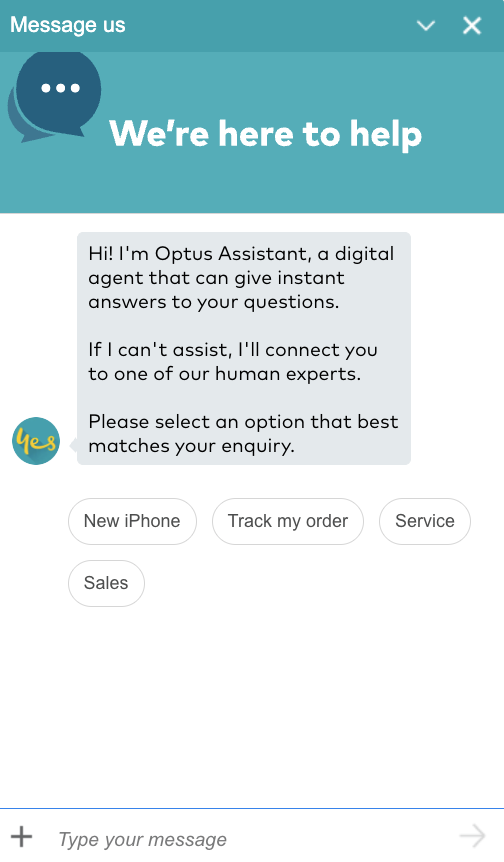
1. Optus Assistant
Optus Assistant, the telco’s AI-powered chatbot, operates across web, mobile and social channels to support customers 24/7. It helps users troubleshoot network issues, explore plan options and manage billing, all without waiting on hold.
Why it works: Optus positioned automation as a complement, not a replacement, for its human support. Its chatbot handles routine questions, freeing agents to focus on technical or account-specific inquiries that need empathy or nuance.
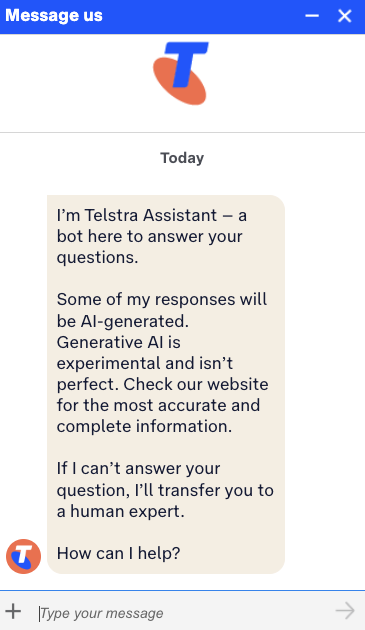
Telstra Assistant offers context-aware responses across the company’s app, web chat and social channels. It provides immediate help for common issues like payment queries and connection problems, and seamlessly hands off complex requests to human agents.
Why it works: Telstra’s chatbot succeeds because it integrates across multiple customer touchpoints. It’s not a standalone tool—it’s part of a broader omnichannel strategy that maintains context across platforms like WhatsApp and Messenger, ensuring customers never have to start their conversation over.
These Australian banks leverage chatbots to handle routine banking inquiries and provide secure, real-time support for customers.
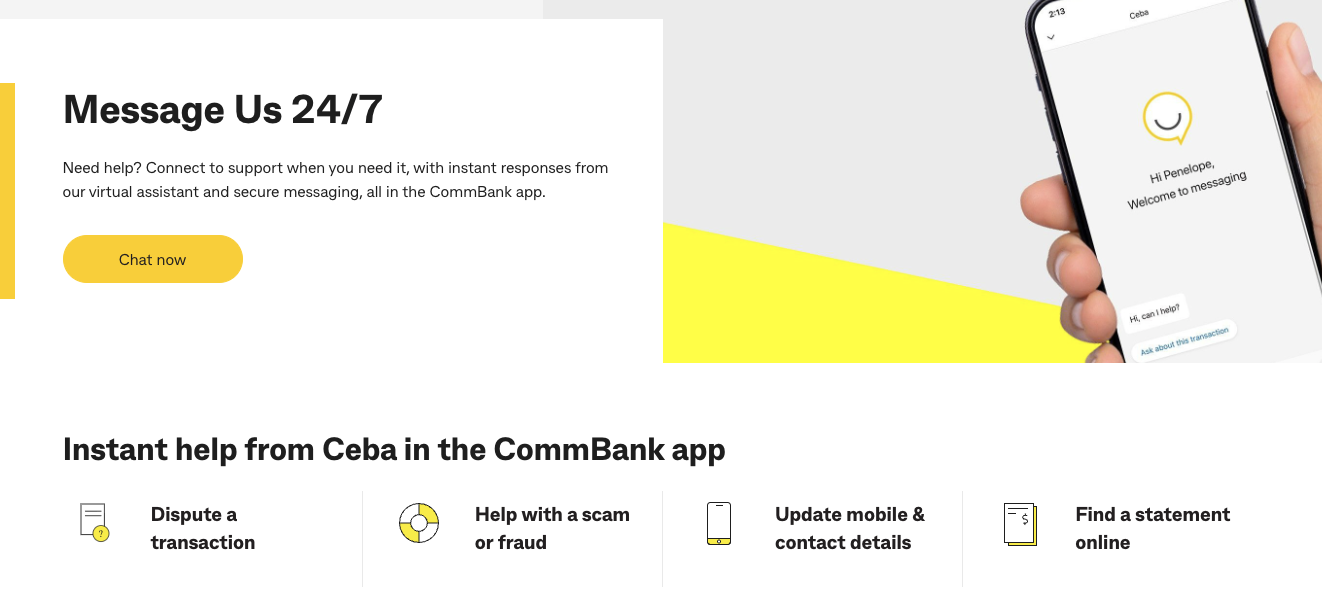
3. CommBank Ceba
Ceba, Commonwealth Bank’s virtual assistant, is available through the CommBank app and online banking. It helps customers check balances, manage transactions, update personal details and report fraud, all within a secure environment.
Why it works: Ceba demonstrates how automation can meet both convenience and compliance. The assistant’s ability to process sensitive data while maintaining strict security protocols builds trust in a sector where accuracy and privacy are critical.
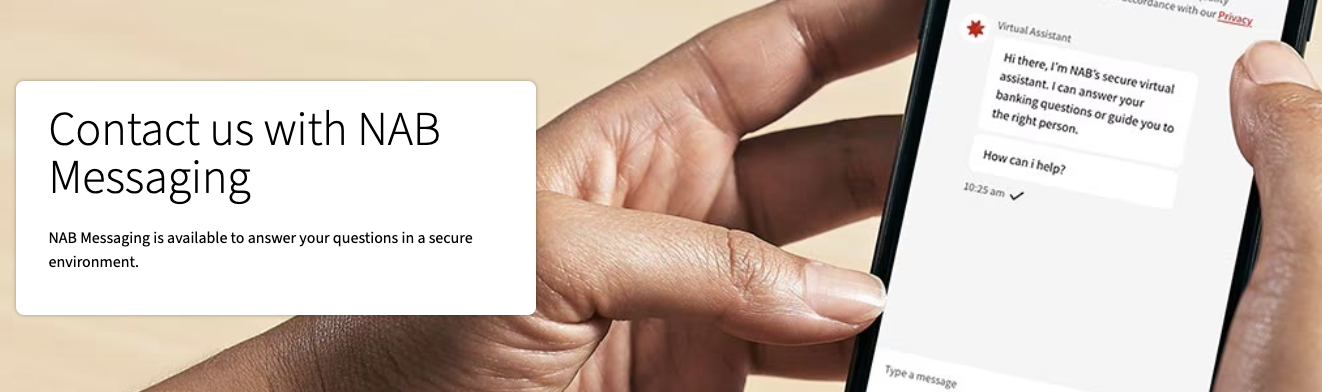
NAB’s chatbot supports customers with everyday banking tasks, from payments to card management. Available 24/7, it uses AI to interpret intent and direct complex queries to human specialists when needed.
Why it works: NAB’s focus is on proactive service. By using conversational prompts and predictive responses, its assistant anticipates needs before customers articulate them. This sets a new bar for responsive digital care in banking.
These retail brands in Australia are using chatbots to improve ecommerce experiences and deliver tailored product recommendations. Chatbots even support lead generation by engaging prospects and qualifying them before they reach sales.
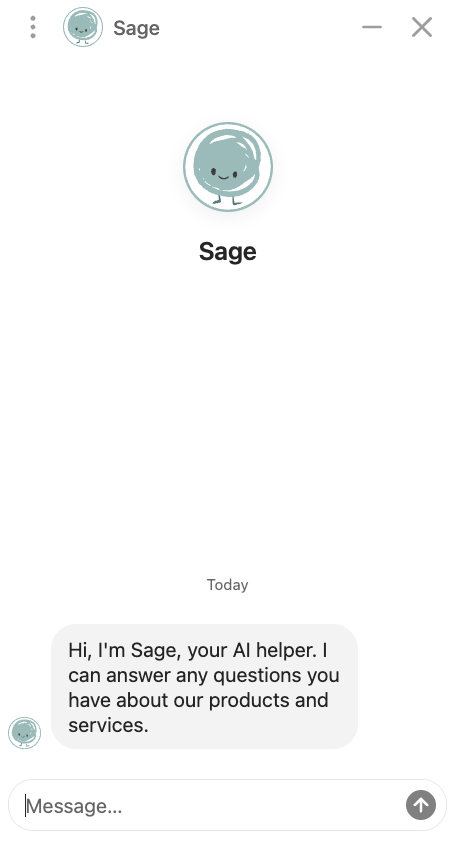
5. Temple & Webster Sage
Sage, Temple & Webster’s AI assistant, guides shoppers through product searches, order tracking and returns. It helps users find what they’re looking for in seconds, reducing dependency on call centres.
Why it works: Sage blends service and sales. It uses behavioural cues, like browsing history or cart activity, to deliver recommendations that feel helpful, not pushy. It’s a model for using chatbots to support both customer experience (CX) and conversion.
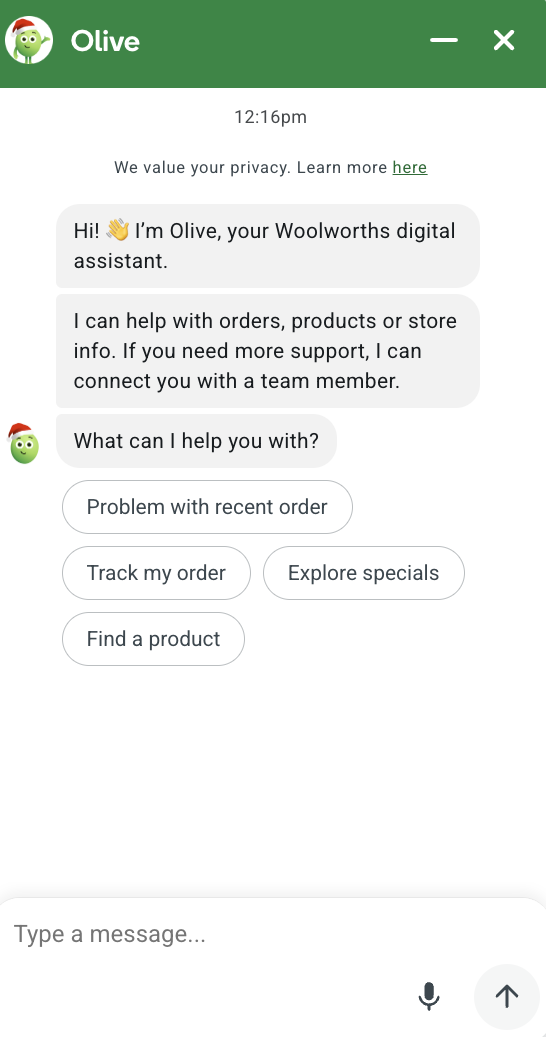
Woolworths’ virtual assistant, Olive, provides instant help with order tracking, online shopping and loyalty rewards. It can also escalate issues to live agents when customer sentiment indicates frustration.
Why it works: Olive’s strength is emotional intelligence. Its AI uses sentiment detection to identify when a customer needs a human response. While a small detail, this makes a big impact in maintaining trust.
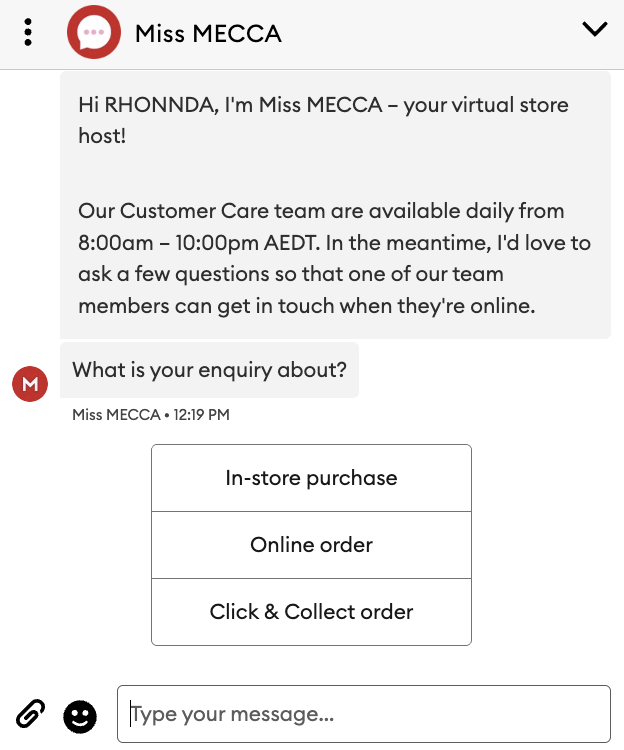
Miss MECCA, the cosmetics retailer’s chatbot, helps customers with product information, shade matching and order support. It can answer simple questions in seconds and escalate nuanced skincare or makeup queries to a beauty advisor.
Why it works: Miss MECCA succeeds because it mirrors the brand’s tone—friendly, helpful and inclusive. By blending conversational flair with expertise, it extends the in-store experience into digital channels seamlessly.
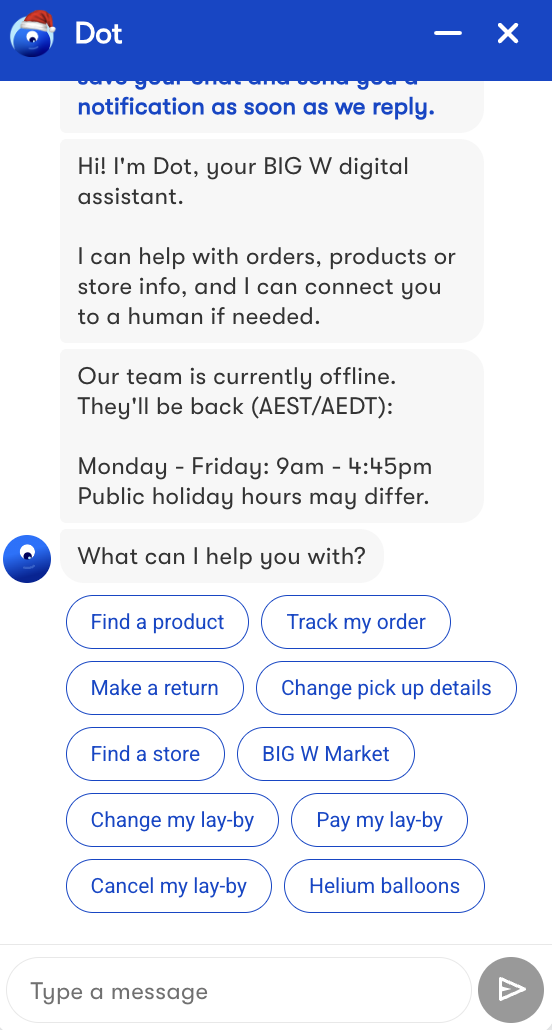
Big W’s chatbot, Dot, supports customers across product searches, stock checks and online orders. It handles common requests autonomously while connecting customers to live agents for detailed or sensitive issues.
Why it works: Dot exemplifies operational efficiency at scale. Its design focuses on clarity, with structured menus, clear CTAs and frictionless escalation. This reduces repeat questions and keeps the experience smooth for shoppers.
Beyond banking, retail and telecom, chatbots are enhancing customer experiences across utilities, health and other sectors in Australia. Below are some examples.
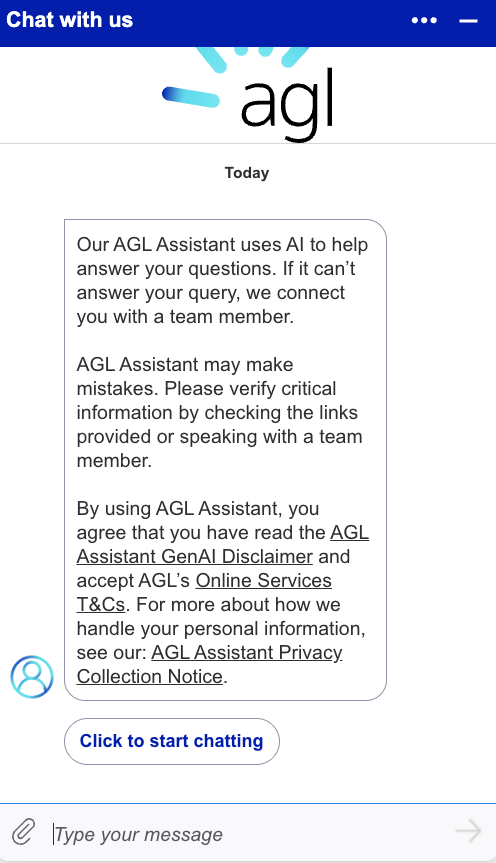
9. AGL Assistant
The AGL Assistant chatbot provides customers with account management, billing queries and energy-saving advice. It’s accessible through the company’s website and app, ensuring ‘round-the-clock support.
Why it works: AGL Assistant shows how automation can extend value beyond troubleshooting. By offering proactive tips, like efficiency reminders during peak periods, it transforms service interactions into brand-building opportunities.
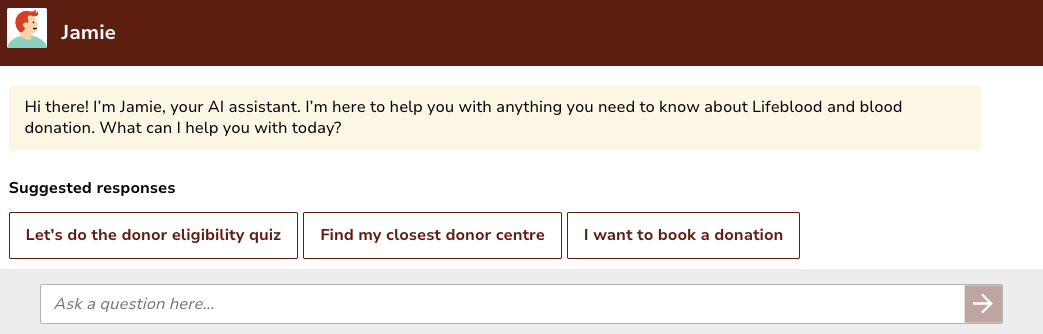
Jamie, the Australian Red Cross Lifeblood chatbot, answers donor questions, checks eligibility and helps users book appointments. It also provides educational resources on blood types and donation processes.
Why it works: Jamie demonstrates how mission-driven organisations can use chatbots to educate as well as serve. Its conversational tone and accessible information design lower barriers to participation, making donation easier and more engaging.
What makes chatbots effective in Australian customer care?
The most effective chatbots aren’t defined by the technology they use but by the experiences they create. They blend precision, empathy and adaptability to meet customer needs while reflecting brand values in every interaction.
For Australian brands, chatbot success comes from integrating automation with thoughtful design and human oversight to deliver fast, reliable and personal service.
Here’s what separates high-performing chatbots from the rest.
Accuracy, context and human handoff
A good chatbot recognises intent and understands context. It remembers what’s been said, keeps track of customer preferences and knows when it’s time to involve a human.
That continuity makes all the difference. When conversations transfer smoothly between automation and agents, customers don’t have to repeat themselves or re-explain issues. For your team, that means less friction, faster resolution and fewer gaps in communication.
In Australia, where customers often interact across multiple channels and time zones, that context keeps communication clear and consistent. A chatbot that “remembers” your last order or conversation builds trust by making every interaction feel connected.
Integrations that create connected experiences
Chatbots reach their full potential when they’re part of a connected ecosystem. By integrating with customer data systems, such as CRMs, order platforms or loyalty databases, they can personalise interactions in real time.
Imagine a customer checking an order status. A connected chatbot doesn’t just say “Your order is on the way.” It can reference delivery timelines, anticipate follow-up questions and flag potential delays before they happen. For brands, this turns automation from a reactive tool into a proactive customer experience driver.
When chatbots have access to the same insights as your human teams, every conversation becomes an opportunity to deepen understanding and build loyalty.
Personalisation at scale
Automation shouldn’t feel automated. The most sophisticated chatbots use data thoughtfully, acknowledging a customer’s loyalty tier, preferences or previous interactions without feeling intrusive.
Finding this balance between efficiency and empathy is what keeps customers satisfied. A chatbot that remembers you cancelled an order last week and asks if you’d like to reorder today doesn’t just save time; it shows attentiveness.
For Australian audiences, that personalisation must also reflect tone and culture. A friendly, conversational approach always outperforms robotic precision.
Service optimisation through feedback and analytics
Chatbots don’t reach excellence overnight—they evolve through learning. Leading brands treat every conversation as a learning opportunity to refine scripts, measure satisfaction and identify intent gaps.
When you track metrics like completion rate, sentiment and customer drop-off points, you understand where conversations stall and where they succeed. Regularly reviewing this data helps you improve content design and tone while anticipating customer needs.
The strongest teams build these insights into an iterative process, adjusting chatbot language and logic with the same care they’d give to any customer-facing campaign.
Compliance and brand alignment
For regulated sectors like finance, healthcare and telecommunications, consistency is non-negotiable. Chatbots help mitigate compliance risks by delivering accurate, approved responses every time. This ensures customers receive the right information no matter when or how they reach out.
But compliance isn’t just about risk avoidance, it’s also a brand trust strategy. When customers see the same level of accuracy, empathy and transparency in every interaction, that reliability reinforces confidence in your brand.
The goal is balance: automation that safeguards standards while empowering teams to handle the complex, sensitive or emotionally charged conversations that only humans can.
How to get started with Sprout’s Bot Builder
Today’s consumers expect support on their schedule, not yours. Chatbots make that possible by providing instant, 24/7 service and managing thousands of routine queries at once.
Sprout Social’s Bot Builder simplifies the process. With guided bot templates, intuitive workflows and unified data insights, you can design chatbots that enhance—not replace—human care.
Here’s how to scale customer care automation strategically with Sprout.
Identify high-volume, repeatable questions
The strongest chatbots are powered by data, not assumptions. Before scripting a single response, analyse your historical customer interactions to uncover the most common questions.
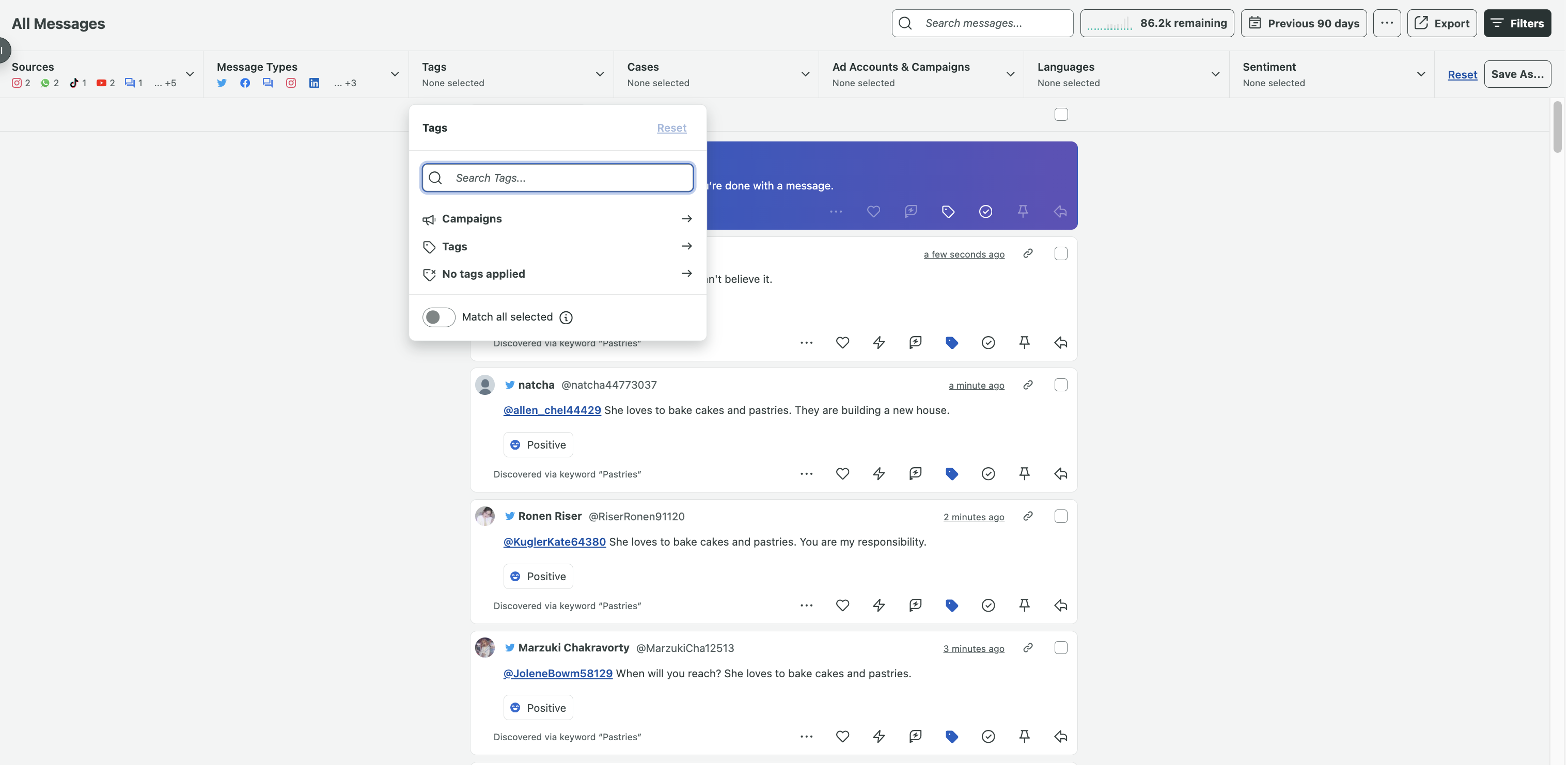
In Sprout, you can easily do this by tagging conversations by theme or question as they land in your Smart Inbox.
Queries like “Where’s my order?” or “How do I reset my password?” might seem small, but together they account for hundreds or even thousands of service tickets each month.
By automating answers to these repeat inquiries, you’ll immediately reduce response times and give your team back hours to focus on complex cases that require human judgment.
Start small. Tackle your top three to five recurring questions first, then expand as your confidence grows. This approach shows ROI quickly and keeps chatbot development lean and manageable.
Map your chatbot to your broader care strategy
A chatbot shouldn’t live in isolation. It should extend your customer care strategy. The key is knowing when automation adds value and when you need a human touch.
Design escalation flows based on customer context and intent. For example, an order-tracking inquiry might stay within the bot, while a complaint or VIP customer request should immediately route to a live agent. The transition should be invisible to the customer and maintain the full conversation history so no one ever has to start over.
Integrate your chatbot design with your team’s service goals, SLAs and workflows. That alignment ensures automation supports, rather than fragments, the customer experience.
Monitor and optimise bot performance
Like any member of your care team, your chatbot needs regular feedback, training and evaluation to stay helpful and on-brand.
Review conversation data regularly to spot friction points, such as repeated drop-offs, misunderstood intents or delayed escalations. Look at metrics like response time, completion rate, sentiment and how often chats get handed to a human. This will help you understand where automation adds the most value (and where it doesn’t).
Use those insights to refine your bot’s language, logic and tone so every exchange feels more intuitive and human over time. The goal isn’t perfection—it’s steady progress that keeps up with customer expectations, product updates and seasonal demand.
Turn AI-powered service into your team’s competitive edge
Chatbots aren’t just a customer service shortcut. They’re a long-term strategy for creating faster, smarter and more personal experiences.
Across Australia, brands from Lifeblood to Optus are proving what’s possible when AI and humans work together: 24/7 support that builds loyalty, boosts efficiency and strengthens every customer connection.
When you power your chatbot strategy with Sprout Social, you give your team the visibility, insights and control to make automation feel human and make every interaction count.
Start your free trial today and see how Sprout helps you design chatbots that not only resolve questions but build relationships.
AI is reshaping social media work in real time. Nearly all marketing leaders agree (97%) that it’s crucial for marketers to know how to use AI, according to The 2025 Sprout Social Index™. And as AI becomes woven into everyday workflows, the ability to write strong AI prompts for social media is becoming a core skill.
Even though AI social media tools are becoming more user-friendly, it’s still important to know how to write clear, well-crafted prompts to produce useful outputs. A few strategic details in your prompt can be the difference between a generic response and something you can publish or act on immediately.
We’ll help you navigate this learning curve so you can write effective prompts that align with your different social media marketing needs. Read on to understand the mechanics of writing AI prompts and how to craft them for the best results. Plus, explore different types of prompts and use cases.
What is an AI social media prompt?
AI social media prompts are the instructions or inputs you give an AI tool to guide the type of output you want it to generate.
Writing AI prompts for social media is an art and a science. Human reasoning and creativity are required to formulate the right query and combination of elements necessary to fully utilize your AI tool and get the insights and ideas you need.
Here are some things that effective social media AI prompts can help you accomplish:
Offload time-consuming tasks
Extract key information from social listening and customer experience data
Ideate and draft compelling social media content
Customize social media content for a global audience
With that context in mind, let’s take a look at the different types of AI writing prompts needed to complete these tasks.
Bonus Resource: Get our top five AI social media marketing resources in one convenient toolkit. Download it for customizable templates and tips to drive smart AI adoption in your role and across your organization.
Why mastering social media prompts is becoming a core skill for social media managers
Social workloads are growing and social teams are feeling it. The Social Media Productivity Report found that nearly half (48%) of social media marketers feel they sometimes or rarely have enough time to get their work done, and 63% report feeling burned out. AI can help ease that pressure by speeding up repetitive tasks and simplifying daily workflows, but input-based tools only save time when you give them effective prompts.
There’s also a clear push to get more value from AI tools. The 2025 Sprout Social Index™ found that half of marketing leaders planned to spend 2025 maximizing the AI tools they already have, and 48% planned to invest in more. As AI becomes a bigger part of social workflows, you need to be able to use it well.
That’s why mastering how to write AI prompts for social media is becoming a core skill. It’s how you unlock real value from external AI tools, reduce day-to-day strain on your workload and keep pace with rising expectations across the industry.
30 ways to write effective AI prompts for social media (with examples)
Because social teams manage so many different responsibilities, prompts fall into a range of categories, from content creation and UGC to polls, personalization, reporting and more. Each category helps you get more accurate, efficient outputs with less effort.
Here are 30 practical prompt scenarios you can use to simplify your workflow and strengthen your social media strategy.
Content creation prompts
Content creation ranks as marketers’ most time-consuming task, according to The Social Media Productivity Report. Content creation prompts are valuable because they can help with heavy-lift upstream work that supports your social content, like idea generation, outlining and identifying key messages.
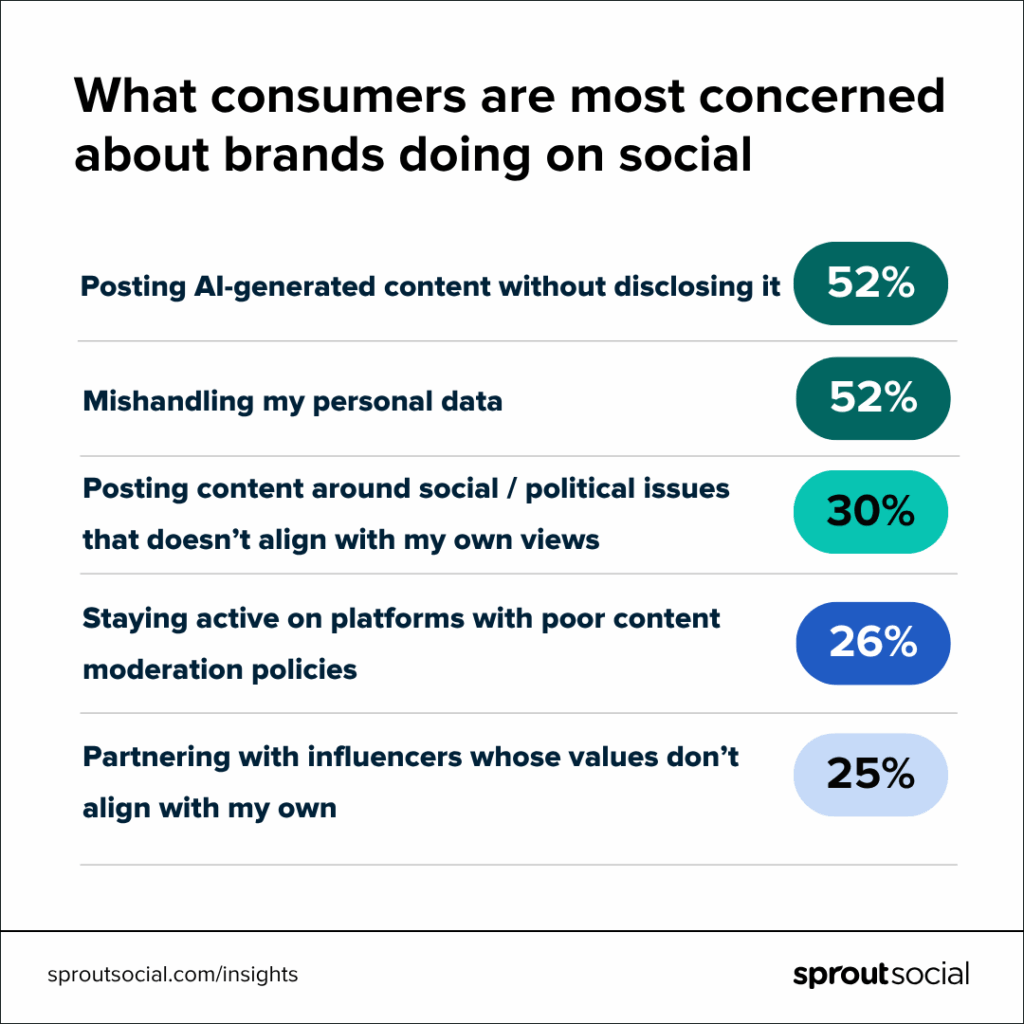
However, AI-generated ideas, outlines and copy all still need human review and vetting, especially given that audiences are skeptical of undisclosed AI content from brands, per our Q3 2025 Pulse Survey.
Use content creation prompts for brainstorming, outlining, identifying key messages and finding angles. Check out these examples:
1. Thought leadership prompt for content ideation
Example prompt: “List three emerging digital privacy trends we can build social content around next month. Focus on the ones with the biggest potential impact on B2B decision-makers.”
2. Key message prompt for LinkedIn carousels
Example prompt: “Identify three social-ready key messages from these attached product release notes that spotlight the customer benefits. The goal is to turn them into a LinkedIn carousel.”
3. Cross-network monthly social content calendar prompt
Example prompt: “Map out a one-month social media content calendar for Instagram, Facebook and LinkedIn based on these themes: product education, behind-the-scenes content and customer stories. Include ideal content formats and a suggested publishing cadence.”
AI prompts for social media posts
Writing social posts is one of the fastest-moving parts of a social marketer’s job, and it often requires network-specific messaging. AI prompts for social media posts give the AI clear direction to draft copy for images, carousels or captions, helping you work faster without losing quality or consistency.
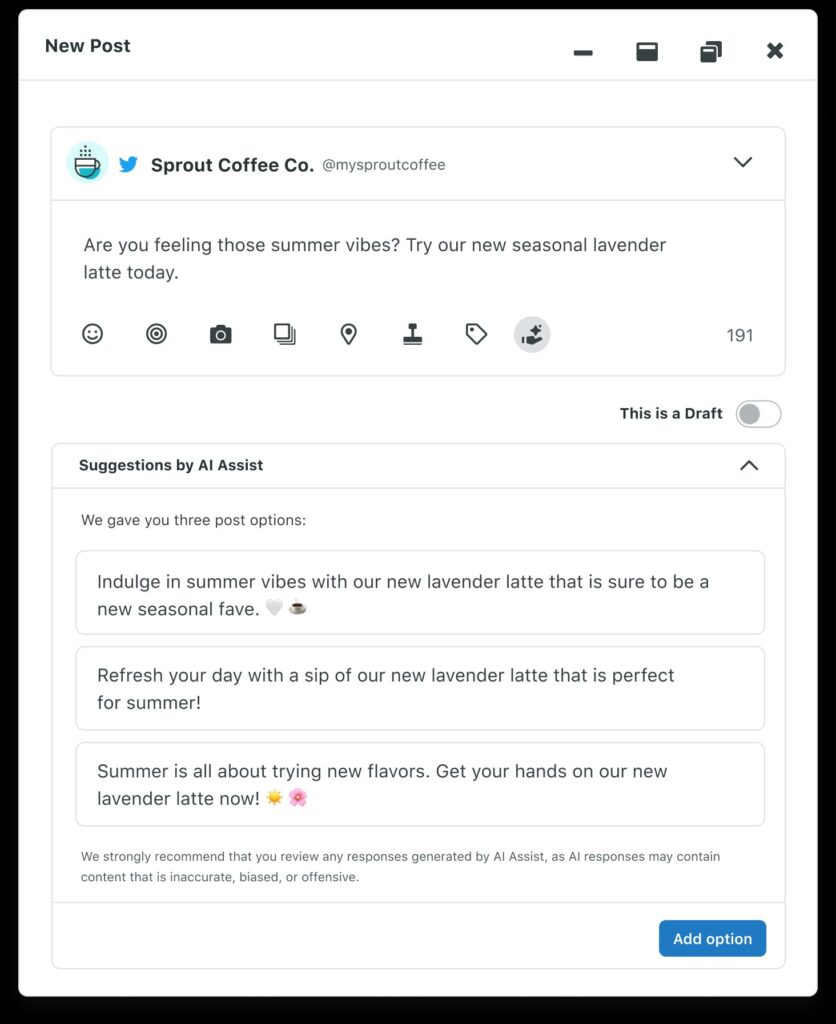
For example, Sprout’s Suggestions by AI Assist capability makes it easy to create content that resonates and performs. The tool’s built-in prompt logic generates three post options based on your topic or existing caption and enables you to make edits as you deem fit.
External AI tools like ChatGPT or Gemini will require more in-depth prompts than built-in tools like AI Assist, so here are three prompts to get you started:
4. LinkedIn thought leadership post prompt
Example prompt: “Write a thought leadership post for LinkedIn explaining why B2B buyers now expect the same level of immediacy and personalization they get from consumer apps. Incorporate data to strengthen the argument. Close with a clear takeaway and call-to-action to leave a comment.”
5. Facebook announcement post prompt
Example prompt: “Write a short Facebook post announcing our upcoming product release, based on the attached file. Explain what’s launching, who it helps and when it will be available. Keep the tone friendly and straightforward.”
6. Instagram feature focus caption prompt
Example prompt: “Write a friendly, benefit-first Instagram caption about our AI scheduling feature based on the uploaded resources. Make it playful but not cheesy. End with a soft CTA to try the beta.”
UGC prompts
Tap into the content your community is already creating with user-generated content (UGC) prompts. UGC prompts help you shape tagged photos, reviews and creator posts into authentic content that supports brand trust and engagement.
Here are a few example prompts to help you put this into practice:
7. Review-based UGC prompt for Instagram
Example prompt: “Write an Instagram caption that’s under 50 words about the customer testimonial below. Highlight the main benefit the customer mentions and include a CTA to learn more at our link in bio. The testimonial text appears in the graphic, so don’t repeat it.”
8. Instagram repost prompt
Example prompt: “Suggest three storytelling angles for an Instagram post that features these tagged customer photos.”
9. Facebook community spotlight series prompt
Example prompt: “Brainstorm five Facebook series concepts that tell short, human stories from our customer community.”
Social poll prompts
Social polls are available on X, Facebook, Instagram and LinkedIn, and they’re one of the easiest ways to gather sentiment, test content themes and understand what your audience cares about.
They work best when they’re timely, relevant and tailored to the people you’re trying to reach. However, coming up with engaging poll ideas quickly can be a challenge. AI poll prompts help you generate clear, engaging questions and answer options faster, so you can spark meaningful interactions and learn from your audience in real time. For example, these:
10. LinkedIn poll question prompt
Example prompt: “Generate five LinkedIn poll questions about the biggest challenges social media professionals face when adopting AI. Write each question from a different angle so I have a variety to choose from. Tailor them to social media managers to surface their real barriers.”
11. Instagram poll answer prompt
Example prompt: “Create four concise answer options for the attached Instagram Story poll question that will fit naturally in the tap-to-select stickers.”
Multi-format transformation prompts
Turning a blog post into a carousel, or a long-form video into a short clip for social can be time-consuming. Fortunately, multi-format transformation prompts can help you repurpose content quickly by directing AI to adapt existing assets for new formats.
The result is faster production, more consistent messaging and the ability to scale stories across social networks while maintaining quality. Here are a few example prompts to show you what’s possible:
Example prompt: “Adapt this Instagram caption into a LinkedIn post. Keep the core message and CTA the same, but adjust the tone and structure to fit a professional audience.”
13. Webinar-to-video content extraction prompt
Example prompt: “Identify three self-contained pull quotes from this webinar transcript that would work as standalone clips for a short social video.”
Optimization and enhancement prompts
Optimization and enhancement prompts help you refine social content to perform better on each network.
They’re especially useful when you already have a draft but need a sharper hook, clearer structure or a tone that resonates with a specific audience. Use these to elevate your drafts, align them with network best practices and publish with more confidence. For instance:
14. Messaging clarity refinement prompt for Instagram
Example prompt: “Edit this Instagram caption to make it clearer and easier to skim. Keep the original key message and the tone, but improve the flow and readability.”
15. Hook enhancement prompt for TikTok
Example prompt: “Suggest three short spoken opening hooks for this TikTok script. The goal is to capture attention in the first few seconds.”
16. Tone refinement prompt for X
Example prompt: “Rewrite this X caption in a more enthusiatic tone without changing the core meaning or length.”
Automation & workflow prompts (agentic AI)
AI social media assistants can handle research, analysis and operational tasks that typically slow teams down. Instead of manually digging through data or switching between tools, you can prompt agentic AI to surface insights and support decision-making.
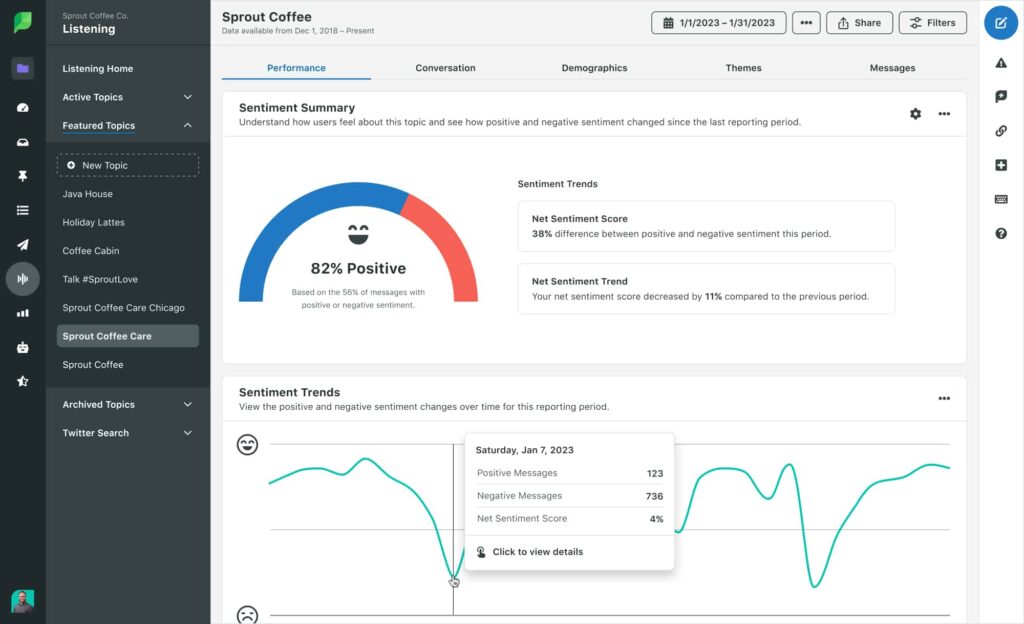
For example, Sprout’s agentic AI, Trellis, enables you to ask questions and deep-dive into your Sprout Social Listening data. This AI listening agent can provide insights into things like campaign performance, topic-focused trends and brand health, giving you the intelligence you need to refine your strategy in real time.
Example prompt: “In the drinks topic, how did sentiment and volume change during our holiday drink campaign launch week compared to the week before? Please focus on messages about our campaign.”
18. Trend detection prompt
Example prompt: “Identify the 50 most viral posts in the drinks topic from the past month. What formats or visual styles are driving engagement, and how can we apply those insights to our next campaign? Explain your thought process.”
Audience targeting prompts
Audience targeting prompts help you tailor social content to the people you want to reach most.
When you’re writing for specific demographics or customer segments, these prompts guide AI to adjust tone, examples and messaging so your posts feel more relevant.
Here’s what an audience targeting prompt can look like:
19. Audience segment prompt for LinkedIn
Example prompt: “Rewrite this LinkedIn post for an audience of mid-level IT managers. Keep the core message, but adjust the examples and vocabulary to match their day-to-day responsibilities.”
Strategy prompts
Strategy prompts help you step back from day-to-day publishing and look at the bigger picture. They’re useful when you need to clarify what your content should accomplish, explore new campaign angles or decide which themes are worth investing in.
To make the responses to your social media strategy prompts even more accurate, add context from Sprout Social Listening. It helps the AI ground its suggestions in real audience conversations, emerging trends and the topics that matter most to your community.
These examples show different ways to write prompts that help with your social strategy:
20. Content-pillar development prompt for TikTok and Instagram
Example prompt: “Review our brand mission and the attached social content calendar for TikTok and Instagram. Suggest three content pillar ideas that would help us stay consistent while expanding into new themes across both channels.”
21. Campaign concept prompt for X, Instagram and Facebook
Example prompt: “Here’s our campaign goal and the key message. Propose two campaign concepts that could bring this to life across X, Instagram and Facebook.”
Social engagement prompts
Social engagement prompts help you create replies and interaction points that feel natural and individualized. Input one of these prompts into an AI tool when you’re looking to keep conversations active, acknowledge your audience in a meaningful way or encourage followers to share more.
Below are some practical examples:
22. Instagram comment response prompt
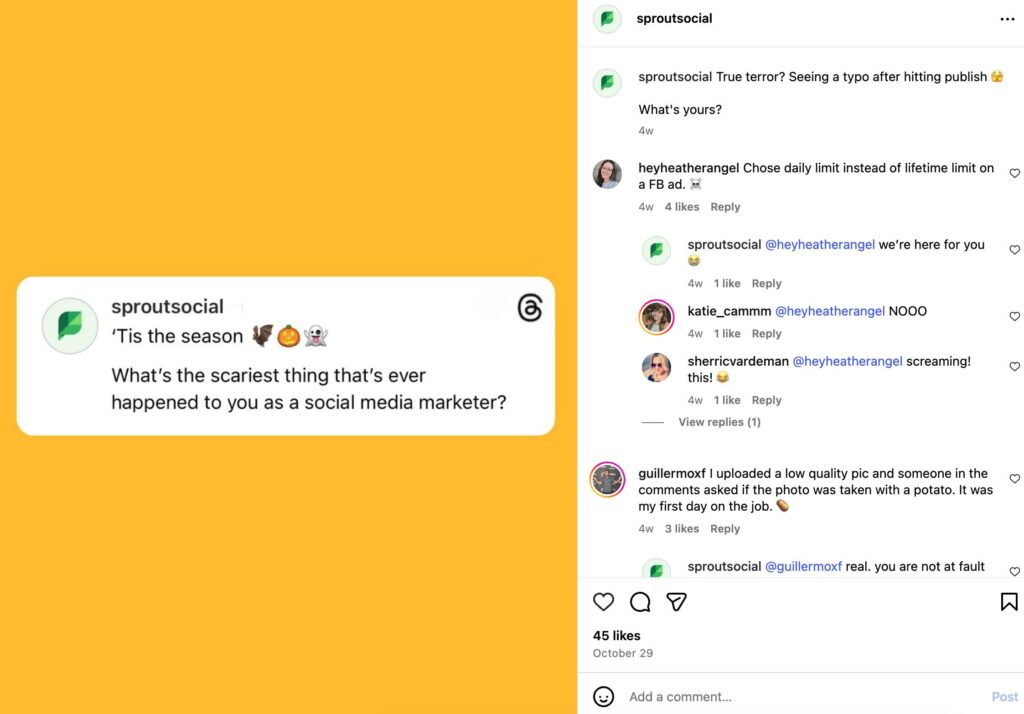
Example prompt: “Write a short, playful reply to this Instagram comment about someone uploading a low-quality photo on their first day as a social media marketer and being roasted for it. Keep it supportive and lighthearted.”
23. Engagement-generating comment prompt for TikTok
Example prompt: “Suggest three short follow-up replies we can use in the comments on this TikTok video that’s gaining traction to encourage more people to join the conversation. Keep them on-brand and non-repetitive.”
H3: Community management prompts
Community management prompts help you handle the conversations that happen on social every day. AI can support the work of replying to inbound messages, moderating comments and answering repeat questions without slowing you down or diluting your voice.
Having help with this is good, because speed matters. The 2025 Sprout Social Index™ found that most consumers expect brands to respond within 24 hours or sooner, and 73% say they’ll buy from a competitor if a brand doesn’t respond. These prompts give AI the direction it needs to draft clear, on-brand replies so you can manage your community efficiently and keep your audience feeling heard.
Check out these examples:
23. Customer refund response prompt
Example prompt: “Draft a clear response to this customer asking why their refund hasn’t been processed yet. Confirm that we’re looking into it, set expectations for timing and point them to the correct support channel for follow-up.”
24. Prompt for correcting inaccurate information in comments
Example prompt: “Create a polite response to this inaccurate comment (see screenshot attached), correcting the misinformation without escalating the tone. Keep it concise and invite the commenter to DM us if they have more questions.”
Crisis management prompts
Crisis management prompts help social teams respond quickly and responsibly when conversations take a negative turn.
The 2025 Sprout Social Index™ reports that 93% of consumers want brands to do more to combat misinformation on social. AI can help you draft factual responses that calm the situation instead of escalating it, but keep in mind these prompts work best alongside a social media crisis management strategy. AI is meant to support your response, not replace the strategy behind it.
The following examples illustrate how crisis management prompts can be written and used:
25. Crisis response prompt for TikTok
Example prompt: “Draft a holding statement script for a video response to a sudden wave of negative comments on our TikTok video. Acknowledge the issue, let people know we’re investigating and avoid speculation until details are verified.”
26. Risk assessment prompt for Instagram
Example prompt: “Review these comments that started appearing on our latest Instagram post and assess whether they show early signs of a potential crisis. Summarize the risk level and flag any themes we should escalate to our comms team.”
Reputation management prompts
Many consumers now treat social media as a primary source of information about brands. In Sprout’s Q3 2025 Pulse Survey, 52% of Gen Zers are more likely to trust info about a brand or products found on social compared to info found through other forms of search, like Google or AI chatbots.
Reputation management prompts support the day-to-day work of managing how your brand shows up in those moments. They help you acknowledge feedback, reinforce brand values and address concerns before they grow. Here’s what these prompts can look like:
27. Google review response prompt
Example prompt: “A customer left a 2-star Google review about slow customer support. Compose a response that acknowledges their experience first, then clarifies how we’re improving wait times. Close by giving them the support lead’s email if they want to reach out. Keep neutral and short.”
28. LinkedIn FAQ prompt
Example prompt: “Create a short reply to this question that keeps coming up on LinkedIn about our new pricing structure. Keep the tone reassuring, explain the change in simple terms and direct people to go to our FAQ page for more information.”
Social media analytics and reporting prompts
Social teams are under constant pressure to translate data into decisions, but pulling insights from multiple networks, filtering noise and turning metrics into a clear story can be time-consuming.
Social media analytics and reporting prompts ask AI to summarize or provide insights into your social metrics. If you’re using external AI tools, your best bet is to upload your data as a spreadsheet or PDF so the AI can base its summaries or explanations on real data.
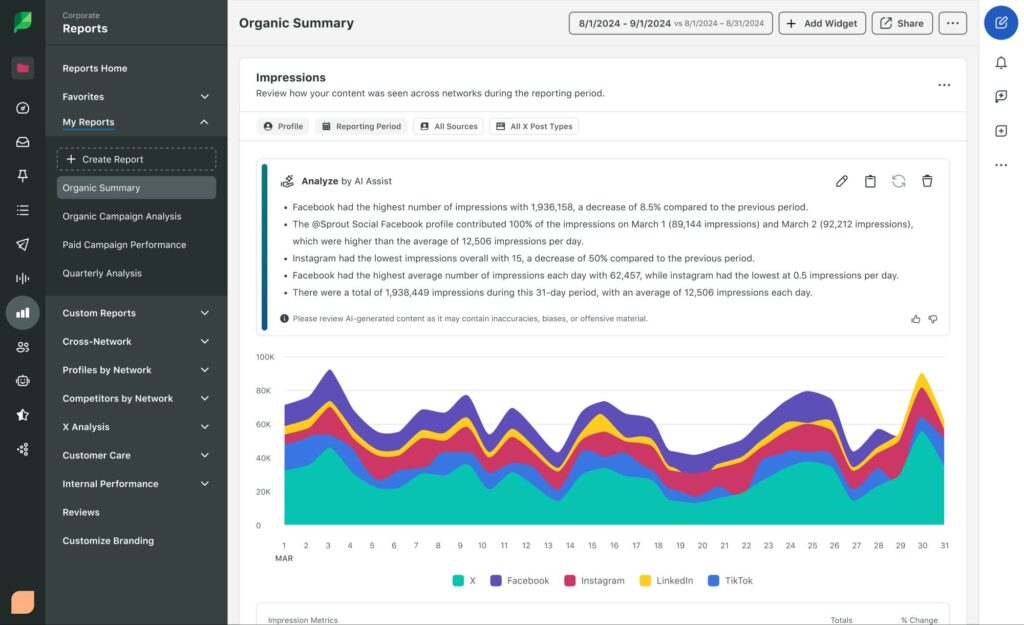
Inside Sprout, built-in features like Analyze Charts by AI Assist can surface summaries and insights directly from your My Reports dashboards (no file uploads required). This lets you spend less time digging through charts and more time acting on what matters.
Here are some examples to assist your prompt writing:
29. Facebook performance summary prompt
Example prompt: “Review the attached Facebook analytics PDF and summarize the most significant month-over-month changes. Focus only on the biggest shifts in impressions, engagements and audience growth.”
30. KPI explanation prompt
Example prompt: “Explain these month-over-month KPI changes in plain language: engagement rate increased from 2.1% to 3.4%, reach grew by 18% and comments declined by 9%. Describe what might have contributed to each shift and how we should adjust our goals for next month.”
How AI social media prompts work behind the scenes
AI tools may feel conversational on the surface, but there’s a lot happening every time you prompt. Understanding the basics can help you write prompts that generate clearer insights, better content and more accurate recommendations for your social workflow.
Here’s a simple breakdown of what happens behind the scenes each time you prompt an AI tool.
Asking your question clearly
When you enter a prompt, the AI tool breaks it down to figure out what you’re asking.
It looks for details such as the topic, the action you want it to take, and the format you expect. This means the AI is trying to understand whether you need a caption, a customer care response, a data summary, or something entirely different. That’s why the more direct your prompt is, the easier it is for the tool to identify the context and give the right answer.
How AI interprets your intent
Once the AI understands the prompt, it starts looking for signals that explain how you want the output delivered. It scans your prompt for details such as audience (millennial home chefs), the task (write a Facebook post), style (creative/formal) or word count (100), to figure out what kind of response you’re expecting.
The tool also analyzes the sentiment you’re aiming for and adjusts its phrasing, word choice and pacing to match. This is why telling the tool you want something “friendly,” “formal” or “reassuring” can dramatically change the output.
Generating the response
After understanding your prompt, the AI pulls together the details you provided to produce a response that aligns with your goal.
Within a single conversation, the tool keeps track of what you’ve already said so it can maintain consistency from one question to the next. That’s why you’re able to refine a post, ask for adjustments or request deeper analysis without needing to restate your original prompt.
In the end, the AI’s output is shaped by the clarity of your prompt: the tone you specify, the task you outline, the audience you define and the details you provide.
This is why the more guidance you give upfront in a prompt, the stronger and more reliable the output will be.
Tips on writing effective AI prompts for social media
AI writing prompts must be clear, concise and direct to ensure the tool accurately understands the task. Each query must be finely tuned, considering factors like topic relevance, keyword selection, structural coherence and target audience, to elicit the best possible response. Let’s dive in.
Define your goal and task
Your prompt needs to tell the AI tool what you’re trying to accomplish. Are you trying to pull insights from your social data to complete a report? Write an X post? Change the tone on a social customer care reply? Since each of these content types has a particular style, the response generated will only be accurate if you focus it on the goal.
AI performs best when queries are focused, which is why complex asks, like drafting a caption, providing a list of hashtag variations and brainstorming visuals, should be broken into separate prompts. This approach results in cleaner outputs and gives you more control over each step of the process.
Add audience and context
Who is the intended audience of the output, and what context is it being used in? Adding these details to your prompts helps the AI tailor its recommendations, analysis or messaging to the people who need it.
Is your target audience between the ages of 30 and 40? Are you writing for a professional audience, such as lawyers or teachers? Or is your content aimed toward customers you wish to convert? Mention the persona you are writing for based on key traits, roles and responsibilities.
For example, an AI writing prompt aimed at executive audiences could say, “Write a blog for business leaders in the SaaS industry about data security”. Specifying the persona is important because it helps the AI tool choose the correct vocabulary from its database and use it contextually.
Context matters just as much. Sharing details like the post topic, the network you’re using, the challenge you’re trying to solve, or the sentiment of a customer conversation gives the AI a more straightforward path to follow.
Set tone, style and structure
Tone, style and structure are all elements that work together to make the response more polished rather than something you need to heavily rewrite.
Choosing the correct tone for your content makes it more compelling and engaging. Specifying a tone such as assertive, happy, empathetic or friendly is especially useful if you’re generating social media posts and social media customer care responses.
It also helps the sentiment analysis algorithms within the AI tool choose the appropriate words and phrasings in the response to ensure it matches the tone you specify.
Your social media management platform may even have built-in features, like Enhance by AI Assist, that enable you to tailor tone in both social posts and social customer care messages in a couple of clicks.
From there, specifying style and structure ensures the output fits the format you need. You can ask for a bulleted list, a short paragraph, or a more narrative approach. You can also ask ChatGPT not to do certain things; for instance, you can now tell it to omit em dashes.
Fine-tune keywords and length
Keywords act as anchors that tell the AI which details matter most. The more specific you are in your query, the more accurate the output will be.
Last but not least, define the word count. It helps the AI tool determine how long or short the response should be. In doing so, the tool can decide how much and which details to include in the response.
Combining as many of these elements in your prompt will help elicit the best response from your AI tool. Think of each of these elements as keywords and include or exclude them from your prompts as required.
5 common pitfalls when writing social media prompts (and how to avoid them)
Even though AI tools generate responses conversationally, they don’t always interpret nuance, intent or context the way humans do. That gap can lead to outputs that feel generic, incomplete or off-brand.
Social practitioners often run into the same prompt-writing challenges, and understanding these pitfalls makes it easier to guide AI toward the results you actually need. Here’s how to sidestep them.
1. You’re rushing because you’re busy, so you write incomplete prompts
Vague or unclear prompts lead to vague outputs. Specify the action you want it to complete, and any other relevant details to give the AI all the context you have.
2. The voice in the content it generates feels “off,” but the messaging is correct
AI needs detailed direction and, ideally, some reference copy. Provide examples, keywords or a short description of the personality you want. Iterating your prompt helps it get closer each time.
3. You ask a question and get an answer that’s too broad to be helpful
Broad questions lead to surface-level insights. Ask a closed-ended question if you’re looking for a specific answer, and call out the timeframe, goals or patterns you want the tool to analyze.
4. The AI entirely misses the point of what you’re trying to ask it to do
If the tool doesn’t know the “why,” it can’t shape the message effectively. Share what the content should accomplish, who it’s for and what outcome you’re driving toward. If you’re still not getting the response you want, try rephrasing your query.
5. Your prompt saved you time, but the AI still needs your oversight
AI speeds up drafting, but you’re still responsible for accuracy and originality. Review all outputs for correctness and make sure they align with your organization’s AI use policy.
The future of AI prompting in social media: Blending human creativity with AI
Writing AI prompts has become an essential skill for social practitioners. Well-written prompts enable you to explore audience insights, interpret performance trends and shape strategies faster and more easily. They can also help you turn ideas into posts, captions and scripts that are aligned with your goals across channels.
But the real value doesn’t come from the technology alone. It comes from how you guide it. Context-rich prompts tap into the strengths of AI while keeping your expertise at the center. As AI becomes more integrated into social media management, the practitioners who succeed will be the ones who know how to pair human judgment with AI efficiency.
Use these tips to write stellar prompts that make AI marketing tools your partner in delivering more impactful social content.