Saturday, 31 January 2026

Threads SEO: The missing link in your social media marketing strategy

You spend your days connecting your content efforts to business value, and the pressure to prove ROI never fades. When a new platform like Threads explodes, the strategic question shifts: “Will this platform affect how our audience finds us?”

Connecting with your audience today means expanding your perspective beyond traditional SEO and embracing social media search as an essential strategy for discovery and brand authority.

You don’t need to choose between SEO and social search. In fact, you win when they work together.

Go beyond traditional SEO: How social search complements your strategy

Audiences are no longer limited to search engines; they use every social network to find information. This shift means that optimizing for Threads SEO is not a siloed social tactic; it is a vital part of your comprehensive discovery strategy.

On Threads, “SEO” isn’t about climbing Google’s rankings; it’s about showing up when someone searches inside the app.

  • Traditional SEO is a direct path: Query > Search Results > Website.
  • Social search is dynamic. Users turn to networks like Threads, Instagram and TikTok for real-time information, peer-to-peer advice and trend-spotting.

Ideally, traditional search and social search strategies work in tandem: Google builds your validity, while social builds your feasibility and trust. This integrated approach directly addresses the primary challenge of Meta Threads SEO: How do you get seen where people are actually talking?

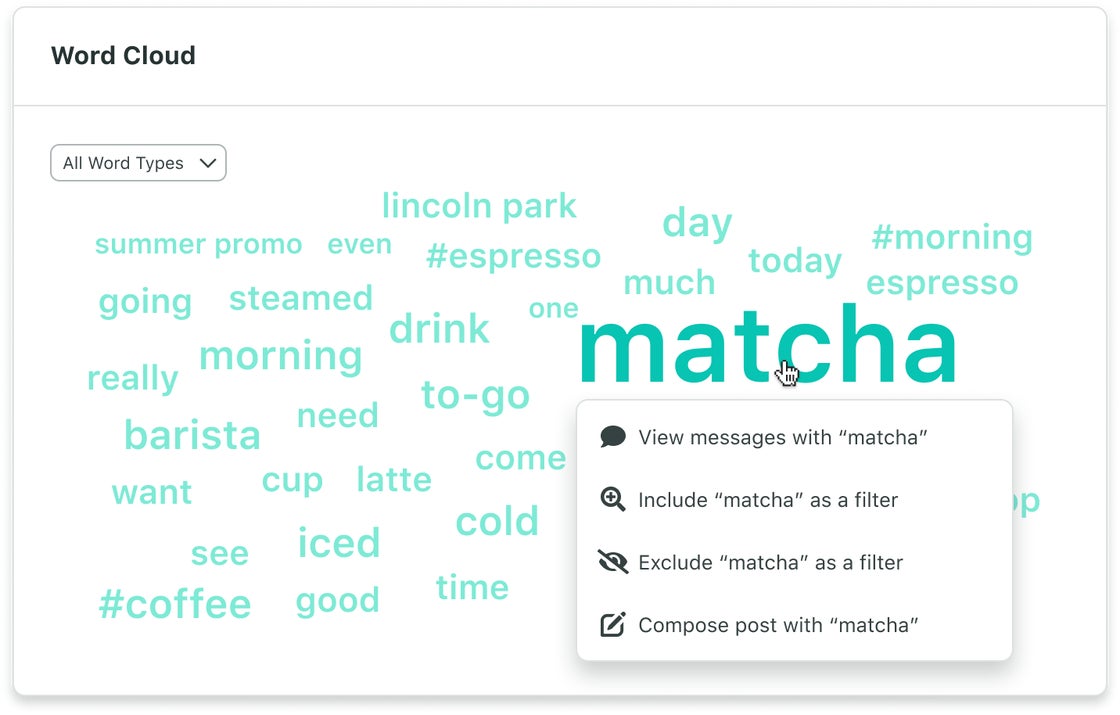
Threads info screen explains platform features like Instagram integration, content visibility and data.

(Source: Sprout Social)

By treating social search as a strategic channel, Threads is no longer just a place to post and becomes a “conversation engine” that influences brand awareness and authority.

Why your audience searches on social media

User behavior has shifted. While Google remains the authority for transactional queries, social media serves a different purpose: instant, authentic trend-focused discovery.

Social search presents clear opportunities for brands. According to Sprout Social’s Q2 2025 Pulse Survey, 41% of Gen Z now turn to social networks for information before search engines. They are looking for three things traditional search often can’t provide:

  1. Authentic experience: Hearing from real people and brands actively participating in the conversation.
  2. Real-time trends: Social networks are the first source of truth for breaking crises or cultural moments.
  3. Visual and conversational cues: Users search for inspiration, reviews and educational content in a visual format.
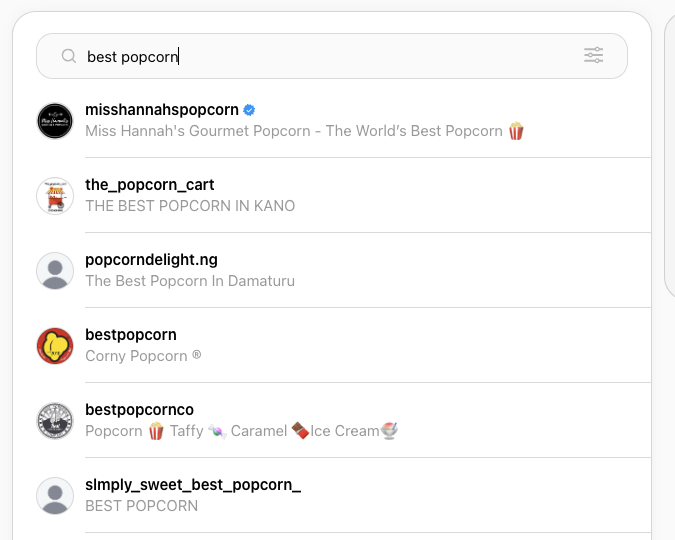
A Threads search for ‘best popcorn’ shows multiple popcorn sellers and brands.

(Source: Threads)

Position Threads as your conversation engine for discovery

Think of Threads as a conversation engine that generates high-value, relevant signals. Brands can use Threads to build sustained authority and meaningful conversations.

Human relevance is the most crucial algorithm of all. When your Threads bio is clear and your posts spark genuine engagement, the network’s algorithm naturally amplifies your reach.

How to optimize your Threads presence for discovery

Optimizing for Instagram Threads SEO requires two things: clarity and conversation. Each time you post, reply, share or repost, you signal to the algorithm who you are and why users should follow you.

The goal is to make your Threads content appear when users search or browse for relevant topics on the network.

Master your Threads profile and bio for visibility

Your Threads profile does more than introduce you; it acts as a foundational signal to users and the Threads algorithm. Keep it concise and keyword-relevant.

For example, instead of, “We help brands,” use a descriptive statement that integrates the problem you solve: “We build social strategies that drive revenue and prove ROI.”

You have about 150 characters to make this impact; use your bio to state your brand’s core value. A fully optimized bio also includes:

  • A clear, consistent profile photo
  • A link to your main hub, like your website or link in bio tool.
  • Primary keywords related to your industry
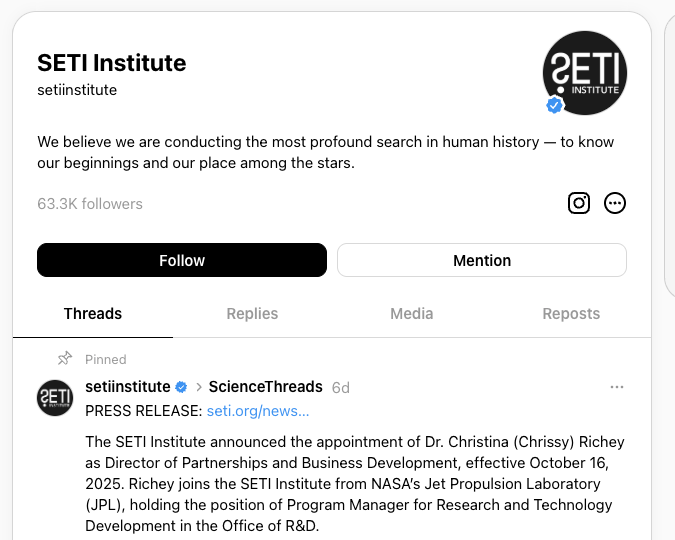
he Threads profile for the SETI Institute, showing the handle, name, bio and profile photo.

(Source: Threads)

An optimized Threads profile and bio helps two key systems:

  • The user: A user instantly understands your value proposition.
  • The algorithm: The platform’s internal logic uses the keywords in your bio, name and handle to categorize your profile for internal search results.

Use keywords and topic tags to signal relevance

The rule for Threads SEO is quality over quantity—posting for the sake of posting only creates noise.

The “SEO” in Meta Threads SEO is less about ranking in a Google search and more about ensuring you appear in a Threads search. Keywords on Threads function as contextual signals for the internal algorithm, while Topic Tags act as Threads’ version of hashtags.

How to use them: If you discuss “influencer marketing strategies,” use that exact phrase in the text of your post and as a Topic Tag. Threads relies on these clear signals to connect users to relevant, real-time conversations. Focus on long-tail conversational keywords—the actual questions and phrases your audience types into the search bar.

Drive conversations that boost your relevance signals

On social media, engagement is the core signal for the algorithm. On Threads, relevance is not measured by link clicks but by conversation.

Replies, reposts and quote-threads are the most powerful signals that your content is valuable. An increase in these signals directly increases your feed visibility, which is the network’s primary form of discovery.

Proactively ask questions, provide unique takes and participate in other threads to generate these signals. Do not wait for conversation; start it.

Sprout Tip: Use Sprout Social’s analytics to track your performance across connected networks. If a topic drives engagement on LinkedIn, test that topic on Threads. Applying cross-platform data ensures you focus on proven conversational content.
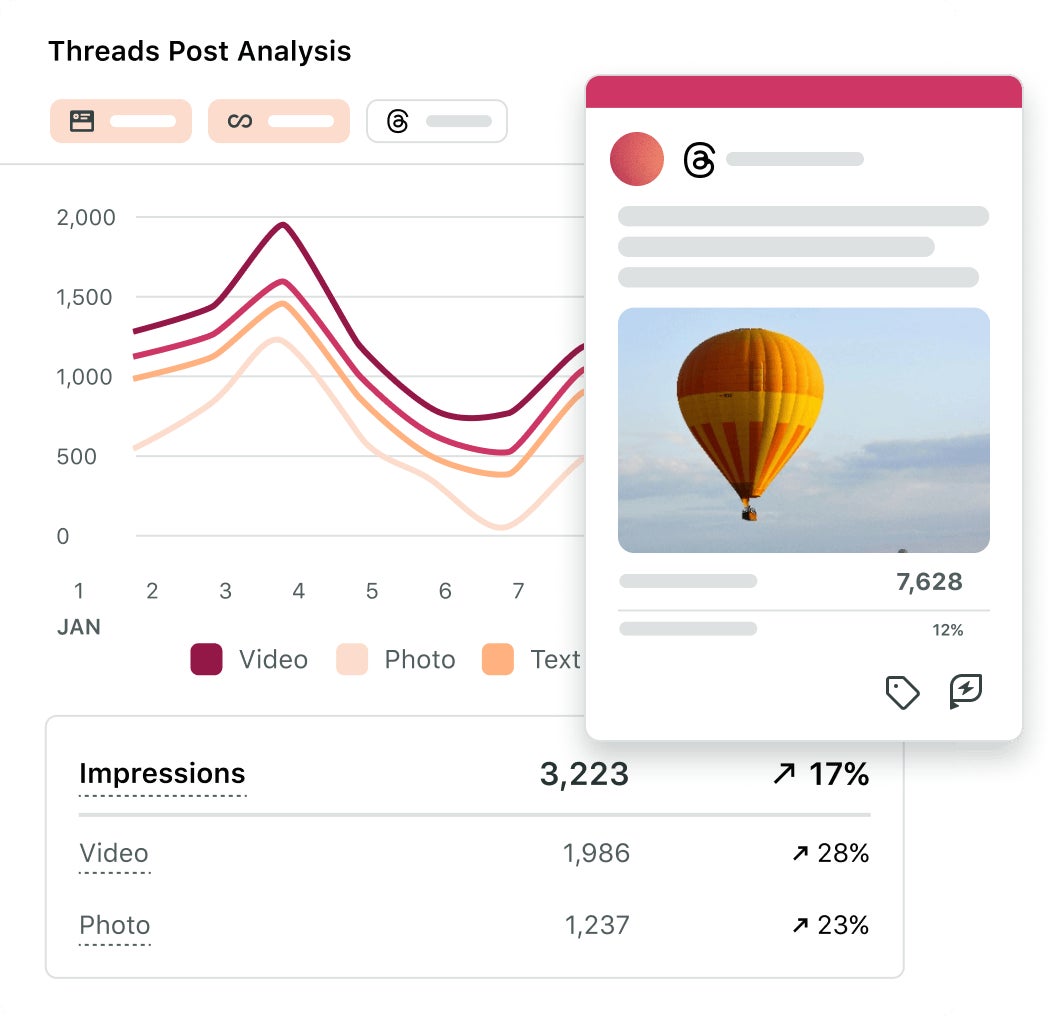
Threads analytics dashboard compares post performance by format, for video, photo and text content.

Threads SEO benefits: Drive traffic and build E-E-A-T

This is where social search meets traditional SEO. Your high-value activity on Threads translates to tangible benefits through referral traffic and brand authority with E-E-A-T (Experience, Expertise, Authoritativeness and Trustworthiness).

Use Threads to amplify your pillar content

Threads is a strategic distribution channel for your core SEO assets. It’s where you’ll directly address audience questions and then link to your in-depth solution, such as a blog, report, case study or support center.

This drives referral traffic to your pillar content. Think of Threads as the appetizer to your long-form content main course.

Try the “teaser” strategy: Take a 2,000-word blog post on “The 5 Pillars of Social Media Listening” and break it down into a five-part thread.

  • Post 1: Hook the reader with a provocative question, such as: “Is your brand still guessing about trends?”
  • Posts 2–4: Each post expands on a single pillar with a strategic takeaway.
  • Post 5: Provide a summary and a CTA to the full article.

This moves users from “problem-aware” to “solution-aware” while driving high-intent traffic to your site.

Build brand authority with authentic conversation

Google’s algorithms are increasingly looking for off-page signals to identify brands that are talked about, trusted and cited. The E-E-A-T framework uses Experience, Expertise and Authoritativeness to measure the ultimate ranking factor: Trustworthiness.

A consistently helpful voice in Threads discussions builds the social proof that strengthens your overall brand reputation. Brands that directly link social activity to E-E-A-T gain a strategic edge over competitors. Here’s how authentic conversation on Threads builds brand authority:

  • You prove expertise in real time: Original posts and replies create an immediate association between your brand and credible value.
  • You drive relevance signals: When your audience replies to, reposts or shares your Threads post, they signal that your content resonates. This increases your discoverability both on Threads and across the web.

How to build a data-backed Threads strategy with Sprout Social

Success on Threads requires more than just consistent posting; it demands a strategy rooted in data and streamlined execution. To maximize your discoverability, you must move beyond guesswork and use a solution that uncovers what resonates with your audience.

Sprout Social empowers you to optimize your Threads presence by handling the heavy lifting of workflow and analysis. While Sprout focuses on holistic management, our platform equips you with the cross-network intelligence and engagement tools necessary to craft the high-relevance content the Threads algorithm prioritizes. When you centralize your social effort, you gain the clarity and bandwidth to focus on what matters: driving the conversations that get your brand seen.

Find your content topics with social listening

You should never guess what your audience wants. Sprout Listening is an essential tool for identifying trends that fuel your Threads SEO strategy.
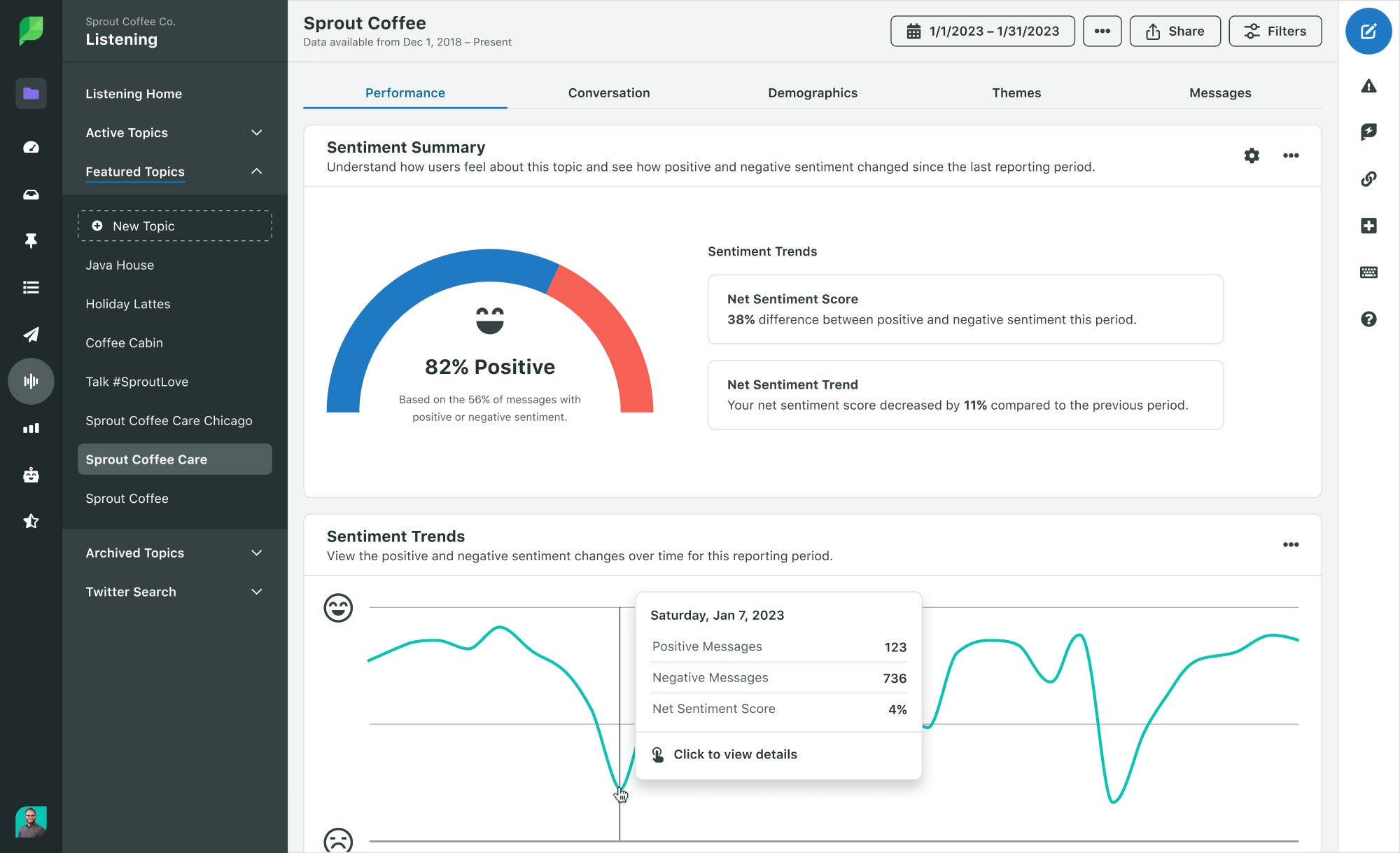
Sprout’s Listening dashboard displays sentiment summary and trend data for Sprout Coffee.

While Sprout’s Listening solution focuses on sources like X, Reddit and the web, it acts as your radar for emerging narratives. Use Listening to:

  • Identify pain points: Find recurring questions and unmet needs for your product or industry.
  • Spot momentum: Detect when a trend is gaining velocity before it becomes saturated.

This data-backed approach ensures your Threads content is always timely, relevant and authoritative. By building content around proven audience interest, you can confidently engage in the conversations your audience searches for and talks about.

Manage your cross-platform presence from one centralized solution

Threads doesn’t need to be “one more thing” to manage, which is why you need an intuitive platform that centralizes your social media engagement and publishing.

Sprout’s Smart Inbox centralizes conversations across Instagram, Facebook, X and LinkedIn. This frees up critical time you’d otherwise spend context-switching or chasing comments, allowing you to engage authentically on Threads.
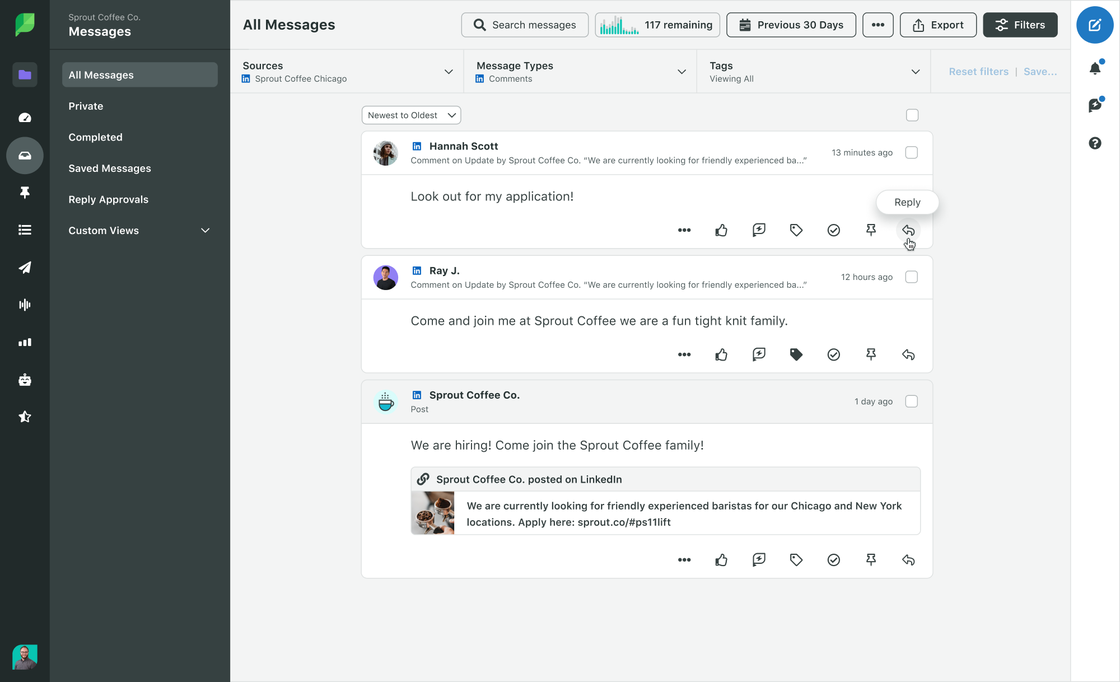
Sprout’s Smart Inbox dashboard shows sources, message types and tags.

Beyond engagement, Sprout also centralizes your content publishing workflows. You can efficiently craft a strong piece of content and then tailor its format for an Instagram caption, a LinkedIn update and a Threads post—all from a single solution. This capability enables you to cross-publish and repurpose content across multiple networks at once, helping you scale a high-quality social media strategy without burnout.

Sprout’s Publishing tool makes it easy to post and repurpose content on Threads and other social networks.

Use analytics to understand what resonates

You need to know what’s working and what’s not. While Threads’ native analytics provides basics, Sprout’s Premium Analytics gives you a strategic view of your data for Threads and other networks.

Don’t treat Threads analytics as an island. Instead, use Sprout’s Threads Profile Report:

  • Compare and align tonal performance: If your “bold” tone on X drives engagement, see if that same tone translates on Threads.
  • Identify top topics: See which content themes drive the most impressions on other networks like LinkedIn and X, then prioritize those for your Threads content.
  • Discover which types of content perform best: Test a mix of formats like text-only posts versus carousels and image-led posts. Then, use the Threads Profile Report to see which formats drive better visibility and engagement. Adjust your content mix accordingly.
  • Measure referral traffic: Prove the ROI of your Threads SEO efforts by tracking click-throughs to your site.

This integrated analytical view empowers you to make strategic decisions, ensuring your investment in Threads pays off by generating not just views but valuable, high-intent traffic and signals.

Win with Threads on social and search

The modern audience has spoken: Discovery takes place in real time and is multichannel. Stop viewing SEO and social media as competing channels. Instead, position Threads as an essential part of a unified, high-value content strategy that drives traffic and proves your brand’s expertise.

Embrace the full potential of social search. You have the tools to transform Threads SEO from a buzzword into a powerful, data-backed channel for discovery.

Ready to build a search-first social strategy? Download our Social Search Optimization Workbook to get started.

The post Threads SEO: The missing link in your social media marketing strategy appeared first on Sprout Social.


from Sprout Social https://ift.tt/Rr6xPiE
via IFTTT

Thursday, 29 January 2026

Luxury brand social media marketing: Strategies by UK brands that scale globally

Luxury brands don’t chase trends. They set them.

Social media is where that influence takes shape in real time. It’s where your brand can inspire, excite and share its vision through carefully crafted stories and visuals.

As Maxime Bicard, Director of Digital Brand and Social Media at Versace, said on Sprout’s Social Creatures podcast, luxury social media content is “an extension of the way [top luxury brands have] always communicated, which is through being inspirational.”

Below, we’ll explore what makes social media marketing different for luxury brands and how to build an inspiring presence without compromising exclusivity.

What makes luxury social media marketing different

Luxury brands play by their own rules. As Maxime Bicard put it on Sprout’s podcast, “It shouldn’t be social channels that dictate how you communicate about the brand. It’s the other way round.”

Unlike mass-market brands that chase trends or visibility, luxury marketing campaigns deliberately build distance. They communicate to inspire, not to engage for engagement’s sake. The quiet moments matter as much as the loud ones because they reinforce an elevated identity.

Let’s talk about how exclusivity fuels desire and how overexposure can quietly undo it.

The psychology of exclusivity and aspiration

Exclusivity is the engine of aspiration. It makes luxury products feel more desirable and a brand feel more meaningful.

Research published in the Journal of Brand Management (2024) shows that when brands use exclusivity well, it elevates how people think, feel and talk about the brand. In turn, that strengthens functional, emotional and social value.

As a result, buyers don’t just want the item. They want to belong to the world that created it.

The risks of overexposure

For exclusivity to inspire aspiration, it has to be just that—exclusive. If you slip into overexposure, the desire fades.

The same study in the Journal of Brand Management explores this idea, showing that not all forms of rarity build lasting value. Natural rarity, with its roots in craftsmanship or limited production, heightens emotional connection and social status.

On the other hand, virtual rarity, like endless “limited drops” or hype-driven releases, may grab attention, but it erodes prestige when overdone.

Burberry offers a great example of how to balance exclusivity and visibility in your online presence. The brand’s posts are understated, confident and restrained. There’s no push to explain, over-sell or show off the most well-known items.

Instead, Burberry uses captions like the one below: “Signature shapes, reworked for crisp winter walks and cosy pub afternoons.”

Burberry Instagram post shows a model in a trench coat that uses an updated design of Burberry’s signature style

(Source: Instagram)

The tone says, “If you know about our signature style, you know. And if you don’t, we’re not for you.”

Even the lack of replies in the comments adds to the quiet sense of distance. A brand like Burberry doesn’t need to jump into every conversation. Its presence sparks conversation on its own.

Luxury brands also demonstrate this through deliberate posting cadence. As Bicard notes, some of the most successful luxury brands now post less often, but with purpose: “I think a lot of brands are trying to get out of this mentality of saying, ‘Okay, we need to post twice a day, we need to post every day,’ because if the content isn’t right, it’s not going to serve you.”

Ultimately, two perfect posts say more than twenty average ones. And in your luxury marketing strategy, restraint offers the ultimate signal of confidence.

6 timeless strategies for luxury social media success

Luxury brand marketing moves at its own rhythm. It’s less about constant visibility and more about long-term influence that balances heritage, creativity and innovation across every social network.

The following social media strategies show how luxury brands can translate timeless values into modern storytelling, while protecting exclusivity.

1. Curate over broadcast

Luxury brands don’t jump on trends. They know their brand personality and they use social to reinforce it. As Versace’s Maxime Bicard put it, “Don’t try to work around the algorithm, try to do what’s best for your brand.”

The best way to do this is to post less but with purpose. A curated approach builds anticipation and protects your brand equity. Tools like Sprout’s Campaign Planner help you build a cohesive, high-end brand presence by letting you visualise long-term campaigns at a glance.

Dashboard view in Sprout’s Campaign Planner showing scheduled posts and performance metrics for visual campaign curation

(Source: Sprout Social)

Seeing every post together makes it easier to shape a consistent narrative over time—one that stays true to your creative direction and luxury ethos.

Plus, the built-in approval workflows act like a creative safeguard that helps you catch anything that feels out of place before it reaches the feed. It gives you space to edit, polish and ensure every post strengthens the story your brand is telling, rather than distracting from it.

2. Design premium visual storytelling

In luxury, visuals don’t just show what you sell. They signal exquisite taste, high-quality craftsmanship and a sense of prestige.

As Maxime Bicard explained, even though the increasing use of social means there’s more luxury content in feeds than before, it still carries high expectations: “Everything is amazingly beautiful, so controlled.”

That level of polish is what audiences associate with luxury: consistency, precision and restraint. But that high-class visual language needs to stay consistent across every platform so every post reflects the same standard of elegance.

Tools like Sprout’s Asset Library help you do this by providing a centralised hub to manage and share approved creative assets. This makes it easier to maintain that consistency and catch anything that feels off-tone or unrefined before it goes live.

3. Tell stories that reward attention

Luxury storytelling invites your target audience to slow down and sink into blissful comfort. You’re not oversharing every little detail. You’re creating moments that feel intentional.

Rolls-Royce does this beautifully on its Instagram account, turning each post into a chapter of a larger narrative. Its Phantom Centenary series post illustrates this approach, unfolding the story of craftsmanship and legacy piece by piece:

Close-up of a Rolls-Royce Phantom Centenary detail, showing engraved glove box artwork

(Source: Instagram)

Long-form captions, series-based storytelling and behind-the-scenes glimpses all help you achieve this emotional depth without diluting your mystique. And when every post contributes to a larger narrative, followers invest in your brand story.

It’s easier to tell that kind of layered story with the right tools. For example, Sprout’s Publishing Workflows enables you to coordinate messaging across markets and channels. This helps you align every chapter of your story, no matter where you’re telling it.

4. Partner with creators who elevate the brand

As Bicard explains, “Luxury brands are approaching authentic creators rather than typical influencers.” This is because luxury brands pick brand ambassadors for resonance, not reach.

It’s a shift from popularity to alignment. You need creators who embody your brand and whose audience mirrors those influencers. You’re looking for creators whose style, values and following all reflect the world you’re building. When they authentically live the brand, you’re not just reaching the right buyers, you’re defining who belongs.

For example, luxury fashion brand, Barbour, partnered with @maryljean, a high-fashion creator whose polished, luxury-focused feed perfectly conveys the brand’s refined aesthetic:

@maryljean poses in Barbour’s classic trench, showing how high-fashion creators bring modern luxury to heritage style

(Source: Instagram)

For maximum impact, choose your UK influencers carefully. Be sure their content, audience and values align with your brand.

This is where tools like Sprout Social Influencer Marketing (a paid add-on) give you a head start. Instead of manually sifting through influencer accounts, you can identify your ideal creators by region, sentiment and style so that every collaboration feels authentic and brand-aligned.

5. Localise for global markets without losing brand voice

Your brand may be global, but your tone should feel local. Whether your audience is in London or Los Angeles, they should receive the same distinctive core message with a regionalised spin.

But localisation doesn’t mean completely changing your voice. It means adapting cultural nuance, imagery and timing while keeping your brand’s personality and point of view consistent.

The key to regional resonance lies in understanding the values of those local audiences. Social listening tools can help. With Sprout Listening (a paid add-on), you can track local sentiment and trending conversations to intelligently adapt your focus to each place without losing your core identity.

6. Balance heritage with innovation

Luxury thrives on history but grows through innovation. From archive-inspired campaigns to digital fashion, the most forward-thinking brands balance timeless craftsmanship with new media.

Bicard highlights this change in format: “There’s been most certainly a big shift towards video over the last three, four years.” But that’s not all that luxury brands are doing to push the envelope and keep the bold spirit of couture alive.

Huge luxury fashion brands now experiment with augmented reality (AR), immersive storytelling and virtual runways to immerse followers in their aesthetic.

For instance, Stella McCartney brought her sustainable ethos to life with an AR “mushroom grotto” try-on filter for the Vogue x Snapchat “Redefining the Body” exhibition. Through these AR activations, Stella McCartney seamlessly merged storytelling, technology and fashion.

Stella McCartney’s Vogue x Snapchat AR filter shows a user wearing the brand’s mushroom-inspired digital gown

(Source: FashionUnited)

But to experiment with confidence, you need creative freedom combined with control.

Sprout’s Publishing approvals and Tagging let you test new formats and automatically route posts through brand and regional reviewers. This ensures every experiment aligns with your visual standards, tone and campaign goals before it goes live.

How to curate community without compromising exclusivity

Luxury brands don’t create community through mass engagement. They build curated connections. The goal is to make the right audience feel included without diluting your brand’s air of mystery.

You don’t need to reply to every comment or open your DMs to the world. Instead, focus on intentional touchpoints that deepen loyalty while maintaining distance.

Here are a few ways to create an exclusive community on social:

  • Use Instagram Close Friends to share limited behind-the-scenes moments with top customers and loyal advocates.
  • Host invite-only Discord or WhatsApp groups for collectors or VIP clients to create spaces where access feels like a privilege.
  • Spotlight community members through private events or limited-run collaborations rather than public shoutouts.

These quiet, deliberate gestures build belonging without overexposure, turning your audience into insiders who value being part of something rare.

Measure what strengthens perception, not just what performs

Luxury brands don’t measure success through reach and engagement alone. As Maxime Bicard explained: “Engagement or reach [don’t fully represent] the power of your brand message.” Instead, focus on resonance—the way your digital presence strengthens brand perception over time.

Learn how to measure the success of your luxury social media campaigns without leaning on vanity metrics.

Define high-value brand engagement

Rather than counting likes, figure out what meaningful interactions from luxury consumer segments look like. These often include the following metrics:

  • Saves
  • Branded hashtag usage
  • Shares
  • Referrals
  • Positive sentiment

These actions signal that your brand is inspiring admiration, not just attention. They build what’s known as digital brand equity: the cumulative strength of your brand’s image and influence online.

Build a brand health dashboard

A health dashboard helps you see how people truly feel about your brand over time, rather than simply showing you how many people interact with it.

These dashboards bring together perception, sentiment and reputation metrics so you can understand the real impact of your social presence beyond short-term engagement.

Sprout’s Premium Analytics (a paid add-on) tracks these deeper signals through visual reports that show changes in sentiment, share of voice and long-term brand lift. That means you can make smarter, data-backed decisions about campaigns and messaging instead of relying on guesswork.

When you’re creating your luxury brand health dashboard, include the following metrics:

  • Branded share of voice across key markets shows how often your brand is part of the social conversation compared to competitors.
  • Sentiment towards creative campaigns or influencers reveals how audiences emotionally respond to your content and partnerships.
  • Growth in referral traffic from social to ecommerce tracks how effectively your social presence drives qualified traffic and conversions.
  • Engagement quality over time (saves, mentions, re-shares) indicates how deeply audiences connect with your content, not just how often they like it.

When you measure the factors that enhance perception (instead of just what performs), you align your social strategy with brand prestige rather than fleeting trends.

Trends shaping the future of luxury on social

Luxury is evolving and so is the way brands show up online. The next chapter of luxury marketing will balance timeless craft with cutting-edge customer experience to blend heritage styles with digital innovation.

Here’s how those trends are showing up today:

Editorial control in the age of speed

As a luxury brand, you can’t afford to sacrifice your refined image for quickfire posting, even in the high-speed motorway of social media, control matters.

Of course, you need to stay agile and responsive to audience sentiment, but you also need the time and space to make sure every post reflects your brand standards. You can achieve this precision with Sprout’s Publishing Workflows, where multi-level approvals and version control allow you to move fast without losing consistency and finesse.

Digital fashion, virtual try-ons and immersive experiences

Web3 and AR are reshaping how people experience luxury. Virtual showrooms, try-on filters and metaverse events let followers step inside your world. These tools invite interaction without eroding exclusivity.

John Richmond’s Tate Modern showcase at London Fashion Week was a great example of this. The luxury fashion brand used AR to project digital versions of their garments into the guests’ surroundings:

Large black-and-white portraits from John Richmond’s immersive AR show at Tate Modern blend digital art with high fashion

(Source: Graduate Fashion Foundation)

The immersive activation bridged digital and physical fashion, showcasing the brand’s innovative side while preserving exclusivity.

Sustainability and value alignment

Consumers now expect environmental responsibility from luxury brands. Research in the Cleaner and Responsible Consumption journal notes that “the luxury fashion industry now embraces environmentally conscious approaches, reflecting consumers’ changing preferences and values.”

Ken Research supports this with a recent study that shows that in the UK, 64% of shoppers say they’re willing to pay more for eco-friendly luxury goods.

This is especially important if your brand targets younger audiences. According to McKinsey, Gen Z and Millennials are leading the sustainability charge, with 40% agreeing that environmental impact is extremely or very important when making purchasing decisions.

For luxury brands, this means going green and showing your commitment to sustainability on social media so your audience knows your environmental priorities.

Elevate every moment, measure every impact

Luxury brand social media marketing isn’t about being everywhere. It’s about being unforgettable. Every post, story and collaboration should reflect intent, craft and control.

With Sprout, you can scale social success without sacrificing precision. Use features like campaign planning, approvals and analytics to keep every asset on-brand and every post intentional, while grounding every decision in insight.

Ready to see how Sprout can help your luxury brand elevate every moment? Book a demo today.

The post Luxury brand social media marketing: Strategies by UK brands that scale globally appeared first on Sprout Social.


from Sprout Social https://ift.tt/y3TjxQo
via IFTTT

How Joy Dakinisun Launched Her New Website with Email Marketing Ready from Day One

Joy Dakinisun

Meet Joy Dakinisun - business coach

Joy Dakinisun, an online business coach, was getting ready to launch her new website quantumleapwithjoy.com. Most of her energy was focused on getting the design right, refining her messaging, and making sure everything reflected her brand.

She knew email marketing would help her capture subscribers from day one. But between finalizing her website, serving clients, and creating content, actually setting it up kept getting pushed to the bottom of her to-do list.

She kept telling herself she'd set it up after launch. But deep down, she knew launching without email meant missing critical opportunities. No immediate value for new visitors. No way to book calls or get support. No foundation for turning interest into income from day one.

😫 The Challenge: Launch Your Website With or Without Email Marketing 

Joy's email marketing was becoming a bottleneck to relaunching her website.

“'When should we get that email marketing set up done? What colors? How?….or just starting simple?'" Joy explains.

She tried setting it up herself but hit the technical learning curve. 

"I tried to set up everything by myself. Noticing that there was a lot to learn first to really get a professional look even if content creation is easier for me as a writer. So I quit and focused on other priorities first."

Joy faced a tough choice: launch without email marketing and miss building her list from day one, or delay her launch to get it right.

💡 The Solution: Professional Email Marketing Ready at Launch

AWeber's Done For You service solved her exact problem. She could launch on schedule with professional email marketing ready to capture subscribers from day one.

What the service provided:

  • Email template matching her new website
  • Automated email series welcoming her new clients
  • Sign up form and landing page to grow her email list

"Done For You literally saved us hours of work and a starting point that not only was simple, but professionally elegant," Joy says.

Email template created in AWeber

📈 The Results: Launched on Schedule with Email Ready to Grow Her Audience

Joy launched her website with professional email marketing ready to go.

What Joy achieved:

  • Launched on schedule with email marketing ready from day one
  • Professional brand-consistent design across website and email
  • More time for her clients 
  • Peace of mind knowing her email system was waiting to be activated

"I now can focus on other priorities and know that if everything else is set up, the AWeber Done For You set up is waiting in the background to be integrated," Joy explains.

🚀 Ready to Launch Your Website with Email Marketing Already Set Up?

Email marketing shouldn't be an afterthought you handle "after launch." Having it ready from day one means you start building your list immediately—not six months later.

Here's how to launch with email ready:

  • Start with AWeber's Done For You service to get professional email marketing ready to capture subscribers from day one
  • Get your email setup done in parallel with your website so both launch together
  • Start building your list immediately instead of losing months of potential subscribers
  • Have consistent, branded communication ready from first contact

Don't launch without a way to grow your audience. 

Get started with AWeber's Done For You email setup and get your email marketing foundation built by experts while you focus on your launch.

The post How Joy Dakinisun Launched Her New Website with Email Marketing Ready from Day One appeared first on AWeber.


from AWeber https://ift.tt/edogr2W
via IFTTT

Wednesday, 28 January 2026

How to use social media market research to turn social data into strategic intelligence

Market research helps us better understand our customers and uncover new business opportunities. But traditional market research is no longer enough, now that consumer preferences and market dynamics change overnight. Social media is the new hub for discovery that bridges this gap.

Sprout’s Q2 2025 Pulse Survey found 37% of users prefer to search on socials for product reviews and recommendations. Social impacts almost every corner of content creation, from online marketing to the production of television shows. More people are using social media as a research tool, meaning its strength as a source of company-wide market research continues to grow.

But the dynamic and rich data source offered by socials isn’t always fully harnessed. You need to use social media market research to uncover critical customer, competitor and industry insights to maintain an accurate pulse on your market while keeping costs low.

We’ll outline what sets social media market research apart from alternative methods and list some of its key benefits. You’ll also see some of the main ways to leverage your social media market research strategy for the benefit of your entire brand.

What is social media market research?

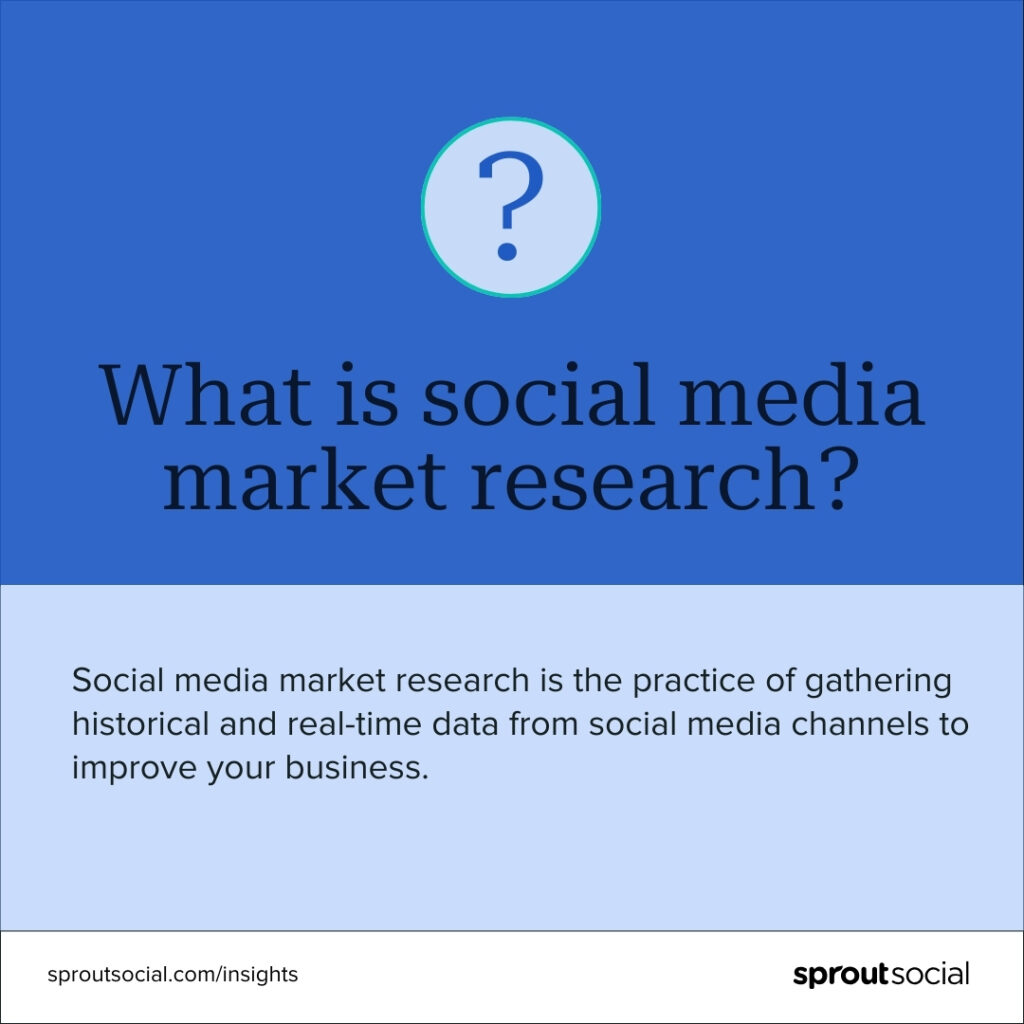
Social media market research is the practice of gathering historical and real-time data from social media channels to improve your business. But it’s more than just monitoring and listening to your social channels; it’s about harnessing the data you’ve collected, and refining the methods you’re using, to create actionable social media intelligence.

Card that says Social media market research is the practice of gathering historical and real-time data from social media channels to improve your business.

While more traditional forms of customer market research are still useful, like focus groups and surveys, social media market research gives you an unfiltered look into audience behavior. It allows you to collect different data points that can be grouped into both qualitative and quantitative categories.

Quantitative data refers to any data you can directly measure. Through social media market research, you can collect metrics like shares, comments and likes on your content and your competitor’s content.

In contrast, qualitative data can’t be directly measured, and includes data like the behaviors and opinions surrounding your brand on socials.

By combining these insights across social networks like Instagram, TikTok, X, Reddit, Facebook and others, you can accurately research how your brand is being perceived online.

The benefits of using social media market research

According to The 2025 Impact of Social Media Marketing report, 80% of marketing leaders are already planning to reallocate funds away from other, more traditional channels towards socials. Market research is no different, and this is because when it comes to customer centricity, content strategy and more, social media offers several benefits over traditional methods.

Becoming more customer-centric

Sprout’s Q4 Pulse Survey found that 55% of all users say most companies do a good job of listening to what audiences say on social media, but they don’t always act on those conversations.

Investing in social media market research clues you in on these audience conversations. It also gives you detailed insight that you can use to adapt to the desires of your audience. This allows you to become more customer-centric over time, and keeps you in tune with what your audience expects from your brand.

Improve audience segmentation

Conducting market research on social media helps you identify different segments of your audience. You can filter audience groups based on demographic and psychographic data like age, gender, location, engagement level, interests and other factors. You can then create a set of target personas based on this data.

Sprout Social's audience segmentation tools

Once you’ve segmented your target audience, it’s easier to create personalized campaigns that cater specifically to certain demographics, and measure performance across different segments.

Manage brand reputation

Users are turning to socials for reliable information. According to The State of Social Media 2025, 36% of consumers are more likely to trust information about a brand found on social compared to information found through other forms of search, like Google or AI chatbots. This increased trust in social media means it’s a vital channel for reputation management.

Use social media market research to conduct sentiment monitoring at scale. These insights reveal wider perceptions of your brand, competitors and industry, so you can get ahead of potential crisis points before they happen.

Optimize your content strategy

An effective content strategy is only as reliable as the data behind it. Use the data you’ve gained from your social media market research to conceptualize, guide and measure the performance of your entire online content strategy.

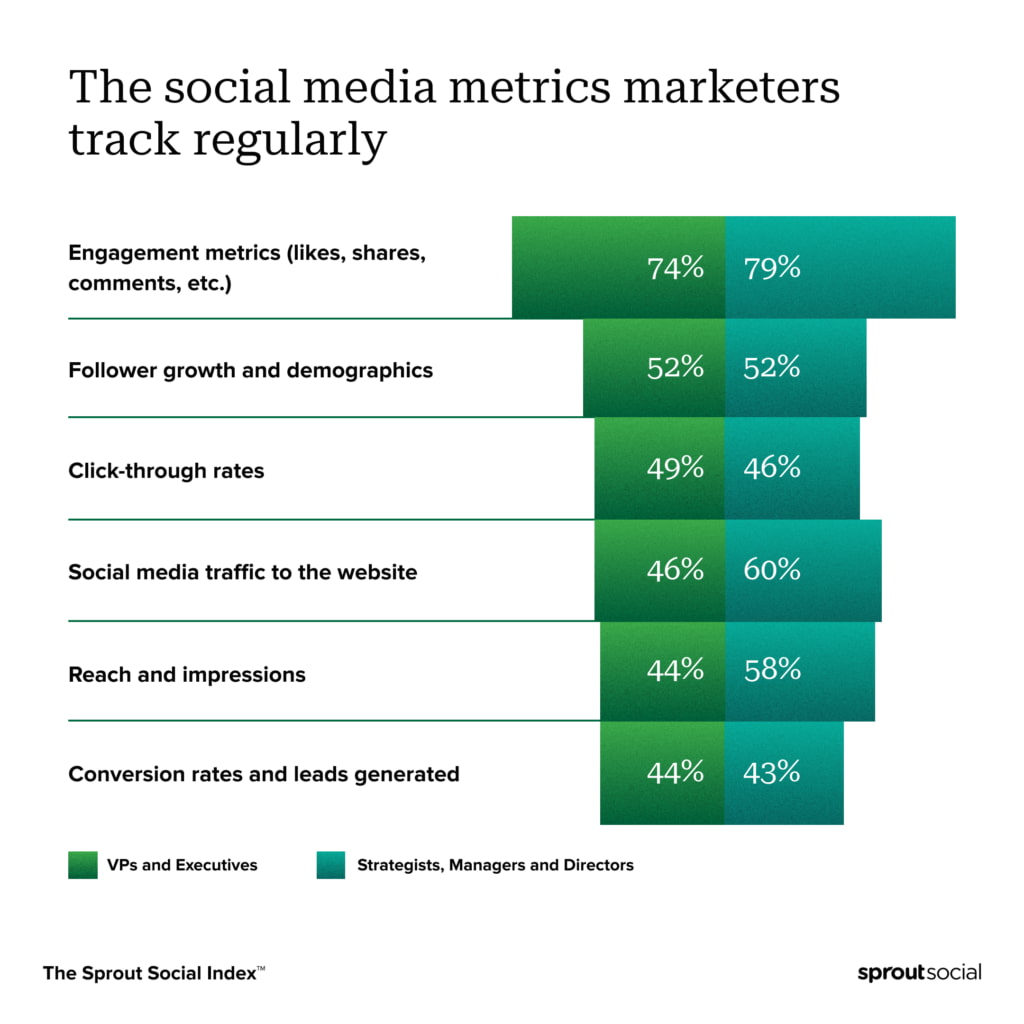
Sprout Social's list of regularly tracked social metrics per The Sprout Social Index

For example, your social research might uncover a new way customers are using your or your competitor’s products. You can harness this insight to design a content campaign around this new value proposition, which affords you a campaign that’s tailored to the demands of your followers.

Effective optimization means continuing to research and improve your strategy. By conducting social media market research frequently, you can continue to reveal new ways to adapt your approach.

Keeping ahead of competitors

Socials are small ecosystems, where you can learn about your brand and analyze your competition.

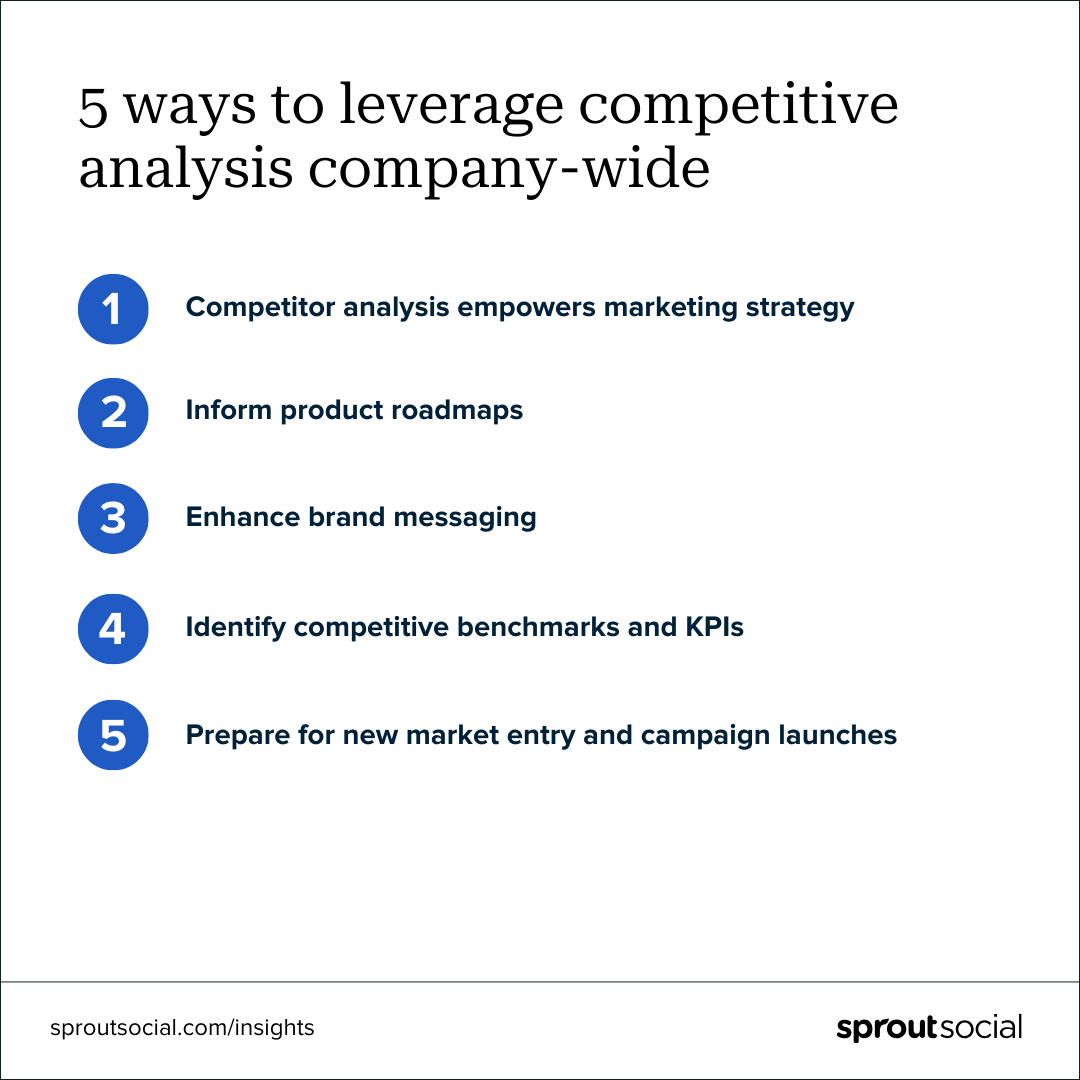
Social data taps into deep competitor insights, such as what people like about competing brands and how customers respond to them. All of which guide how you can differentiate yourself from the pack if you adapt your insights to impact the wider company. Beyond using competitive intelligence to empower your marketing strategy, these insights can inform your product roadmaps, identify benchmarks, provide insight into new markets and more.

Sprout's list of 5 ways to leverage competitive analysis

Tap into online culture and predict future trends

There’s nowhere more appropriate for tracking online culture than socials, and it’s an area where most agree brands should be doing more. Data from The 2025 Sprout Social IndexTM found that 93% of consumers agree it’s important for today’s brands to keep up with online culture.

As well as meeting this expectation, social media market research allows you to get ahead of the game and predict future trends. Use social listening and other strategies to predict how customers will adapt to products and brands in the future, and start pivoting towards these movements.

A recurring social market research strategy means you stay ahead of the curve and can prepare your brand for tomorrow’s major cultural shifts. For example, 2025’s summer of celebrity showdowns between jean labels, showing how keeping (or not keeping) a pulse on culture impacts the resonance of campaigns.

How to use social media for market research

It’s one thing to conduct market research, but you also need to learn how to turn your insights into actionable social intelligence. By turning your social media market research into intelligence, you can improve your discoverability, refine campaigns and center your brand around trends and customer voices.

These eight strategies explain how you can use market research and tools to extract social intelligence for your brand.

Identify audience segments

To properly identify your audiences, it’s worth first building out your community management strategy using social networks. Leverage platforms like Reddit to know what your audience is talking about and respond to threads directly.

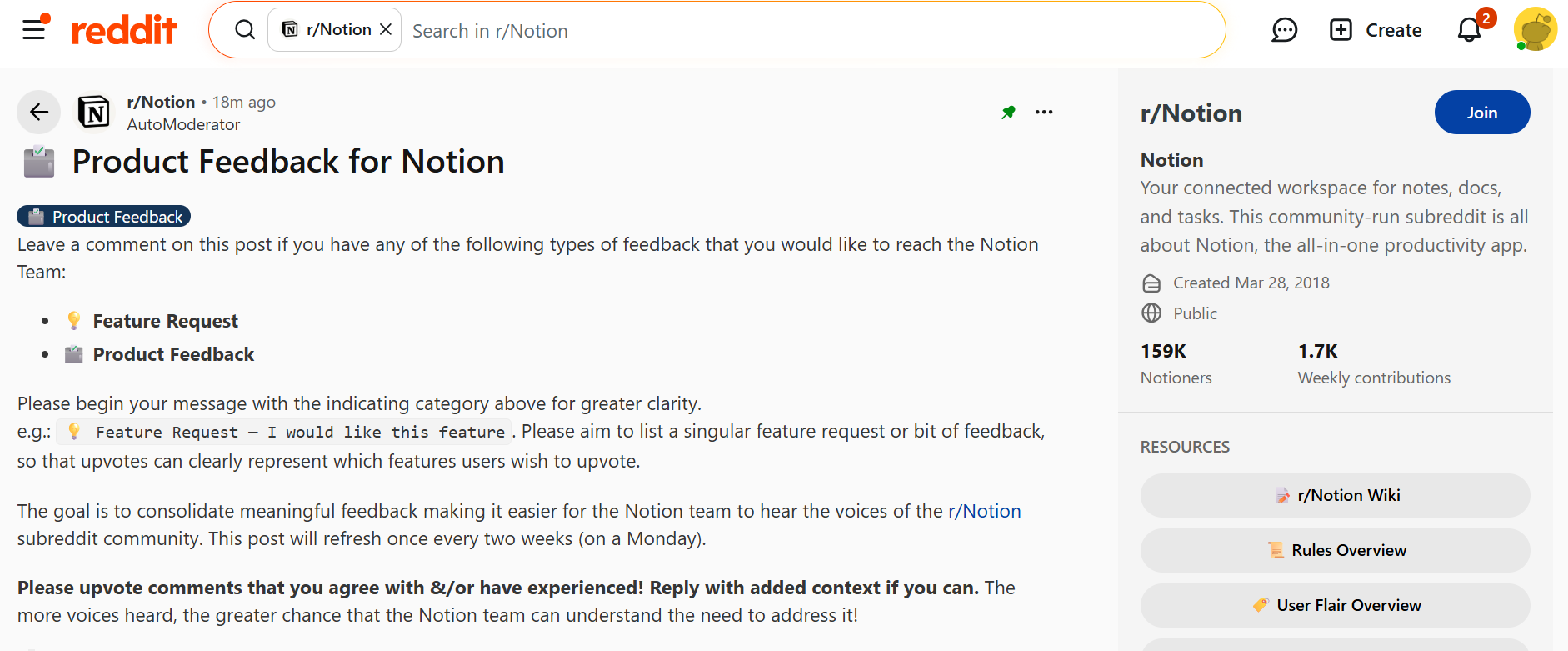
One example of brands making use of Reddit is Notion. They manage the r/Notion subreddit, and include an easy way for users to communicate feature requests or product feedback through a pinned conversation.

A screenshot of Notion's reddit channel

Tools like Sprout Social Analytics determine how users are engaging with your content, and who they are. Combine this with social listening to reveal even more data about their behaviors, and use all this data to identify key audience segments among your followers.

Then, create a target persona for each of these segments, and use this persona to create personalized content strategies tailored to their needs.

Social listening and monitoring

Social listening is its own irreplaceable technique when conducting social media marketing research. Use social listening to find out what your audience really thinks about your brand and content.

Customer comments are often not as simple as “I like [brand]” or “I don’t like [brand]”. Some are indirect, don’t tag your handle or misspell your brand name. A dedicated social listening tool navigates these issues to give you a clearer idea of what customers expect from you and distinct insights on how to address them.

Sprout's social listening dashboard

With social listening, you can focus on being active and proactive. Active social listening means adapting based on the data you’ve collected, and using it to inform changes in how you operate. Proactivity then means using social listening to get one step ahead of your audience. Create a proactive strategy for social listening that allows you to get ahead of conversations.

Listening tools can be combined with media monitoring tools, like NewsWhip by Sprout Social, to stay on top of conversations. Once you’ve collected this data, use Sprout listening to look at the long-term impacts of conversations surrounding your brand. You’ll better understand audience sentiments and learn to recognize cultural shifts, which you can adapt to in order to effectively optimize in the future.

Content analysis

You can also use social media analytics to determine which of your content is performing well, and where there’s room for improvement. A social media management tool like Sprout provides granular insights into your content performance, down to the performance of individual posts.

Track this performance across different networks, post types and campaigns to reveal what’s really working for your brand. Then, alter your strategy so you’re creating more of this content, while modifying content types that could do with a refresh.

Trend analysis

Social listening can be used to discover popular trends within your industry and related to your brand. Don’t just focus on short-term changes; look at long-term trends that have evolved over time, and use this data to predict how your audience’s expectations might change moving forward.

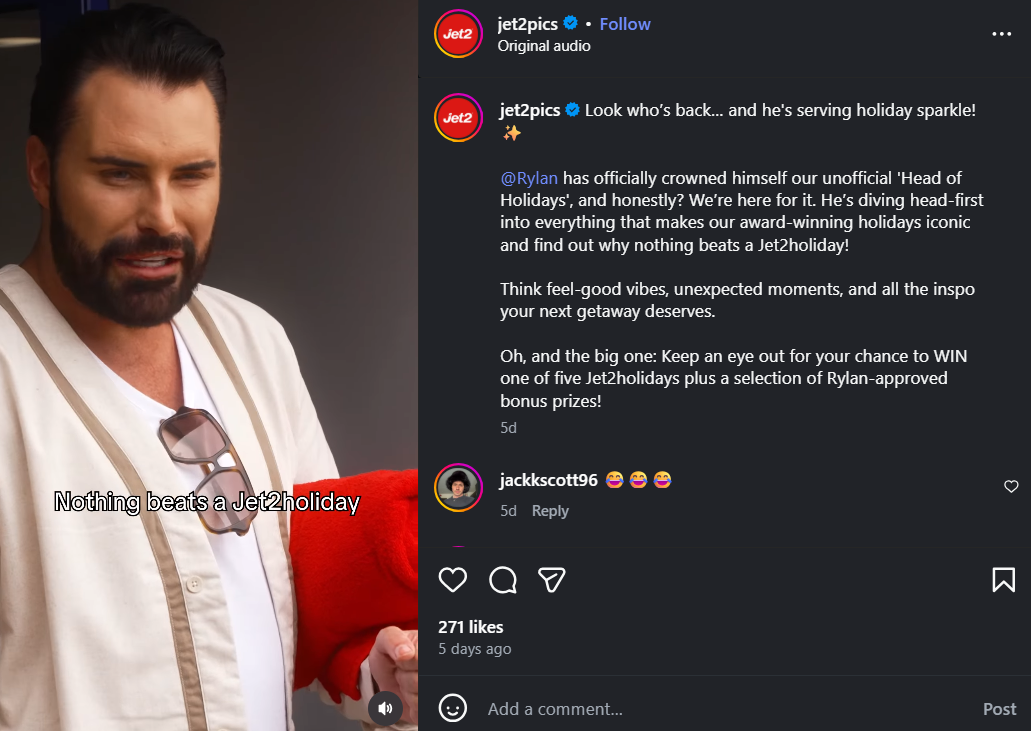
Throughout 2025, the UK airline Jet2 found itself at the center of an online culture trend around its slogan. The brand has continued to capitalize on this naturally occurring meme with a series of supportive content campaigns, most recently featuring UK celebrity Rylan. They’ve proven that the best way to keep a trend going is to support its growth with your own content, without going overboard.

Jet2's Instagram page showing a campaign with UK celebrity Rylan

Influencer mapping

Influencers continue to play a significant role in social media strategy. As their audiences grow, it’s essential that your social media marketing strategy also involves tracking and reacting to key influencer voices in your market.

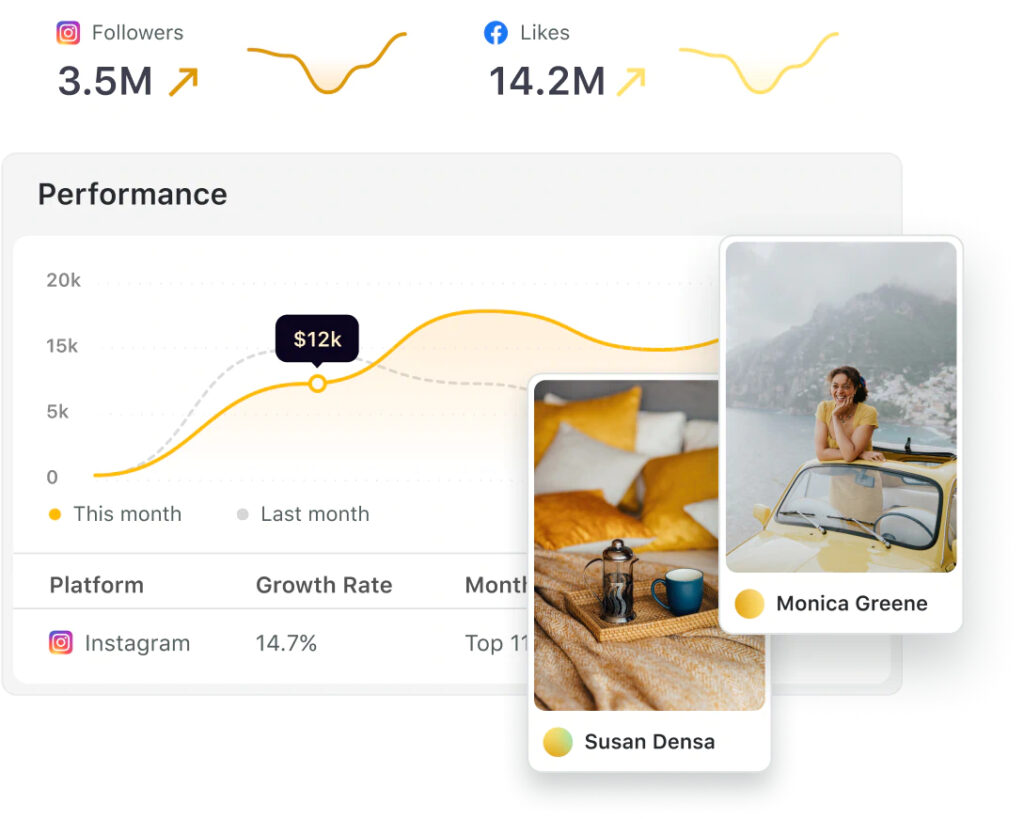
With influencer mapping, you can track the most important influencers and voices within your industry, or in communities that matter to your brand. Tools like Sprout Social Influencer Marketing provide more detailed data on these influencers; who they are, what they post about, how they’re performing and the metrics that matter across their accounts.

A visualization of influencer marketing metrics

Mapping these individuals gives you a list of influencer marketing campaign partners who are the best fit for your brand. It also helps you discover and tap into niche communities where these influencers are active, and find ways of joining the conversation with your own content.

Competitor intelligence to know where you stand

Insights from social media market research guide your competitor strategy for short-term and long-term campaigns. The ability for social research to uncover competitor intelligence is one of the key reasons why, according to Sprout’s Q1 2025 Pulse Survey, one of the top specialized roles marketers would like to add to their teams is a social media intelligence lead.

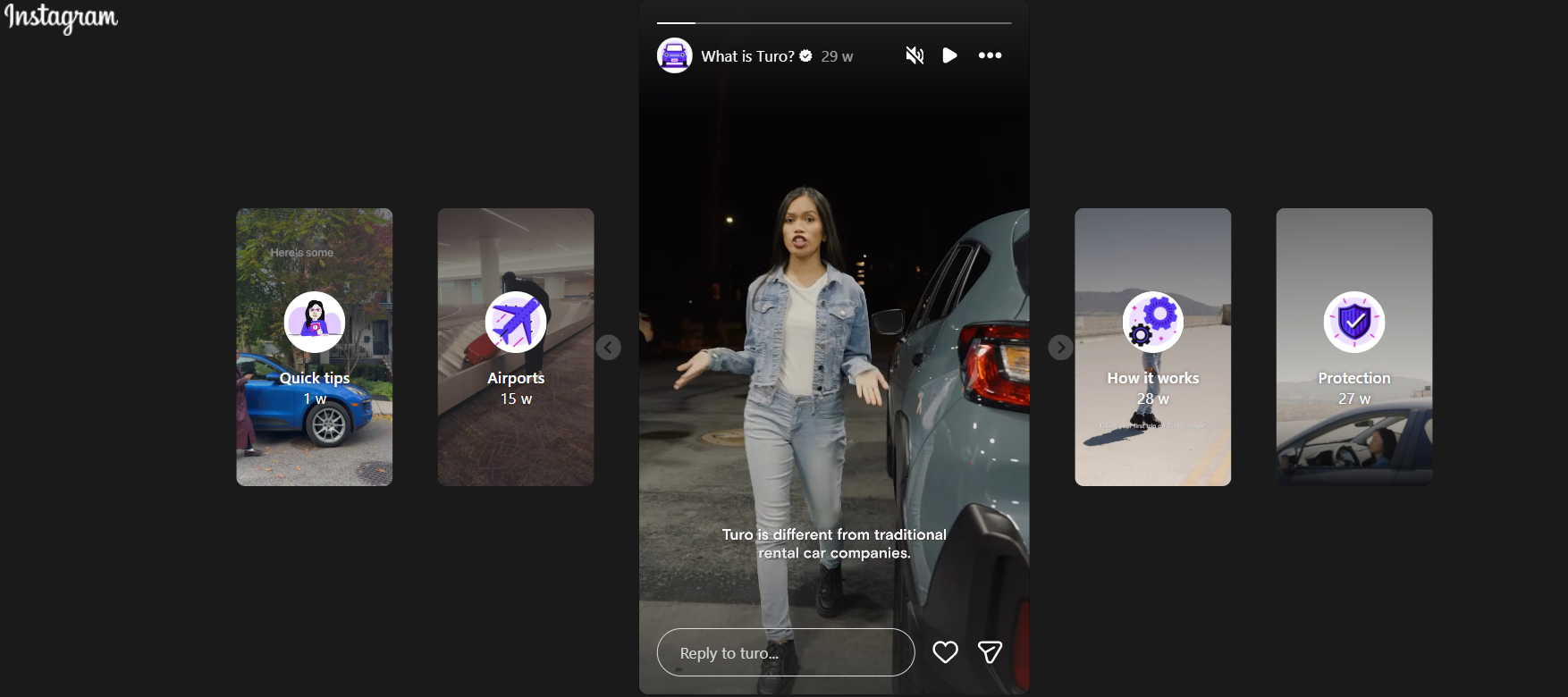
One example of this is Turo, which is competing with traditional car rental companies. They regularly use their social content to compare their service to renting vehicles to explain why they are a better alternative.

Turo's saved Instagram stories

Use social media research to understand your competitors’ content and ad strategy, track how the market responds to them and know where you are in terms of audience segmentation. With Sprout Social, you can set up a competitive analysis report across various social networks including review websites, like Google My Business, to track competitor benchmarks and understand your customers’ attitudes toward the competition.

Turn social data into actionable insights

Bring all the data, insights and recommendations from the strategies above together to create actionable social intelligence. This will connect your research to specific business goals, across your marketing department and the wider business.

As a first step, map your data to the key metrics that represent your customers, from how they engage and feel to what makes them convert, which every department cares about.

If you’re struggling with what to focus on, AI capabilities like those found in Sprout can help you transform millions of data points into insights that tell the story of how your brand, industry and audience are converging. Sprout also enables you to create custom reports, which can be downloaded via PDF or shared directly with others.

Build an integrated tech stack

Your social data shouldn’t live in a silo; it should flow through all of your platforms for a holistic view. Use tools that can integrate your social and customer data, so you can get a full view of customer behavior and connect your social media research to business impact.

Sprout integrates with several other leading providers, including Salesforce and Tableau, so you can unify your data and understand each step of the customer journey.

The challenges of social media as market research

Social media definitely isn’t perfect, so neither is the market research that comes from it. Keep these limitations in mind as you’re collecting and analyzing social media data:

  • Representation bias. You may have some preconceived notions or assumptions when collecting data. Make sure you’re aware of these, as they could skew your findings if left unchecked. This is particularly important if you’re trying to predict future trends or changes through your research.
  • Bots and bad actors. Unfortunately, social media remains vulnerable to bots designed to manipulate conversations and influence public opinion. Try to identify commenters as bots before you place too much value on their sentiments. But don’t dismiss bots entirely; look at the conversations they’re trying to start, and think about how those attempts might impact your brand in the future.
  • Cultural nuances. When collecting qualitative data, think about the cultural nuances that might be present from certain commenters. Sarcasm, irony, pop culture references, memes, slang and other behaviors can distort sentiment analysis attempts if you don’t have the right context.
  • Data privacy. Consider data privacy measures and laws when collecting any data across platforms. Similarly, make sure you keep your findings and social data protected.
  • Fragmented data. Since social platforms are owned by different companies, each network has its own algorithm, and they don’t always share metrics. They also have different policies on provided analytics, which can lead to fragmented data across your accounts.
  • Algorithmic opacity. There’s often some level of mystery around how different algorithms work, and each prioritizes different aspects depending on audience preferences and the network’s business goals. Bear this in mind when tracking organic trends across socials.

A social media management tool can help you navigate these challenges. Use a unifying social media marketing tool to bring all of your profiles under one roof, so you can more directly compare the similarities and catch the differences across networks. Advanced analytics tools can also help with mitigating bot data and irrelevant content by filtering the noise from your social engagement.

Lead the era of intelligence

Social media intelligence is no longer the future of effective research—it’s happening now. Brands that have already started to embed social insights into their market research and business strategy can continue to reap the rewards of rich social data, and are better positioned to define the next era of business.

See how you can start making use of the social intelligence at your fingertips by scheduling a Sprout demo today.

The post How to use social media market research to turn social data into strategic intelligence appeared first on Sprout Social.


from Sprout Social https://ift.tt/GQi58ku
via IFTTT

Tuesday, 27 January 2026

Influencer marketing and SEO: Building lasting visibility

Influencers drive the conversations that shape what people search for next.

Their content surfaces in search results and strengthens the authority signals that lift organic rankings. Yet many teams still treat influencer marketing and SEO like they’re speaking different languages.

In reality, when you connect the two strategies, your brand shows up everywhere your audience is looking, including traditional, AI-driven and social media search.

This guide explores how influencer marketing fuels SEO and how to use them together to maximize your brand’s long-term visibility.

Influencer marketing and its impact on SEO in 2026

Influencer marketing drives discoverability across every channel.

When creators start conversations, their posts generate search demand and brand mentions that strengthen your site’s credibility.

And when high-authority creators repeatedly mention your brand alongside target keywords (like “Sprout Social’s social media analytics tools”), industry leaders believe Google’s entity graph begins associating your brand with that topic. This indirectly boosts SEO authority signals for your brand.

Influencer and SEO strategies are no longer parallel efforts—they’re interdependent engines. When they work together, each amplifies the other. This turns creator reach into organic visibility.

Here’s how linking your influencer marketing and search engine optimization strategies creates a continuous loop of discovery, engagement and growth:

Influencer activity creates SEO authority signals

Influencer content sparks activity that search engines pick up on.

While Google can’t see private engagement inside TikTok or Instagram, it does notice the results that come from influencer marketing: more people searching for your brand on Google, more visits to your website and more sites linking to your pages.

Imagine a creator posts content about an eco-friendly deodorant on Instagram, like this promo for Wild by Emilie Mathieu:

@emiliemathueu43’s Instagram post promotes Wild deodorant with a promo code

(Source: Instagram

After seeing this post, some of Emilie Mathieu’s followers look up the brand on Google and visit its website, driving search demand.

Then, a sustainability blogger who follows that creator posts a rundown of “The Best Natural Deodorants” and includes a link to the product page, like in this article by More Than Greens:

More Than Greens’ blog shows a review of Wild deodorant

(Source: More Than Greens)

That blog link creates a backlink—a key signal that can strengthen the brand’s authority and help it rank higher in Google search results.

Backlinks are like other websites vouching for you. When credible sites link to your pages, it tells Google your brand is trustworthy and relevant in its field. That trust, powered by E-E-A-T signals (experience, expertise, authoritativeness and trustworthiness), helps your site rise in search rankings.

In this way, influencers don’t just extend your social reach. They also turn social trust into credibility signals that power SEO growth.

Influencers bridge social and traditional search

The best influencers create content around phrases people are actually searching for and optimize it using keywords in titles, captions and hashtags. This brings their content to the top of in-app searches, making their social media posts easier to find.

From there, how visibility grows depends on the network. On YouTube, for example, engagement metrics—such as likes, comments and watch time—help videos rise in YouTube search. Because YouTube is part of Google’s ecosystem, those engagement signals also push the content higher in Google’s search engine results pages (SERPs).

On Instagram, TikTok and other closed networks, optimization and engagement increase visibility in social search feeds. Since Google can’t see in-app metrics, it uses public metadata like captions, hashtags and context to understand and rank the content.

When an influencer’s post ranks high in social search, it inspires audience action. People often turn to Google to learn more, creating a ripple effect: more searches, more backlinks and more clicks that build SEO authority.

That’s how influencers bridge social and traditional search. Optimization drives discovery everywhere, while engagement fuels in-app reach. Together, they improve brand visibility and turn awareness into measurable growth.

Influencers drive discovery in social search

Social media platforms have become powerful search engines for product discovery. According to the 2025 Sprout Social Index™, consumers head to social media channels to research products one to six months before making a purchase.

Influencers fit into this by introducing users to products they’ve never seen before, which sparks curiosity and prompts further searches.

Picture this: Someone types “gifts for anglers” into TikTok. A creator’s review of your brand’s leather tackle bag ranks near the top. The viewer watches, saves the post and starts digging deeper. This time, they search for your brand name and similar terms like “sustainable fishing gear” and “leather tackle bags.” Each new search deepens their interest and exposes them to even more creators and products.

When this happens across thousands of viewers, your brand and category gain organic search traffic. That growing search volume signals that your products are relevant and in demand. Later, when people search for terms like “best fishing gifts,” “eco tackle bags” or “gifts for fishing enthusiasts,” they find creators mentioning your brand. That’s when you truly start dominating discovery.

Discovery doesn’t come from guessing what people search for. It happens by knowing what they already search for. Social listening tools identify trending keywords and questions in real time. Knowing those terms lets you brief your influencers to create and optimize content around them, which helps turn everyday searches into powerful moments of discovery.

Creators help your brand capture long-tail keyword searches

Social media influencers who understand search intent mirror what people search for and optimize their content with those terms.

Imagine a creator reviewing your sustainable yoga mat. They focus on phrases audiences already search, like “best eco yoga mats,” “non-slip mats for home workouts” and “top 10 cork yoga mats.” To reach those searchers, they build these terms into their video titles, captions and hashtags.

You then monitor which creator phrases perform best and repurpose them across your own content by adding them to social posts, blogs and product pages. This helps your brand rank higher for long-tail keywords on Google so you stay visible long after the campaign ends.

Evergreen influencer content compounds authority

The most valuable influencer collaborations produce evergreen content that drives results long after publication.

Evergreen content is the opposite of trend-driven posts. Trend content rides a moment, like a viral dance or a trending hashtag, but it disappears when attention moves on. Evergreen content stays useful and searchable because it answers questions or solves problems that don’t change over time.

Think about it like this: Because you sell oven cleaning products, you join a TikTok dance trend by having a creator use your products to clean their oven mid-routine. Your post is a fun way to engage for a week, but once the trend fades, so does the visibility.

Now, imagine this same creator posts a YouTube tutorial on “the best oven cleaning hacks ever,” like this video by Pro Housekeepers:

Pro Housekeepers' YouTube tutorial gives hacks for cleaning an oven while promoting cleaning products

(Source: YouTube)

Since there will always be ovens that need cleaning, people will continue to search for information on this topic. Because the video answers a real question and continues attracting views, Google will index it for years to come.

8 best practices for connecting influencer marketing and SEO

Influencer marketing and SEO work best when they feed into each other. Influencers encourage engagement and discovery, while SEO turns that attention into lasting visibility. To make the most of both, bridge your creative campaigns with data-driven optimization.

Here are eight ways to use influencer activity to boost search performance:

1. Align influencer content with high-value keywords

High-value keywords are phrases that your ideal customers search for with strong interest or buying intent, such as “best cruelty-free moisturizer” or “eco-friendly gym gear.”

When influencers use these terms naturally in their posts, their content becomes more discoverable.

Use social listening to discover trending questions and phrases related to your products. Share those insights with creators so they can weave them into captions, titles and scripts, boosting visibility and engagement.

2. Leverage multiple formats for cross-channel search reach

Different content formats show up in different searches. When influencers repurpose content across platforms, such as posting a YouTube Short on TikTok or sharing a Facebook carousel on LinkedIn, they expand your visibility in search results everywhere.

This extends beyond social search. For example, video reviews often show up in Google’s video results or Featured Snippets, while carousels, infographics and blog collaborations gain visibility in Images, organic results and Google News.

Encourage creators to repurpose content and experiment with formats. The more variety they use, the more search surfaces your brand appears on.

3. Track brand mentions and backlinks

Influencer content often travels far beyond social. For example, digital magazines quote creators’ YouTube reviews, and bloggers regularly link to Instagram posts in product roundups. Each of those mentions creates a backlink that strengthens SEO authority.

Track off-platform mentions to understand where your campaigns deliver real SEO value. These insights allow you to refine future partnerships and focus investment on content that gets more visibility.

4. Use analytics to connect engagement to SEO signals

Google can’t track engagement on closed platforms, but likes, shares and comments still matter. They ignite curiosity that drives people to search, click and spend time on your site, which boosts your ranking.

Dig into what drives engagement in the first place. Tools like Sprout Premium Analytics (paid add-on) help you connect social engagement spikes to referral traffic and broader SEO metrics from your other tools. These insights show how social resonance fuels search demand to help you plan content that drives discovery.

5. Collaborate on evergreen, search-friendly content

Trend-led influencer content fades fast, while evergreen content keeps performing. That’s because tutorials, reviews and “how-to” guides answer questions that never go out of style.

A YouTube video on “how to clean hiking boots,” for instance, can keep driving traffic for years after a campaign ends. Planning creator content around ongoing, everyday challenges instead of short-term trends creates discoverable, linkable and consistently valuable content that builds authority over time.

Dig into engagement data to find posts your target audience keeps coming back to. This will help you identify which evergreen topics will attract long-term interest.

6. Amplify influencer content across owned and earned channels

Don’t keep influencer content locked in the creator’s feed. Repurpose it across your own channels to extend its reach, lifespan and impact.

Sharing influencer content in your social posts, newsletters, blogs and press features exposes it to new audiences and reinforces consistent messaging across every touchpoint.

It also creates new chances for people to gain awareness of your content, where they may decide to reference, link to or embed your content. Remember, this is valuable for possibly producing high-quality backlinks and mentions that signal authority to Google and AI engines.

7. Optimize influencer partnerships for topical authority and E-E-A-T

Not all creators boost SEO equally. The difference comes down to who already holds authority in search. When you partner with influencers who rank in Explore pages, YouTube search or Google results, you tap into their credibility to leverage your own.

Use tools like Sprout’s Influencer Marketing platform to consolidate metrics like engagement rate, content performance and audience demographics in one place. This helps you identify creators who align with your brand and generate real results, ultimately strengthening your credibility and visibility on social networks and search engines.

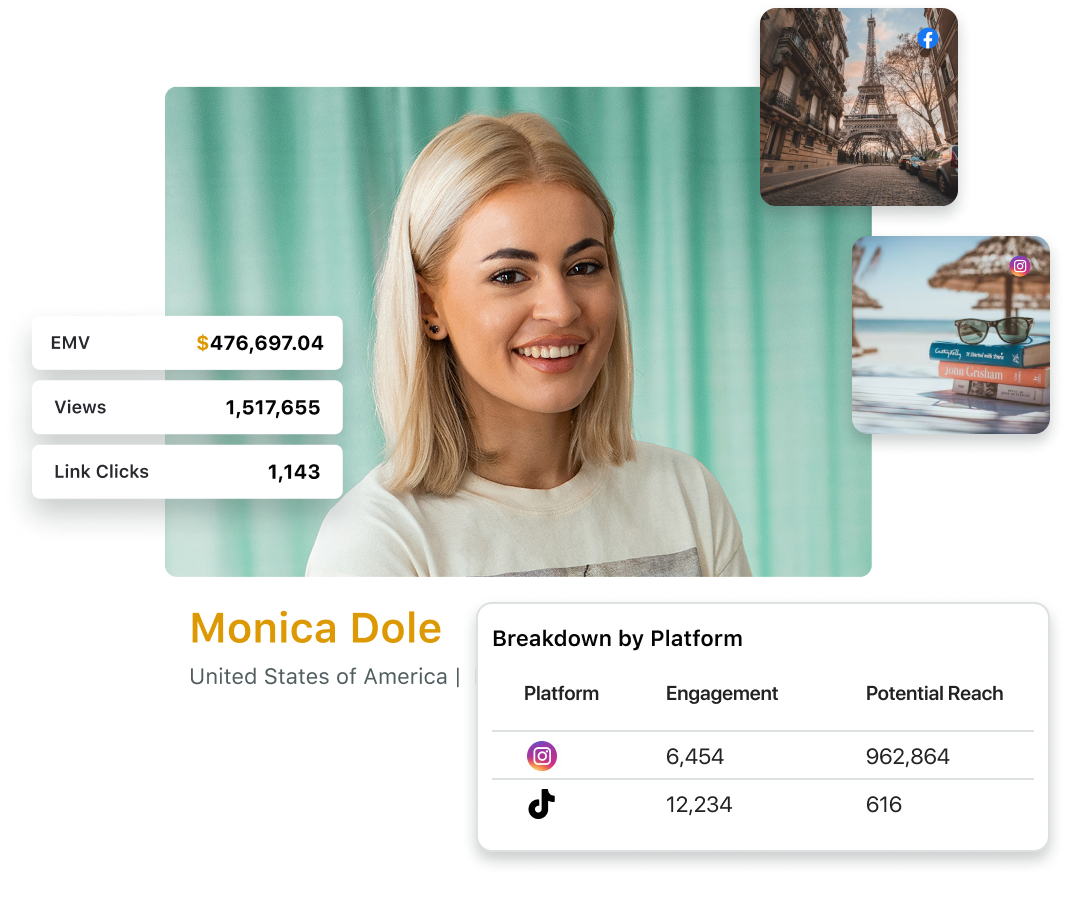
Sprout Social’s Influencer Marketing dashboard shows engagement rate by platform for Monica Dole

Get a free Sprout Influencer Marketing demo

8. Measure ROI across both social and search ecosystems

To understand the true value of your influencers, you need to measure how their interactions translate into long-term visibility and impact. That means tracking the real ROI of influencer marketing.

Look beyond social metrics and connect engagement to SEO outcomes, such as backlinks, keyword rankings and referral traffic.

Analytics dashboards that combine social engagement data—spikes in reach, impressions and clicks—with traffic and conversion metrics from web analytics reveal which content drives impact.

Layering in keyword and backlink data from your SEO tools shows exactly how influencer-driven engagement contributes to higher rankings and measurable ROI.

Tips for creating an SEO-aligned influencer marketing campaign

SEO and influencer marketing form a reinforcing cycle. Engaging content from trusted creators drives new searches and interactions, while SEO ensures that visibility continues over time, keeping both the content and its creators easy to find. The more you connect the two, the stronger both become.

Here are some tips to maximize the benefits of influencer marketing campaigns by aligning them with your SEO strategies:

Select creators strategically

Seek out creators who already rank well in search and reach the audience you want to attract. When they mention or link to your brand, the trust they’ve established transfers because backlinks from high-authority sites carry more weight in search engine rankings.

But don’t just rely on one type of content creator. Mix it up by partnering with bloggers for contextual links, YouTubers for video visibility and short-form creators for in-app discovery. This variety builds backlink diversity and strengthens your authority across multiple channels.

Craft an SEO-specific campaign brief

When influencers understand your SEO goals, their content can actively strengthen your search performance. That’s why it helps to include SEO direction alongside creative guidance in every campaign brief.

Outline focus keywords, anchor text and target URLs so creators know exactly where to link and how. These links, from YouTube descriptions, blogs or social posts, help search engines connect influencer content with your site. If the creator can provide do-follow links, even better—those pass on extra SEO value.

Don’t forget to clarify content rights upfront so you can later repurpose influencer assets across your own channels. Reusing this content on your website reinforces consistent messaging while contributing to your owned SEO strategy.

Repurpose content regularly

Don’t let influencer content fade after posting. Instead, try turning high-performing videos into blog posts, embedding short-form clips into how-to articles or creating carousels out of infographics. Likewise, convert your top-ranking blogs into scripts for creators.

This constant cross-pollination keeps your brand visible wherever audiences search for it.

Create assets just for influencer campaigns

Generic content disappears quickly because it doesn’t add value or feel personal to an influencer’s audience. However, custom, co-branded assets do both by blending your brand’s message with the creator’s voice, making the content more engaging and memorable.

Let’s say you’re a tour operator partnering with a travel influencer. Instead of sending them a generic booking page, you create a “Backpacking Essentials” landing page featuring the influencer’s top packing tips, your travel advice and several tour itineraries.

The landing page feels relevant to the influencer’s audience and naturally ties your expertise to their content. When they share the page across social and link to it on their blog, it drives traffic, shares and backlinks, all while giving you clean conversion data through tracked URLs.

How to measure success across influencer marketing and SEO

To prove impact, you need to connect what happens on social to what happens in search—and, ultimately, to business results. Social engagement alone doesn’t tell the full story. The real value comes from understanding how influencer-driven awareness translates into discoverability, traffic and conversions over time.

These three KPI categories reveal how each stage of your influencer marketing and SEO efforts contributes to measurable ROI:

Platform-level KPIs

Tracking reach, engagement and impressions reveals how far your influencer content travels and how audiences respond. These metrics show how visible your content is and how well it resonates across social channels.

SEO-aligned KPIs

Monitoring backlinks, referral traffic, keyword rankings and SERP visibility highlights how much influencer content boosts organic search performance and long-term discoverability.

Business impact KPIs

Measuring conversion rates, assisted revenue and pipeline influence connects influencer and SEO efforts directly to ROI.

Sprout Social’s Influencer Marketing dashboard shows influencers’ performance, along with their growth rate for Instagram

Bringing these metrics together in one view by combining analytics platforms with influencer marketing reports reveals exactly how social engagement fuels search visibility and drives business growth.

Put influencer marketing and SEO into practice for growth

Effective influencer marketing builds lasting visibility, authority and ROI. Connecting influencer activity with SEO turns every post, mention and backlink into compounding growth. Social signals drive discovery, while search visibility builds credibility, creating a loop that strengthens your brand across channels.

Managing that connection isn’t easy. Tracking creator performance, keywords and backlinks across tools makes measurement difficult. Sprout’s Influencer Marketing platform brings insights together, identifying creators, aligning high-quality content with SEO goals and measuring total impact in one place.

Ready to unify social and search? Request a demo today.

The post Influencer marketing and SEO: Building lasting visibility appeared first on Sprout Social.


from Sprout Social https://ift.tt/QGP35jp
via IFTTT

Monday, 26 January 2026

How to win with the Pinterest algorithm in 2026

Facebook connects people and Instagram celebrates moments, but Pinterest surfaces images and ideas that help users find what they want to buy. It’s a visual discovery engine that uses a social media algorithm that’s more like YouTube’s than X’s.

If you don’t know how the Pinterest algorithm works, you risk wasting your budget on Pins that never surface in search. In fact, adapting to algorithm changes was among the top challenges for marketers that year. This is just one of many social media algorithms that brands must master.

Here’s what you need to know about how ranking on Pinterest works, plus practical steps to optimize your Pins for greater visibility and engagement.

What is the Pinterest algorithm?

Pinterest’s algorithm is the engine that powers its network. In other words, it’s the “special sauce” that determines which Pins land in the places that matter: search results, home feeds and “related Pins” recommendations. A combination of eye-catching visuals, text overlays and user engagement fuels these signals.

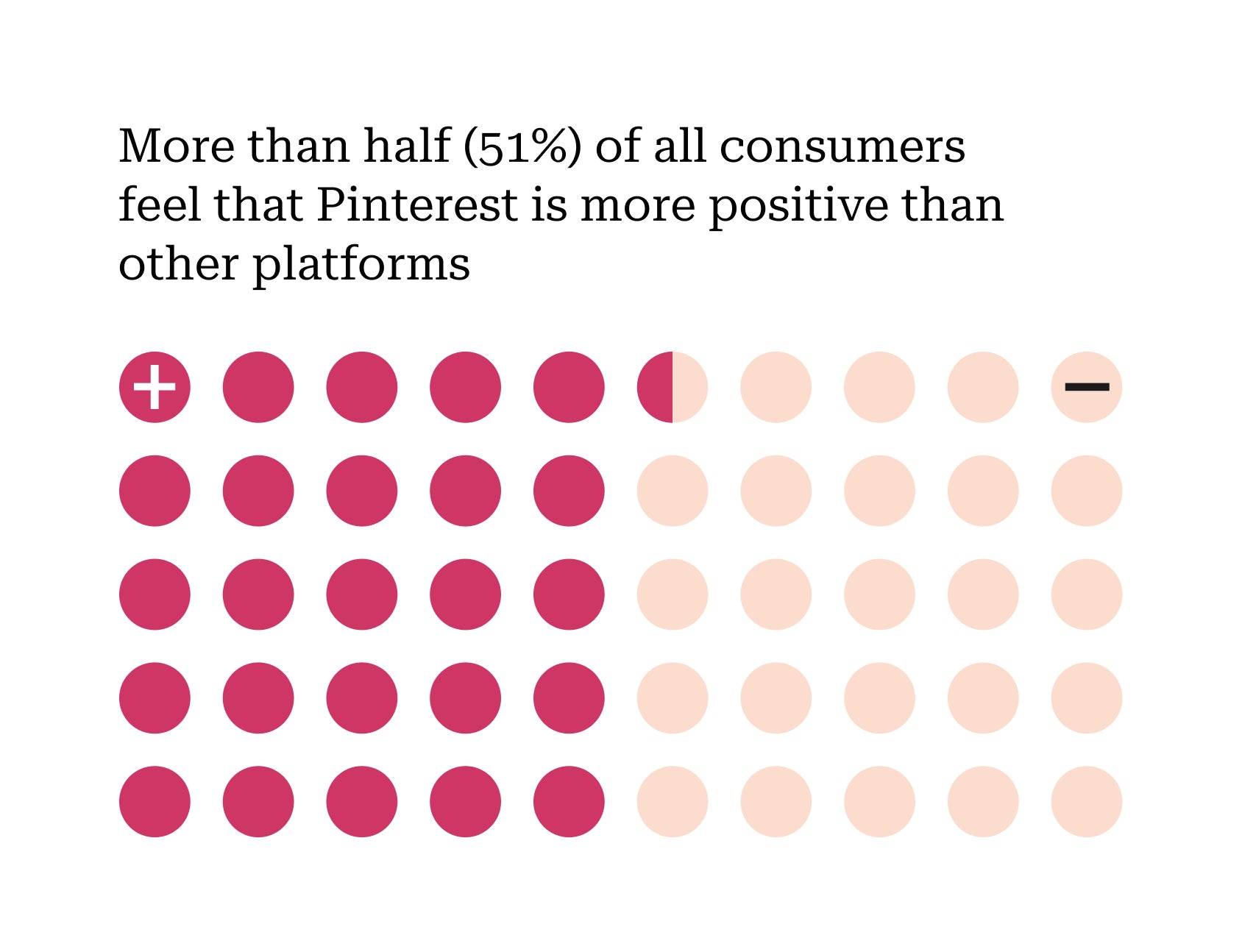
As social media search becomes more competitive and visual-first, Pinterest stands out as a network for brands that understand discovery. That’s because, unlike other social media networks, Pinterest acts as a visual search engine that delivers ideas, products and inspiration when people are ready to buy. In fact, 85% of weekly Pinterest users say they’ve purchased something from a Pin. And according to Sprout Social’s 2024 Social Media Content Strategy Report, more than half of consumers say that Pinterest feels more positive than other social media networks.

Sprout Social’s data shows that 51% of consumers “feel that Pinterest is more positive than other platforms.”

Underneath the Pinterest hood, machine learning takes the wheel. The network’s algorithm tracks what users click, save and engage with. It then learns from those patterns and predicts what they’ll want to see next. As a result, Pins that match genuine interest naturally rise to the top.

How the Pinterest algorithm works: 4 key ranking signals

Pinterest’s algorithm follows a simple logic: reward high-quality, fresh content that resonates. For this, it weighs four main signals—quality, engagement, relevance and freshness—to decide which Pins deserve visibility. Here’s more on how this process works:

1. Pin quality

Pinterest measures each Pin’s quality and engagement, as well as how well a Pin captures attention and drives action over time. It also looks at how many people save your Pins, zoom in on images or click through to your site. As a result, the Pins that keep generating interest, rather than peaking once and disappearing, rise higher in results.

Simply put, high-quality Pins have the following qualities:

  • Visually compelling: The most successful Pins use high-resolution, vertically oriented images or videos.
  • Engaging: High-ranked Pins generate saves, comments, zooms and click-throughs.
  • Popular: The algorithm prioritizes Pins that keep generating interest, regardless of their age.

2. Pinner Quality

The algorithm also considers your account’s overall behavior, or your authority as a creator, to assess reliability. This includes signals like how frequently you post, whether you save your own content and how audiences respond to comments. The network rewards active, consistent contributors.

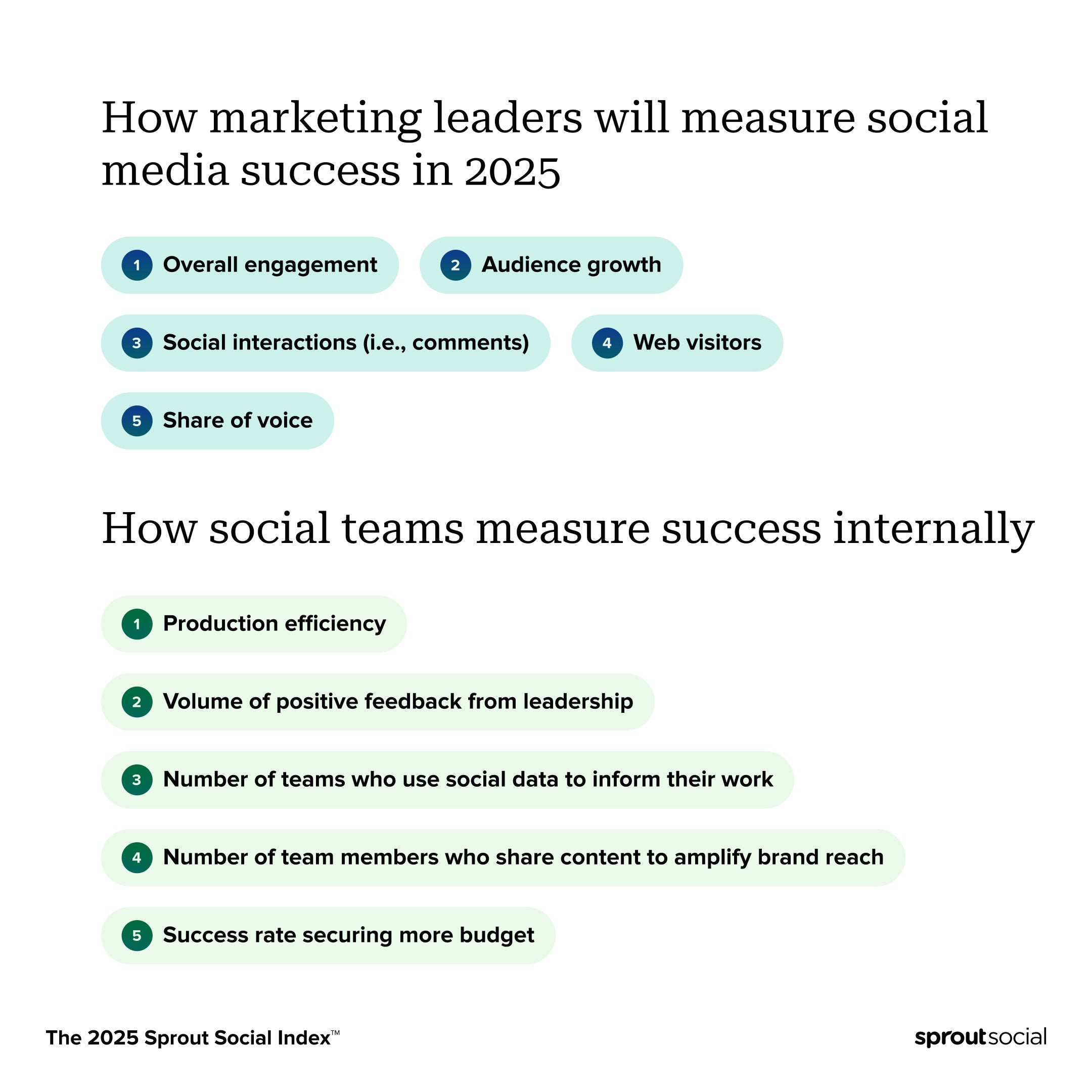
According to the 2025 Sprout Social Index™, engagement is the top KPI that leaders use to measure social success. On Pinterest, stronger engagement lifts your Pinner Quality and signals to the algorithm that you’re a trusted creator. In other words, the algorithm favors creators whose Pins consistently spark meaningful action over those who post irregularly or rely mainly on repins.

Sprout Social’s data shows that overall engagement is the top way that marketing leaders measure social media success.

3. Relevance

Relevance indicates whether your content reaches the right audience at the right moment. This is where keywords are critical. Pinterest’s algorithm scans titles, Pin descriptions, board topics and linked domains to understand intent and match Pins to what users are searching for. It also measures topic relevance, or how closely your content aligns with each user’s established interests.

A Pin about sustainable decor, for example, performs best when it does the following:

  • Includes relevant keywords
  • Lives on a matching board
  • Links to a domain that reinforces the same theme

4. Recency and freshness

Pinterest wants to show users new ideas. That’s why the algorithm gives fresh Pins an early visibility boost, especially when they pick up engagement quickly.

Pinterest values a living ecosystem of ideas, not a static catalog. As a result, a steady flow of new URLs will strengthen your domain quality while also improving the visibility of your evergreen Pins over time.

Best practices to optimize your pins

Pinterest stats show that users save more than 1.5 billion Pins every week, which makes this social network one of the most powerful discovery engines in social. But to stand out, brands need to capture a combination of creativity and consistency.

This is where strategy meets art: Pairing search-driven thinking with scroll-stopping design helps you create Pins that perform. Every visual choice, caption and keyword sends a signal to the algorithm about your content’s quality and intent. Small refinements add up here, especially when they align with Pinterest marketing best practices.

Here are a few tactics you can use to help your content stand out in search and feeds:

Master keyword research for Pinterest

Pinterest behaves like Google since search intent drives discovery and keywords power visibility. This is why the most effective brands on Pinterest approach keyword research with a social-first mindset. The approach is similar to SEO but more heavily considers how people browse and save ideas.

To perform your own keyword research for Pinterest SEO, use the network’s autocomplete, related Pins and trending searches to find the language that your audience already uses. High-intent, long-tail keywords carry more weight than broad terms here, especially when they appear naturally in titles, descriptions and hashtags.

A strong Pin also includes the following information:

  • A clear title that contains the keyword and states a clear benefit (for example, “Summer outfit ideas for work”)
  • A detailed Pin description with context and two or three keyword phrases
  • Relevant hashtags that are specific to the content

Keyword-rich Pins enhance visibility, especially for e-commerce brands. They also surface extra details like pricing or product information, which drive more click-throughs and signal value to the algorithm.

Create engaging Pins: Video, idea and rich Pins

Research indicates that people retain a staggering 95% of a message they see in a video compared to just 10% from text. This is why video Pins and Stories tend to hold attention longer, which helps the algorithm recognize stronger engagement.

To try it out for yourself, test these high-engagement Pin formats:

  • Static Pins: A staple on Pinterest, these Pins are perfect for clean, eye-catching visuals that stop the scroll. They perform best when designs are simple, text overlay is clear and images tell a story at a glance.
  • Video Pins: Short, vertical videos of products and tutorials capture moments and stories beyond the static image. They also encourage longer watch times and repeat views.
  • Idea Pins: This multi-page format (formerly Story Pins) is excellent for step-by-step guides or collections. Additionally, the algorithm heavily favors these Pins for building engagement.
  • Rich Pins: These Pins automatically sync information from your website to your Pins (like price, availability, ingredients or article headlines). This adds a layer of context that the algorithm loves, which makes your Pins more relevant and trustworthy.

Pro tip: Dynamic content also makes your brand feel more human. With it, instead of just showing a product, you can let audiences see it in action.


Optimize your posting cadence

Post timing affects how quickly your Pin gains engagement. Pins that perform well in the first few hours signal quality to the algorithm, which can further extend their visibility. This early traction also leads to wider distribution across the network.

That’s why timing Pins for when your audience is most active helps your content reach more people. To identify those windows when users are most likely to engage with your Pins, lean on insights from your analytics or Sprout’s ViralPostⓇ feature.

Sprout’s engagement chart shows the days and times with the highest and lowest global user engagement on Pinterest.

Post consistently with a Pinterest content calendar

Consistency on Pinterest matters too. That’s because the algorithm notices how often you show up, not just what you post.

A consistent posting cadence builds your Pinner Quality and indicates that your brand contributes reliably to the network. When your Pins follow a clear theme too, you’ll help the algorithm understand your niche and recommend your boards to the right target audience.

A content calendar makes this kind of consistency easier by turning your Pinterest presence into a growing library of ideas rather than just a pile of one-off uploads. Over time, that rhythm will help both your audience and the algorithm know what to expect from your brand and keep users coming back for more.

Measuring and adjusting your Pinterest strategy

Pinterest’s search algorithm is always evolving, so your strategy should too. Staying relevant now means paying attention to what’s working, testing new formats, spotting early shifts and adjusting before performance slips.

This kind of adaptability depends on measurement, but that’s where many teams hit a wall. According to Sprout’s data on social media ROI, 97% of marketers say they can communicate the value of social media to their brand, but only 30% feel confident about proving their return.

Using Pinterest’s built-in business account analytics alongside Sprout’s cross-platform insights helps social teams close that loop. By analyzing performance and iterating on what resonates, marketers can spot shifts early, experiment with new creative and refine their Pinterest strategy as the algorithm evolves. After all, the brands that treat iteration as part of their process, not a reaction, are the ones that stay ahead.

Below are three more ways to further fine-tune your Pinterest strategy:

Track metrics with Pinterest analytics

Pinterest analytics reveal what’s really powering your visibility with metrics like impressions, saves, Pin clicks and click-throughs. These show how your content connects with people and where engagement starts to fall off.

Each metric also tells part of the algorithm’s story:

  • Impressions measure reach.
  • Saves show interest.
  • Clicks signal conversion potential.

Performance isn’t about big numbers alone, though. Understanding which boards, topics or creative styles sustain engagement also helps you refine your focus. When certain formats consistently outperform others, for instance, that’s a sign that the algorithm has found a strong relevance between your content and your audience.

Use A/B testing on Pin types

Optimizing your results on Pinterest starts with testing. To do this, compare formats like static versus video or carousels versus Story Pins to see how your audience interacts with your content. Insights from these tests will highlight what catches and sustains their attention.

Sprout’s tagging feature simplifies this process by labeling posts for direct comparison across campaigns. This makes it easy to identify high-performing patterns and helps you decide where to invest your creative energy. When trends start to take shape, building on them helps your Pins gain momentum and increasingly grows their visibility.

Stay updated on algorithm changes

Even small tweaks to Pinterest’s algorithmic ranking logic can shift what performs almost overnight. It’s the teams that notice those changes early that will be able to maintain strong visibility while others struggle to catch up.

As an early warning system, use social listening tools to surface trends and detect shifts in language, imagery and search behavior across social and the web. Reporting dashboards then translate those signals into measurable data points that guide next steps. Sprout’s combination of listening and reporting in this area also helps social teams pinpoint new opportunities and catch drops in performance.

prout’s word cloud shows social listening data for “matcha,” including “drink,” “to-go,” “morning” and “espresso.”

How Sprout helps you succeed on Pinterest

Behind every strong Pinterest strategy is a system that keeps everything organized, consistent and measurable. That’s what Sprout does—it helps teams plan smarter, post on time and see what drives results with clarity, rhythm and data that elevates your content in Pinterest’s algorithm.

Here’s how you can use Sprout Social to achieve your Pinterest strategy goals:

Plan and schedule Pins with publishing and calendar tools

Sprout’s social media publishing and calendar tools give you one central place to plan across Pinterest, Instagram, TikTok and the rest of your social media ecosystem. Seeing the full picture in this way will help you align your timing, creative direction and campaign pacing.

This cross-channel visibility also reduces guesswork and helps you manage recurring content, reuse high-performing assets and stay agile without losing structure. Fewer moving parts here mean stronger Pinner Quality and a workflow that scales as your brand grows.

Optimize timing with ViralPostⓇ

Visibility depends largely on timing, which is why Sprout’s ViralPostⓇ is so important. This feature studies engagement patterns across your audience and recommends when content is most likely to perform well. That way, instead of relying on trial and error, you can let the data guide your scheduling so every Pin gets a fair shot at discovery.

Sprout Social’s scheduling tool shows ViralPostⓇ optimal send times, with starred time options for publishing.

Then, when your Pins go live during peak windows, they’re more likely to earn early engagement. This, in turn, helps the algorithm recognize high-quality Pins and extend their reach across the home feed and related search results. As a result, you’ll end up with a more consistent, predictable rhythm for publishing.

Measure success with Premium Analytics

Every platform promises insights, but few deliver a complete view of ROI. Sprout’s Premium Analytics dashboards, however, connect activity with outcomes. This makes it easy for social practitioners to see which Pins drive traffic, which boards sustain engagement and which creative themes convert best.

Performance tracking becomes simpler when everything lives in one view, whether that’s comparing results across channels, tracking growth over time or identifying where to adjust. That’s why clear analytics transform data into decisions that directly improve visibility and impact.

Inform your Pins strategy with social listening

Trends on Pinterest often start on other networks, like TikTok and X, or in the broader culture. Sprout Social Listening monitors these conversations across the web, helping you spot emerging keywords, seasonal themes and creative directions before they peak on Pinterest.

Instead of guessing what to Pin, you can use these cross-platform insights to shape ideas that resonate. This ensures that your Pinterest content calendar is always relevant and ahead of the curve, which allows you to create Pins that meet demand, rather than just react to it.

Master the Pinterest algorithm with a data-driven approach

Winning on Pinterest is about consistency, not hacks or luck. The brands that rise are those that treat Pinterest like the visual discovery engine it is and refine their approach through testing, data and creativity. That way, every insight becomes a building block for stronger performance, from keywords that convert to visuals that hold attention.

Sprout’s features turn this process into an optimization engine with clear data and easy visualization. This helps you spot what’s working, adjust quickly and keep the momentum going.

Ready to see how your Pins and repins perform more clearly, fine-tune your strategy, and keep your content visible where it matters most? Request a Sprout demo today to learn more.

The post How to win with the Pinterest algorithm in 2026 appeared first on Sprout Social.


from Sprout Social https://ift.tt/VIUr0JL
via IFTTT