Wednesday, 1 July 2020

How to master social media for retail and win more customers

Retailers arguably have the most to gain from social media marketing.

And despite popular belief, social media isn’t killing retail: it’s simply encouraging the space to evolve.

Recent data from the most recent Sprout Social Index should serve as a wake-up call for retailers skeptical about what social media is worth. Whether it’s a digital or in-person purchase, social followers signal potential business for brands of all shapes and sizes.

actions consumers take when following brands on social - including 89% that buy from the brand

The takeaway from these stats? Social media for retail is centered around the customer journey.

Maybe someone’s learning about your brand for the first time. Perhaps you’re looking to reach former or current customers.

Either way, retailers need to create a social customer journey that encompasses all of the actions above versus only acquisition or attention.

Social media for retail: how to create a compelling customer journey

The beauty of social media for retail is that you can engage with people at just about any point of the customer lifecycle.

But therein lies the challenge of social media marketing for retailers, too.

To make the most of your campaigns, it’s crucial to understand the tactics and strategies that are proven to work among today’s top retailers. In this guide, we break down social media for retail and what brands need to do to map out that ever-so-important customer journey.

1. Adopt an omnichannel social presence

Retailers can’t afford to stick to a single social platform.

While putting all of your efforts into one channel might keep you from spreading your resources thin, doing so also means leaving money on the table.

Literally.

And yes, recent stats point to just how important Instagram is for retailers today in terms of social selling. That said, there’s more to social media for retail than the ‘gram.

Let’s take a quick dive into how retailers can spread their social presence across multiple platforms while taking advantage of each channel’s strengths and best practices.

Lululemon manages to tick all the boxes of what it takes to run a thriving brand account on Instagram. Stunning product photos? A distinct brand voice? Clear calls-to-action to entice customers? It’s all there in black-and-white.

Meanwhile, Lululemon also takes advantage of paid Facebook advertising while also double-dipping their Instagram content. This Facebook ad provides a glimpse of how retailers can roll out a hybrid social media strategy that features paid ads in addition to organic content.

In addition to organic social media, Lululemon runs paid social ads

Lululemon has also managed to master Pinterest for business, promoting pins and inspiration boards featuring their products. Although some retailers might sleep on Pinterest, the product is a well-documented hotspot for consumers to research potential purchases.

Lululemon is a shining example of a retailer with an active Pinterest presence

And of course, the brand is also active on Twitter to cross-promote content, address customer service concerns and give customers shout-outs just because.

To ensure that you’re hitting up every segment of your potentially fragmented audience, it’s important that you have a strategy for promoting content between platforms. Sprout can help with that through social scheduling that not only lets you cross-promote content, but time your promotions based on optimal engagement.
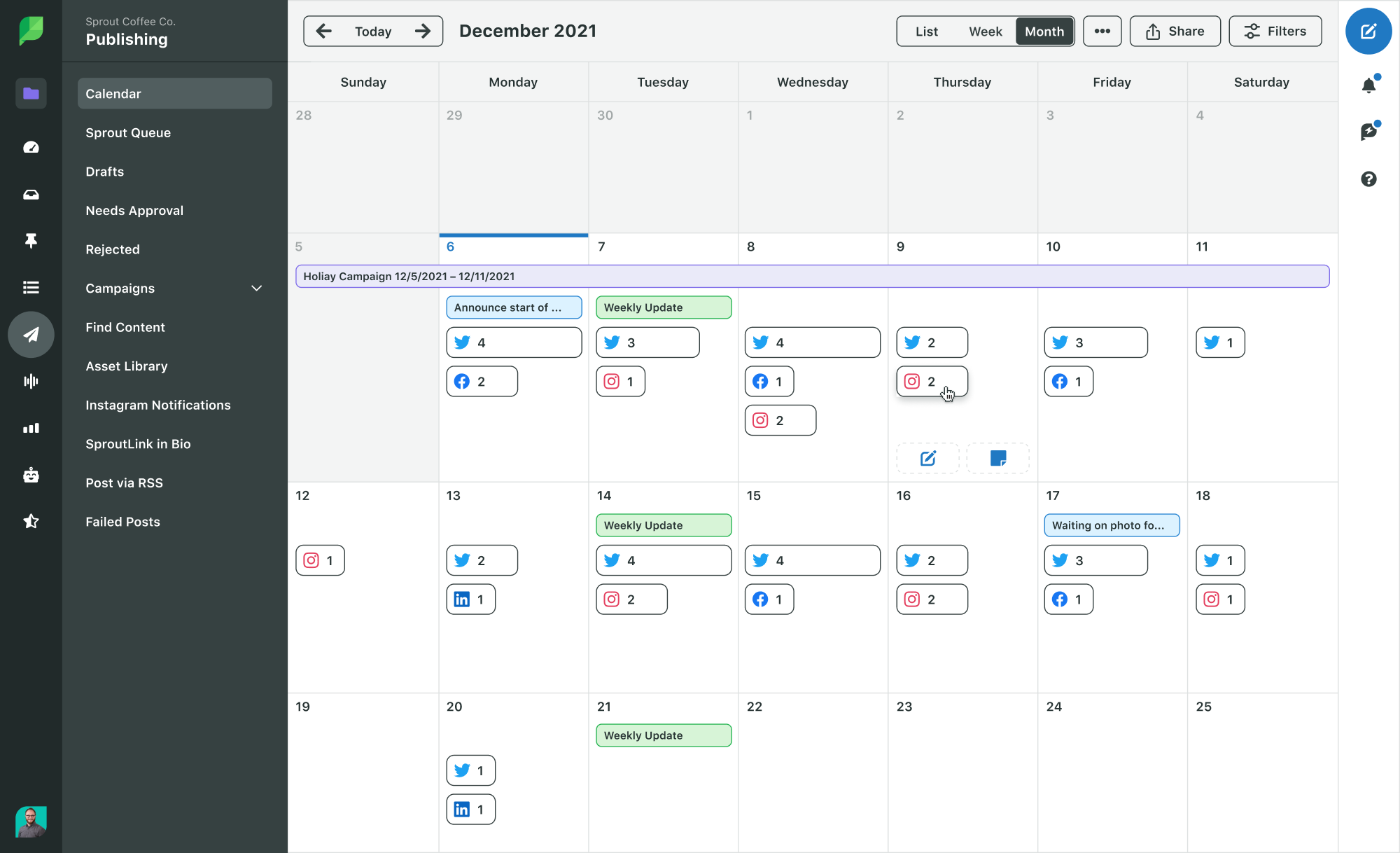
social media for retail means publishing to multiple platforms at the same time - Sprout can help with that

2. Use social media to supplement your existing marketing campaigns

This might seem like a no-brainer, but so much of social media for retail means finding ways to mesh your social presence with existing paid campaigns.

Running a promotion? Launching a product? Time-sensitive offers? No matter what you’re pushing, you can’t afford for your followers to be in the dark or assume they’re going to learn about your promos elsewhere.

Some brands might be wary of pushing products to hard on social media. That said, the majority of consumers‘ purchasing decisions are influenced by the brands they follow.

Additionally, consistently publishing coupon codes, offers and discounts is fair game for encouraging impulse buys. If nothing else, striking product photos are prime Instagram content that doesn’t come off as “salesy” if they’re presented with some creative flair. Check out how ShopBop makes it happen.

Speaking of cross-promotion, consider that any given retailer’s email list is their bread and butter for encouraging repeat business. With an engaged email list and social following, brands have more opportunities to nurture customers and keep them in the loop about their latest promotions. Here’s how ShopBop puts their Instagram feed front-and-center via their email newsletter.
Shopbop has a social media marketing strategy for retail that also meshes with their email campaigns

3. Gather feedback from your social customers

Of course, social media for retail isn’t just as simple as blasting offers and deals.

Although customers are more than happy to follow retailers in pursuit of a sale, your long game should be to sell your brand beyond your products.

This means figuring out your brand identity and making connections with customers. Perhaps one of the easiest and most effective ways to do so is through asking questions.

What sort of products do people want? What sort of content do they want to see? Whether through Instagram Stories or question-based posts, picking people’s brains is easier than ever. Additionally, question-based content encourages replies and interactions which are like candy to modern social algorithms.

The feedback gathered from customers can not only inform your content and product strategies but also serve as a break from purely promotional content. Retailers like Best Buy do an awesome job of asking playful questions while subtly featuring their products at the same time.

See how that works?

4. Dedicate time to providing social customer service

Food for thought: customer service concerns are among the top reasons that consumers engage with retailers on social media.

And so if you’re equipped to handle such concerns, you’re golden. Consider that there is no “one-size-fits-all” for customers to reach out, though. Here’s a snapshot of why customers reach out to retailers via our Sprout Social Index.

index chart - why people reach out to brands on social

Effective social media for retail means listening and responding to customer concerns with care. This means both personalizing your replies while also responding in a timely manner. As noted in our guide to Twitter customer service, 60% of people expect a response within an hour.

Don’t think of responding to such concerns as customers being needy, though. The ability to respond with grace spells good news for your brand as you strive to keep customers around for the long-haul. Check out how Publix manages to address a reasonable concern while still scoring a “Like.”

In fact, companies like Publix have managed to make stellar customer service part of their online identity.

Social customer service isn’t just about addressing questions and complaints. Customer care also means giving customers shout-outs to highlight their positive experiences. As noted by our data, that’s the top reason why customers reach out: capitalize on those moments and let them serve as social proof for your brand.

The more you’re able to highlight your satisfied customers, the better.

The takeaway here is that customer service can’t be an afterthought for retailers. Through consistent monitoring and social listening, you can make sure those precious mentions don’t fall by the wayside.

5. Listen for trends to influence your product and content strategies

Speaking of listening, social media retail trends are constantly changing.

Brands are constantly experimenting with new ways to engage with followers. At the same time, competitors and new products are constantly flooding any given retail space which speaks to the need for brands to have a strong pulse on their industries.

Sprout’s social listening suite includes a query builder where brands can easily monitor mentions, hashtags and industry-related keywords to better track what customers are buzzing about.

Listening is crucial for brands looking to stay on top of social media retail trends

More advanced listening features in Sprout can also help retailers monitor their brand sentiment and mentions to ensure healthy, positive growth in engagement over time.

Sentiment analysis can help retailers better understand how customers feel about their brand

Beyond questions and concerns, your customers can be a goldmine of business intelligence on social media. It’s all a matter of making sure you’re listening, though.

6. Curate user-generated content to promote your satisfied customers

Easily one of the biggest needs when it comes to social media for retail, brands need to be on the hunt for user-generated content (UGC)

Even retail giants like Target (with nearly 4 million Instagram followers) rely on UGC to show off their products.

Customer photos are noted to increase conversions and engagement among social followers. Your customers want to talk about their latest purchases, granted you give them a chance to do so.

For example, Target encourages followers to @mention them within posts which allows followers to be featured in their feeds.

Retail giants like Target encourage followers to share user-generated content

Meanwhile, Anthropologie uses the branded hashtag #myanthropologie to entice customers to post their photos.

Retailers like Anthropologie encourage followers to share user-generated content

Whether it’s for an influencer marketing campaign or simply encouraging UGC, retailers these days are expected to create their own hashtag to encourage organic promotion on behalf of their followers. Doing so provides yet another avenue for customers to engage with your brand and vice-versa.

7. Make social shopping as seamless as possible

As noted by the number of brands totally killing social media for retail, encouraging purchases directly from social media is more than possible.

However, it’s not as simple as dropping product links and walking away.

If you want to increase your social media conversion rate, you’re going to need to make shopping a seamless experience.

For example, let’s look at how easy Crate and Barrel makes shopping their Instagram feed. Their bio link call-to-action is loud and clear, as is their social-specific landing page which makes it a cinch to browse products.


Retailers use their Instagram bios to drive business

Ideally, you want to keep your customers moving from Point A to Point B rather than bouncing between a bunch of links and re-directs. Even if you don’t use a third-party tool for social shopping, making your social landing pages scrollable and mobile-friendly is a must-do.

Social media for retail means creating a seamless shopping experience

Additionally, note that social platforms are constantly rolling out new shopping and advertising features tailored for social media for retail. For example, the roll-out of Instagram checkout signals how networks are trying to make it easier for brands to encourage purchases. Here’s a snapshot of the feature from Crate and Barrel’s feed.

Shoping directly via posts is a growing social media trend for retail brands

8. Remarket to current and former customers

Of course, we can’t talk about social media for retail without discussing paid ads.

With social algorithms seemingly cracking down on purely promotional organic posts, running ads allows retailers to appeal to customers without running the risk of spamming them.

The good news is that retailers can personalize and target their advertising like never before. Brands can run campaigns to prospect for new customers or reach out to returning customers simultaneously.

For example, Facebook and Instagram’s dynamic ads can reach former customers or folks on your email list who you’re looking to reactivate. Such ads serve as a cost-effective way to reintroduce your brand to customers and are likewise noted for their high ROI. This retargeting campaign from Gathre resulted in a staggering 91% return on ad spend.

Paid social media for retail such as Facebook ads are perfect for encouraging repeat customers

9. Don’t forget your physical packaging

If you’re a retailer, you have a distinct opportunity to make a lasting impression on your customers in-person.

This can be done by combining your social presence with your physical packaging if possible. From stickers and business cards to quite literally wrapping up your products with your social handles, there are tons of creative ways to couple social media with in-person promotion. Here’s an awesome example from Vistaprint.

Even something as simple as a branded business card snuck into your shipped orders is a smart move. Retailers can’t be shy about promoting their social presence and in-person creatives are one of the most meaningful ways to do it.

10. Increase your customer lifetime value over time

The end-game of social media for retail is to nurture customers and encourage them to become long-term shoppers.

In other words, you can’t afford to solely focus on acquisition. Growing your follower count is nice, but ask yourself: is your social presence resulting in long-term engagement and purchases?

If someone is willing to follow your brand, they’ve already signaled their interest to make a purchase. This highlights the need to promote offers while also connecting with a diverse content calendar. As noted by the examples above, retailers have a ton of creative options available for regularly engaging their target audiences.

At the same time, think about how you can increase what your social following is worth over time.

Ramp up your efforts during the holidays where consumer spending is at an all-time high. Run influencer marketing and UGC campaigns. Try your hand at social ads.

And along the way, make sure you’re keeping a close eye on engagement via social analytics. By tracking your growth and engagement by the numbers, you can better understand what’s encouraging purchases from your followers over time.


Sprout Social's reporting makes it easier for retailers to understand the ROI of their social campaigns

And with that, we wrap up our guide!

How are you using social media for retail?

There’s no denying that retailers have their hands full in terms of their social presence.

But as we said, retailers have the most to gain from social media at large.

From uncovering new customers to increasing the value of the ones you already have, the amount of creative business opportunities available to retail brands on social media is seemingly endless.

And with the help of tools such as Sprout Social, brands can run and monitor their campaigns by-the-numbers to win more customers along the way.

We want to hear from you, though. What do you see as the future of social media for retail? Any challenges that you’ve faced in pursuit of more business? Let us know in the comments below!

This post How to master social media for retail and win more customers originally appeared on Sprout Social.


from Sprout Social https://ift.tt/2w2WEjZ
via IFTTT

How to run a successful Instagram contest

There are many reasons you might want to run an Instagram contest, whether you’re looking to quickly grow your online presence or simply want to give back to your followers.

But there are some rules and guidelines you need to keep in mind if you want to host an Instagram contest to ensure that it’s both legal and successful.

To help make sure you put on the best Instagram contest possible, we’ve put together this guide on how to run an Instagram contest that your audience will be excited to enter and share. Let’s dive in!

Instagram contest rules

First things first, we need to go over Instagram’s rules and legalese. You may have noticed that most Instagram contests or giveaways come with an extra long caption with lots of fine print.

This is because Instagram has a lot of rules and guidelines in place to ensure they’re released from any liability in case any party doesn’t follow through with their end of the deal.

Here’s a quick summary of the most important points in Instagram’s contest rules:

  1. You are responsible for the lawful operation of your Instagram contest.
  2. Avoid inaccurate tagging in photos.
  3. Include a complete release of Instagram by each entrant, as well as copy clearly outlining that your contest is in no way, shape or form sponsored by Instagram.
  4. Instagram will not assist you with your contest.
  5. You run an Instagram contest at your own risk.

You can read the full policy here, but basically, Instagram is making sure you know they’re not liable, and that you make sure your followers know that Instagram is not liable, regardless of how your contest pans out.

Instagram contest ideas and examples

So you’re ready to start planning for your Instagram contest. But how exactly do you want to have people enter, and what are the benefits for your overall marketing strategy? There are several different types of contests you could run, so we’ve put together a list of our favorites for you to choose from.

1. Like, comment and follow

One of the most popular methods of entry is to have people like your photo announcing your Instagram contest, leave a comment and follow your account in order to gain entry.

Here’s a great example of this type of Instagram contest put on by CAUSEBOX.

instagram contest - causebox contest example

Simply name your prize, lay down the ground rules and watch the entries fly in. You can ask people to comment with why they should win, nominate someone to win or simply tag a friend to spread the word.

However, that last option is a great contest idea all on its own–read on for more ways to make tagging friends in contest work effectively.

2. Tag a friend

Want to really get the word out about your Instagram contest? Ask people to tag a friend when they enter! Users can tag as many friends as they like in order to get even more entries.

Then, those users are likely to enter and tag some of their own friends, creating a ripple effect of awareness around your contest and brand.

You can also host a tag a friend Instagram contest in order to ask your followers to nominate someone who deserves a prize, like in this example below, run by doll10beauty.

instagram contest - doll10beauty contest example

In this example, they asked followers to tag a doctor, nurse, grocery store worker or another essential worker who has been going to work non-stop through the COVID-19 pandemic.

This is a great way to thank people who have been working hard to help others, as well as grow your customer base at the same time.

3. User-generated content

If you’re looking to put together a campaign around gathering user-generated content (UGC) to share online, creating an Instagram contest around that concept can be a great way to do it.

Ask your audience to share a photo onto their feed using a specific hashtag or tagging your business so that you can easily find all of the entries in one place.

Not only does this reward your customers for helping you out, but it gives you an entire arsenal of user-generated photos to share on your feed for future content planning.

4. Collaboration

Another great way to broaden your audience is by collaborating with a similar brand involved in a contest together.

If you go this route, users will then have to follow each brand going in on the contest together in order to enter. Here’s an example of what this might look like from Ring Concierge and Elemis.

instagram contest - ringconcierge contest example

Many influencers also host collaborative giveaways like this, meant to help their followers discover new brands and bloggers, and vice versa.

If you’re working to grow your Instagram presence, a collaborative contest or giveaway might be your best bet.

5. Instagram stories

While Instagram contests are all about giving back to your audience, there are important benefits for your overall Instagram marketing strategy too: brands can garner a lot of attention and generate a bigger audience through them as well.

Having your audience share a post on their Instagram Stories as a form of entry can be another great way to get the word out there.

It’s super easy for users to share posts to their Instagram Stories, so asking for something like this as an entry isn’t asking too much of your audience, and can be a great way to spread the word.

How to run an Instagram contest

Now that we’ve covered a few great Instagram contest ideas, let’s take you through a quick step-by-step guide on how to actually run your contest or giveaway.

1. Define your Instagram contest objective

Before anything else, you need to make sure you define the overall objective of your Instagram contest so that you know how to determine whether or not it was successful in the end.

Are you trying to engage your audience more in your content? Are you aiming to generate a larger following? Is your plan to build a library of UGC to share on social media?

Whatever your main goal or objective is, keep it in mind throughout your entire contest planning process so that everything you do makes sense for your end goal.

2. Choose your entry method

How will users enter your Instagram contest? Think back to the examples we shared above. Which falls most in line with your main goal or objective?

Be sure that whatever you choose, it’s easy for people to enter your contest. No one is going to enter a contest that requires them to do a lot of work–people want your entry process to be simple and easy.

Once you decide the best entry method for your contest, it’s time to start planning out the rest of the details.

First, determine how long your Instagram contest will last. How many days will your audience have to enter? Make sure that deadline is predetermined and that you clearly let your audience know when entering will end.

Second, are you going to use a hashtag for your campaign? Whether you have people post photos with that hashtag or ask them to use it in the comments, creating a campaign-specific hashtag that no one else is using is a good idea. This way, you’ll be able to tell the contest entries from regular posts about your brand.

Third, what is the theme for your contest? This is especially important for UGC-focused contests. You want to make sure your audience knows what types of photos you’re looking for them to share.

And finally, how will you notify the winner? Will you tag them in a comment? Share a new post? Message them? Tag them in an Instagram story? This is something you need to have planned beforehand and let your entrants know early on.

3. Select a prize

Before launching your contest, you need to select a good prize. You want this to be specific to your target audience, and not something that anyone would want to win.

For example, a cash prize or an iPad or iPhone could apply to anyone, whereas a gift card or product from your shop would appeal only to the people who would buy from you anyways. This helps engage your target audience further and can also help your awareness goals–if the winner posts their own photos of the products they received from your contest, you’ll get additional awareness and reach out of your efforts.

4. Design your campaign assets

Put together graphics to promote your Instagram contest so that you can cross-promote it on various platforms, in your email newsletter, on your website and more.

Be sure to create imagery both for your Instagram feed and to share on your Instagram Stories to increase the number of followers who see the contest early on, giving you plenty of time to collect entries.

5. Pinpoint who will manage your Instagram contest

You don’t want to have too many cooks in the kitchen, so pinpointing who will manage what on your Instagram contest is a good idea.

You can also utilize Sprout Social’s team collaboration tools to ensure that everything runs smoothly and no entries are missed.

instagram contest - smart inbox team collaboration

Just assign various comments and posts to the corresponding team members to ensure nothing gets left behind. You can also tag posts as related to a specific contest, so that it’s easy to sort out these mentions and posts from other types like customer service-related messages or posts relating to a different campaign.

6. Launch your Instagram contest

You’re ready to go! Launch your Instagram contest, wait for the entries to roll in and announce your winner!

Make sure to check your metrics to see how your Instagram contest performed against your initial goals. If your contest was a success, consider adding regular contests and giveaways into your social media strategy.

Create your next Instagram contest today

Now that you know how to run a contest on Instagram, it’s time to get started. Pinpoint your goals, decide the best way to gather entries and start giving away fun prizes to your audience.

Find other ways to ramp up your social media strategy with our free social media toolkit.

This post How to run a successful Instagram contest originally appeared on Sprout Social.


from Sprout Social https://ift.tt/2sar4n5
via IFTTT

How this artist tells visual stories through email to make more Shopify sales.

BOMONSTER is an artist who creates art and apparel for hot rod, truck, and motorcycle fans using a unique scratchboard style to create his images with a sharp knife. A blackened board is scratched with a sharp Xacto blade revealing a white layer underneath. 

BOMONSTER visually tells a story through his scratchboard art that creates an emotional connection with his audience. He sells his artwork at live music events and car shows across the country, and through his website with the help of his wife and adult children.

But BOMONSTER had a problem. He knew he needed a way to keep in touch and connect with his customers. At shows, his customers kept asking him if he had an email list to subscribe to for updates on his work. 

He tried to do it on his own by sending them PDFs from his personal email, but most of his messages went into spam folders. Plus, creating emails on his own was tedious and lacked eye-catching design and branding — which are important elements to an artist. 

Not only did he need an email marketing solution that could easily integrate with his Shopify website, he needed an email marketing provider that had the features he needed to run his business. He also wanted something affordable and powerfully-simple. AWeber was the perfect option.

“What’s important to my customers is important to me.” 

At live shows, BOMONSTER found that people continually asked him if he had an email list in order to receive updates. 

He knew he needed to put an email marketing plan in place to help build customer relationships.

“I did a lot of research into email service providers (ESPs) when opening my Shopify site, and most were too expensive or offered analytics too advanced for my start-up needs. I read some favorable reviews of AWeber that made it seem like it was easy to use. So, I decided to give AWeber a try,” says BOMONSTER.

"Whenever I send out an email, I notice a spike in sales from my website."

BOMONSTER sought an ESP that works seamlessly with Shopify, which gives him the freedom to create and alter the look and feel of his site. 

"I love that AWeber works well with Shopify. Everything is seamless, from the pop-up forms that integrate with my lists, to product and blog links in my emails," says BOMONSTER.

AWeber's Shopify integration also enables tag support, which allows you to apply unique tags for each product your subscribers purchase. With tags, you can also pinpoint customers who have shown peak interest in your product but haven't purchased yet. Then, you can send them a message to motivate them to buy finally. 

https://ift.tt/3eRY7k2

How to set up tag support in AWeber's Shopify integration

  1. Connect your Shopify integration with AWeber.
  2. Select "Advanced Settings."
  3. Enter the "Product," "List," and all of the "Tags" that you want to automate.
  4. Click the green "Add automation" button after you enter each tag.
  5. To automate a specific campaign, go to the "Messages" tab in the AWeber dashboard and click "Campaigns." 
  6. Select the campaign you want to automate and click the blue "Replace Trigger" button.
  7. Then select the "Tag Applied" blue button.
  8. In the side column, under "Tag Applied " enter the tag you want to trigger each campaign.
  9. Activate your campaign.

Related: Watch this demo to learn more about AWeber’s Shopify integration

"Email is the ultimate storytelling vehicle."

Email is all about creating an emotional connection and telling a relatable, visual story. Each email that BOMOSTER sends tells a story and creates a deeper and more meaningful connection with his audience. Listed below are a few of his favorite email moments.

A different approach to holiday promotions

BOMONSTER's #1 objective for his emails is sales, but if they look too "sales-ey," it can affect the open rate. He tries to avoid the pattern of continuous discounts, "how-to" or "what's new" emails – understanding those could be effective strategies in small doses – but he wants the customer always to be surprised with something new. 

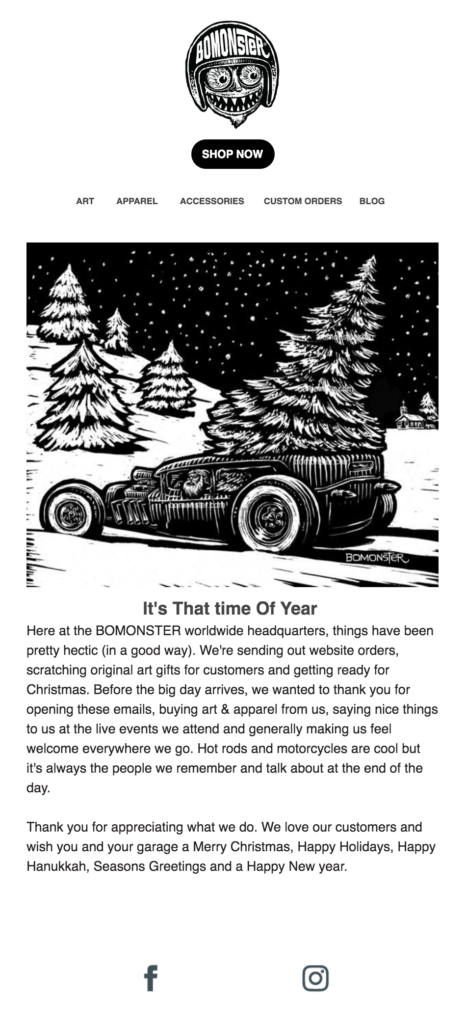
Rather than the traditional holiday promotional email, for Christmas, he sent out a "Merry Christmas – thank you for your support" message with a cool Santa hot rod graphic. He found it generated sales because it was an alternative to the holiday "sell/sell/sell' emails.

Holiday email from BOMONSTER with a Santa hot rod graphic.

BOMONSTER's "fiercest competitors"

During COVID-19, BOMONSTER sent out an email linked to some artist friends' websites calling them his "fiercest competitors.” 

The other three artists he promoted in that email are friends of BOMONSTER. "We're all self-employed and going through a tough time. It might have been a little reverse psychology to promote myself while promoting them. But it came from a genuine place of being a fan of all their work and wanting my customers to support all good work in the category, not caring who gets the sale," says BOMONSTER.

Email highlighting other artists.

Father's Day — celebrating Dad, the ultimate photobomber

For Father's Day, BOMONSTER sent a funny story about his dad always accidentally photo-bombing his pictures. 

BOMONSTER email showing his Dad photobombing card show pictures.

Virtual car show

BOMONSTER watches corporate brands and how they react to customer trends. Music and entertainment went 100% to streaming services. Zoom meetings became popular and live events started branding themselves as "virtual" experiences. 

BOMONSTER thought a virtual car show through email could be a fun way to use his car show photos taken earlier to connect with his audience when those car shows were canceled.

BOMONSTER email on virtual car show.

"Business in 2021 will go to the brands that create online relationships with their customers."

As companies adapt to an online sales model, the ones that connect personally to their customers will win. One of the benefits of small business is the ability to talk personally to customers with credibility. 

BOMONSTER knows many of his customers from live events or social media. He decided to write his emails in first-person to create a more personal “letter” feel. 

"My emails show that I am a person, not a corporation. I don't mind being personal because I imagine actual customers when writing," says BOMONSTER.

“Artists don't sell, people buy.”

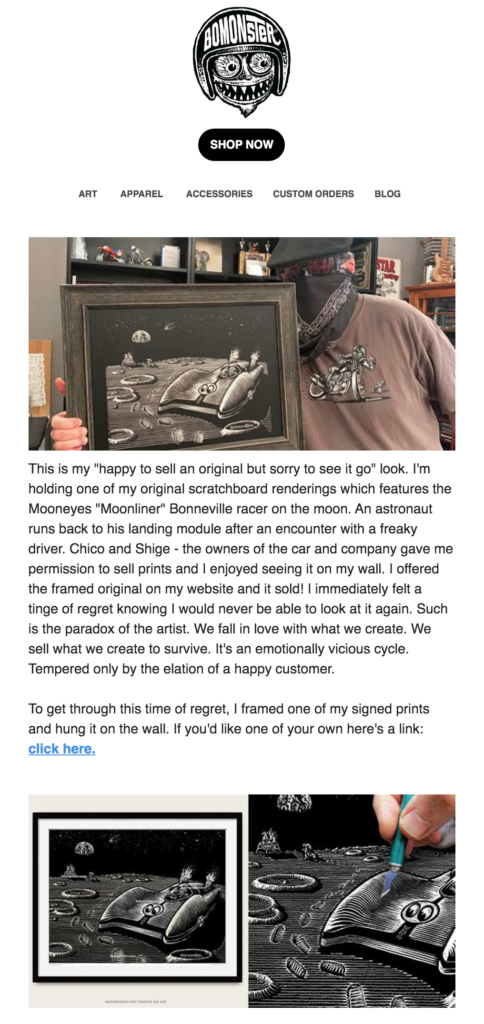
Art is an emotional decision and rarely a rational purchase. It either grabs you, or it doesn't. “Not everyone likes my art but the ones who do, love it. There’s nothing I could say to the ones who don’t think otherwise. All we can control is presenting it as well as we can and hope someone relates to it enough to want it,” says BOMONSTER.

Email allows BOMONSTER to present his art virtually, which is seen by more potential customers.

BOMONSTER email on his original art comissions.

BOMONSTER's best advice? "Pay attention to what large, successful companies do, and apply them to your small business."

BOMONSTER opens emails he receives and takes note of what they look like and how they communicate. Some inspire, others get closed immediately. He identifies what he likes and that he can emulate.  

BOMONSTER's five rules for email marketing:

  1. Friendly wins over insincere
  2. Fun wins over boring
  3. Good art direction wins over standard forms
  4. Clarity wins over complexity
  5. Design for mobile, and it will also work on desktop

Connect with your audience and start growing your email list today!

In your AWeber account, you'll get everything you need to grow your own business online — including sign up forms, newsletters, landing pages, and access to hundreds of integrations to the most commonly used business products and solutions.

Start your 30-day free trial today.

The post How this artist tells visual stories through email to make more Shopify sales. appeared first on Email Marketing Tips.


from Email Marketing Tips https://ift.tt/2CQZcKT
via IFTTT

Some UK bus riders will get Facebook DMs to warn if transport is too busy as lockdown lifts


This article was originally published by Sarah Wray on Cities Today, the leading news platform on urban mobility and innovation, reaching an international audience of city leaders. For the latest updates follow Cities Today on Twitter, Facebook, LinkedIn, Instagram, and YouTube, or sign up for Cities Today News. Oxfordshire County Council is using technology from UK start-up Zipabout to help manage demand on its bus network as COVID-19 lockdown restrictions continue to be eased in the UK. Zipabout’s Passenger Connect service will deliver personalized journey updates for bus passengers on how disruption and crowding may affect their travel, as well as providing…

This story continues at The Next Web

Or just read more coverage about: Facebook

from Social Media – The Next Web https://ift.tt/38jcSdb
via IFTTT

Tuesday, 30 June 2020

Social media managers, you matter now more than ever

The start of the new decade brought on a whole new set of challenges for social media managers. Between COVID-19 and the growing movements for racial equality worldwide, social media managers have had a lot on their plates and left many to wonder, “Does what we do matter? Does social media marketing matter?”

The answer is yes, for a myriad of reasons.

Social media managers’ skills and responsibilities are essential

Raise your hand if you’ve had a family member, friend or colleague underestimate your responsibilities and assume your job in social is fun and easy 24/7.

It’s true that social can be really enjoyable, but social media management is much more than that. Social media managers are creators, analysts, community moderators, digital strategists, writers, the list goes on. The many talents and skills they have are critical in supporting overall marketing goals. But you already know that.

What you might not know is that 70% of consumers say it’s important for brands to take a stand on social, and 66% of that group say it’s because they believe brands can create real change. Behind those brands taking a stand are the social media managers crafting the messaging, fielding the feedback both good and bad, and answering hard questions. They play a key role in helping brands use their platforms to stand up for their values and share important messages with whoever needs to hear them.

That’s not to say that if your brand isn’t taking a stand, your job isn’t important. If you spend your days connecting with your audience, answering hard questions (whether they’re about a stance, customer service or a community issue), developing new creative approaches, you’re helping move something forward. The knowledge and experience you’ve gained from social can be used as the fuel to build a brand people love and look to during trying times.

Social media managers are “digital bodyguards” for your brand

Unlike many other marketing disciplines, social media managers listen and talk to their audience every day, which is why marketing leaders should look to you for the voice of the customer. You know firsthand what concerns are on your audience’s minds, the expectations they have of your brand and how the current state of the world is affecting them. Be transparent with leadership about what’s happening. Let them know what people are angry about and what you want to do to help.

Unfortunately, not every social media manager has the final say about what their brand does or does not post. Many brands have joined conversations about Black Lives Matter, voicing their support or announcing contributions to the cause, some garnering praise, while others get called out for performative allyship. On the flip side, some brands have simply chosen silence. In both scenarios, social media managers become the “digital bodyguards” of brands.

As hard as it might be, you need to share how the public responds with your leaders. If your audience demands change and action, communicate that. You have a chance to be an advocate for your followers, shake things up and highlight the ways your company can make change from within. Use social to gather industry intel and other brand examples to build your case, then report back to the people who are making final decisions or developing messaging for your brand.

Social media managers can make an impact both inside and outside their organizations

If 2020 has confirmed one thing, it’s that social media is a major piece of the average person’s news diet and fuels the circulation and amplification of major stories as they develop. Many people will look to your brands for community news and updates. This is a chance to build trust with your audience, educate them and let the human side of your brand shine through.

It’s not just government social media managers who can do this. Spending all your time on social media means you’re most likely a news-absorbing machine. You constantly dig through trending topics and public discussion so you can do your job well. Consider how you can bring that knowledge into your strategy and turn it into education for your followers.

Ben & Jerry’s is one of the standout brands actively advocating for racial and cultural equality. While you’ll still see an occasional plug for a new ice cream flavor, they’ve continued to use their platform to educate their followers on historic injustices or cultural movements, while still serving it in a way that’s relevant to their brand and industry.

Not every social team has the same resources or freedom to follow in Ben & Jerry’s footsteps, but if you’re inspired, it’s worth a conversation with leadership about how you might incorporate more meaningful resources into your brand’s content.

Social media managers, you are not your brand

It’s easy to slip into an existential crisis while the world goes through crises that feel out of control. As we continue to ride the turbulent waves of 2020, remember this: you are not your brand. Your worth is not measured by the decisions your brand makes. If leadership directs you to post something that doesn’t go over well or chooses to take a path you’ve warned will get social media backlash, that’s not on you.

When you finally close your laptop or put down your phone and disconnect from work at the end of the day, it’s your personal happiness, values and fulfillment that matter most.

Social media managers: We see you, we hear you, we appreciate you.

If you need moral or professional support as you face the frontlines of social this year, join The Social Marketers’ Exchange Facebook Group—we’ll see you there.

This post Social media managers, you matter now more than ever originally appeared on Sprout Social.


from Sprout Social https://ift.tt/31AcOVd
via IFTTT

How to bring the in-store experience online with social: An interview with Philz Coffee

Coffee is the start of the day for so many. Meaning coffee brands have a pretty big target audience. Being able to recreate the positive experience those people have at their regular coffee shop on social is a unique accomplishment. And that just so happens to be the mission of Philz Coffee, according to Jolie Meschi, Philz’s Marketing Communications Manager.

“One of the things I love most about my job is that I get to carry the interactions that our customers have in-store, online.”

Jolie has been with the company for six years and throughout that time has been responsible for running the coffee chain’s social platforms, influencer strategy and PR. She’s even dabbled in the brand’s events management. Across its three main social channels, Philz has a combined following of just over a hundred thousand. Those hundred thousand online coffee-lovers are reflective of close to 60 stores in over 50 communities.

“If you can’t connect with people face-to-face, the next best thing is to be on devices where they are,” Jolie said. “It allows us to bridge that gap and reach those customers anywhere.”

As Philz has grown and expanded into new markets, the importance of social media marketing has become a vital part of its business. Even more so during the pandemic. With that comes the task of demonstrating social’s value as an arm of marketing to the rest of the company. It’s a task that Jolie welcomes.

“Social media has become the go-to spot for customers to give us feedback, whether they realize it or not,” she said. “Showing people how you can create authentic relationships through engaging posts or sharing content that tells the story of the brand, then showing the impact it’s having on our customers is really important.”

Here’s a look at three key ways Jolie is social’s biggest champion within her organization.


1. Build trust across the business

Building trust is an important part of any relationship. For social media managers, it means creating contact points with different departments across your organization. According to Sprout data, 47% of all social marketers, from interns to the C-suite, say developing a strategy that supports their organization’s goals is their number one challenge. That may be due in part to a lack of trust and close working relationships within organizations.

Luckily, for Jolie that’s not the case. While companies across the world are adjusting to remote collaboration, trust-building was already a pretty natural thing for the team at Philz.

“It’s in our culture,” Jolie said. “It’s trying to create contact points throughout the week, throughout the day, with different departments, whether it’s our recruiting team to check in on what they need from us just so that they understand it’s a revolving door. I’m always here to help them with their needs.”

Because cross-collaborative relationships are such a normalized part of the culture, it’s easy for Jolie to schedule consistent, weekly meetings to share feedback and dive into what’s working (and what’s not) on every front of the business.

“I definitely feel like I get more buy-in when I have face time and one-on-one conversations and relationships with people in other departments,” Jolie said.

The strong working relationships mean team members feel comfortable being a partner to her.

“You’d be surprised how many people I get emails from saying, ‘Hey, do you want to post this on social?’ Or, ‘Hey, I’m speaking at this event in case anybody’s interested in learning about that on social!’” she said. “It makes my job a lot easier when people are engaged.”

Jolie discovered another benefit by embracing a less orthodox approach to fostering trust between team members, prior to pandemic.

“Every quarter we actually get to work on bar with our baristas,” she explains. “It really builds trust across all levels of the company, and also kind of levels the playing field.”

They also made it a habit to stay up to date on the in-store experience in order to adjust. Taking their laptops into the cafe, working from any shop they live near—that kind of connection behind the scenes is reflected in front of their customers. With a grassroots, personalized approach to marketing, Philz has become the fun environment that coffee-lovers know the brand to be. Now it’s up to Jolie to ensure that same environment remains on social, despite the limitations of a post-COVID world.


Try this: Scheduling consistent touch bases is one way to communicate. But fostering an open workflow creates the environment a company needs to go beyond consistency and build trust. If you have brick and mortar stores, spend time with the people behind your in-store experience. Even if operations are different now, there’s still valuable insight to gain in order to build the kind of community and understanding that informs strategy.

2. Share what success looks like

A natural extension of the cross-collaborative environment Jolie has built is communicating insights more broadly. Her social team of two often shares out reporting on social, email and all digital efforts. And at Philz, success is all about progress.

“It can be difficult in the retail coffee space to find a benchmark of good social metrics,” Jolie says. “Obviously, we love to see high engagement, we love to see customers commenting, saving, sharing posts. But to really prove that we’re moving the needle on our end, we usually benchmark against ourselves.”

With that focus in mind, she makes it a point to tie back every win to hard sales in the store so she can help others involved in the work visualize if and how they’ve moved the needle. This way, when her team shares results, they’re able to celebrate wins as a company.

“At the end of the campaign, we’ll do a wrap-up,” she explained. “We’ll include customer highlights, then hard data and how it all compares to a similar campaign or the last campaign we did.”

Data shows that 39% of marketers struggle to demonstrate the importance of social media marketing to the rest of their organization. The numbers show that even in a time when social is the most accessible and most engaged with channel where consumers reach brands, its value is downplayed because of the historical disconnect between social and bottom-line business metrics. Jolie conquers that challenge at Philz by sharing insights regularly and widely.

She admits it can be overwhelming to maintain a regular cadence for breaking down campaign data and sharing it out. But the environment of open communication at Philz makes it easier. Sharing social results went along with other project update schedules their team had in place in different departments.


“There’s usually a kickoff meeting, check-in meetings, then a wrap-up meeting,” she said. “So we naturally followed the cadence that way. But also tactically, it’s an easier way to digest data.”

Try this: When you wrap each campaign, take all your social metrics and compare that to historical sales. Draw correlations where you’re able in order to tie results back to hard sales in the store, for example. Then set a quarterly, cross-functional meeting to share those insights, not only informing but educating other members of your team.

3. Tap social for innovation

There’s no feedback forum more honest than social media. It’s where consumers refuse to hold back.

“They assume that somebody isn’t on the other side looking at it,” Jolie says. “So it’s really satisfying to respond to somebody like that, in a positive, courteous way. They’ll immediately change their tone and attitude because they realize there is a human there that actually cares.”

That’s all people ever really want, right? To be heard. Which makes it extra satisfying to Jolie when they’re able to gather social feedback and turn it around into action items for Philz.

“One of the biggest things that has come from a collection of social media feedback is that we have a slow-down coffee process, and the wait time can be a bit longer than a normal coffee shop,” Jolie explains. “We heard all about it on social—people running late, missing buses, missing trains. When we were trying to figure out ways to innovate and make ourselves faster and more accessible to all people, that really helped birth our mobile app.”

Listening to your community on social helps you drive innovation and enables companies to think outside of their own perspective. It not only gives you the opportunity to repair rifts in your relationships with customers, but drives social media’s impact on business. Jolie’s mobile app example illustrates how powerful social is in product development and improvement.

During the pandemic, while many companies grapple with how to leverage social to stay connected, Philz found the perfect way to meet coffee-lovers where they are. The team launched an IGTV series called “Philz At Home,” where team members show how they uniquely prepare coffee at home, continuing to inspire customers and meet them where they are.

Philz Instagram Story


Try this: Aligning your brand with consumer needs in a two-step process. Start by meeting with team members to understand their goals and department needs. Then pass social feedback on to those team members and say, “Hey, you’re trying to solve for X and I’ve heard a few people on social talking about this. Would you like me to share those insights with you?” Invite social into those projects and make its value intrinsic to product and marketing development.

How will you champion the influence of social?

It’s clear that the secret ingredient to championing social at Philz is trust. From team members to customers, Jolie understands that building relationships is a slow, but rewarding process (kind of like great coffee).

Her story comes down to the importance of companies embracing social media and a social-first environment. She wears many hats, taking her time to comb through data, listen to her customers and communicate with her peers, but every step of the way she and her team have found balance in work, trust and life.

The results aren’t just happy coffee lovers. The result is getting to see social, and the powerful insights it provides, take center stage.

To connect with other social marketers who are always on, join our Facebook groups, The Social Marketers’ Exchange or The Agency Exchange. And share with us if you’re planning to try any of these tips.

This post How to bring the in-store experience online with social: An interview with Philz Coffee originally appeared on Sprout Social.


from Sprout Social https://ift.tt/3eOXbNl
via IFTTT