Showing posts with label Sprout Social. Show all posts

Thursday, 29 October 2026

How to use social media audience segmentation to drive smarter business decisions

For brands, social media is a goldmine of real-time insight into consumers’ preferences, behaviors and motivations. And segmenting social users intentionally—using live conversation data rather than static demographic details—empowers leaders to make smarter business decisions, whether it’s optimizing spend, discovering new markets or driving revenue.

But social media audience segmentation isn’t a one‑off marketing exercise. It’s a dynamic, cyclical process designed to spot emerging opportunities and inform data-grounded strategies.

With the help of this guide, you can better understand how to approach social media audience segmentation and use it to make an impact across the business.

What is social media audience segmentation?

Social media audience segmentation is the process of breaking down your target audience that’s engaging on social networks into smaller, distinct groups based on shared characteristics, behaviors or interests.

In contrast to broader marketing segmentation, social segmentation draws on real-time social data. Think live conversation, engagement and sentiment data, rather than CRM or survey inputs that may reflect the past and not a user’s present feelings.

Segmentation is one of the many pillars of social media intelligence, helping organizations move beyond broad audience assumptions by uncovering the distinct groups driving conversations online. Teams can then make more targeted decisions aligned to the current pulse of the market across customer care, product innovation, campaign planning and overall business strategy.

Why audience segmentation matters more than ever

One of the key factors driving the need for segmentation is the degradation of trust and attention among consumers.

According to the Q1 2026 Sprout Pulse Survey, consumers are becoming more particular about what they engage with online, with two-thirds (66%) feeling more selective than a year ago. AI slop (i.e. undifferentiated, one-size-fits-all content) was cited as a contributor to eroding trust; 56% of respondents said they see AI slop often or very often.

Many brands are mistakenly investing in this generic content. This ultimately results in wasted budget as platforms are increasingly rewarding relevance over reach.

Segmentation is what enables brands to achieve personalization and, in turn, resonance with their audiences—without necessarily needing to increase headcount or budget.

4 types of social media audience segments (and where social data fits)

Let’s take a look at four key types of social media audience segments, what they tell you and the social signals that paint the picture of who they are.

Demographic segmentation

Basic demographics like age, gender or follower count are a reasonable starting point in creating social media segments. This data is garnered via self-disclosure (i.e. a user inputs this information when creating a profile), network-level audience demographics reported by ad managers or analytics tools.

While these details don’t tell you much on their own, they can reveal behavioral trends. For instance, you may see a generational skew depending on the networks and content formats a person engages with. In general, Instagram Reels and TikToks attract a younger audience, while Facebook’s most active users skew older.

However, it’s important to note that demographics don’t provide the soundest basis for segmentation because the data is often self-reported. Users may skip fields or deliberately enter false details to protect their privacy or access age-restricted content.

Demographic-based targeting is also losing its predictive power. Per the 2026 Influencer Marketing Report, only 17% of consumers check follower count before following a creator. For nearly half of respondents (47%), things like content topic and behavior matter far more.
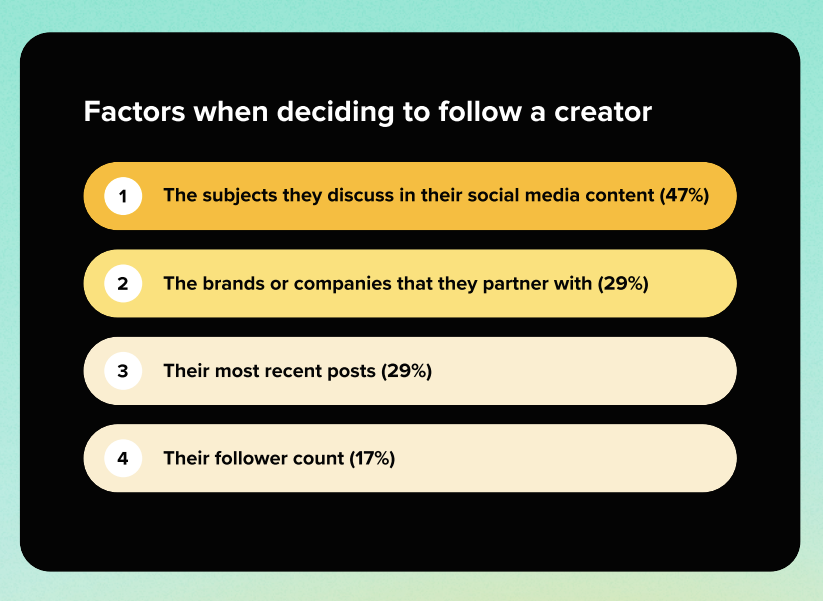
An infographic breaking down the top four factors social users consider when deciding to follow a creator.

With that in mind, demographics should be used as a starting point rather than a primary segmentation driver. Instead of examining people’s surface-level traits, look at the things they say and do unprompted on social. These signals are more dynamic and indicative of how people identify themselves.

Psychographic segmentation

Psychographics is the classification of people based on psychological criteria—such as values, attitudes or motivations—that influence their engagement and consumption patterns.

To segment your social audience by psychographics, review their comments, posts and shares. The content they post or engage with can tell you a lot about their internal beliefs. Your brand can then use these insights to tailor its content and target these users more closely.

For example, if your audience members regularly post about climate change and sustainability, you can place them into an environmentally motivated segment. From there, you can center your messaging around subjects related to your brand, like ethically sourced materials, reusable products or community initiatives.

Behavioral segmentation on social

While psychographics focus on what users believe, behavioral segmentation shines a light on how they behave on social. The actions they take, the conversations they partake in and the content formats they engage with.

To build behavioral segments, brands must observe audiences’ patterns. How often do they post? What formats do they share (e.g. static images, carousels, Reels)? What are they talking about in comment sections? Whose posts are they commenting on?

Finding the answers to these questions can unearth important information about consumers’ decision-making and motivations. In addition to seeing how people behave, you’ll begin to understand why. You won’t just see who they interact with, but who they really are behind the screen.

Say you identify a segment of users consistently participating in giveaways, promo codes and engaging with shopping-on-a-budget content. With this data, you can glean what might be most important to them when making purchase decisions: fair pricing and discount offers. From there, you can tailor your social messaging accordingly, whether it’s highlighting affordable prices or sharing the outsized value of your offerings.

Geographic segmentation

A person’s physical location shapes their social and spending habits—and the two often go hand in hand.

Various social signals enable brands to glean a user’s whereabouts, including location tags, geotagged posts and stories, and the language or dialect they use on social. Additionally, some network behaviors and preferences are region-specific.

Pew Research Center’s Social Media Platform Use Around the World report analyzed users in 37 countries for five networks: Facebook, Instagram, TikTok, X and Snapchat. It found that Facebook is the most favored globally, especially in high- and middle-income countries, such as the United States, Canada and Australia. But in high-income regions in Europe and the Asia-Pacific region—like Germany, Spain and Japan—Instagram is more popular. In contrast, TikTok is among the top platforms in certain middle-income Asian and African nations, including Malaysia, Pakistan and Ghana.

Brands should also examine social users’ conversations for localized topics or trending hashtags tied to a region (e.g. event-driven spikes, regional slang or local news reactions).

This type of segmentation is most useful when paired with a behavioral overlay. Rather than examining audiences in Australia, review audiences in Australia discussing parenting challenges, such as screen time or school readiness.

You could even go one step further and add a demographic layer (e.g. audiences in Australia between the ages of 35 and 44 discussing parenting challenges).

Social media audience segment Summary Social signals
Demographic Defined traits such as age, gender, income or education level. ●      Self-disclosed profile data

●      Network-level audience demographics reported by ad managers or analytics tools

Psychographic Values or attitudes that affect users’ buying behaviors. ●      Sentiments and values expressed in comments and posts
Behavioral Habits or actions users perform on social. ●      Engagement patterns

●      Conversation topics

Geographic Where a user lives. ●      Location tags

●      Geotagged posts and stories

●      Languages and dialects

●      Region-specific network preferences

Essential tools for social media audience segmentation

Classifying audiences by intent signals (e.g. people discussing pain points, shared interests, a competitor or a use case) can help companies transcend static segments and derive more actionable data.

But to get there, you need the right tools in your kit.

Social listening platforms

Social listening tools empower brands to treat segmentation not just as a refinement tool, but a discovery mechanism. Because social media is rife with unprompted, authentic data, it can surface segments or insights that businesses didn’t even know to look for.

Take e.l.f. cosmetics as an example. Through social listening, the brand picked up on an up-and-coming trend in which people were repurposing empty foundation bottles into oversized, custom lip glosses. The makeup brand capitalized on the community-led trend, launching a dedicated campaign that garnered 85 million organic views, two million engagements and 1,000+ user-generated videos. It even prompted the launch of its very own product: a limited-edition DIY Halo Gloss Kit.
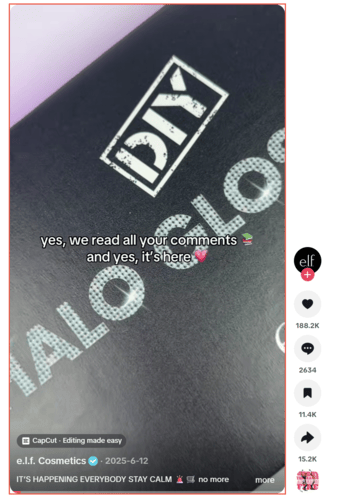
A TikTok video from e.l.f. cosmetics announcing the launch of its DIY Halo Gloss Kit.

Oat milk brand Oatly also turned social listening data into action with its Matcha Latte launch. Across Reddit, X, Instagram and TikTok, the business noticed a surging demand for matcha latte drinks. These findings were then presented to their Innovation and R&D teams, ultimately becoming the basis for a new beverage.

TikTok video of an influencer comparing homemade matcha latte to Oatly's matcha latte.

With Sprout’s Social Listening, picking up on these invaluable trends is made simple. Backed by AI technology, it sifts through billions of data points to hone in on the trends, learnings and conversation themes that you can leverage to drive real business impact.

CRM integrations

CRM integrations allow teams to connect audience intelligence from social channels with first-party customer details. Using these datasets in conjunction, you can determine whether emerging segments are actually driving leads, revenue or long-term customer value.

For example, Sprout Social’s integrations with Salesforce and HubSpot provide teams with a holistic view of their audience members. By connecting these tools, you get a look at users’ social activity as well as their lead status, customer lifetime value and purchase history. Brands can then use these insights to validate which audience segments represent meaningful growth opportunities and which may be part of a passing trend.

AI analysis

Leveraging AI can streamline the lift in segmentation via pattern detection across datasets and large volumes of conversation. Instead of manually tagging and coding data, your team will be free to focus more on strategy development.

Think of an AI tool as your always-on, directly embedded teammate. As an example, Sprout’s AI agent Trellis continuously monitors emerging engagement trends, sentiment shifts and audience signals. Then, it sums these findings up in a way that’s easy to understand and actionable. If you have a question about something specific, you can simply ask Trellis, and it will generate executive-ready responses and recommendations.

How to build a social media audience segmentation strategy (step-by-step)

Armed with an understanding of segment types and the right tools, you can craft and continuously refine your segmentation strategy by following these steps:

1. Define your business objective

Start by identifying the core goal that the audience segment relates to. Whether it’s fostering brand awareness, driving qualified leads or increasing online sales, each objective requires a different segmentation lens.

If your goal is brand awareness, you’ll need to focus on segments less familiar with your brand, and ideally with broad reach or strong share activity. Think users who share your posts to their stories, tag their friends in your comment sections or engage with viral-leaning formats like TikTok videos with trending audio.

If your goal is lead generation, you should prioritize segments showing high-intent behaviors. Users who click on in-post product links, comment questions like “How long is the warranty?” or DM your brand would likely fall into this segment.

Defining your objectives upfront makes it easier to evaluate whether your segments are contributing to the outcomes you care about.

2. Aggregate your social & listening data

Before segmenting your audience, you need a consolidated view of the conversations and engagement signals happening across your social channels. This means pulling data from your native platform analytics, social listening tools and any third‑party dashboards your team uses.

A social media intelligence platform with AI agents or Boolean search queries like Sprout Social streamlines this process by filtering out the noise. AI agents can quickly surface recurring themes, cluster similar conversations and flag anomalies you might miss manually. Boolean queries, including those created by AI agents, help you refine your listening streams by featuring only the topics, keywords or sentiment markers that matter to your brand, while excluding high‑volume distractions that skew results.

For instance, a marketer at a coffee shop may want to parse through mentions of their most recent seasonal beverage. Here’s what their queries may look like:

(“The Good Bean Coffee Co.” OR “Good Bean Coffee” OR “Good Bean”) AND (“Maple Pecan Latte” OR “MPL” OR “Maple Pecan” OR “Maple Latte”)

Although finding the right social listening queries can be tricky, Sprout’s Listening Query Builder makes the process quick and intuitive. The Queries by AI Assist tool is especially helpful, strengthening your query as you build it. It automatically suggests related keywords based on the keyword you initially provide, so you can get the insights you need even faster.

Sprout’s Queries by AI Assist tool helps you generate initial keyword suggestions quickly

3. Identify patterns and segments

Instead of looking for vague shared interests, drill down by creating specific listening themes that map directly to your business objectives. These themes act as buckets that help you classify conversations, behaviors and signals with more precision.

For example, you may set up listening themes like competitor complaints, feature requests, product misconceptions, purchase‑barrier discussions, category trends or emerging customer frustrations. Each theme gives you a structured way to spot recurring patterns, be it a spike in users asking for a specific feature or a cluster of conversations about a competitor’s recent misstep.

Once you’ve grouped your data into clear themes, you’ll be able to see at a glance which segments are forming organically, what they care about most and where your brand has opportunities to respond, differentiate or improve.

For example, household and personal care brand Dyson uses its social data to identify complaints it should respond to in its Instagram comments to improve customer care and preserve its reputation.

An Instagram post from Dyson. In the comment section, the brand responds to a customer complaint.

4. Validate segments against business data (CRM/BI)

Once you’ve identified your audience segments, validate them against your CRM and BI data to ensure they reflect real customer behavior. Cross-reference social signals with purchase history, lifecycle stage, product usage or support tickets.

This practice is what’s going to transition your segmentation from a marketing‑only exercise into a cross‑functional asset. Pairing these datasets provides real‑time context that builds a complete customer profile.

Let’s revisit the feature request listening theme. You may notice a segment consistently talking about advanced features or power‑user workflows. CRM data can tell you whether these users belong to higher‑value tiers, purchase add‑ons or have longer retention periods. If they do, you’ve validated a segment that’s ideal for upsell messaging or early access programs.

5. Activate segments across teams and channels

For many businesses, marketing-generated segments rarely reach the teams that could act on them commercially. According to the 2026 Social Intelligence Report, only 36% of organizations say social data regularly informs decisions outside marketing. Research and development (R&D) only sees this data 18% of the time.
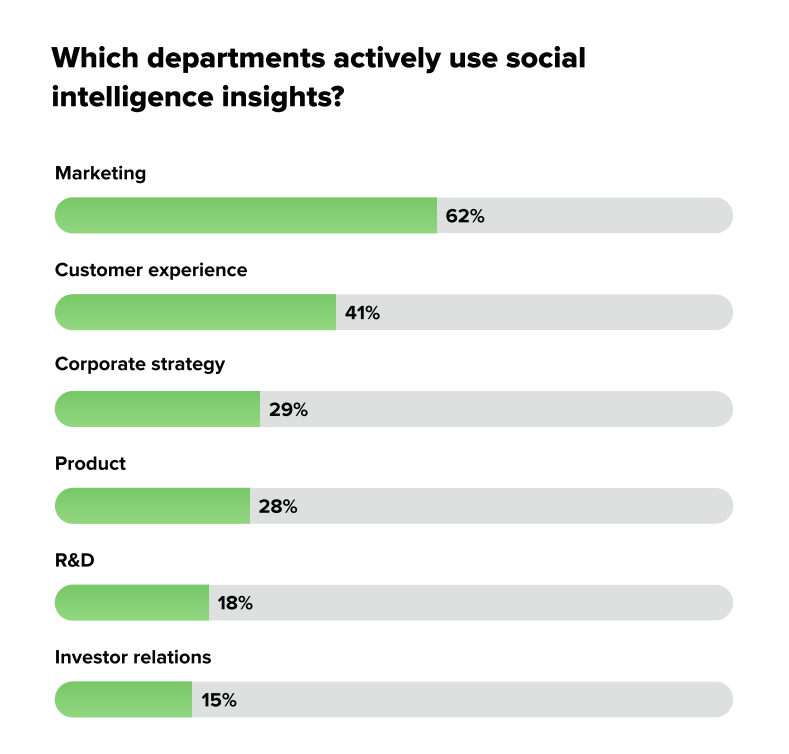
An infographic from the 2026 Social Intelligence Report, breaking down which departments use social intelligence insights.

But when it does reach cross-functional teams, the business impacts are tangible and powerful. The report found that customer retention is the #1 reported outcome of social intelligence (45%).

To help your brand reap those rewards, route segment‑level insights directly into the departments’ workflows. For instance, customer experience (CX) teams should receive segment data that highlights friction points, recurring complaints or onboarding gaps. CX teams can use this to refine support scripts, improve self-service content (e.g. how-to guides or FAQs) or proactively address issues before they escalate.

Common audience segmentation mistakes to avoid

Even the smartest segmentation strategies can encounter the occasional pitfall. But the first step in avoiding them is awareness. Here are some common mistakes to avoid:

  • Treating segments as static: Audience insights, behaviors, interests and platforms evolve constantly. Refresh segments regularly to keep insights relevant.
  • Focusing too heavily on demographics: Age, location and follower count provide context, but behaviors, intent signals and content engagement are often more predictive.
  • Keeping insights siloed in marketing: Share segmentation findings with product, customer care and leadership teams to drive more informed decisions across the business.

Make segmentation a business intelligence discipline

When fueled by real-time behavioral data instead of static details, social media audience segmentation goes from a channel-specific exercise to an ever-evolving intelligence engine.

Moving forward, brands will fall into one of two camps: those that treat segmentation like a standard reporting function and those that treat it as a live intelligence system. The latter group will be better positioned to uncover emerging needs and shifting priorities, adapt faster and make informed business decisions that keep them relevant to customers.

If you’re ready to secure your spot in the second group, download The Social Signal Playbook. With its insights and tactics, you’ll learn how to build a more proactive, insight-driven approach to understanding your audience.

The post How to use social media audience segmentation to drive smarter business decisions appeared first on Sprout Social.


from Sprout Social https://ift.tt/QObZcju
via IFTTT

Thursday, 22 October 2026

How to build your social media team for the future of marketing

It’s certainly not 2010 anymore. So why are so many businesses still resourcing social media teams as if it is?

Social teams have evolved far beyond publishing posts and responding to comments. Today, they manage content and video production, influencer partnerships, customer care, social search, paid media, community engagement and increasingly, social intelligence. Social’s role is expanding across the business, and a social team’s structure needs to evolve with it.

Organizations are also looking to social data for more than marketing insights. According to Sprout’s Social Intelligence Report, 93% of leaders view social intelligence as essential for future growth, yet only 10% of organizations have embedded it into enterprise strategy. Closing that gap requires more support for social teams that are already stretched across a growing list of responsibilities. They need the right people, roles and processes to turn social data into action across the business while creating more capacity for strategic work.

There’s no one-size-fits-all social media team structure. But the strongest teams connect their work directly to business outcomes rather than organizing solely around the tasks they complete. Building for that future requires the right mix of specialized expertise, cross-functional relationships and technology to keep pace with social’s expanding role.

In this guide, we’ll break down how to structure a social media team, which roles to prioritize and how to build and manage a team that’s prepared for the future of marketing.

How to structure a social media team

Social’s dynamic nature can give marketers a professional advantage if leaders give them space to grow. With the right structure, teams can quickly refine and grow their skills, creating career-making opportunities.

Proactively experimenting with new social media department structures can also shift a brand’s trajectory—helping it win a larger audience, build customer loyalty and sustain growth.

Here are four common models to consider, plus how your structure may evolve as your company grows.

1. Functional

The functional model organizes social media team roles around specific responsibilities, such as influencer partnerships, social media intelligence or paid media. Generalists may also have defined focus areas, including content creation, video production and social search optimization (SOSEO).

At Sprout, the social team also partners closely with Brand Creative on asset development and with teams across the organization—including PR, Content, Customer Marketing, Events, Internal Comms, Revenue Marketing and Product Marketing—on messaging, research and distribution.

Constantly switching between incoming DMs, reporting, influencer coordination and content production can limit time for creative and strategic thinking. A functional structure can help reduce burnout, clarify ownership and create more room for social marketers to deepen their expertise.

With clearer focus areas, teams can scale priority initiatives and measure their impact more effectively. This model works especially well for organizations that want to support career development while assigning clear ownership to specific social priorities.

2. Network

Some teams align individual employees to specific networks, such as TikTok, Instagram, Facebook or LinkedIn. With this approach, each person owns a network strategy from development through execution, which in turn enables them to build deep network expertise.

Sprout’s social team experimented with a network-specific structure in 2022 before eventually moving away from it. While the model supported highly intentional content and stronger network-specific audience insights, it wasn’t scalable for a growing team.

The social landscape has also become more fluid since network-based structures first gained popularity. New networks emerge and consumer preferences change rapidly, creating gaps or redundancies when roles are tied too closely to individual networks.

A network-based social structure can still work as an interim model for lean teams developing their social media marketing strategy from the ground up. As the team grows, shifting toward functional ownership can make it easier to adapt across networks.

3. Audience engagement

Another common team structure organizes social media team roles around audience engagement goals and customer needs. These typically fall into three categories:

  • Awareness: Creating content to increase brand visibility among new and existing audiences.
  • Engagement: Creating content and responding to comments, DMs and other inbound interactions to build community and strengthen brand loyalty.
  • Customer Service: Managing customer questions, requests and complaints to resolve issues quickly.

These teams often include specialists beyond content and community management. For example, an awareness-focused team might include a content creator, an influencer marketing strategist and a performance analyst who work together to develop relevant and effective content.

Because this model requires employees to work across multiple networks, centralized social media management software becomes especially important. Bringing publishing, engagement, reporting and collaboration into one system reduces time spent switching between disconnected platforms.

4. Center of excellence

In a social media center of excellence (CoE) model, representatives from different departments form a central council that shapes social strategy and establishes shared standards.

Participants may include leaders from PR, employer brand, HR, product, customer care and other teams that rely on or contribute to social. Together, they align priorities, improve information sharing and create clearer governance around how the organization uses social.

CoE models tend to work best for large organizations with social stakeholders spread across multiple departments or regions. A centralized group reduces silos and gives distributed teams a shared framework for decision-making, measurement and execution.

5. Structure by company size

Company size can help determine which structure makes the most sense, but complexity is often the better signal. A lean team may work well with broad ownership until the volume of channels, stakeholders and social data becomes difficult for a few people to manage.

As demand grows, teams usually need more specialization and clearer ownership. Enterprise organizations also need stronger governance, especially when social intelligence spans multiple departments. Sprout’s Social Intelligence Report found that only 29% of organizations house social intelligence within the social team, with responsibility spread across functions like analytics, marketing, communications, insights, corporate strategy and product.

The key is to evolve the structure before unclear ownership starts slowing the team down. For larger organizations, that may mean formalizing decision rights, reporting standards or a center of excellence that connects social intelligence across teams.

How to build a social media (dream) team: 9 roles to invest in

Marketing leaders are prioritizing specialists in areas like social search, customer care, paid media, influencer marketing and social intelligence. These roles deepen expertise in the parts of social that influence discovery, customer experience and business decision-making.

The right mix depends on your goals, audience and existing resources. Larger teams may hire dedicated specialists, while leaner teams may combine responsibilities across a few roles or partner closely with other departments.

Here are nine roles and capabilities to consider as you build out your team.

1. The SOSEO strategist

As social and AI change how consumers discover brands and products, search behavior is spreading across more platforms. Sprout’s Q2 2026 Pulse Survey found that search engines and social media are the two most commonly used search platforms across all age groups and demographics. Consumers especially favor social when looking for experiential, highly visual or peer-led information.

An SOSEO strategist is a valuable addition to a modern social team because they own your social search strategy and work with the broader team to create discovery-focused content. They conduct audience and keyword research, then use those insights to inform and optimize content strategy and analyze trends.

2. The social customer care lead

Your social customer care lead serves as a conduit between your social media and customer service teams. This role is essential for businesses that receive a high volume of customer questions or support requests through social.

This individual documents social customer care processes, creates escalation management strategies and manages integrations between social media and case management tools. They also support customer service agents as they learn how to deliver more brand-aligned support across social channels.

Speed matters here. According to Sprout’s Q3 2026 Pulse Survey, 38% of consumers expect a response to a customer care issue within one to two hours, including 14% who want a reply within minutes. A dedicated social customer care lead streamlines response workflows so teams can act quickly and deliver a consistent customer experience.

3. The paid media specialist

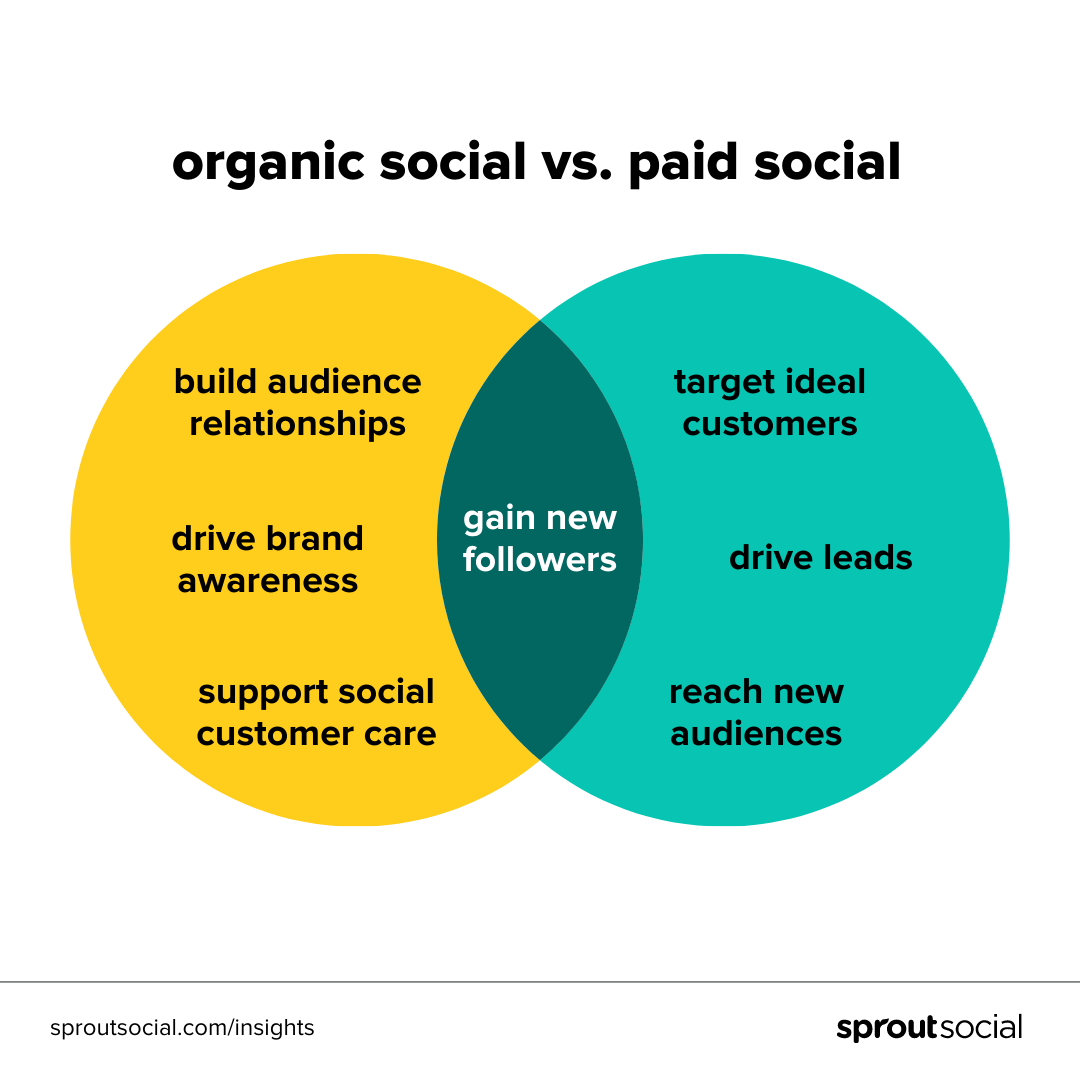
Organic and paid social strategies are two halves of a whole, so they should complement and reinforce each other.

Venn diagram showing how organic social builds relationships and awareness while paid social targets customers and drives leads, with both supporting follower growth.

Whether you aim to boost brand awareness, welcome new followers or gather new leads, combining both efforts can improve results. It’s still valuable to separate organic and paid social media team roles so each area gets the focus and expertise it requires.

While other social media marketers focus on the art of organic content, a teammate who specializes in paid digital media can further optimize those efforts and deepen social’s business impact.

4. The influencer marketing strategist

Influencer marketing now directly influences purchase decisions. According to Sprout’s 2026 Influencer Marketing Report, two-thirds of consumers made a purchase based on an influencer’s recommendation in the past year, and nearly one-third did so 10 times or more.

A great influencer marketing strategist does more than source influencers and build relationships. They also integrate influencer partnerships across the funnel, from influencer shop pages on your site to repurposing creator content across channels.

Managing those is inherently high-touch. Add ongoing performance reporting, budget optimization and campaign planning, and a dedicated strategist quickly earns their place on the team.

5. The social intelligence analyst

Social is a powerful source of business intelligence, so having someone on your team who can interpret the data is critical.

A social media intelligence analyst makes sense of raw numbers and reports, turning them into actionable insights. They track key performance indicators, assess whether your strategy is on track and recommend adjustments when it isn’t.

Their impact also extends well beyond the social team. According to Sprout’s Social Intelligence Report, 98% of professionals agree social intelligence has driven cross-functional business outcomes. A strong analyst shows where social data matters most, whether that’s revealing an emerging audience need or tying social activity to revenue.

6. The content creator

Social teams are producing more video, graphics and network-native content than ever, so they need more professionals with hands-on creative production expertise to support it.

A content creator may specialize in video, photography, design or editing, but technical skill is only part of the job. They also need to know internet culture: what people are paying attention to, how different platforms communicate and when a trend fits the brand versus when it feels forced.

That combination of creative skill and cultural fluency makes the role especially valuable on fast-moving social teams.

7. The social media leader

The more influence social has across the business, the more important it is to have someone senior steering the function.

A social media leader sets direction for the function and represents its priorities in broader marketing and business conversations. They also translate social insights for executives and make the case for the resources the team needs.

As the role matures, day-to-day execution takes up less of its focus. The leader spends more time clarifying priorities, removing roadblocks and ensuring social has a voice in broader business decisions.

8. The extended team

Some of the most important members of a social team may sit outside it.

Brand, PR, legal, product and customer care all influence how social operates. They also rely on social for audience, competitor and market intelligence. Sprout’s Social Intelligence Report found that marketing (62%), customer experience (41%), corporate strategy (29%), product (28%) and R&D (18%) actively use social intelligence insights.

Strong cross-functional relationships create a two-way flow of information. Social teams bring in expertise from across the business, then share relevant insights with the teams best positioned to use them.

9. The AI assistant

AI is already changing the balance between execution and strategy on social teams.

Sprout’s Social Intelligence Report found that 80% of individual contributors spend at least half their time on operational execution, leaving less room for strategic thinking.

An AI assistant can take on repetitive work like monitoring, first-draft replies and report generation. The payoff is more time to interpret what the data means, decide where the team should focus next and craft high-quality content.

How to make a case for expanding your social media team

Hiring is a big investment, and recruiting can take time. But under-resourcing carries its own costs, especially when social data plays a bigger role in business decisions.

Only 17% of professionals say they’re extremely confident their organization is maximizing the value of social media data. Limited budget and dedicated resources are also the second most-cited barrier preventing social intelligence from influencing strategic decisions.

If your team is already stretched, build the case around what more capacity would make possible.

Here are three ways to make that argument to senior leadership and the C-suite.

1. Use budget trends to your advantage

Social investment is still rising. According to Sprout’s 2026 Influencer Marketing Report, more than 75% of marketers say their influencer marketing budgets increased compared to the previous year.

Higher investment raises expectations for the team behind it. Leaders need people who can manage increasingly complex programs, prove their impact and turn performance data into business-ready insights.

When budgets grow, but headcount doesn’t, the team has less room to take on the strategic work those investments demand.

2. Explain the opportunity cost

More resources create space for work that teams often push aside when they’re overloaded. That could mean more community building, deeper analysis or more time to turn social data into useful business recommendations.

Only 17% of professionals say they’re extremely confident their organization is maximizing the value of social media data. Sprout’s Social Intelligence Report also found that 86% believe their organization may have missed opportunities over the past two years because consumer insights were delayed, siloed or underused.

Missed opportunities put a clearer price tag on under-resourcing. Point to insights the team couldn’t act on quickly enough, or opportunities that stalled because no one had the bandwidth to act.

3. Underscore the urgent priority of company-wide social intelligence

Evangelizing social intelligence org-wide is still out of reach for most teams, leaving valuable audience and industry insights buried.

And the stakes are rising. By 2029, 71% of directors predict social data will influence core enterprise strategy more than traditional market research. Next year, 26% of organizations plan to invest more in social intelligence through headcount.

More dedicated resources let teams get useful social insights to colleagues across the business faster. Over time, social intelligence can play a much larger role in how teams understand customers and make decisions.

How to future-proof and manage a social media team

Managing a social media team often comes down to one question: how quickly can the team turn an insight into action? This gets harder as more stakeholders, approvals and data enter the picture.

Speed-to-action is one of the biggest gaps. Sprout’s Social Intelligence Report found that only 10% of organizations can act on a social insight within hours. Most take one to two weeks.

Effective management clears roadblocks so the team can move with more focus and consistency. Here are the areas leaders should prioritize.

1. Invest in your team’s ongoing development

Fostering opportunities for growth and career advancement is crucial for retaining experienced social talent. Even when immediate pay increases or promotions aren’t possible, leaders can still invest in skill development and create clearer paths toward specialization.

Budget for conferences, courses and professional development resources where possible. Free communities can also connect team members with peers and expose them to new ideas and approaches.

Ongoing development prepares people for the future of work and makes it easier to recruit and retain candidates with the skills your team needs.

2. Identify more opportunities for cross-functional data sharing

The best social media strategies influence decisions well beyond marketing. That level of impact happens only when social data is accessible across the business.

Forward-thinking companies share social intelligence across departments so it can inform customer, product and business decisions.

Executive sponsorship accelerates that work by opening doors to broader collaboration and making social data more visible across the organization.

Over time, wider access to social intelligence also makes it easier to demonstrate how the team contributes beyond channel performance.

3. Encourage experimentation

Emerging technologies are redefining what it means to work in social. In the past, regular social media data analysis, along with managing a full content calendar and engagement duties, felt daunting. Now, thanks to AI, teams can expand their impact without adding more hours to the day.

AI tools can analyze massive amounts of social listening data and turn it into recommendations that support cross-departmental work. To stay ahead, support your social media team in experimenting with the latest AI use cases.

Invest in tools that prioritize AI development and work with business leaders to establish thoughtful AI use policies. These policies protect your business and brand while setting clearer guardrails for experimentation.

4. Advocate for stronger attribution models

According to the Impact of Social Report, over half of marketing leaders say incompatibility between their social media management tools and the rest of their marketing tech stack is the top reason they can’t understand social’s impact on their business. They also cite difficulty setting up reliable attribution models and limited internal knowledge about connecting social efforts to business goals.

The same report found that fewer than half of marketing leaders say their teams embed social data into any CRM (customer relationship management) software.

Make social data integration a priority for your analytics team. As more budget moves to social, proving results will matter even more. At Sprout, prioritizing social reporting within marketing analytics led to a multi-touch attribution model that revealed a 5,800% increase in social’s pipeline impact.

5. Establish workflows

Speed often breaks down in the handoffs. A useful insight or a social media compliance check may still sit for days if ownership is unclear or an approval gets stuck.

Audit the workflows behind those delays. Look for bottlenecks in approvals and handoffs, then clarify who owns what. Clearer processes help the team respond while the insight or trend is still relevant without sacrificing compliance.

6. Foster a feedback culture

Teams work better when people can be candid about what’s working and what isn’t.

Make feedback part of the regular rhythm, not something you save for formal reviews or moments when something goes wrong. Regular check-ins create space to surface friction early and clarify expectations before small issues start affecting the work.

Feedback should also move both ways. Managers need input on how processes are landing just as much as team members need direction on their work. Over time, that openness makes it easier to learn from experiments, adjust course and build trust across the team.

7. Measure the ROI of your social media team

If your reporting stops at likes, reach and engagement, you’re missing the bigger picture.

Sprout’s Social Intelligence Report found that only 43% of organizations have clearly defined social intelligence success metrics. The most commonly reported outcomes include improved retention (45%) and identifying new audiences or segments (40%), along with more responsive messaging and better executive decision-making.

Use those kinds of outcomes to define what success looks like for your team. The clearer the link between social and business priorities, the easier it is to show where the team is driving value.

Lead a social media team of tomorrow

The future of social depends on teams that have the structure, expertise and support to drive measurable business impact. As social takes on a larger role across the organization, leaders need to build teams that can evolve with it.

Two mistakes can limit that potential: treating the social team primarily as a content-creation and reporting function, and treating social as simply a communications channel. Social is part of many users’ everyday lives, so it provides intelligence that can influence decisions across the business, from customer experience to long-term strategy.

Building for that future starts with recognizing the function’s full value and resourcing it accordingly. Explore Sprout’s Social Intelligence Executive Brief for more insights on turning social data into business action.

The post How to build your social media team for the future of marketing appeared first on Sprout Social.


from Sprout Social https://ift.tt/WS01MRq
via IFTTT

Wednesday, 21 October 2026

How to create a Black Friday social media marketing strategy

Black Friday prep is happening earlier than ever for shoppers this year. Your customers are already looking for deals online and increasingly on social media. According to a Q3 2026 Sprout Social Pulse Survey, 78% of users plan to use social as much or more than they did last year to help them find and purchase gifts this year.

Social media is now tied with physical stores for gift purchase discovery, with 46% of customers marking them as top choices. As customers face increasing economic pressure this year, many are using social media to research the best deals. If you want to make the most of Black Friday on social media, start planning your strategy now. Customers are eager for ideas well before November.

In this guide, we walk through how to build effective Black Friday social media campaigns this Q4.

5 types of Black Friday social media posts (+ examples)

Spurred by the growth of online shopping and social commerce, Black Friday has become a multi-day event, including Small Business Saturday and Cyber Monday. According to the data, customers are thinking about their holiday shopping differently this year, and ecommerce is a key part of their plans.

More than half of respondents (69%) to the Q3 2026 pulse survey said they’re concerned about rising prices due to tariffs. Over a third (36%) are planning to shop earlier to specifically avoid tariff-related price jumps, and 56% are planning to reduce their holiday spending overall due to economic conditions.

For brands, that means competition is higher and earning customer trust will take more legwork. To create a winning Black Friday marketing strategy, it’s crucial to tap into the power of social.

Nearly a quarter (23%) of the Q3 pulse survey respondents said the quality of a company’s social media customer service makes them more likely to purchase this holiday season, and a similar percentage said the originality of holiday-specific social content makes a difference. Here are different types of Black Friday social media posts that have worked for other brands to inspire your campaign planning.

Influencer collaborations

Partner with influencers to create tailored content for specific demographics. From fashion lovers to tech enthusiasts, influencers can connect with high-intent niche audiences. If your Black Friday deals are perfect for a particular type of customer, working with influencers who already speak to that crowd can build trust and revenue

Offering special discounts and promo codes via influencers is one way to track ROI of a campaign and boost sales. In fact, promo codes are the leading factor influencing the purchasing decisions of social media scrollers. Thirty percent of respondents to the Q3 pulse survey said promo codes influencers share make them more likely to purchase from a brand during the holidays, more than any other factor in the survey.

Keep in mind that follower count is not the main barometer of impact for your influencer partnerships. Instead, focus on social media discoverability. Working with influencers who can create hyper-relevant content is key to getting your campaign seen by new audiences. Small businesses with modest budgets and larger companies alike can embrace micro-influencer marketing this gifting season.

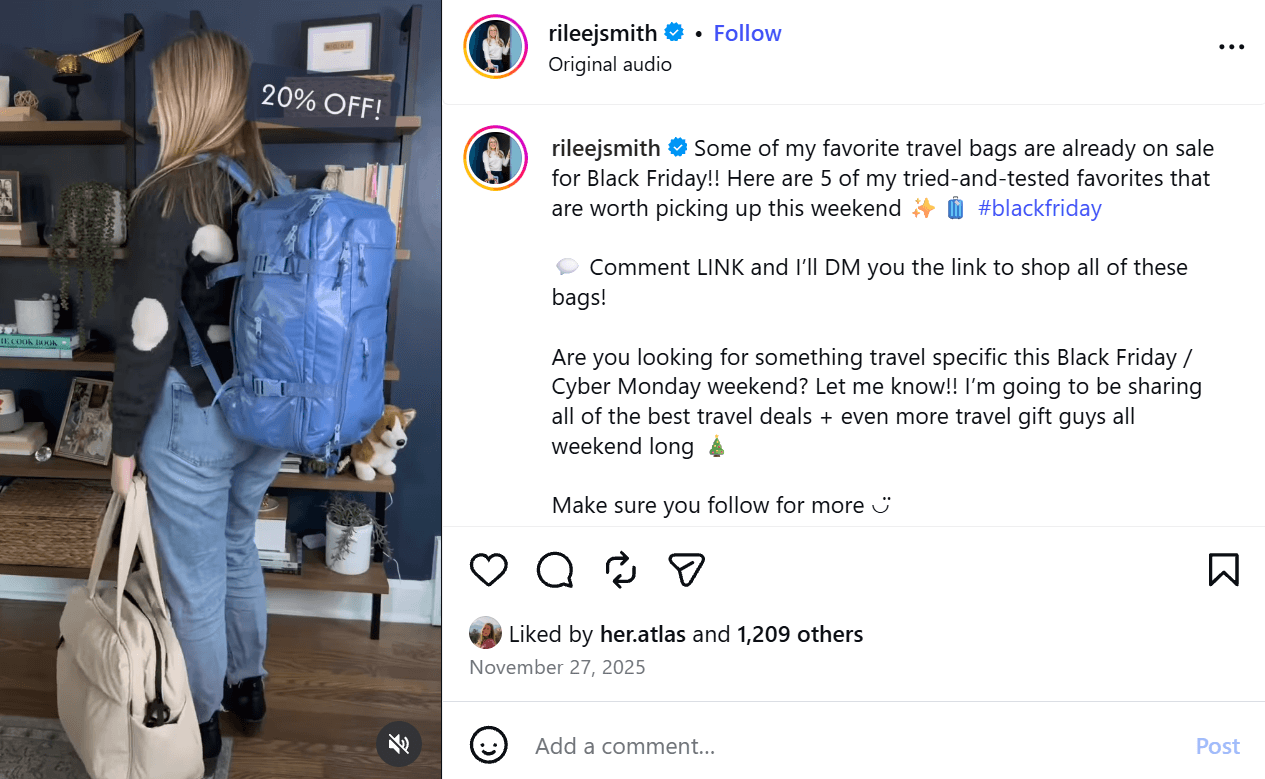
For example, Rilee Smith, a travel and packing influencer on Instagram, crafted a video in partnership with five of her favorite bag brands to offer her followers a slate of Black Friday sales. Her video showed each of the bags in action and what discounts the brands offered.

Rilee Smith models two travel bag options in a Black Friday sale Instagram video. 

Giveaways and contests

Grab consumer attention by giving away free merchandise. Create a social media giveaway or contest to improve your engagement and supercharge the buzz around your brand.

Giveaways and contests boost your follower count, convert leads, amplify brand awareness and increase loyalty.

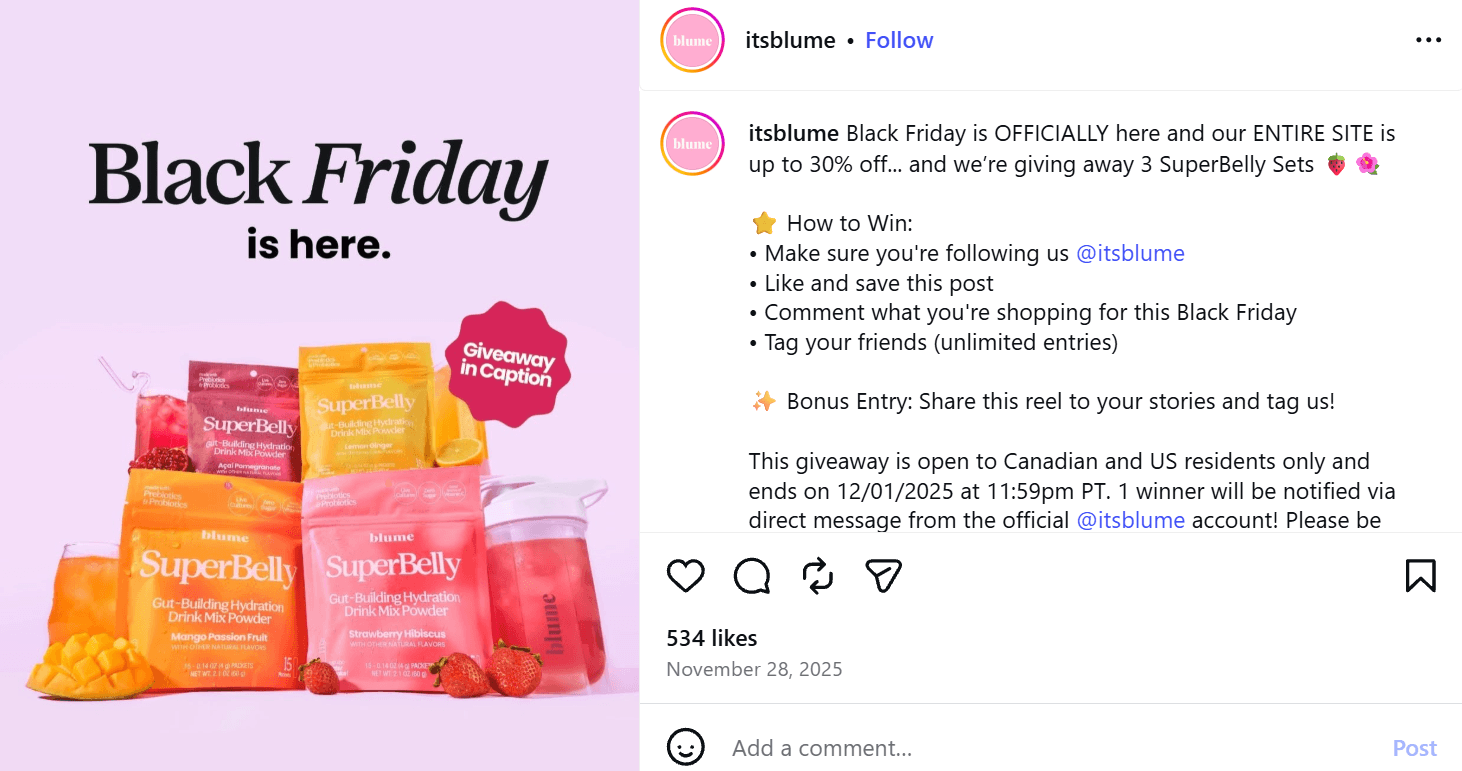
You can tie giveaways to an influencer campaign or a specific product. Supplement brand Blume held a Black Friday giveaway featuring their SuperBelly product line. The giveaway post also mentioned their Black Friday sale and required specific engagements to enter. The result was promotion of the giveaway and the broader discounts available for the shopping-centric weekend.

Blume’s Black Friday giveaway post on Instagram, featuring their SuperBelly product line

Loyalty programs

Want to incentivize your audience to return to your website or shop with you after Black Friday ends? Promote your rewards or loyalty program. These programs typically offer discounts, coupons or early access to repeat shoppers—all of which encourage brand loyalty.

The cost savings loyalty programs offer are especially appealing to customers this year and create a way to build trust with your audience. Discounts, special social content and exclusive savings for your loyalty members show them you know their discretionary dollars are valuable, and you’re willing to go the extra mile to keep them coming back.

Luggage brand SWISSGEAR offered their rewards members early access to a 60% off Black Friday sale. Customers looking to plan their holiday purchases as early as possible this year will appreciate a first shot at discounts and bundles. Your social channels are a useful tool alongside email marketing to let members know about exclusive benefits for the holidays.

Swiss Gear’s Black Friday members’ early access announcement on Facebook

Omnichannel activations

When consumers shop on social, they don’t stick to a single platform. They’re browsing TikTok, Instagram, Reddit, Pinterest and more. Their research does include traditional marketing avenues like print, digital and brick and mortar stores, too. Our Q3 pulse survey found that shoppers are sourcing gift ideas from a variety of sources:

  • Social media: 46% (and 54% for Gen Z)
  • Physical stores: 46%
  • TV: 31%
  • Review sites: 23%
  • AI chatbots: 15%
  • Print or digital media: 13%

Due to social media saturation, it’s important for brands to take a multichannel marketing approach to reach audiences and break through the noise. This includes all of your social channels, digital touchpoints and even real life activations.

During Black Friday, use omnichannel marketing by creating a seamless customer experience, from your social networks and chatbots to email strategy and customer care. UK brand Gymshark’s annual Blackout event on Black Friday incorporates several of their social media channels, their physical stores, email and Reddit posts.

Gymshark teases a black friday announcement on TikTok

Community-inspired posts

A brand community comprises people who have an emotional connection to your brand. When you reach your community effectively, you increase brand loyalty and even encourage customers to become brand evangelists.

Take a cue from your community when creating your Black Friday content. Get to know their other favorite brands, personal values and how they spend their holidays. Use these insights to guide your social content development. Look for ways to give back to causes your audience cares about, and that align to your brand values.

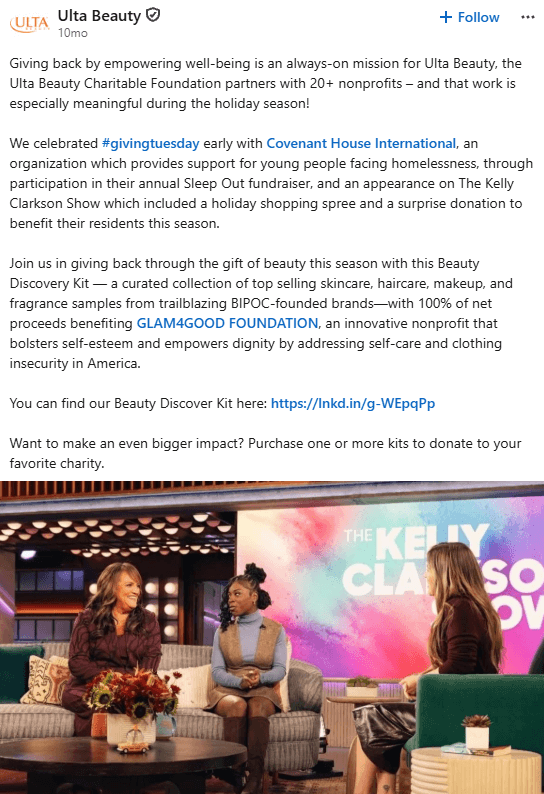
On GivingTuesday—the Tuesday after Black Friday when people make donations to charitable organizations—Ulta Beauty shared about two partnerships it participated in for the occasion. This included a special product bundle customers could purchase to support the cause.

Ulta Beauty’s Giving Tuesday announcement on LinkedIn

7 Black Friday social media marketing tips

When developing a Black Friday social media marketing strategy, you need to plan ahead. Now is the time to get your content calendar in order, take stock of what’s been successful for you this year (metrics-wise) and think about how you will stand out in a swarm of other Black Friday social media campaigns.

Follow these tips to execute your Black Friday social-first marketing strategy successfully.

1. Encourage opt-ins and new followers

Build awareness for your brand by engaging new potential followers and email subscribers. Use an early-bird special to entice customers to follow your social accounts or to opt-in to your email newsletter for a unique Black Friday discount code.

The takeaway

Focus on growing your customer base before Black Friday so your content can reach a wider audience.

2. A/B test different creative strategies

Kick off your Black Friday campaigns early to A/B test your different creative options. For example, analyze how a short-form video performs compared to a static graphic with the same message.

As Black Friday approaches, go with the creative format that will bring the most engagement, awareness and positive sentiment.

The takeaway

Using a data-driven approach to guide your Black Friday marketing can help you yield better results (e.g. more engagements and conversions) by ensuring you use the creative that most resonates with your audience.

3. Partner with creators and influencers

Creators and influencers can help you generate more engagement, reach new audiences and strengthen your community on social this Black Friday. Search for creators that are topically relevant to your campaign, and start reaching out to them as soon as possible to build the most impactful campaigns.

Finding and vetting these creators is easier with Sprout Social Influencer Marketing. Our AI-powered semantic search capabilities take a closer look at the context of influencer content, making it easier to assess influencers’ alignment with your brand and audience.

For example, say you work in the travel industry and want to partner with influencers to promote your Black Friday holiday package deals. Rather than manually hunting for creators with a travel niche, you can simply search “Europe travel vlog” or “budget travel tips”.

Sprout Social Influencer Marketing will then show creators who explore relevant themes and topics in their content, even if those phrases don’t appear verbatim. This makes it easier to find a broader range of influencers, including those you might’ve overlooked with standard search filters.

For your Black Friday promotions, keep in mind that consumers prefer content from influencers who have used your products before. The 2026 Influencer Marketing Report found that 37% say the influencer should have used the product at least once, and 44% say the influencer should have been using the product for a long time. The holiday season is a great time to tap existing brand partnerships and work with influencers who have had successful campaigns for you in the past.

The takeaway

Align your Black Friday influencer content with what your audience cares most about to drive engagement and foster trust. Look to campaigns that have done well in the past for ideas.

4. Prepare your profiles

One of the easiest ways to prepare for Black Friday is to get your profiles ready. An up-to-date profile is essential to converting viewers and followers into buyers and brand superfans.

People will first notice your profile photos (both headers and profile pics). Consider updating your pictures with a holiday-inspired or sale-focused theme.

Consider also adding links in your profile bios (Instagram, X, TikTok) or About sections (Facebook, LinkedIn) to your Black Friday promos.

The takeaway

Refreshing visuals and links across your social media profiles can help grab user attention and entice them to click—essential for increasing Black Friday sales.

5. Automate elements of your social strategy

Expect to ramp up your customer care strategy and content production as you enter the holiday season. Customer care is particularly important. While it may be one of the busiest times of year, it can’t fall to the wayside—if it does, you might lose your customers. According to the Q3 pulse survey, 27% of consumers plan to use social media more this year for holiday customer service needs, and 38% expect a response from brands within 1-2 hours.

Here’s how you can use  a social media management platform like Sprout to level up your holiday customer service:

  • Quick, 24/7 support: Program chatbots to provide instant, round-the-clock customer support, so your care team can focus on more complex needs..
  • Case categorization: Immediately identify which customer queries need manual responses with automatic case categorization.
  • Personalization: Use Enhance by AI Assist to detect the sentiment of inbound messages and align the tone of your response with that of the customer (i.e. more friendly, confident or professional, depending on the context).
  • Compliance capabilities: Ensure your team provides consistent, compliant care during every interaction with features like Blocked Words, Secure Forms, Data Masking and more.

You can also use Sprout’s automation and AI marketing resources to manage other elements of your social media strategy, scale smoothly and prevent burnout:

  • Content production: Generate scroll-stopping captions and accessible image alt texts with AI in seconds to free up your team’s time for strategy.
  • Approvals: Create automated approval workflows to keep your social media approvals running smoothly and efficiently. Automatically loop in relevant team members, get the green light to post content and send messages, and establish approval timelines.
  • Scheduling: Use Sprout’s Optimal Send Times to publish your content at times that will garner more impressions and engagement.

These tools will help you seamlessly and effectively execute in advance and during the big sale.

Sprout Social Listening example data

The takeaway

With the help of automations and AI, social media management tools empower your team to provide quick and personalized customer care, optimize content development and build stronger social strategies.

6. Create different promotions for different audiences

If you serve one specific, hyper-niche audience, skip to the next section. But, if you have several audience types, you should create different Black Friday social media posts for each market segment.

For example, department stores should create posts highlighting holiday deals geared toward different audiences, whether it’s a customer interested in home decor and electronics or looking for clothing and outdoor gear.

The takeaway

Tailor your Black Friday marketing to your audience segments (including their interests and product preferences) to enhance relevance and, in turn, drive engagement.

7. Measure your campaign’s impact

Creating a reporting strategy for your Black Friday campaign is key to knowing what worked and what needs tweaking. A campaign performance report should provide insights on reach, engagement and conversions to see if your marketing efforts hit the mark. Sprout’s Trellis features a Performance and Engagement agent that helps you extract those metrics from across your social media accounts. This saves you the busy work and aggregates insights quickly so you can pivot as needed during the holiday season.

Having these insights at hand will also help you make smarter, data-driven decisions to optimize your budget and resources for next year.

The takeaway

It’s never too early to start planning future Black Friday campaigns. Draw insights from this year’s campaign data to refine your strategy, allocate resources more effectively and yield greater results in years to come.

Black Friday social media campaigns to inspire you

Take a look at these successful Black Friday social media campaigns to help get the ball rolling as you plan yours.

Glossier

Glossier’s marketing approach leans into real, everyday people using their products. While their social feed is full of aesthetically pleasing photos, the content is also approachable and achievable.

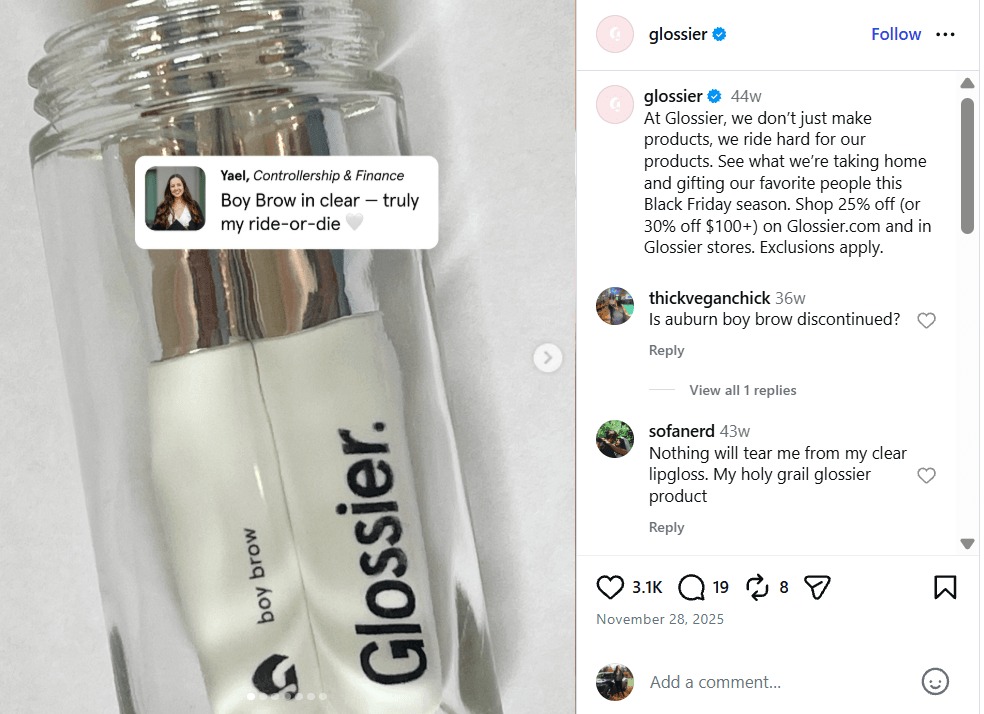
For Black Friday, Glossier kept that same tone and recruited a number of employees to share what items they were getting for themselves and for gifting during Black Friday sales.

Glossier’s Black Friday employee post on Instagram

The brand shared a carousel of recommendations from team members placed over photos of the products themselves. It was a riff on the typical influencer strategy, turning employees who live and breathe the products into valuable word-of-mouth promo. And with 40% of all consumers frequently (once a month or more) discovering a product or service through employee-generated content, it’s a strategy that will inevitably drive sales.

More than ever, customers are looking for the humans behind the brand that they can relate to. For Black Friday deals, your team can provide approachable, likable voices without the lift of a full influencer partnership.

Lowe’s

Black Friday in the pre-social media era was built around “doorbuster” deals that had people lining up outside right after Thanksgiving dinner. Lowe’s leveraged nostalgia for the Black Friday of yesterday, popular unboxing videos and strategic scarcity to drive a surge in interest to their stores.

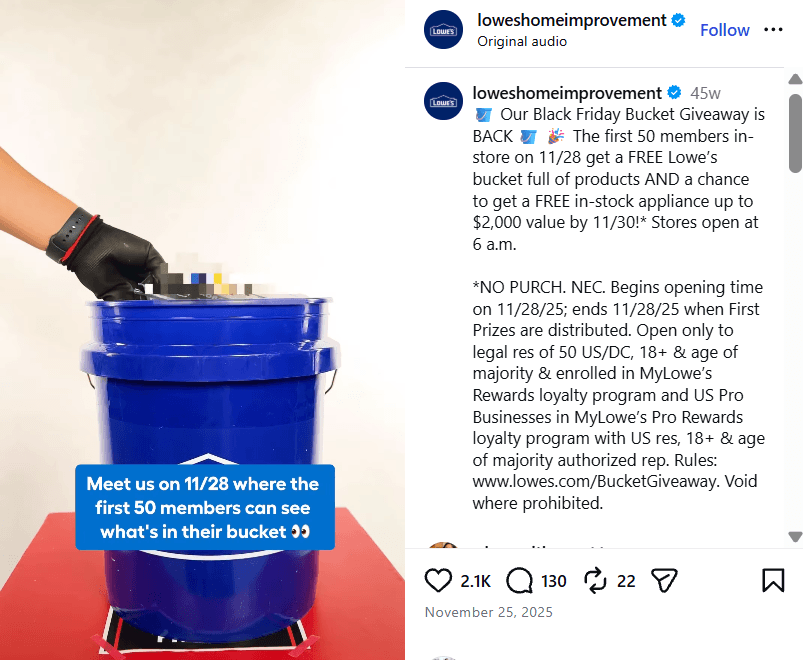
The Lowe’s Black Friday Bucket Giveaway tied together a giveaway, benefits for loyalty members and the power of UGC content in one campaign. The first 50 Lowe’s Rewards members in line at their retail locations on Black Friday received a blue bucket filled with branded products. Each bucket had a chance to win $2,000 toward an appliance purchase.

Lowe’s bucket giveaway post on Instagram

The social promo featured a blurred look at products in the bucket to heighten the mystery. As customers received their buckets on Black Friday, UGC posts flooded in. Customers eagerly recorded their bucket “unboxings” and a lucky few posted the thrill of being the $2,000 winners. A fairly humble item—a blue bucket—turned into a boon for those who received free appliances and the Lowe’s brand overall.

GoPro

GoPro has built a thriving community around their cameras. GoPro loyalists actively debate different cameras, share tips for getting the best shots and trade ideas across channels. A major chunk of the brand’s social media content comes from community submitted photos and videos for the GoPro Awards or shared on users’ personal pages.

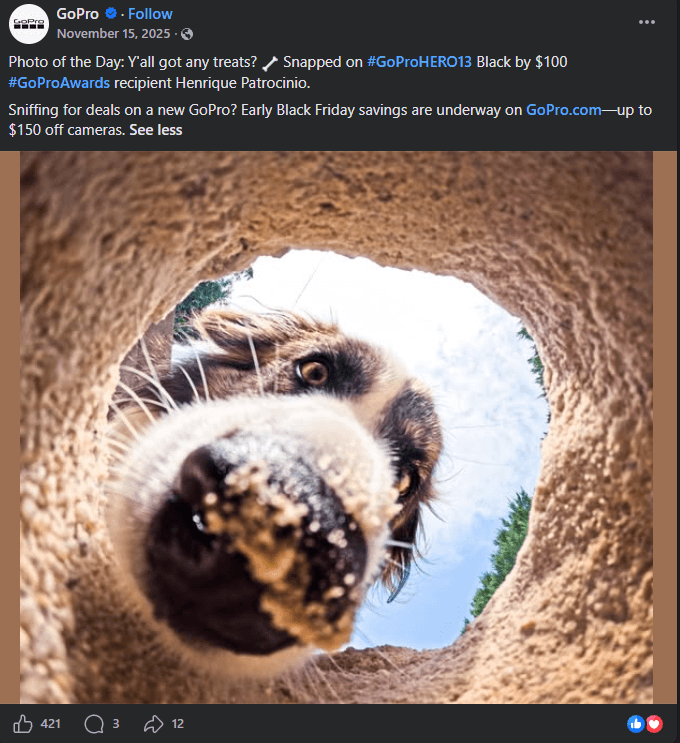
While many of the videos shared are breathtaking, featuring extreme sports and beautiful locales, some capture the lighter side of life and the GoPro brand humour. For Black Friday, GoPro shared a series of posts of community content with a dash of silliness.

A photo of a dog and a Black Friday announcement from GoPro on Facebook

From an up close and personal shot of a cute dog’s snout to a Redbull athlete “collecting coins” on a bike to add up to the Black Friday discount, these posts offer entertainment and connection via community-created content. And keep the brand grounded in their customers’ literal and metaphorical viewpoint.

Plan (and schedule) your Black Friday social media posts

To prepare for the retail holiday, make sure your Black Friday social media campaign and customer care strategy are in place well before the end of November. Keep in mind consumers’ economic mindset this year as you develop your approach, and look for ways to meet their needs, and offer a bit of delight while doing so. Social media users are stretching their dollars this year, and each purchase feels like a bigger decision.

Your Black Friday social media campaigns should go beyond offering a one-time deal and instead open the door for ongoing brand connection. As you build your campaign, remember to reinforce your mission, align with your organization’s goals, make your creative count and schedule your content ahead of time.

For more resources to help you plan your holiday strategy, check out our insights about holiday shopping trends.

The post How to create a Black Friday social media marketing strategy appeared first on Sprout Social.


from Sprout Social https://ift.tt/UCvxiIs
via IFTTT

Thursday, 15 October 2026

Building trust through social media: 5 ways to earn it

Authenticity is the most important brand characteristic on social media, according to Sprout’s Q3 2026 Pulse Survey. But as audiences grow more skeptical of what they see in their feeds, brands need to work harder to earn their trust.

People rely on social media for news, product recommendations and connection. At the same time, Sprout’s Q1 2026 Pulse Survey found that 35% of users trust social media less than they did a year ago. AI-generated content adds to that skepticism, making it harder to distinguish real experiences from manufactured ones.

Sprout’s Be So FR webinar explored this “trust recession” and the growing demand for content that reflects real people and experiences. Brands need to show who’s behind their content and follow through when customers reach out.

Building trust through social media starts with what you publish and how you respond to your audience. In this guide, we’ll explore what earns audience trust and practical ways to strengthen it.

Why trust is now built on social media first

People often encounter your brand through someone else’s post before they visit your website. They search for recommendations, compare customer experiences and ask questions in the comments. Those interactions help them decide whether to trust you.

Sprout’s 2026 Pulse Surveys show how people use social to find information and decide what to buy:

  • Search: 21% of consumers turn to social media first when searching for information, according to Q2 data.
  • Influencer impact: 67% made a purchase directly because of an influencer’s recommendation in the past year.
  • Trends and culture: Q3 data found that 54% of consumers turn to social media to keep up with trends and cultural moments, ahead of TV and streaming at 45% and conversations with friends and family at 42%.

These social media statistics show why brands need to pay attention to conversations beyond their own accounts. With influencers playing such a significant role in what people buy, choosing credible partners matters.

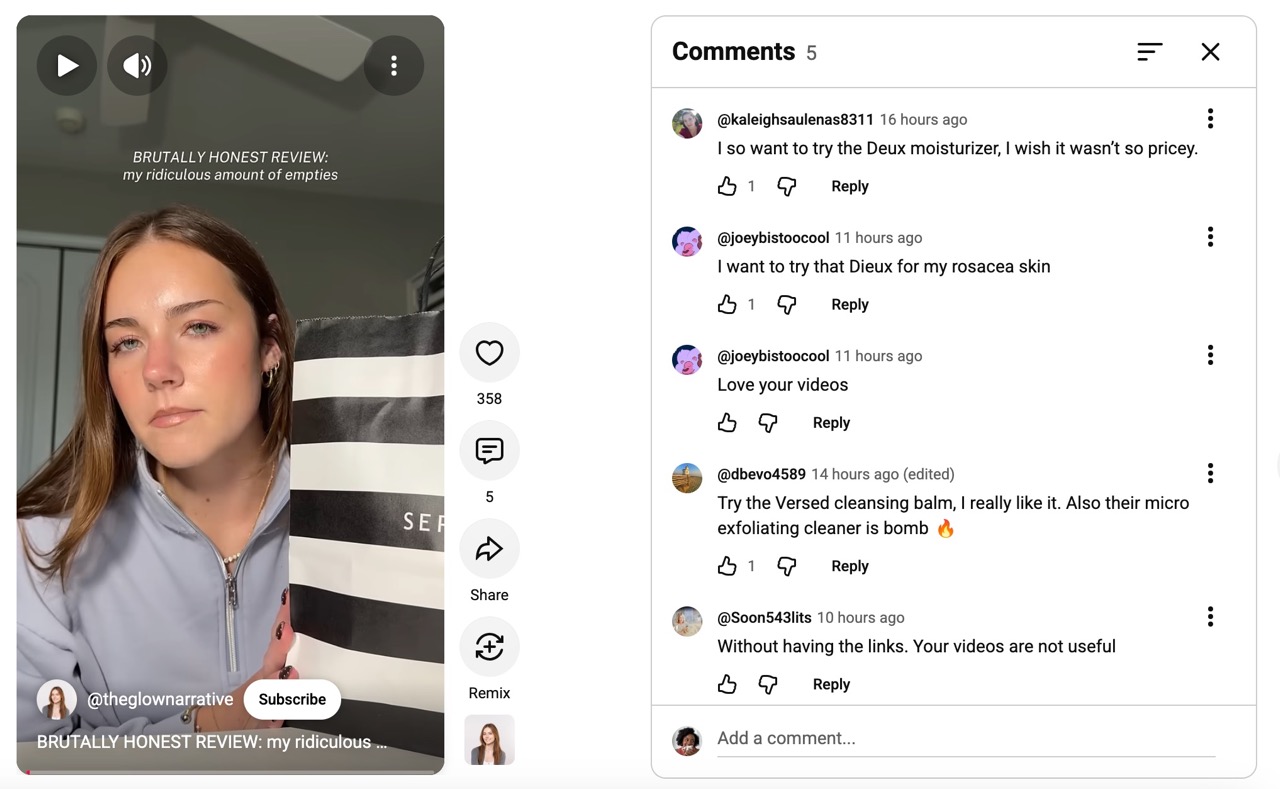
For example, viewers of @theglownarrative’s skincare review discuss product prices, share what they want to try and recommend alternatives. Her review gives viewers a starting point, while the comments offer additional perspectives. Brands that partner with creators who share honest, firsthand experiences give potential customers more reason to trust their products.

YouTube skincare review by @theglownarrative, with comments discussing product prices, skin concerns and alternative recommendations.
The same online scrutiny applies when something goes wrong for a brand too. According to Sprout’s Q2 2026 Pulse Survey, consumers first hear about a brand crisis on social. And 64% say it’s important for brands to respond publicly on social rather than through a press release or website statement.

How building trust on social media is a growth lever

Social media’s influence gives brands a chance to turn audience trust into growth. When people trust your brand, they’re more likely to choose your products and recommend them to others. As Sprout’s Q2 2026 Pulse Survey highlights, creating multiple points of connection with your brand and through partnerships with trusted voices can strengthen customer relationships and support growth:

  • Authentic influencer partnerships build buying confidence. Eighty-one percent of consumers say it matters whether an influencer has used the product they promote. Creators with firsthand product experience offer more credible recommendations.
  • Employee content introduces potential customers to your business. Forty percent of consumers rated employee-generated content as more authentic than posts from a brand’s main account. The same proportion discover products or services through employee content at least once a month.
  • Timely crisis responses protect customer relationships. Response speed influences how consumers judge a brand’s public crisis response. Addressing problems promptly and following through on a solution gives customers a reason to keep doing business with you.

The signals that earn audience trust

Building audience confidence starts with how your brand shows up day to day. The table below outlines four trust builders—consistency, responsiveness, transparency and proof—and the behaviors that undermine them.

Trust builder Trust breaker
Consistency: Maintain a recognizable voice and follow through on your stated values. Chase trends that clash with your identity or make promises your actions don’t support.
Responsiveness: Acknowledge questions promptly and provide helpful answers or clear next steps. Ignore customer concerns or send generic replies that don’t address the issue.
Transparency: Disclose relevant AI use and paid partnerships, and acknowledge mistakes. Hide sponsorships, present AI-generated content as real experiences or avoid accountability.
Proof: Share customer experiences, employee expertise and recommendations from creators who know your products. Rely on unsupported claims or endorsements from people with no firsthand product experience.

Consistency

A consistent voice and posting cadence set expectations for your brand. Your values need the same follow-through: if you promote a commitment to customer care, your replies should reflect it. Maintain that reliability across everyday posts, campaigns and difficult conversations.

Responsiveness

Helpful replies show customers that you take their concerns seriously. Sprout’s Q3 pulse survey found that 38% expect a customer care response within two hours, including 14% who expect one within minutes.

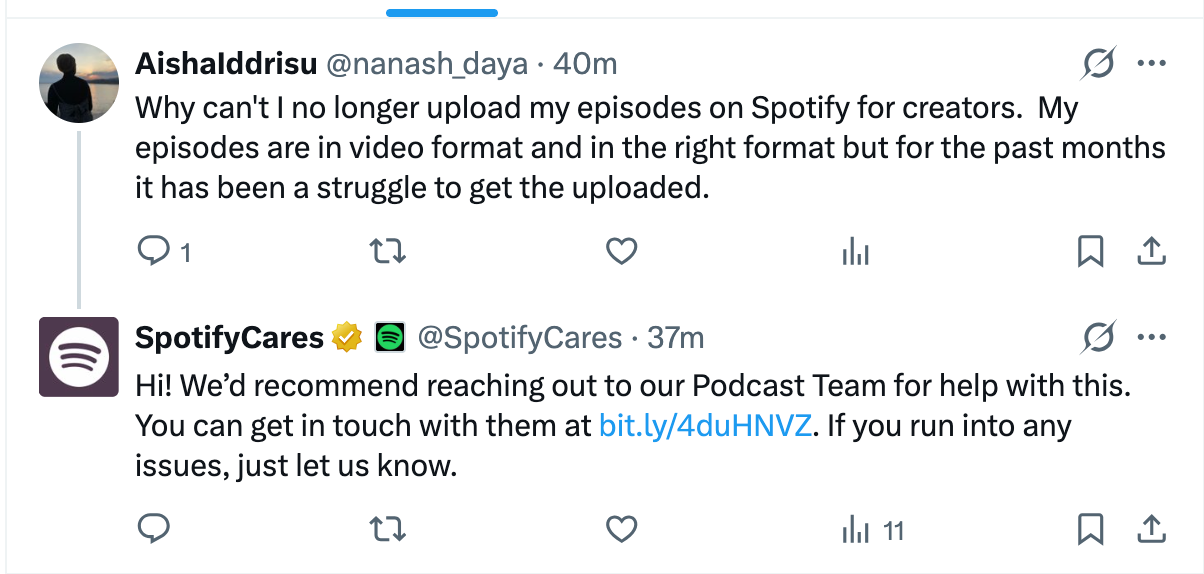
For example, SpotifyCares responds to a creator’s upload problem within minutes, connects them with the right team and invites them to follow up if they run into issues.

SpotifyCares replies to a creator’s upload problem on X, directing them to the Podcast Team and inviting follow-up.
Speed matters during crises, too, as Q2 pulse survey findings show. Acknowledge the issue promptly, explain what you know and tell people when to expect an update. The quality of your response matters as much as how quickly you send it.

Transparency

Be up front about how you create your content and what you’re promoting. That includes paid partnerships, relevant AI use and the limits of your product claims.

Sprout’s Q1 pulse survey found that 28% of consumers most want brands to stop posting AI-generated content without labels. Disclose when content is AI-generated and have a person check it for accuracy before publishing. Disclosure explains how you created it, while human review reduces the risk of publishing inaccurate information.

Proof

Customer reviews and recommendations show whether your brand delivers on its promises. Sprout’s Q2 pulse survey found that 57% trust everyday users most for product recommendations, ahead of experts, mega-influencers and brand employees.

Each perspective offers something useful. Customers describe their experiences, employees explain how products work, and creators demonstrate them in use. Specific details make it easier to judge whether your product fits their needs.

5 ways to build audience trust

Put these trust builders into practice with five steps to create credible content, choose partners and strengthen relationships with your audience.

1. Stay authentic to your brand

Start with a voice your team feels comfortable using in everyday conversations. Sprout’s Q3 pulse survey found that 26% of consumers want brands to sound less corporate and 24% want them to be less salesy. Replace stock promotional language with specific, useful information about your products and the people who use them.

Assess recent posts for language that feels forced or interchangeable with another brand. Give your team examples of how your voice translates into captions and customer replies. Before joining a trend, ask whether it fits your brand and gives your audience something worthwhile.

2. Listen to what people want (and act on it)

Read comments and customer care messages for recurring questions. To get a fuller picture of what people want, look beyond those who contact you directly. Social listening expands that research by tracking conversations about your brand, industry and competitors. It reveals common concerns and unmet audience needs.

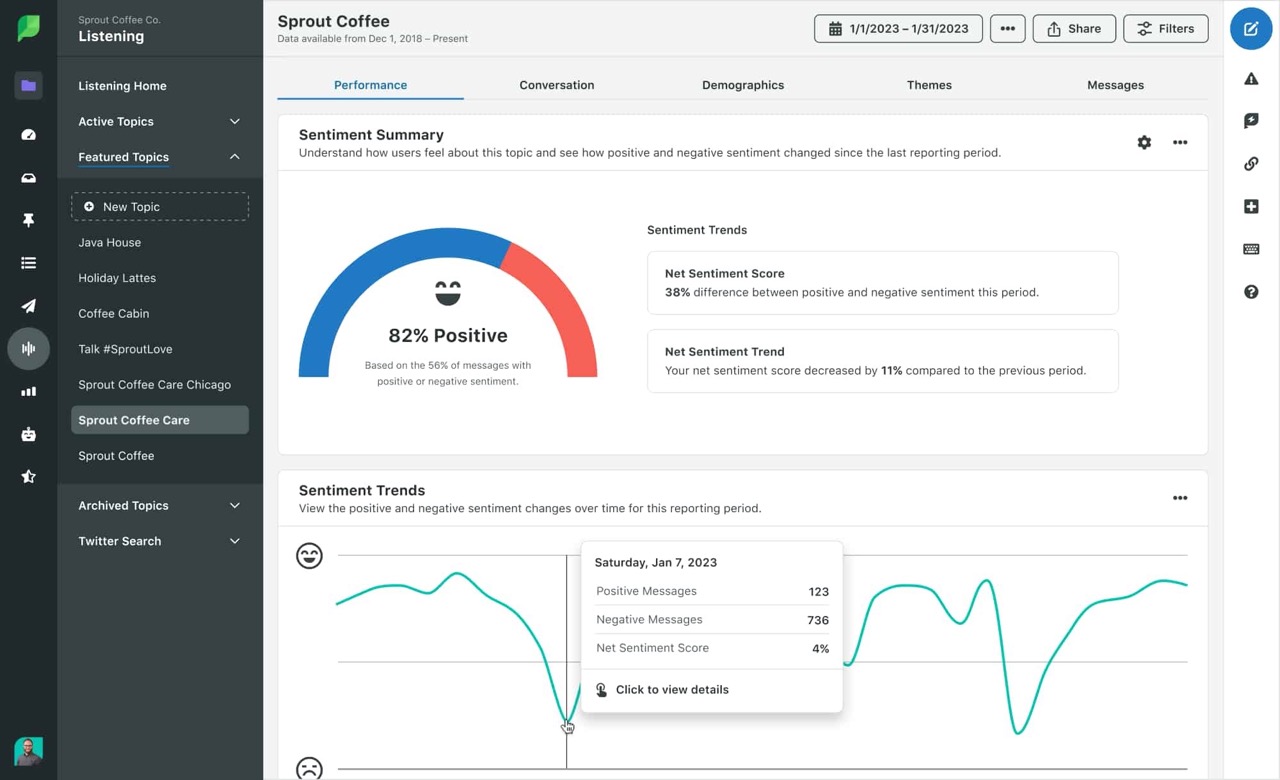
With Sprout Social Listening, your team can explore those conversations by topic, compare themes and track sentiment over time. Use it to investigate recurring frustrations or questions that your content hasn’t addressed.

Sprout Social Listening dashboard displays a sentiment summary with 82% positive sentiment and a chart tracking sentiment changes over time.
Use those findings to make a concrete change. Repeated setup questions might call for a tutorial. Pricing confusion might reveal information missing from your website. Share relevant feedback with the teams responsible for resolving it.

Close the loop by explaining how audience feedback influenced your decision.

3. Choose influencer partnerships carefully

Look for creators whose content and expertise fit your brand. Sprout’s 2026 Influencer Marketing Report found that 47% of consumers consider a creator’s topics when deciding whether to follow them, compared with only 17% who consider follower count. Prioritize relevant expertise and audience fit when building your shortlist.

Examine potential partners’ recent posts, past sponsorships and responses to criticism. Check whether they make accurate claims and disclose paid relationships. These details help you assess their credibility and identify potential brand safety concerns.

Sprout Social Influencer Marketing automates creator evaluation and partnership management. Customizable Brand Safety Reports flag content that needs a closer look, while Creator Hub supports content submissions and approvals.

Once you’ve chosen a creator, give them time to get familiar with your product so they have something meaningful to share. Agree on disclosure requirements and accurate claims, then leave room for their perspective. A demonstration or thoughtful review will be more useful to their audience when it reflects their experience.

4. Amplify user-generated content and employee voices

Invite customers to share how they use your products, then ask permission to feature their posts and credit their work. Choose examples that show the product’s value, such as a customer explaining how it solves a particular problem.

Employees also bring firsthand knowledge to your content. Sprout’s 2026 Influencer Marketing Report found that 46% of consumers most want to hear from frontline employees. Invite employees to demonstrate products or answer questions customers regularly ask.

Make participation voluntary and provide time and support to contribute. Also consider additional compensation: 61% of consumers believe employees should receive extra pay for promoting their company on social.

5. Build a community, not just an audience

Give people ways to connect around interests they share with your brand. Invite them to exchange advice, share their work or help develop an idea. Respond to their contributions and recognize useful discussions.

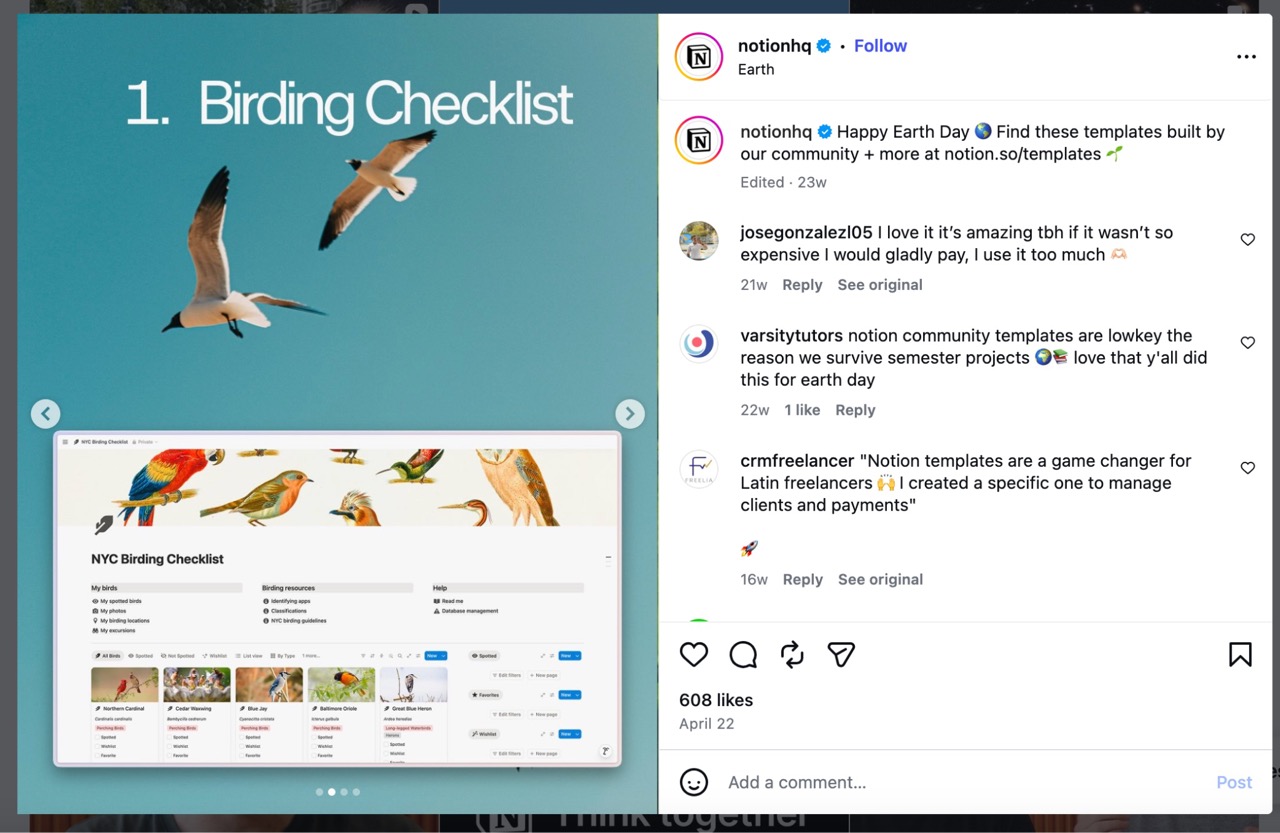
Notion’s Earth Day Instagram post offers an example: it features community-built templates and directs followers to those resources. Members contribute tools other users can put to work, and Notion gives those contributions visibility.

Notion’s Earth Day Instagram post showcases a community-created birding checklist, with comments sharing template experiences.
Start with a recurring activity your team can support, such as a monthly member showcase or an expert Q&A. Keep participating between posts, so people have a reason to return and connect.

Keep trust at the center of your strategy

When you review your social strategy, consider whether each interaction gives people more confidence in your brand. Did your content help someone make a decision? Did your response resolve their concern? Have you delivered what you promised?

These questions keep trust connected to the customer’s experience. Use them to identify what deserves more investment and where your approach needs to change.

For more insight into the voices consumers trust and what they expect from brand partnerships, explore Sprout’s 2026 Influencer Marketing Report.

The post Building trust through social media: 5 ways to earn it appeared first on Sprout Social.


from Sprout Social https://ift.tt/4LUtbxw
via IFTTT

Tuesday, 13 October 2026

Personal branding: What it is and how to build yours

You’ve heard it from mentors, recruiters and that coworker who posts on LinkedIn every morning: You need a personal brand. Truth is, you already have one, because people form a public perception of your brand whether you shape it or not. This guide shows you how to take control of that perception and turn it into real opportunities.

Personal branding once sounded like a celebrity-only game. Today, founders, marketers, job seekers and employees use it to stand out in crowded feeds and earn trust before they ever say hello. It’s how people decide whether to follow you, hire you or buy from you.

Branding yourself feels daunting when you don’t know where to start. But the strongest personal brands are built on who you already are.

You don’t need a massive following, a big budget or a magnetic personality. You need well-defined goals, a sharp sense of your value and the habit of showing up.

Ready to build yours? Let’s dig in.

What is personal branding?

Personal branding is how you present yourself as an individual to your audience. It’s the mix of expertise, values and personality people associate with your name. Our glossary definition covers the short version, and this guide shows you how to build one.

The idea isn’t new. Management writer Tom Peters popularized it in 1997 with his Fast Company essay “The Brand Called You.” Social media turned his idea into something anyone with a phone can act on.

Think about how corporate branding works. We associate specific feelings, values and expectations with brands we trust. Every company has a story and image.

The same applies to you and your personal brand. The difference comes down to who owns it, how it sounds and what it’s for.

Personal branding

Corporate branding

Focus

You as an individual

A company, product or service

Owner

You

The company’s marketing and leadership teams

Voice

First person, shaped by your experiences and opinions

A shared brand voice guided by style guidelines

Goal

Trust, influence and opportunities for you

Awareness, customers and revenue for the business

Where it lives

Your social profiles, newsletter, talks and portfolio

Brand social accounts, website, ads and packaging

People often treat personal branding as a synonym for being an influencer. It doesn’t have to be. A software engineer, a nurse and a small business owner can each build a personal brand without chasing fame.

Your brand should highlight your human side. Voices and personalities set brands (and people!) apart. Branding yourself means aligning your online persona with your real-life one.

Building your brand goes beyond just marketing yourself. Here are the key pieces of a personal brand:

  • Voice and values. That is, what you say and what you believe. Your brand voice shouldn’t be one-size-fits-all or robotic.

  • Content. What you create, and how you present it, attracts your audience. If you write long-form newsletters, mastering Substack SEO gets those deep dives discovered by new readers.

  • Creativity. You don’t need to be a creative genius to build a personal brand. But some sort of creative trademark helps you stand out from the crowd.

  • Personality. There’s no one-size-fits-all personality type for your brand. Energetic, laid back or suit-and-tie, you do you.

  • Authenticity. Your personal brand shouldn’t feel manufactured or made up. Align your online persona with who you are offline and your brand will never feel forced.

Why is personal branding important?

Here is why building a personal brand is worth the effort.

Standing out from the crowd

The people who’d benefit the most from a personal brand are often focused on building something else. A company, art, you name it.

Like it or not, everyone’s a content creator now. That means who we are and what we make are often one and the same.

Among the countless creators and marketers out there, growth is daunting. Your audience only has so much attention to give.

With a compelling brand and consistent content, you give yourself a chance to shine. People don’t grow audiences or garner influence by accident. And both your personal brand and what you create sit within your control.

Relatability and authenticity matter to modern audiences

According to The 2025 Sprout Social Index™, consumers rank authenticity and relatability as two of the three most important brand content traits. Apply the same logic to individuals. This matters even more in an era where “influence” can feel manufactured.

That’s your edge as an individual. Nobody else has your experiences, your opinions or your sense of humor.

Making stronger connections with your community

Your voice and values shape your ability to grow your audience. Putting your personality front and center attracts like-minded followers.

That also means engaging with your audience to understand their needs and challenges. This goes hand in hand with establishing trust and building meaningful relationships.

When followers feel seen, they comment, share and come back for more. That’s how an audience becomes a community.

Opening doors to career and business opportunities

A strong personal brand puts your expertise on display before anyone asks for it. Recruiters, clients, collaborators and event organizers find you, instead of the other way around.

The 2025 Edelman-LinkedIn B2B Thought Leadership Impact Report found that thought leadership builds trust and opens doors where ads and traditional sales methods fall short. When you share your expertise in your own voice, you become the kind of thought leader buyers want to hear from.

What makes a strong personal brand?

A strong personal brand is specific, consistent and rooted in real value. Before you post anything, get well-defined answers to these questions.

  • Purpose: Why you’re building a brand at all (a new role, clients, a community or a product launch).

  • Niche: The narrow topic you want to be known for. Precision is memorable and breadth is forgettable.

  • Audience: The specific people you want to reach and the problems they need solved.

  • Value: What you give that audience that no one else does (expertise, perspective, entertainment or community).

  • Story: The experiences that explain why you care and why people should listen to you.

Pull those answers into a short personal brand statement. For example: “I help early-stage founders turn customer conversations into content that sells.”

Use that statement as a filter. If a post, bio or partnership doesn’t support it, skip it.

What are examples of successful personal branding?

Anyone can build a personal brand—not just celebrities. In fact, employee advocacy and personal branding overlap every time employees post on behalf of their brands.

Here are a few examples of people who’ve built personal brands across industries:

  • Founders like SparkToro co-founder Rand Fishkin. Rand has keynoted hundreds of marketing and tech events, and his research has been cited by outlets like the Wall Street Journal, according to his SparkToro bio. In a 2020 interview, he said personal branding comes in two varieties: brands that grow up around people as a byproduct of building something, and personas people construct on purpose, which can feel authentic or inauthentic.

  • Twitch streamers like Pokimane. With more than 9.46 million followers as of June 2026, she’s the most-followed female streamer on Twitch. Her brand travels well beyond Twitch, too, with millions of followers on TikTok, YouTube, Instagram and X (formerly known as Twitter).

  • Celebrities like Dwayne Johnson. Despite being one of the most famous celebrities in the world, Johnson isn’t afraid to give a peek into his personal life. In a May 2023 Instagram post, he opened up about mental health and urged men to take theirs seriously.

  • Politicians like Maxwell Frost. Frost is making a name for himself as the first member of Gen Z elected to Congress. His candid posts and sense of humor signal a new brand of politician that’s far from the norm.

How to build your personal brand in 7 steps

Brand-building takes conscious effort. Here are seven actionable steps you can take to get yours off the ground.

1. Figure out where your brand stands today

Building a successful personal brand means having a following. After all, followers validate that what you’re doing is valuable to others.

It’s a classic chicken-and-egg problem: you need followers to establish a brand, but you can’t establish a brand without followers.

So start from square one by asking yourself:

  • How many followers do you have right now?

  • What communities can serve as the basis for a bigger audience?

  • Where am I most active? Where is my audience most active?

  • What are my goals? Followers, traffic, sales?

Then run a quick personal brand audit to see what other people see:

  • Search your name and note what shows up first

  • Review every profile and bio for outdated or mismatched details

  • Ask a few trusted peers for three words that describe you

Compare their answers to how you want people to see you. The gap between the two is your starting point.

To avoid spreading yourself thin, we recommend prioritizing growth on one platform at a time. Having a presence is one thing, but building a brand on a platform is serious work.

2. Choose your audience and platforms

Your personal brand can’t speak to everyone. Pick the specific people you want to reach, then go where they already spend their time.

Each social media platform rewards a different kind of content. Use this table to match your audience and strengths to the right home base.

Platform

Best for

Content that works

LinkedIn

B2B professionals, executives and job seekers

Industry insights, career lessons and text posts

Instagram

Creators and lifestyle or visual niches

Reels, carousels and Stories

TikTok

Reaching new audiences with entertainment and education

Short-form video, tutorials and trends

YouTube

Deep-dive education and evergreen search traffic

Long-form tutorials, explainers and Shorts

X

Real-time commentary and industry conversations

Quick takes, threads and live event posts

Threads

Casual conversation and community building

Text-first posts, questions and replies

Substack

Long-form thought leadership and an owned audience

Newsletters, essays and podcasts

Start with the platform where your audience is most active and your strengths shine brightest. Add a second one once your first feels like a habit.

3. Brainstorm ways to provide value to your audience

Followers and clout don’t happen by accident.

What value you provide varies depending on your industry and audience. In most cases, building a unique personal brand means creating something, well, unique. New ideas and resources. That includes:

  • Educational content (tips, tutorials, how-tos)

  • Personal anecdotes and experiences

  • Ratings and reviews on products or brands relevant to your audience

  • Original artwork or music

  • Fresh perspectives and opinions

  • Motivational content

Don’t sweat your follower count. Data from the 2026 Sprout Social Influencer Marketing Report shows only 17% of consumers check a creator’s follower count before deciding to engage. Audiences prioritize subject relevance and content style instead.

You need to create something that highlights your value and influence. People need a reason to follow you. Creating valuable content on a steady schedule is how you start.

4. Be consistent when putting yourself out there

Creating value is only half the equation—consistency makes it stick.

Building your brand means maintaining your brand, too. Sharing and creating content on a regular basis is a must-do. You can’t let your account gather cobwebs, and the same goes for responding to comments from followers.

Staying consistent takes sustained effort, and it’s what separates a personal brand from a one-off post.

If your audience is split across Instagram and TikTok, you must adapt to each platform’s publishing frequency. Maintaining that cadence takes dedicated effort.

Growing across platforms is easier with social publishing tools like Sprout Social. Scheduling and cross-posting means you can publish to multiple platforms at once. That means less chaos and no need to bounce between apps.

Social media publishing Sprout

Consistency also matters when it comes to your personal branding across platforms. This is where your creatives like logos and color schemes come into play.

example of consistent personal branding

5. Prioritize trust, authenticity and relatability

Building a personal brand doesn’t require a magnetic personality. You can be introverted or even “quiet” and still build a valuable brand.

The key is being relatable and real. That means sharing content and experiences that speak to your audience. Think challenges you overcame or resources that solve a problem.

Before posting anything related to your personal brand, always ask yourself:

  • “How does this build trust?”

  • “Am I being real with my audience?”

  • “Who does this post or piece of content speak to?”

If you can confidently answer all three, you’re ready to post.

6. Measure what’s working and adjust

Personal brands evolve, and your strategy should, too. Check your results every month and double down on what works.

Focus on the signals that tie back to your goals:

  • Engagement: Comments, shares and saves show whether your content resonates.

  • Follower quality: New followers should match the audience you chose in Step 2.

  • Profile visits: Rising visits signal that your posts make people curious about you.

  • Inbound opportunities: Job offers, client inquiries and speaking invites are the clearest proof your brand works.

Pay attention to the conversations you’re not tagged in, too. Social listening surfaces mentions of your name, your niche and the topics you want to own across public networks.

Sprout’s social media analytics pull performance from your connected profiles, including LinkedIn personal profiles, into one place, so you spot trends without juggling spreadsheets.

7. Be conscious about avoiding brand burnout

Personal branding is a long game. Protect your energy so you can keep showing up.

  • Don’t make personal branding too personal. There’s a fine line between being vulnerable and oversharing. Set boundaries for what you’re willing to put out there.

  • Don’t overdo it. As your brand grows, you’ll feel pressure to post more. Don’t sacrifice quality for quantity.

  • Don’t overthink it. “Be yourself” sounds like cliché advice. But brand authenticity matters and people can tell when you’re faking a persona.

How do personal brands drive business value for brands?

Personal brands don’t stop at the individual. When employees and executives build credible voices on social, the brands they work for gain reach and trust they can’t buy.

The 2026 Sprout Social Influencer Marketing Report shows 40% of consumers discover new products or services through employee-generated content every month. Audiences also find frontline workers more authentic than polished brand accounts.

  • Executives: Leaders who post about industry challenges and brand values build trust with buyers, investors and candidates. Our guide to LinkedIn for executives shows you where to start.

  • Employees: Subject-matter experts extend reach to audiences a brand account never reaches.

Infor proves it at scale. After rolling out Employee Advocacy by Sprout Social, the company onboarded 1,500 employees in a single day. It generated $100K in earned media value in one month.

How are you building your personal brand?

There’s no universal rulebook for building a personal brand—and that’s your biggest advantage. It’s entirely unique to you.

Don’t let the process intimidate you. Start by sharing helpful content in your authentic voice, and build from there.

Sticking to the steps above puts you on the right track. If you haven’t already, check out our 30-day social media plan to jumpstart your branding journey.

Ready to see which posts grow your brand fastest? Start a free trial or request a demo to explore the platform’s features.

The post Personal branding: What it is and how to build yours appeared first on Sprout Social.


from Sprout Social https://ift.tt/IX29OFq
via IFTTT