Monday, 6 July 2020

Grammar for marketers: how to mind what your brand says

The importance of grammar for marketers can’t be overstated.

Sure, you probably haven’t thought much about sentence structure or punctuation since high school.

That’s what autocorrect and grammar-checkers are for, right?

But errors can still run rampant despite such tools. Grammar mistakes on social media are particularly tricky when your message has gone live and you have no way to click “undo.”

Consider also how grammar slip-ups beyond social media (think: email, print, sales pages) can hurt your brand’s credibility. This is especially true if you have to make constant corrections.

The good news? You don’t have to go back to the classroom to get your grammar on.

In this guide, we’ll break down the basics of grammar for marketers and crucial rules to follow (and some you can break).

Why is grammar important for marketers?

So, why does grammar matter so much for marketers? Consider the following reasons, for starters:

Grammar goes hand in hand with clarity

No surprises here. Whether it’s a tweet, sales letter or something in-between, just about any marketing message gets muddled without good grammar.

How so? For example, something as simple as a comma splice or run-on sentence can cause confusion in your copy. Forcing readers to re-read and do double-takes isn’t good news for converting customers.

Clarity is particularly important for global brands and non-native speakers trying to wrangle the complex grammar rules of other languages.

Proper grammar makes you look more credible

This is the big one.

Think about it. Let’s say you come across a grammar error in a marketing email. You might pick up on it or gloss it over without a second thought.

But let’s say it keeps happening. You’d rightfully be skeptical of a brand that didn’t bother to proofread their campaigns, right? Errors raise questions about their sense of professionalism and attention to detail, too.

On the flip side, companies are expected to put out error-free content and copy. It’s when they don’t that people typically start to notice.

If you’re making careless grammar errors, people will call into question what else your business might be overlooking. This might be a bit of a leap in logic, but it’s understandable.

On that note, a one-off grammar mistake isn’t going to kill your business. Repeat errors are bad news, though.

Good grammar equals greater accessibility

For brands concerned with accessibility, grammar is critical.

This statement from MailChimp highlights how much clarity matters for readers with disabilities:

About 15% of the world’s population lives with a disability. That’s one billion people. Of those billion people, 285 million are visually impaired and may use a screen reader to access web content.

These assistive devices use page elements to navigate web and email content, and read text aloud.

For those living with disabilities, accessible content isn’t just about convenience, it’s about necessity.

Brands should embrace accessibility and empathy. This means that all of your audience is able to read your messages without any roadblocks.

How to avoid grammar errors and mistakes as a marketer

Again, getting a grip on grammar for marketers doesn’t require a bunch of memorization or complicated rules.

Here are some tips and resources to consider to help you level up your grammar without having to crack open a textbook.

Take advantage of proofreading tools

Chances are you’re doing this already. Tools such as Grammarly are must-haves for marketers looking to quickly catch common errors in social posts, blogs and emails.

The platform’s browser plugin automatically picks up on issues without having to leave whatever you’re writing.

Tools like Grammarly are practically universal when it comes to grammar for marketers

Tools like the Hemingway Editor are perfect for double-checking the readability of your marketing copy. Anything you can do to increase the clarity of your copy is a plus.

Similar to Grammarly, tools such as Gramara are perfect for non-fluent English writers looking to make sure their copy makes sense.

Tools like Gramara are particularly useful when it comes to grammar for marketers who are non-fluent English writers

However, grammar for marketers is about more than just installing a grammar plugin and calling it a day.

By paying close attention to your apps’ suggestions, you can actually learn what a comma splice is and stick to subject-verb agreement rules. Using grammar tools as a crutch doesn’t help much in the long-run.

Share your copy among your team for a “second opinion”

Listen: nobody is immune to errors.

The more teammates that are able to scan your copy, the easier it is to catch mistakes.

Collaborating on your copy also serves as a sort of “second opinion” on your message. Just because something makes perfect sense in your head doesn’t necessarily mean its clear on paper.

And much like blog posts and presentations typically go through a back-and-forth editing process, so can your social media posts.

That’s why many brands today have a dedicated social media approval process that requires messages to be reviewed and refined. With tools like Sprout Social, you can stick to a collaborative process that doesn’t require you to bounce between email chains. Instead, you can approve messages within a single click.

Improving grammar for marketers means allowing multiple people to view your messages, such is the case with approved posts in Sprout

Establish a style guide (and make it shareable)

Another important piece of grammar for marketers is sticking to a dedicated style guide.

In short, the function of a style guide is to provide a reference point for your marketing messages. This includes specific instructions that break down the following:

  • How to speak to your target audience
  • What your brand voice should be (think: humorous, serious)
  • Terms you should and shouldn’t use

Having a style guide handy gives you and your colleagues a consistent reference point for how to talk to your audience. You can likewise create a secondary style guide for those outside your organization (think: agencies, creatives, contractors) so they don’t mix up your messaging, either.

When is it okay to break grammar rules?

Don’t worry: we’re not in school.

Grammar for marketers is largely situational and you don’t always stick to rigid rules. Let’s look at some examples:

When it’s okay

If your brand voice is informal or humorous, strict grammar isn’t make-or-break. Throwing around slang and text-speak is a-okay in social posts.

For customer support, grammar is somewhat of a gray area. We recommend sticking to proper grammar when dealing with more serious issues, but quick shout-outs and “thank yous” don’t need to pass any tests.

When it’s not okay

Bear in mind that there are some situations where you probably shouldn’t play loosely with grammar rules. This includes:

  • Marketing emails
  • Product descriptions
  • Product page and service pages
  • Presentations and reports
  • Public statements and apologies
  • Internal documentation

These sorts of messages should ideally be clear and error-free for the sake of professionalism.

5 grammar rules that marketers can break

To wrap things up, let’s look at some examples of traditional grammar “rules” and situations where marketers can break them.

Active vs. passive voice

If you’ve ever had to write a blog post, chances are you’ve been hammered on and on about the need for active voice versus passive voice.

Active voice: “A new business opened…”

Passive voice: “A new business has been opened…”

In short, statements using active voice feel more immediate, actionable and to-the-point. On the flip side, passive voice often results in needlessly lengthy and drawn-out statements.

Although most marketing messages are written in active voice, there are situations where passive voice makes sense. For example, tutorials or step-by-step guides often require statements in the passive voice (think: “This feature can be used to…”).

The takeaway? Passive voice doesn’t automatically mean that your copy is “wrong.”

Contractions (think: “can’t” vs. “cannot”)

Contractions are conversational. They represent a subtle way to keep your messages from sounding needlessly robotic.

Brands should talk naturally and speak their customers’ language. Sprinkling contractions throughout your marketing copy allows you to do so without your messages losing their meaning.

“I don’t think so, but that shouldn’t be a problem!”

“I do not think so. That should not be a problem.”

Heck, you’d be hard-pressed to find a brand that doesn’t use contractions.

Beginning a sentence with a preposition

But why?

Beginning sentences with prepositions (think: “but,” “and” or “with”) might be a pet peeve of your editor. That said, doing so is totally fair game in social posts or blogs.

We often see prepositions kickoff sentences in marketing copy, much like this section from Slack’s homepage:

an example of slack using a preposition at the beginning of a sentence on their website

Slang

Whether or not you should rely on slang depends largely on your industry. Many companies do, especially those marketing to Gen Z and other younger crowds.

Much like contractions, slang makes your copy more conversational and conveys a casual tone to your audience.

That said, relying on slang too much might make your message seem out-of-touch or otherwise trying too hard. When in doubt, use slang sparingly.

Sentence fragments

Sentence fragments (think: “In the car” or “At home”) are actually used frequently in marketing copy.

Punchy and easy to understand, fragments often simplify your message and highlight key features of your product without too many details.

Here’s an example from Evernote’s homepage:

an example of active voice used on evernote's website banner

These types of messages are likewise effective on social media where posts are typically on the shorter side, anyhow.

And with that, we wrap up our guide!

Have you mastered grammar for marketers?

Improving your grammar skills might not seem like a priority.

But the short answer to why grammar is important for marketers? It makes your messages easier to understand.

Going through the effort of doing so makes sense for brands in just about every industry. Meanwhile, the process of coming up with a style guide ensures that your marketing messages are crystal clear no matter who’s writing them on behalf of your business.

Speaking of which, make sure to check out our how-to on coming up with a social media style guide yourself!

This post Grammar for marketers: how to mind what your brand says originally appeared on Sprout Social.


from Sprout Social https://ift.tt/2BynhGh
via IFTTT

The science behind why everyone is angry on Twitter on Mondays


The link between hot weather and aggressive crime is well established. But can the same be said for online aggression, such as angry tweets? And is online anger a predictor of assaults? Our study just published suggests the answer is a clear “no.” We found angry tweet counts actually increased in cooler weather. And as daily maximum temperatures rose, angry tweet counts decreased. We also found the incidence of angry tweets is highest on Mondays, and perhaps unsurprisingly, angry Twitter posts are most prevalent after big news events such as a leadership spill. This is the first study to compare…

This story continues at The Next Web

from Social Media – The Next Web https://ift.tt/3grOMQs
via IFTTT

Wednesday, 1 July 2020

WhatsApp officially announces QR codes and animated stickers


WhatsApp today announced a slew of new features that are set to roll out “over the next few weeks.” While we’ve heard about some of these for a while, it’s nice to get official confirmation. The most notable addition is likely the ability to add contacts via a simple QR code, similar to the feature Snapchat introduced many moons ago; it’s a feature we’ve been hearing about since 2018. While people aren’t meeting up in person all that often these days because, you know, coronavirus, it’s a handy feature to have so you don’t have that should save some time…

This story continues at The Next Web

Or just read more coverage about: WhatsApp

from Social Media – The Next Web https://ift.tt/31zwkRH
via IFTTT

How to master social media for retail and win more customers

Retailers arguably have the most to gain from social media marketing.

And despite popular belief, social media isn’t killing retail: it’s simply encouraging the space to evolve.

Recent data from the most recent Sprout Social Index should serve as a wake-up call for retailers skeptical about what social media is worth. Whether it’s a digital or in-person purchase, social followers signal potential business for brands of all shapes and sizes.

actions consumers take when following brands on social - including 89% that buy from the brand

The takeaway from these stats? Social media for retail is centered around the customer journey.

Maybe someone’s learning about your brand for the first time. Perhaps you’re looking to reach former or current customers.

Either way, retailers need to create a social customer journey that encompasses all of the actions above versus only acquisition or attention.

Social media for retail: how to create a compelling customer journey

The beauty of social media for retail is that you can engage with people at just about any point of the customer lifecycle.

But therein lies the challenge of social media marketing for retailers, too.

To make the most of your campaigns, it’s crucial to understand the tactics and strategies that are proven to work among today’s top retailers. In this guide, we break down social media for retail and what brands need to do to map out that ever-so-important customer journey.

1. Adopt an omnichannel social presence

Retailers can’t afford to stick to a single social platform.

While putting all of your efforts into one channel might keep you from spreading your resources thin, doing so also means leaving money on the table.

Literally.

And yes, recent stats point to just how important Instagram is for retailers today in terms of social selling. That said, there’s more to social media for retail than the ‘gram.

Let’s take a quick dive into how retailers can spread their social presence across multiple platforms while taking advantage of each channel’s strengths and best practices.

Lululemon manages to tick all the boxes of what it takes to run a thriving brand account on Instagram. Stunning product photos? A distinct brand voice? Clear calls-to-action to entice customers? It’s all there in black-and-white.

Meanwhile, Lululemon also takes advantage of paid Facebook advertising while also double-dipping their Instagram content. This Facebook ad provides a glimpse of how retailers can roll out a hybrid social media strategy that features paid ads in addition to organic content.

In addition to organic social media, Lululemon runs paid social ads

Lululemon has also managed to master Pinterest for business, promoting pins and inspiration boards featuring their products. Although some retailers might sleep on Pinterest, the product is a well-documented hotspot for consumers to research potential purchases.

Lululemon is a shining example of a retailer with an active Pinterest presence

And of course, the brand is also active on Twitter to cross-promote content, address customer service concerns and give customers shout-outs just because.

To ensure that you’re hitting up every segment of your potentially fragmented audience, it’s important that you have a strategy for promoting content between platforms. Sprout can help with that through social scheduling that not only lets you cross-promote content, but time your promotions based on optimal engagement.

social media for retail means publishing to multiple platforms at the same time - Sprout can help with that

2. Use social media to supplement your existing marketing campaigns

This might seem like a no-brainer, but so much of social media for retail means finding ways to mesh your social presence with existing paid campaigns.

Running a promotion? Launching a product? Time-sensitive offers? No matter what you’re pushing, you can’t afford for your followers to be in the dark or assume they’re going to learn about your promos elsewhere.

Some brands might be wary of pushing products to hard on social media. That said, the majority of consumers‘ purchasing decisions are influenced by the brands they follow.

Additionally, consistently publishing coupon codes, offers and discounts is fair game for encouraging impulse buys. If nothing else, striking product photos are prime Instagram content that doesn’t come off as “salesy” if they’re presented with some creative flair. Check out how ShopBop makes it happen.

Speaking of cross-promotion, consider that any given retailer’s email list is their bread and butter for encouraging repeat business. With an engaged email list and social following, brands have more opportunities to nurture customers and keep them in the loop about their latest promotions. Here’s how ShopBop puts their Instagram feed front-and-center via their email newsletter.
Shopbop has a social media marketing strategy for retail that also meshes with their email campaigns

3. Gather feedback from your social customers

Of course, social media for retail isn’t just as simple as blasting offers and deals.

Although customers are more than happy to follow retailers in pursuit of a sale, your long game should be to sell your brand beyond your products.

This means figuring out your brand identity and making connections with customers. Perhaps one of the easiest and most effective ways to do so is through asking questions.

What sort of products do people want? What sort of content do they want to see? Whether through Instagram Stories or question-based posts, picking people’s brains is easier than ever. Additionally, question-based content encourages replies and interactions which are like candy to modern social algorithms.

The feedback gathered from customers can not only inform your content and product strategies but also serve as a break from purely promotional content. Retailers like Best Buy do an awesome job of asking playful questions while subtly featuring their products at the same time.

See how that works?

4. Dedicate time to providing social customer service

Food for thought: customer service concerns are among the top reasons that consumers engage with retailers on social media.

And so if you’re equipped to handle such concerns, you’re golden. Consider that there is no “one-size-fits-all” for customers to reach out, though. Here’s a snapshot of why customers reach out to retailers via our Sprout Social Index.

index chart - why people reach out to brands on social

Effective social media for retail means listening and responding to customer concerns with care. This means both personalizing your replies while also responding in a timely manner. As noted in our guide to Twitter customer service, 60% of people expect a response within an hour.

Don’t think of responding to such concerns as customers being needy, though. The ability to respond with grace spells good news for your brand as you strive to keep customers around for the long-haul. Check out how Publix manages to address a reasonable concern while still scoring a “Like.”

In fact, companies like Publix have managed to make stellar customer service part of their online identity.

Social customer service isn’t just about addressing questions and complaints. Customer care also means giving customers shout-outs to highlight their positive experiences. As noted by our data, that’s the top reason why customers reach out: capitalize on those moments and let them serve as social proof for your brand.

The more you’re able to highlight your satisfied customers, the better.

The takeaway here is that customer service can’t be an afterthought for retailers. Through consistent monitoring and social listening, you can make sure those precious mentions don’t fall by the wayside.

5. Listen for trends to influence your product and content strategies

Speaking of listening, social media retail trends are constantly changing.

Brands are constantly experimenting with new ways to engage with followers. At the same time, competitors and new products are constantly flooding any given retail space which speaks to the need for brands to have a strong pulse on their industries.

Sprout’s social listening suite includes a query builder where brands can easily monitor mentions, hashtags and industry-related keywords to better track what customers are buzzing about.

Listening is crucial for brands looking to stay on top of social media retail trends

More advanced listening features in Sprout can also help retailers monitor their brand sentiment and mentions to ensure healthy, positive growth in engagement over time.

Sentiment analysis can help retailers better understand how customers feel about their brand

Beyond questions and concerns, your customers can be a goldmine of business intelligence on social media. It’s all a matter of making sure you’re listening, though.

6. Curate user-generated content to promote your satisfied customers

Easily one of the biggest needs when it comes to social media for retail, brands need to be on the hunt for user-generated content (UGC)

Even retail giants like Target (with nearly 4 million Instagram followers) rely on UGC to show off their products.

Customer photos are noted to increase conversions and engagement among social followers. Your customers want to talk about their latest purchases, granted you give them a chance to do so.

For example, Target encourages followers to @mention them within posts which allows followers to be featured in their feeds.

Retail giants like Target encourage followers to share user-generated content

Meanwhile, Anthropologie uses the branded hashtag #myanthropologie to entice customers to post their photos.

Retailers like Anthropologie encourage followers to share user-generated content

Whether it’s for an influencer marketing campaign or simply encouraging UGC, retailers these days are expected to create their own hashtag to encourage organic promotion on behalf of their followers. Doing so provides yet another avenue for customers to engage with your brand and vice-versa.

7. Make social shopping as seamless as possible

As noted by the number of brands totally killing social media for retail, encouraging purchases directly from social media is more than possible.

However, it’s not as simple as dropping product links and walking away.

If you want to increase your social media conversion rate, you’re going to need to make shopping a seamless experience.

For example, let’s look at how easy Crate and Barrel makes shopping their Instagram feed. Their bio link call-to-action is loud and clear, as is their social-specific landing page which makes it a cinch to browse products.


Retailers use their Instagram bios to drive business

Ideally, you want to keep your customers moving from Point A to Point B rather than bouncing between a bunch of links and re-directs. Even if you don’t use a third-party tool for social shopping, making your social landing pages scrollable and mobile-friendly is a must-do.

Social media for retail means creating a seamless shopping experience

Additionally, note that social platforms are constantly rolling out new shopping and advertising features tailored for social media for retail. For example, the roll-out of Instagram checkout signals how networks are trying to make it easier for brands to encourage purchases. Here’s a snapshot of the feature from Crate and Barrel’s feed.

Shoping directly via posts is a growing social media trend for retail brands

8. Remarket to current and former customers

Of course, we can’t talk about social media for retail without discussing paid ads.

With social algorithms seemingly cracking down on purely promotional organic posts, running ads allows retailers to appeal to customers without running the risk of spamming them.

The good news is that retailers can personalize and target their advertising like never before. Brands can run campaigns to prospect for new customers or reach out to returning customers simultaneously.

For example, Facebook and Instagram’s dynamic ads can reach former customers or folks on your email list who you’re looking to reactivate. Such ads serve as a cost-effective way to reintroduce your brand to customers and are likewise noted for their high ROI. This retargeting campaign from Gathre resulted in a staggering 91% return on ad spend.

Paid social media for retail such as Facebook ads are perfect for encouraging repeat customers

9. Don’t forget your physical packaging

If you’re a retailer, you have a distinct opportunity to make a lasting impression on your customers in-person.

This can be done by combining your social presence with your physical packaging if possible. From stickers and business cards to quite literally wrapping up your products with your social handles, there are tons of creative ways to couple social media with in-person promotion. Here’s an awesome example from Vistaprint.

Even something as simple as a branded business card snuck into your shipped orders is a smart move. Retailers can’t be shy about promoting their social presence and in-person creatives are one of the most meaningful ways to do it.

10. Increase your customer lifetime value over time

The end-game of social media for retail is to nurture customers and encourage them to become long-term shoppers.

In other words, you can’t afford to solely focus on acquisition. Growing your follower count is nice, but ask yourself: is your social presence resulting in long-term engagement and purchases?

If someone is willing to follow your brand, they’ve already signaled their interest to make a purchase. This highlights the need to promote offers while also connecting with a diverse content calendar. As noted by the examples above, retailers have a ton of creative options available for regularly engaging their target audiences.

At the same time, think about how you can increase what your social following is worth over time.

Ramp up your efforts during the holidays where consumer spending is at an all-time high. Run influencer marketing and UGC campaigns. Try your hand at social ads.

And along the way, make sure you’re keeping a close eye on engagement via social analytics. By tracking your growth and engagement by the numbers, you can better understand what’s encouraging purchases from your followers over time.


Sprout Social's reporting makes it easier for retailers to understand the ROI of their social campaigns

And with that, we wrap up our guide!

How are you using social media for retail?

There’s no denying that retailers have their hands full in terms of their social presence.

But as we said, retailers have the most to gain from social media at large.

From uncovering new customers to increasing the value of the ones you already have, the amount of creative business opportunities available to retail brands on social media is seemingly endless.

And with the help of tools such as Sprout Social, brands can run and monitor their campaigns by-the-numbers to win more customers along the way.

We want to hear from you, though. What do you see as the future of social media for retail? Any challenges that you’ve faced in pursuit of more business? Let us know in the comments below!

This post How to master social media for retail and win more customers originally appeared on Sprout Social.


from Sprout Social https://ift.tt/2w2WEjZ
via IFTTT

How to run a successful Instagram contest

There are many reasons you might want to run an Instagram contest, whether you’re looking to quickly grow your online presence or simply want to give back to your followers.

But there are some rules and guidelines you need to keep in mind if you want to host an Instagram contest to ensure that it’s both legal and successful.

To help make sure you put on the best Instagram contest possible, we’ve put together this guide on how to run an Instagram contest that your audience will be excited to enter and share. Let’s dive in!

Instagram contest rules

First things first, we need to go over Instagram’s rules and legalese. You may have noticed that most Instagram contests or giveaways come with an extra long caption with lots of fine print.

This is because Instagram has a lot of rules and guidelines in place to ensure they’re released from any liability in case any party doesn’t follow through with their end of the deal.

Here’s a quick summary of the most important points in Instagram’s contest rules:

  1. You are responsible for the lawful operation of your Instagram contest.
  2. Avoid inaccurate tagging in photos.
  3. Include a complete release of Instagram by each entrant, as well as copy clearly outlining that your contest is in no way, shape or form sponsored by Instagram.
  4. Instagram will not assist you with your contest.
  5. You run an Instagram contest at your own risk.

You can read the full policy here, but basically, Instagram is making sure you know they’re not liable, and that you make sure your followers know that Instagram is not liable, regardless of how your contest pans out.

Instagram contest ideas and examples

So you’re ready to start planning for your Instagram contest. But how exactly do you want to have people enter, and what are the benefits for your overall marketing strategy? There are several different types of contests you could run, so we’ve put together a list of our favorites for you to choose from.

1. Like, comment and follow

One of the most popular methods of entry is to have people like your photo announcing your Instagram contest, leave a comment and follow your account in order to gain entry.

Here’s a great example of this type of Instagram contest put on by CAUSEBOX.

instagram contest - causebox contest example

Simply name your prize, lay down the ground rules and watch the entries fly in. You can ask people to comment with why they should win, nominate someone to win or simply tag a friend to spread the word.

However, that last option is a great contest idea all on its own–read on for more ways to make tagging friends in contest work effectively.

2. Tag a friend

Want to really get the word out about your Instagram contest? Ask people to tag a friend when they enter! Users can tag as many friends as they like in order to get even more entries.

Then, those users are likely to enter and tag some of their own friends, creating a ripple effect of awareness around your contest and brand.

You can also host a tag a friend Instagram contest in order to ask your followers to nominate someone who deserves a prize, like in this example below, run by doll10beauty.

instagram contest - doll10beauty contest example

In this example, they asked followers to tag a doctor, nurse, grocery store worker or another essential worker who has been going to work non-stop through the COVID-19 pandemic.

This is a great way to thank people who have been working hard to help others, as well as grow your customer base at the same time.

3. User-generated content

If you’re looking to put together a campaign around gathering user-generated content (UGC) to share online, creating an Instagram contest around that concept can be a great way to do it.

Ask your audience to share a photo onto their feed using a specific hashtag or tagging your business so that you can easily find all of the entries in one place.

Not only does this reward your customers for helping you out, but it gives you an entire arsenal of user-generated photos to share on your feed for future content planning.

4. Collaboration

Another great way to broaden your audience is by collaborating with a similar brand involved in a contest together.

If you go this route, users will then have to follow each brand going in on the contest together in order to enter. Here’s an example of what this might look like from Ring Concierge and Elemis.

instagram contest - ringconcierge contest example

Many influencers also host collaborative giveaways like this, meant to help their followers discover new brands and bloggers, and vice versa.

If you’re working to grow your Instagram presence, a collaborative contest or giveaway might be your best bet.

5. Instagram stories

While Instagram contests are all about giving back to your audience, there are important benefits for your overall Instagram marketing strategy too: brands can garner a lot of attention and generate a bigger audience through them as well.

Having your audience share a post on their Instagram Stories as a form of entry can be another great way to get the word out there.

It’s super easy for users to share posts to their Instagram Stories, so asking for something like this as an entry isn’t asking too much of your audience, and can be a great way to spread the word.

How to run an Instagram contest

Now that we’ve covered a few great Instagram contest ideas, let’s take you through a quick step-by-step guide on how to actually run your contest or giveaway.

1. Define your Instagram contest objective

Before anything else, you need to make sure you define the overall objective of your Instagram contest so that you know how to determine whether or not it was successful in the end.

Are you trying to engage your audience more in your content? Are you aiming to generate a larger following? Is your plan to build a library of UGC to share on social media?

Whatever your main goal or objective is, keep it in mind throughout your entire contest planning process so that everything you do makes sense for your end goal.

2. Choose your entry method

How will users enter your Instagram contest? Think back to the examples we shared above. Which falls most in line with your main goal or objective?

Be sure that whatever you choose, it’s easy for people to enter your contest. No one is going to enter a contest that requires them to do a lot of work–people want your entry process to be simple and easy.

Once you decide the best entry method for your contest, it’s time to start planning out the rest of the details.

First, determine how long your Instagram contest will last. How many days will your audience have to enter? Make sure that deadline is predetermined and that you clearly let your audience know when entering will end.

Second, are you going to use a hashtag for your campaign? Whether you have people post photos with that hashtag or ask them to use it in the comments, creating a campaign-specific hashtag that no one else is using is a good idea. This way, you’ll be able to tell the contest entries from regular posts about your brand.

Third, what is the theme for your contest? This is especially important for UGC-focused contests. You want to make sure your audience knows what types of photos you’re looking for them to share.

And finally, how will you notify the winner? Will you tag them in a comment? Share a new post? Message them? Tag them in an Instagram story? This is something you need to have planned beforehand and let your entrants know early on.

3. Select a prize

Before launching your contest, you need to select a good prize. You want this to be specific to your target audience, and not something that anyone would want to win.

For example, a cash prize or an iPad or iPhone could apply to anyone, whereas a gift card or product from your shop would appeal only to the people who would buy from you anyways. This helps engage your target audience further and can also help your awareness goals–if the winner posts their own photos of the products they received from your contest, you’ll get additional awareness and reach out of your efforts.

4. Design your campaign assets

Put together graphics to promote your Instagram contest so that you can cross-promote it on various platforms, in your email newsletter, on your website and more.

Be sure to create imagery both for your Instagram feed and to share on your Instagram Stories to increase the number of followers who see the contest early on, giving you plenty of time to collect entries.

5. Pinpoint who will manage your Instagram contest

You don’t want to have too many cooks in the kitchen, so pinpointing who will manage what on your Instagram contest is a good idea.

You can also utilize Sprout Social’s team collaboration tools to ensure that everything runs smoothly and no entries are missed.

instagram contest - smart inbox team collaboration

Just assign various comments and posts to the corresponding team members to ensure nothing gets left behind. You can also tag posts as related to a specific contest, so that it’s easy to sort out these mentions and posts from other types like customer service-related messages or posts relating to a different campaign.

6. Launch your Instagram contest

You’re ready to go! Launch your Instagram contest, wait for the entries to roll in and announce your winner!

Make sure to check your metrics to see how your Instagram contest performed against your initial goals. If your contest was a success, consider adding regular contests and giveaways into your social media strategy.

Create your next Instagram contest today

Now that you know how to run a contest on Instagram, it’s time to get started. Pinpoint your goals, decide the best way to gather entries and start giving away fun prizes to your audience.

Find other ways to ramp up your social media strategy with our free social media toolkit.

This post How to run a successful Instagram contest originally appeared on Sprout Social.


from Sprout Social https://ift.tt/2sar4n5
via IFTTT

How this artist tells visual stories through email to make more Shopify sales.

BOMONSTER is an artist who creates art and apparel for hot rod, truck, and motorcycle fans using a unique scratchboard style to create his images with a sharp knife. A blackened board is scratched with a sharp Xacto blade revealing a white layer underneath. 

BOMONSTER visually tells a story through his scratchboard art that creates an emotional connection with his audience. He sells his artwork at live music events and car shows across the country, and through his website with the help of his wife and adult children.

But BOMONSTER had a problem. He knew he needed a way to keep in touch and connect with his customers. At shows, his customers kept asking him if he had an email list to subscribe to for updates on his work. 

He tried to do it on his own by sending them PDFs from his personal email, but most of his messages went into spam folders. Plus, creating emails on his own was tedious and lacked eye-catching design and branding — which are important elements to an artist. 

Not only did he need an email marketing solution that could easily integrate with his Shopify website, he needed an email marketing provider that had the features he needed to run his business. He also wanted something affordable and powerfully-simple. AWeber was the perfect option.

“What’s important to my customers is important to me.” 

At live shows, BOMONSTER found that people continually asked him if he had an email list in order to receive updates. 

He knew he needed to put an email marketing plan in place to help build customer relationships.

“I did a lot of research into email service providers (ESPs) when opening my Shopify site, and most were too expensive or offered analytics too advanced for my start-up needs. I read some favorable reviews of AWeber that made it seem like it was easy to use. So, I decided to give AWeber a try,” says BOMONSTER.

"Whenever I send out an email, I notice a spike in sales from my website."

BOMONSTER sought an ESP that works seamlessly with Shopify, which gives him the freedom to create and alter the look and feel of his site. 

"I love that AWeber works well with Shopify. Everything is seamless, from the pop-up forms that integrate with my lists, to product and blog links in my emails," says BOMONSTER.

AWeber's Shopify integration also enables tag support, which allows you to apply unique tags for each product your subscribers purchase. With tags, you can also pinpoint customers who have shown peak interest in your product but haven't purchased yet. Then, you can send them a message to motivate them to buy finally. 

https://ift.tt/3eRY7k2

How to set up tag support in AWeber's Shopify integration

  1. Connect your Shopify integration with AWeber.
  2. Select "Advanced Settings."
  3. Enter the "Product," "List," and all of the "Tags" that you want to automate.
  4. Click the green "Add automation" button after you enter each tag.
  5. To automate a specific campaign, go to the "Messages" tab in the AWeber dashboard and click "Campaigns." 
  6. Select the campaign you want to automate and click the blue "Replace Trigger" button.
  7. Then select the "Tag Applied" blue button.
  8. In the side column, under "Tag Applied " enter the tag you want to trigger each campaign.
  9. Activate your campaign.

Related: Watch this demo to learn more about AWeber’s Shopify integration

"Email is the ultimate storytelling vehicle."

Email is all about creating an emotional connection and telling a relatable, visual story. Each email that BOMOSTER sends tells a story and creates a deeper and more meaningful connection with his audience. Listed below are a few of his favorite email moments.

A different approach to holiday promotions

BOMONSTER's #1 objective for his emails is sales, but if they look too "sales-ey," it can affect the open rate. He tries to avoid the pattern of continuous discounts, "how-to" or "what's new" emails – understanding those could be effective strategies in small doses – but he wants the customer always to be surprised with something new. 

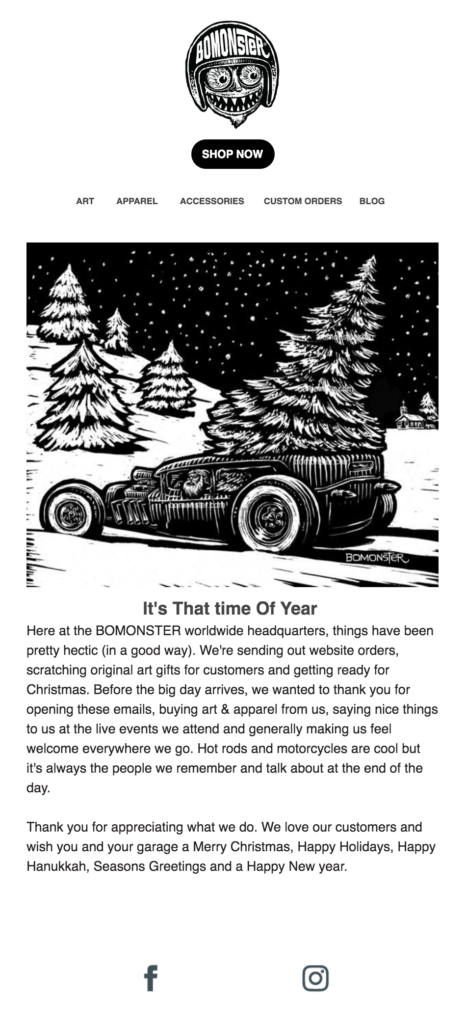
Rather than the traditional holiday promotional email, for Christmas, he sent out a "Merry Christmas – thank you for your support" message with a cool Santa hot rod graphic. He found it generated sales because it was an alternative to the holiday "sell/sell/sell' emails.

Holiday email from BOMONSTER with a Santa hot rod graphic.

BOMONSTER's "fiercest competitors"

During COVID-19, BOMONSTER sent out an email linked to some artist friends' websites calling them his "fiercest competitors.” 

The other three artists he promoted in that email are friends of BOMONSTER. "We're all self-employed and going through a tough time. It might have been a little reverse psychology to promote myself while promoting them. But it came from a genuine place of being a fan of all their work and wanting my customers to support all good work in the category, not caring who gets the sale," says BOMONSTER.

Email highlighting other artists.

Father's Day — celebrating Dad, the ultimate photobomber

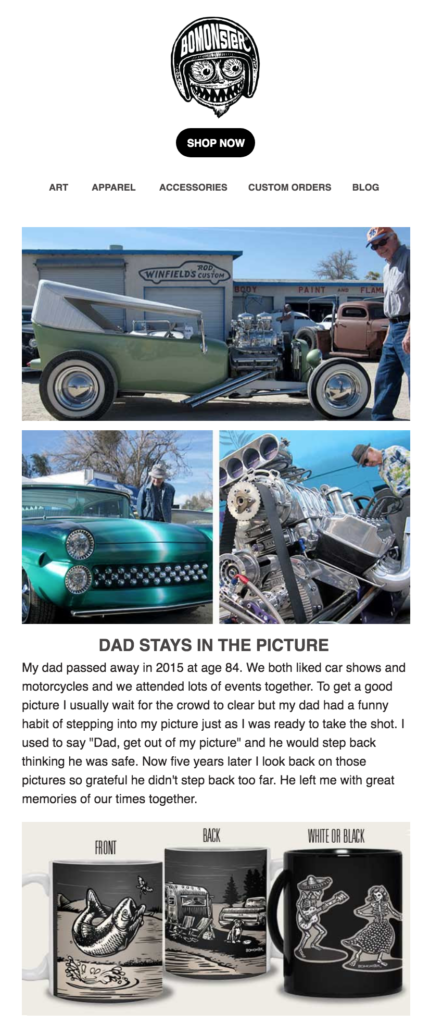
For Father's Day, BOMONSTER sent a funny story about his dad always accidentally photo-bombing his pictures. 

BOMONSTER email showing his Dad photobombing card show pictures.

Virtual car show

BOMONSTER watches corporate brands and how they react to customer trends. Music and entertainment went 100% to streaming services. Zoom meetings became popular and live events started branding themselves as "virtual" experiences. 

BOMONSTER thought a virtual car show through email could be a fun way to use his car show photos taken earlier to connect with his audience when those car shows were canceled.

BOMONSTER email on virtual car show.

"Business in 2021 will go to the brands that create online relationships with their customers."

As companies adapt to an online sales model, the ones that connect personally to their customers will win. One of the benefits of small business is the ability to talk personally to customers with credibility. 

BOMONSTER knows many of his customers from live events or social media. He decided to write his emails in first-person to create a more personal “letter” feel. 

"My emails show that I am a person, not a corporation. I don't mind being personal because I imagine actual customers when writing," says BOMONSTER.

“Artists don't sell, people buy.”

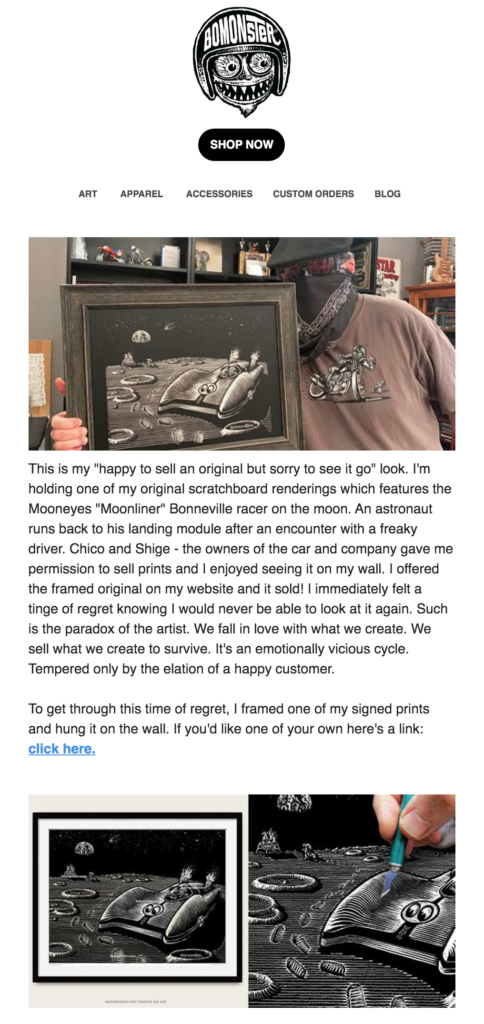
Art is an emotional decision and rarely a rational purchase. It either grabs you, or it doesn't. “Not everyone likes my art but the ones who do, love it. There’s nothing I could say to the ones who don’t think otherwise. All we can control is presenting it as well as we can and hope someone relates to it enough to want it,” says BOMONSTER.

Email allows BOMONSTER to present his art virtually, which is seen by more potential customers.

BOMONSTER email on his original art comissions.

BOMONSTER's best advice? "Pay attention to what large, successful companies do, and apply them to your small business."

BOMONSTER opens emails he receives and takes note of what they look like and how they communicate. Some inspire, others get closed immediately. He identifies what he likes and that he can emulate.  

BOMONSTER's five rules for email marketing:

  1. Friendly wins over insincere
  2. Fun wins over boring
  3. Good art direction wins over standard forms
  4. Clarity wins over complexity
  5. Design for mobile, and it will also work on desktop

Connect with your audience and start growing your email list today!

In your AWeber account, you'll get everything you need to grow your own business online — including sign up forms, newsletters, landing pages, and access to hundreds of integrations to the most commonly used business products and solutions.

Start your 30-day free trial today.

The post How this artist tells visual stories through email to make more Shopify sales. appeared first on Email Marketing Tips.


from Email Marketing Tips https://ift.tt/2CQZcKT
via IFTTT

Some UK bus riders will get Facebook DMs to warn if transport is too busy as lockdown lifts


This article was originally published by Sarah Wray on Cities Today, the leading news platform on urban mobility and innovation, reaching an international audience of city leaders. For the latest updates follow Cities Today on Twitter, Facebook, LinkedIn, Instagram, and YouTube, or sign up for Cities Today News. Oxfordshire County Council is using technology from UK start-up Zipabout to help manage demand on its bus network as COVID-19 lockdown restrictions continue to be eased in the UK. Zipabout’s Passenger Connect service will deliver personalized journey updates for bus passengers on how disruption and crowding may affect their travel, as well as providing…

This story continues at The Next Web

Or just read more coverage about: Facebook

from Social Media – The Next Web https://ift.tt/38jcSdb
via IFTTT