Our mission is simple: to deliver powerfully-simple email marketing tools to help small business owners and entrepreneurs — like you — grow your business.
That’s why we’re excited to introduce AWeber Free — our completely free email marketing and landing pages plan!
If you’re just getting started with your small business or kicking off a passion project, AWeber Free is designed to give you everything you need to start building your audience today.
Watch the video below to hear about what you’ll get with AWeber Free.
https://ift.tt/2C0zxj6
Introducing AWeber Free
What’s included with AWeber Free?
AWeber Free gives you everything you need to create amazing looking emails and landing pages, automate your email marketing, and integrate with other business systems.
Here’s everything you can do with AWeber Free:
Grow an email list. Use AWeber’s sign up forms to grow your list. You can send 3,000 emails per month to 500 subscribers on AWeber’s free plan.
Create and send beautiful newsletters. Access all of AWeber’s amazing content creation tools — like the drag-and-drop email builder, Smart Designer, hundreds of email templates, library of professional images, and more — to send newsletters your audience will love. Plus, you’ll be able to automate your email campaigns, saving you time and energy.
Build unlimited landing pages. Landing pages are a great tool to help you grow your list. Use any of our pre-built landing page templates to get started.
Connect the tools you use every day. Access AWeber’s integration library and connect with the tools you use everyday to make email marketing seamless.
Ask us anything, anytime: Ask our award-winning customer solutions team any question by phone, chat and email. They’re available 24 hours a day, 7 days a week to help you succeed with email marketing.
Migrate to AWeber for free. If you’re currently using another email service provider and want to move your content over to AWeber Free (or our Pro plan), we’ll do that fast and at no cost to you.
With AWeber Free, you’ll never have to worry about time running out on a free trial. Plus, you can start a free account without ever having to enter your credit card information.
Why is AWeber adding a free plan?
The world is different than it was just a few short months ago. The decision to add AWeber Free comes as many small businesses continue to face challenges posed by COVID-19.
We knew we could play a part to help small business owners overcome these challenges. With AWeber Free, our hope is to remove the cost barrier to entry for small businesses who need email marketing and landing pages, but just don’t have the financial means to access it yet.
You know that an awesome landing page is the first step to growing your list, selling more, and building relationships with your audience.
So, you built one. You took time to write convincing landing page copy. You’re ready to send your new subscribers value-packed emails. But there’s one problem.
How do you actually get people to your landing page to sign up?
That’s why we asked three experts to share how they drive traffic to their landing pages, and they shared some of the best strategies to help you begin promoting your own landing page. Read on to learn what they had to say.
Social media is a great way to promote your landing page — as long as you’ve built credibility first.
Sam Flynn, Social Media Trainer & Speaker, Managing Director, Planet Social Media
Social media is a perfect driver of traffic to your landing page.
The first step is to make sure you are clear on who your social media audience is. Once you have a good idea, think about what would drive them to want to go to your landing page. Is there a lead magnet that is highly relevant ? And, how can you get this across to them?
In terms of your call-to-action (CTA), you will need more than a simple “click here to get x.” Be more descriptive of the benefits behind this particular lead magnet. Give them value in the post itself, such as one of the points covered on your lead magnet, then direct them to your landing page for more.
You could also use video as part of your strategy, sharing a short video elaborating on one point covered in your lead magnet, then directing them to your lead magnet to get the remaining points. If you are speaking to a camera, be sure to include subtitles, for accessibility for all and to cater for those who will listen without audio.
Finally, make sure you build up your credibility with your audience by sharing a range of posts, especially those that demonstrate your expertise. They’ll be far more likely to click through to your landing page if they think they are going to get results from doing so!
When done right, Search Engine Optimization (SEO) is the best way to drive traffic to your landing page.
Sean Tinney, Demand Generation Manager, AWeber
The most highly engaged, highest converting customers come from SEO, in my experience. These are potential customers who are actively searching for a specific product or service. But in order for SEO to be effective, you need to do your research and add keywords to your landing page that provide the answer to what people are searching for.
Here at AWeber, we are providing marketing services to help our customers grow their business. So when I build a landing page using our AWeber landing page builder, I make sure I’m using keywords that potential customers might be searching for.
The more targeted or specific your keywords, the greater the likelihood of success. Very popular terms and keywords tend to be highly competitive, so search terms that are more specific tend to be easier to rank for.
Measure, track results, and adjust course.
Cathy McPhillips, VP of Marketing at Content Marketing Institute
We promote our landing pages a number of ways: blog post calls-to-action (CTAs), banner ads on our website, social media, email promotions, and through our webinar speakers and Content Marketing Institute team members. Each of these tactics has a sourced URL so we’re able to evaluate the effectiveness and the timing promotions.
For example, if we’re posting on social media four weeks before a webinar, but 90% of our webinar signups through social media happen 28 hours before the event, then we shouldn’t be posting on social media so early. We also are able to see our key influencers which helps us fine tune our distribution strategy.
We also use different copy for each of our promotions to the landing page, because this page or webinar will appeal to our personas in different ways. We have found that pulling data, discussing key takeaways, or asking questions that the landing page will answer are the best ways to engage our customers and to get them to take that next step toward conversion.
Build your own landing page today.
AWeber’s Landing Page Builder makes creating a landing page for your business easy. Get started with AWeber Free to start building your landing page and growing your list today.
With the social media landscape evolving constantly, there’s always something new to learn for both novice and experienced marketers alike. Naturally, you might have a lot of pressing social media marketing questions that you’re embarrassed to ask because they seem like common knowledge. But no question is too simple because it can be challenging to catch up.
In this post, we answer some of the most common and important questions about social media. Besides general social media FAQs, we’ll also tackle platform-specific questions with a focus on Instagram FAQs. Let’s get started.
General social media questions
1. How many people are on social media?
As of April 2020, a total of 3.81 billion people around the world use social media, putting the worldwide social media penetration rate at 49%.
2. What is the most popular social media platform?
Based on user count alone, Facebook continues to be the most popular social media platform. It had garnered 2.6 billion monthly active users by Q1 of 2020. The Sprout Social Index XV: Empower & Elevate also found that it’s the most popular platform for both marketers and consumers. Eighty-nine percent of marketers surveyed used the platform while 83% of consumers surveyed used it.
3. How long does the average person spend on social media per day?
In 2019, the average social media user spent around 1 hour and 15 minutes per day on social media. eMarketer predicts that this average will increase by 8.8% in 2020 due to social distancing and people spending more time indoors during the pandemic. So we can expect that social media users will spend around 1 hour and 22 minutes on average using social media every day.
4. What is the fastest growing social media platform?
While Instagram once held this coveted position, the platform’s growth has tapered off for a while. In fact, its US user growth rate dropped to 6.7% in 2019. Meanwhile, TikTok saw a 97.5% increase in its US user base. Granted, these numbers will decline as the hype dies down, projections still show that the platform will continue to see a double-digit growth rate in the coming years.
5. What’s the best time to post on social media?
The best time to post on social media depends on several factors. While your choice of platform and your industry both matter, your audience activity plays the biggest role. So ideally, you should look at your post performance to get valuable data about the perfect post timing for your business.
You can also use our guide on the best time to post as a starting point before you find what works best for your business and industry.
6. How often should I post on social media?
Again, this largely depends on your audience. While you definitely should publish at least one post every day, you should see if posting more often will make any difference in your performance. Once you find a posting frequency that works for you, create a publishing calendar, and follow it consistently.
7. Which social media platform should I use to promote my business?
While the natural assumption is that you should be on all the popular platforms, this can be counterproductive if not executed with a strategy. Instead, focus on a couple of platforms that are highly popular among your target audience. So the best platforms to use will vary for each business. Check out our guide on how to choose the best social media channels for your business.
8. How do I get started with social media marketing?
There are a few things you need to begin marketing on social media – a goal, a target audience and a strategy. Find out what you want to achieve through social media marketing and what types of people you want to attract. Then create a social media strategy to streamline and organize your approach.
9. What kind of content should I post?
This also depends on your industry and what appeals to your target audience, although visuals typically take the cake on social media. Try out some of our social media post ideas and see which ones perform the best to find out what type of content your audience likes.
10. How can I get more followers on social media?
Growing your social media following involves a lot of planning and strategizing as well as posting the right content and targeting the right audience. Use our comprehensive guide on how to grow your social media audience to get started.
12. How many followers does the average Instagram user have?
Since the purpose of personal Instagram accounts is to connect with family and friends, the average Instagram personal account has about 150 followers.
13. What percentage of Instagram followers sees your post?
While Instagram hasn’t made anything official, many users have noticed that their posts reach only about 7% of their followers. This is mainly because the platform prioritizes posts from accounts you regularly interact with.
14. How many Instagram posts are there?
Since its inception, Instagram has seen over 50 billion photos uploaded on the platform. And there is an average of 100 million photos and videos uploaded every day.
15. Does Instagram sell your information?
While Instagram doesn’t sell your information, it shares analytics data about users’ activity and preferences with third-party partners such as advertisers and analytics services. In Instagram’s data policy, Instagram promises to never sell your information.
16. What information does Instagram collect?
Besides your device information, Instagram collects the content, communication and information you provide. This can include metadata about your content such as the location, for instance. It also collects information about how you use the platform as well as the people, accounts and hashtags you interact with. Read the full Instagram data policy to learn more on what information is collected.
17. Can you export Instagram followers?
Yes. While not in the Instagram app itself, there are several tools out there such as IGExport and Phantombuster that will let you export your Instagram followers into a .csv file.
18. Is there a way to download Instagram posts?
Instagram gives you an option to download a copy of all the posts you’ve shared on the platform. Find out how to do this through the Instagram Help Center. As for posts shared by other people, Instagram won’t let you download them directly but you can use third-party apps like DownloadGram and Ingramer for this. Keep in mind that recent changes in Instagram’s terms of use affects any image downloading, reposting and embedding that you may want to do.
19. How do you save someone else’s picture on Instagram?
Instagram lets you save someone else’s post so you can easily find it again later. For this, just click on the “Save” button at the bottom of the post and Instagram will add it to your collection. Note that this isn’t the same as downloading the photo or video. As mentioned in the previous answer, you’ll need to use third-party apps to actually download the photo or video to your device.
20. How can I see who saved my pictures on Instagram?
While Instagram doesn’t give you the option to see who’s saved your posts, Instagram Business Profiles can find out how many times a post has been saved. You can find this information under the Post Insights, but this only shows you the number of saves and not the details of people who’ve saved it to their collection.
21. How do you get pictures off of Instagram?
To remove pictures or videos you’ve posted on Instagram, tap on the options button above your post and then choose “Delete.” You’ll need to tap “Delete” again to confirm that you want to remove the post from Instagram.
22. How do you get your “Top Live” on Instagram?
Just as Instagram recommends posts based on your activity and the accounts you interact with the most, it used to give suggestions for live videos you might want to watch. You could access this “Top Live” section at the top of your “Explore” page before, but Instagram has since removed it.
23. How can I share live video replays?
Instagram gives you the option to share a replay of your live video to IGTV once the broadcast ends. Just choose “Share to IGTV” when you see the option at the bottom of your screen. You’ll also get the option to “Download Video” in case you want to save it to your camera roll or “Delete Video” if you don’t want to keep it.
24. How can I see who is live on Instagram?
When someone you follow goes live on Instagram, you’ll see their profile picture at the top of your Feed and it will have a colorful ring around it along with the word “Live.” Just tap on the profile picture to start watching their live video.
25. How can I see active users on Instagram?
Instagram lets you see the active status of only people you follow or have exchanged direct messages with. If they’re currently active, you’ll see a green dot next to their profile picture and username. Note that you won’t be able to see if users have turned off their activity status..
Bonus Question
Did we answer most of your social media questions?
Let us know if you have any other pressing questions about social media or Instagram FAQs that you’d like us to answer. We understand that things change quickly and you need answers just as fast. Be sure to check out our social media stats to understand the landscape better across all social platforms.
Welcome to TNW Basics, a collection of tips, guides, and advice on how to easily get the most out of your gadgets, apps, and other stuff. It’s election year in the US, which means you’re probably going to see lots of political ads. While some social media platforms have banned them — such as Twitter — Facebook has yet to do so. But luckily, as of this June, it does offer an option to shut them off yourself. Facebook‘s history with political ads, and politics in general, is a complicated and unpleasant one. Suffice to say the platform’s infamous for hosting…
Content marketing gets thrown around a lot in the marketing industry as something you need to pay attention to. But what exactly is it and why is it relevant to you, a marketer? How can you harness content to your marketing advantage?
From infographics to blog posts to video tutorials, you’ve most assuredly been at the receiving end of content marketing. On brand teams, it’s sometimes a standalone effort or handled as a segment of an overall marketing strategy. Content marketing looks different for everyone and there are multiple ways to go about it.
When 70% of marketers are actively investing in content marketing, you know it’s something worth diving into, even if you don’t know exactly what it is.
What is content marketing?
Content marketing involves using content to provide value to the receiver in an informative and strategic way. Let’s break down the phrase. Content encompasses everything from ebooks to webinars to blog posts. The marketing portion is how you distribute it, which channels you use and the subsequent metrics that are produced.
Unlike a cold call from a salesperson, content marketing is more like a marathon. In content marketing, you take existing content or create new content and then distribute it in a way that helps the person receiving it.
When you publish a company blog post, the blog post is the content. Deciding when and how to promote it, such as via a newsletter and social media, is the marketing. You might even decide, based on historical data of past published blog posts, to identify the best days and times to share it.
The most important part of content marketing is that you aren’t trying to rein in a customer immediately. You use your content to establish trust and authority so that your customer associates you with the topics covered in your content. For example, for a beauty brand, when a customer is eventually they thinking about which eye makeup palette to purchase, if they’ve been in your content marketing flow, they’ll recall the useful video you published detailing how to do basic eye makeup.
And that’s content marketing in a nutshell.
Who is involved in content marketing & what do they do?
Depending on how your company is structured, content marketing might be its own position or team or it could be a part of the duties of several people. For some companies, content marketing is part of an SEO specialist’s job. For other companies that rely heavily on social media as a distribution channel, it’s usually part of the social media marketing team’s responsibilities.
A content marketer does not ask for random content. Instead, they use historical data and outside sources to determine what kind of content is needed. Through an SEO lens, a content marketer would research keywords, see where the company falls short and then determine what content is needed to fill that gap. Once the content has been produced, they’ll also decide when to publish it and how.
The when is especially significant if you work in an industry that is heavily reliant on seasons. A fashion brand won’t be talking about styling winter clothing in the middle of summer. And a travel agency wouldn’t talk about spring break trips if it’s not planning time.
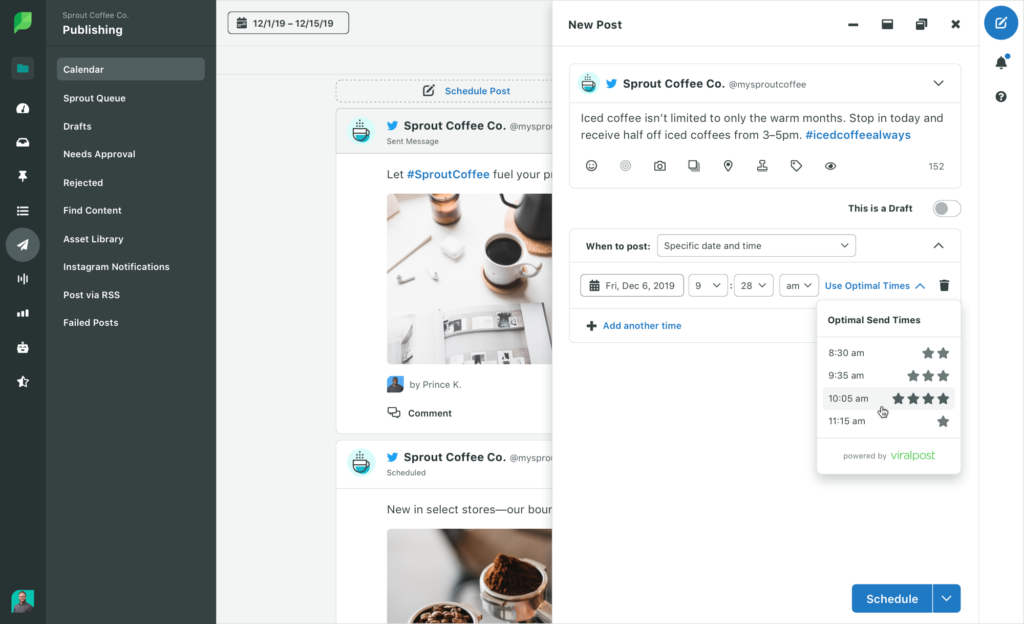
At the granular level, the when is also important when it comes to distribution. Technology like Sprout’s ViralPost feature helps you easily identify when is the best time for you to post. And the publishing calendar gives you an eagle-eye view on how often you’re distributing the content.
Once the content is produced and distributed, the work doesn’t stop. You want to know how well that content is performing through metrics like site traffic, referrals and social shares. How it performs will inform the content marketer on determining a future content marketing strategy. Maybe after five infographics that didn’t gain traction despite different distribution methods, you realize that infographics are not for your brand. Or that instructional videos receive a lot of interaction when they’re published so you’ll further invest in a video marketing strategy.
Where does content marketing fit into the marketing pipeline?
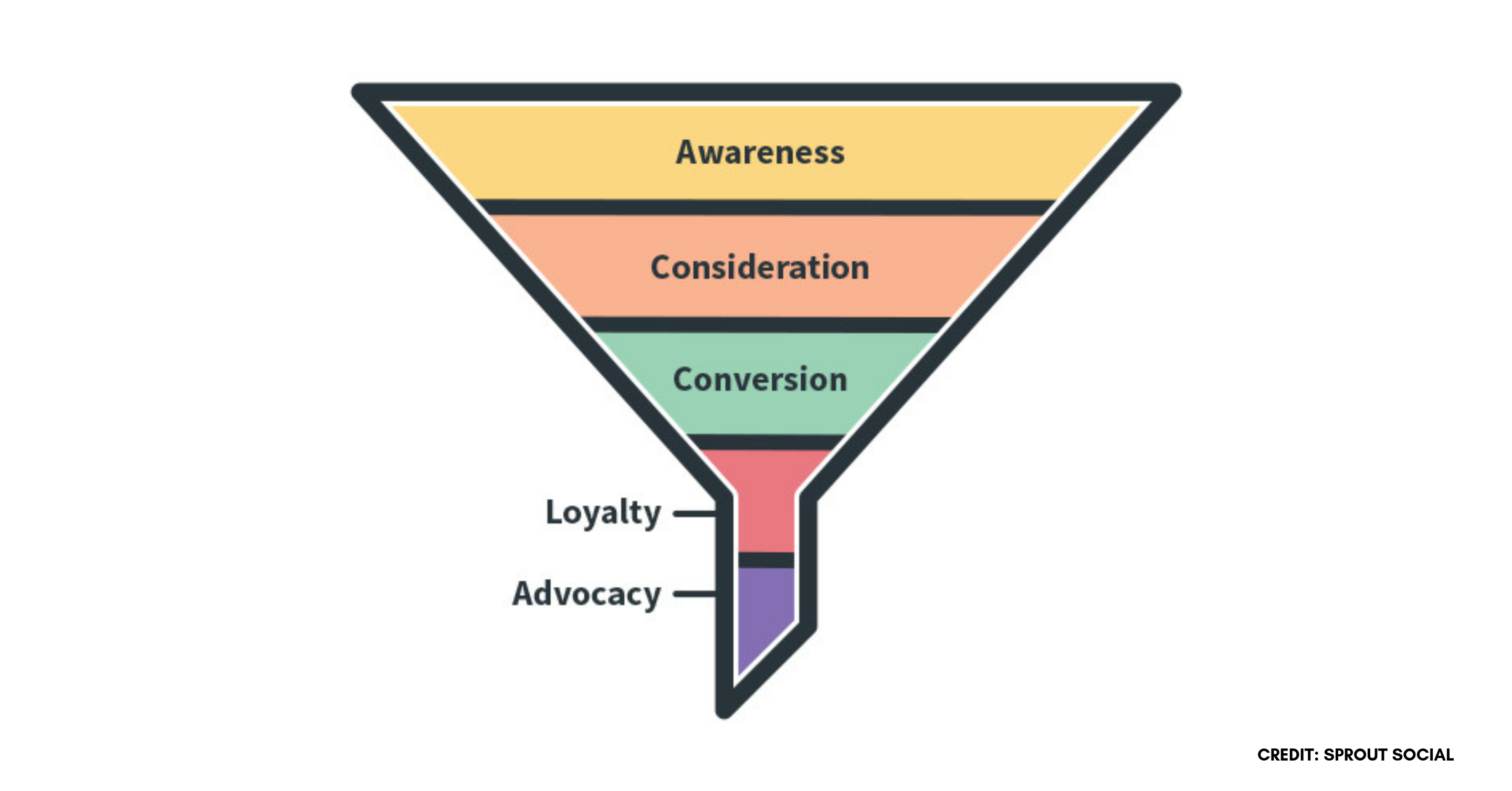
Content marketing can fit into every part of the marketing funnel. When you approach content marketing as a strategy, you’ll want to note where each type of content fits in.
Content that exists as informative how-to guides and webinars for anyone, not just your customers, falls into the awareness stage. For an auto manufacturer, this content might look like a video explaining why it’s important to change your oil and when to change it. This would apply to everyone who owns a car, regardless of the manufacturer.
In the consideration and action stages, the content might look like comparison charts between you and a competitor. Using the auto manufacturer again as an example, you might list all the features that set you apart from your nearest competitor.
Within the engagement or loyalty stage, content types include instructional videos on how to use your product and guides to make the best use of your purchase. At this stage, an auto manufacturer might conduct interviews with current auto technicians to help customers maintain their cars.
And at the final stage, advocacy, you create interesting and creative content to help keep your customers happy, returning and engaged. For the auto company, it could be hosting a customer loyalty event and converting some of them to brand ambassadors.
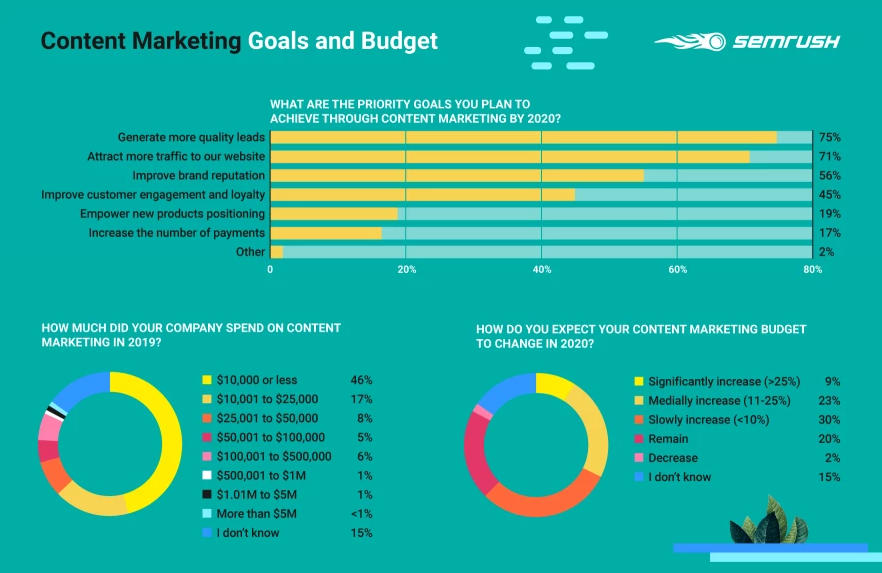
Goals of content marketing vary by team but according to one survey, 75% of marketers use it to generate more quality leads, 71% to attract more traffic to the website and 56% to improve brand reputation.
It is important to note that one piece of content might overlap multiple stages. A customer might look at a product how-to video but be in the awareness stage. The existing content, though, still informs them about how your company operates. Knowing that product how-to videos exist and getting a preview of your product in action might weigh in on their decision to purchase further down the funnel.
What does content marketing look like?
Now that you know what content marketing is in theory, what does it look like in practice? Remember, content marketing is a combination of the right content with the right distribution and the right strategy. Let’s take a look at how three brands use content marketing.
Topshop: Blog post
The Topshop blog is filled with posts that range from company news to styling ideas.
Topshop identified the oversized shirt as a trend to jump in on and published a post detailing how to style it. As an awareness stage article, you don’t have to purchase the shirt from the company or have an oversized shirt on hand to get value from the article. Perhaps you were looking to purchase such a shirt or you didn’t know what to do with it. The article gives you the tips and ideas you might need.
The post is promoted on their home page, via Twitter and could be promoted through their newsletter.
The Lip Bar: Video tutorials
On the Lip Bar’s website, there is an entire page dedicated to tutorials.
Some of these videos are useful if you have their products while some, like the “How to clean your foundation (brush off)” video in the screenshot above, are applicable to anyone who is looking to learn about that topic.
Video is a big portion of Lip Bar’s strategy. They’re posted in their social media channels, used in IGTV and embedded into their product pages. It’s clear that they’ve taken care to produce a video for each portion of the marketing funnel.
Red Bull: All the things
Where do we start with Red Bull? At its core, Red Bull is a drink. But it’s also become a lifestyle brand, in many ways thanks to its investment in content. It has TV shows, events, a magazine, sponsorships that run a whole gamut of sports and much more.
When you visit Red Bull’s website, you aren’t taken to a product page. In fact, you barely see the drink anywhere. The company has turned content marketing into an art, giving potential and current customers various content to consume.
There are many components of their content marketing strategy and the distribution is through all of their events, athlete highlights and magazine. If you hadn’t heard of Red Bull before, odds are high that you would have at least come across one of their branded content pieces.
Next steps
Now that you know what content marketing is and why it’s important, the next steps include learning even more about content marketing and how to execute a strategy.
Is your content not working out for you? Go through a checklist to identify what’s happening. Do you want to use social media as a distribution tool but don’t know where to start? You’ll need a social media toolkit to establish that strategy.
Facebook has taken down disinformation networks linked to Brazilian President Jair Bolsonaro and disgraced former Trump adviser Roger Stone, the company announced yesterday. The network connected to Bolsonaro was “involved in coordinated inauthentic behavior in Brazil” that sought to influence elections and denigrate opponents of the government, according to Facebook. Most recently, the accounts have echoed Bolsonaro’s claims that the coronavirus pandemic has been exaggerated — which even a positive test for COVID-19 has failed to curb. Their network used duplicate and fake accounts to “create fictitious personas posing as reporters, post content, and manage Pages masquerading as news outlets,” according to…
While having thousands of Twitter followers is great, those numbers don’t mean much if those followers don’t engage with your Tweets. That’s akin to having something important to say but being unable to get people to listen to you. So even though the platform has a huge potential to drive brand visibility and growth, you may be unable to make full use of it if you can’t drive Twitter engagement.
In this post, we help you uncover some of the top strategies to bring up those numbers and engage your Twitter audience more effectively. Let’s dive right in.
What is Twitter engagement and why does it matter?
Twitter engagement refers to all the ways people interact with your brand and its posts on the platform. So it not only includes likes, Retweets and replies but also brand mentions (tagged or not), follows, embedded media and links, just to name a few. In other words, it’s an indicator of how popular your brand is on the platform.
At this point, you may have started to get a fair idea of why Twitter engagement is so important. But let’s break it down and try to understand the specifics of why you should work on engaging your Twitter audience:
1. Massive audience base
The main appeal of Twitter is its massive audience base. With 330 million monthly active users recorded in 2019, it’s one of the biggest social media platforms and makes a significant contribution to brand visibility and growth. So you can imagine how the level of engagement you get on Twitter makes such a huge difference for your brand.
2. Builds exposure
Twitter allows users to quickly Retweet posts in just a few clicks, which could further promote sharing. And due to the Twitter algorithm, when people share your Tweets, it could help build exposure within their followers’ feeds.
Some likes and replies will show up in a person’s followers’ feeds, as you can see in the example below. A user liked Steak-umm’s Tweet, and that same Tweet appeared in her followers’ feed signifying that she liked it.
The best part is that this exposure doesn’t just end within the Twitterverse. With people often sharing screenshots of Tweets and conversations on other platforms or turning them into memes, you could potentially expand your reach even further. In fact, an estimated 1.6 billion unique visitors each month see Tweets through third-party platforms.
3. Boosts brand-consumer connection
With fewer privacy restrictions, Twitter allows brands to quickly discover and respond to Tweets concerning them. This allows you to connect with customers directly while resolving any complaints or issues at the earliest.
And when you engage with your audience this way, you get to strengthen your relationship with them. In fact, the Sprout Social #BrandsGetReal study found that liking or responding to a customer is the top social media behavior that can help brands connect with consumers.
4. Promotes openness
In line with the previous point, fewer restrictions also promotes transparency and openness between brands and consumers. Because interactions with customers through Tweets and replies is open for everyone else to see, it could quickly reach a large community.
How to measure engagement on Twitter
Now that you understand just how crucial Twitter engagement is, you’re probably curious where your current engagement rate stands. Keep in mind that your total engagements don’t translate directly to engagement rate on Twitter. You have to consider your following size too.
You may have hundreds of followers, but if only a small percentage of those followers like or Retweet your Tweets, your engagement rate needs improvement. Besides likes, Retweets and replies, you may also want to consider less typical actions like branded hashtag use, follows and linkbacks as engagement actions.
With so many factors to consider, it can be challenging to manually calculate your average Twitter engagement rate. And the native Twitter analytics won’t break it down for you either. So consider investing in a Twitter analytics tool to get a more accurate picture of your engagement and measure other performance metrics on the platform.
The Twitter analytics and reporting tool from Sprout lets you do just that. Your Twitter Reports dashboard will give you an in-depth look at your organic impressions, total engagements and link clicks. It also helps you track other metrics such as your net follower growth to gain a more comprehensive view of your Twitter performance.
5 ways to boost Twitter engagement
Once you start keeping a close eye on your Twitter engagement rate, you might notice a huge disparity between your following size and your engagements. That’s likely because you haven’t yet started making an active effort to boost your Twitter engagement. So check out these five strategies to get those numbers up:
1. Catch your audience at the right time
Timing is one of the most crucial factors that influence how well your Tweet performs or how many people engage with your Tweets. That’s because the platform sees around 350,000 Tweets on average every day. So it’s important to get your Tweet out at a time when people are highly active for a better chance of visibility.
At Sprout, we analyzed 20,000+ pieces of content from our customers to see how engagement changes by timing. Based on our findings, the best time to post of Twitter is either Wednesday or Friday at 9 a.m. Of course, this might vary based on factors like location and industry. So test different timings for your Tweets to see what works best.
2. Make the most of visual elements
Any regular Twitter user knows just how much a photo or video stands out on the platform amid all the text Tweets. On mobile, in particular, a Tweet with a visual element takes up at least half the screen. And the more visible your Tweet is, the more likely it is to engage your audience. In fact, if your Tweets include a GIF, those Tweets get 55% more engagement than those without.
So it’s crucial that you use visual elements if you want to boost your Twitter engagement. You could post original graphics to share useful information and updates, photos of your team, videos demonstrating how to use your product, tasteful memes relevant to your industry and more. Even if you have to share a link, make sure you include a thumbnail or attach a relevant picture.
Check out this Tweet from Evernote, for instance. The team could’ve easily just posted the text with the link to their productivity playlist. Instead, they included a photo of a cassette labeled “productivity jam.” This not only catches the eye instantly but is highly relevant to the link. Plus, it’s consistent with the brand’s green and white color scheme.
Drive up your Twitter engagement is by actively engaging with your audience yourself. Instead of routinely Tweeting and expecting the likes to flood in, why not give out likes and Retweets from your end as well? Based on the principle of reciprocity, engaging with others will make them feel more inclined to engage with you.
Plus, when you interact with your customers’ Tweets or replies, your conversation gains more visibility in the feeds of other users, as mentioned earlier. This makes way for even more engagement for your brand. Here’s an example of Chipotle responding to someone who thanked the company for giving him some free chips and guac.
Go one step further with this and engage with posts that don’t directly @mention your brand. For example, check out how Feedly responds to a prospective user’s Tweet because someone mentioned the brand in the replies.
It seems like Twitter sees a new viral topic every other day. Your brand can capitalize on this by participating in trending conversations and topics relevant to your industry or your company. This helps you gain visibility with people who have yet to followed you on Twitter, which then paves the way for more engagement.
For an easy way to discover trending conversations to participate in, click on “show more” under the “What’s happening” section at the right-hand side of your screen.
This will bring up a long list of trending conversations personalized just for you, either by location or interest. But you can also look for trending topics in other industries as well.
Go through these topics to see whether there are any posts you could join the conversation with a reply or Retweet. Or see if there’s any trending hashtag that you could make use of.
5. Create polls on relevant topics
Drive up your Twitter engagement by creating interactive content like Twitter polls. Polls allow you to ask questions on relevant topics and choose between several options. And since people can vote with just a click, it’s an easy way for them to engage.
So consider creating Twitter polls regularly if you want to see more engagement. Perhaps you could ask them what they’re using your product for, for instance. You could also ask them about their preferences when it comes to your content such as what time you should post, what types of posts do they want to see from you. This doubles up as a tactic to feed your social content strategy.
Additionally, like this thread from Sprout, you could offer several useful tips through a series of Tweets and then use polls to ask your followers about their opinions on your tips.
Have these tips changed the way you think about your own social posts? #GAAD
These are some of the basic strategies that can help you begin amplifying your Twitter engagement. But keep in mind that not all engagement is good engagement, and crisis management may need to be done. So at the core, whatever strategies and approaches you apply should help you drive meaningful engagement.
What other strategies have you used to improve your Twitter engagement? Are you using any tools to bring up those numbers? Let us know in the comments. And don’t forget to sign up for our free social media toolkit to get an even more comprehensive guide on boosting your engagement.