Wednesday, 7 July 2021

How to put together a marketing tech stack that scales your business ASAP

Is your marketing tech stack actually helping your company grow?

It’s no secret that businesses today rely on a ton of different tools to reach their target audience.

But consider that the average company juggles hundreds of apps at a time and is constantly churning through software.

This phenomenon results in wasted time for your team, not to mention little to no sense of cohesion between your marketing tools.

Listen: a strong martech stack empowers your team to work smarter while also speeding up the process of acquiring, nurturing and converting customers. This guide breaks down how to build your stack from scratch.

What is a marketing tech stack, anyway?

A marketing tech stack represents the collection of tools and software that encompass the marketing side of your business, including:

  • Advertising tools (think: lead capture forms, social media, email automation)
  • Customer data and analytics (think: CRM, Google Analytics)
  • Internal communication and collaboration tools (think: project management tools, Slack)

The concept of a “stack” illustrates how the software above should seamlessly work together (and not be siloed). The good news is that most major marketing tools boast native integrations or can be connected via apps like Zapier.

The sample workflow below from Typeform highlights how a marketing tech stack can streamline your processes.

zapier connects the tools in your marketing tech stack

For example, teams can easily integrate online form entries with their CRM, help desk software and project management app in just a couple of clicks. See how that works?

Why your marketing technology stack matters so much

Not to be dramatic, but the apps you choose are often make-or-break for your business.

And if you’ve chosen tools on the fly or are winging it with free trials, we totally get it.

That said, it’s important to put your marketing tech stack under the microscope and not default to certain tools “just because.” Let’s look at some key benefits of aligning your software below.

Instantly increase your scalability and growth

This is the big one. Through integrations and automation, you can streamline the processes of customer acquisition and retention.

Think about what happens when a lead reaches out to your business or a customer has a pressing concern. How quickly is your team notified? Is the outreach process consistent or something you’re forced to freestyle?

With the right marketing tech stack, you can put these processes on autopilot and make them more efficient. This makes it easier to scale.

Save serious time (and stress) on behalf of your team

Simply put, marketing software can automate tedious tasks and eliminate time-wasters from your team’s schedule.

Food for thought: a CRM can save a sales team ~14 hours per week on manual data entry. When you have a tool like a CRM that can log interactions and schedule follow-ups automatically, you allow your team to focus on more pressing tasks like actually talking to customers.

The same time-saving benefits of a CRM apply to all of the tools in your marketing tech stack as they work together. In short, your combo of apps should boost employee engagement and make everyone’s lives easier.

Give your company a competitive advantage

Martech is a huge factor for standing out against the competition.

If your closest competitor’s tech stack produces more comprehensive lead data or a faster response time when handling customers, it’s a sign that you need to step it up.

Every marketing stack is totally different, though. What works for a startup versus an enterprise is apples and oranges: what matters is putting together a software combination that makes sense for your business.

What’s the foundation of a strong martech stack?

Chances are you’ve seen the bloated Martech 5000 list, highlighting the thousands of marketing apps available to companies today.

But you obviously can’t demo everything (nor should you).

Again, you need to focus on putting together a stack that fits within your scope and budget, all the while addressing your biggest needs. Below we’ve broken down what an effective marketing tech stack looks like piece-by-piece.

Attraction and acquisition tools

For starters, you have the fundamental tools that drive people to your business. From content marketing to lead capture and beyond, these are the top-of-funnel tools that encompass the following:

  • Advertising platforms (Google, Facebook ads)
  • SEO (Ahrefs, SEMrush)
  • Email marketing and landing page tools (ActiveCampaign, Klaviyo, Mailmunch)
  • Social media (Sprout Social)

Working in tandem, these apps allow you to promote your content, increase your visibility and ultimately acquire customers. For example, Sprout helps you condense all your social feeds, content calendar and reporting in one place, increasing efficiency over logging in and out of individual native platform apps to manage these functions.
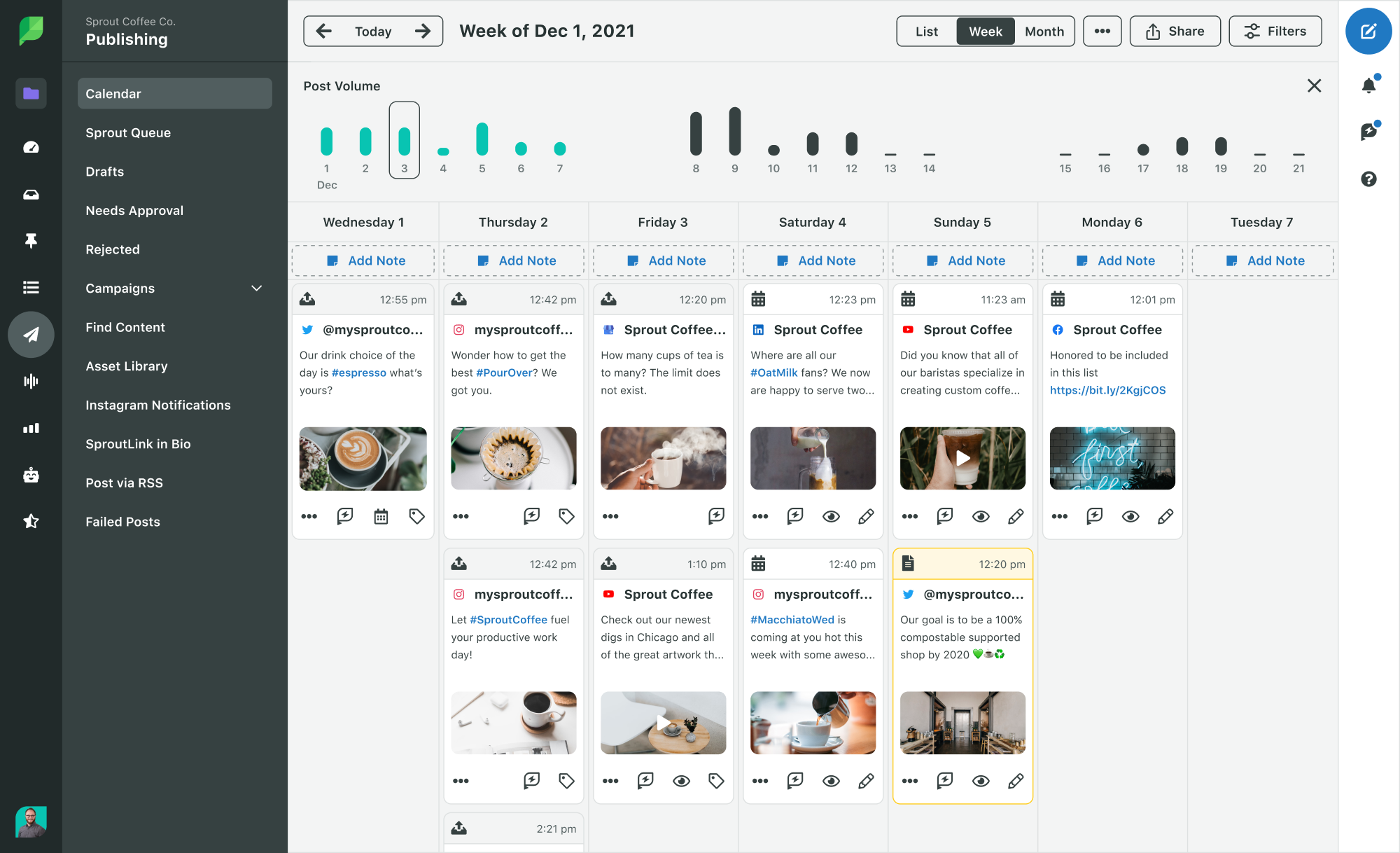
sprout social publishing calendar as part of your marketing tech stack

Customer engagement tools

At this stage, you’re concerned with managing your customer relationships and separating prospects from leads.

This is where CRM tools like HubSpot, Zoho and Pipedrive (see below) come in handy. Providing an all-in-one place to monitor and engage your list, a CRM serves as the centerpiece of your marketing tech stack.

Pipedrive CRM

Marketing analysis tools

Assessing the performance of your marketing efforts should be a top priority and something that’s done consistently.

This is where reporting tools like Google Analytics or Hotjar come into play, highlighting your top-performing content, campaigns and marketing messages. After all, you can’t figure out what’s working and what’s not until you look at the data.

google analytics

Marketing optimization tools

Piggybacking on the point above, almost nothing is “one and done” when it comes to marketing campaigns.

Continuous monitoring of metrics and performance encourages you to fine-tune your strategy over time. Optimization tools such as Unbounce (see below) and Optimizely make it a cinch to test campaigns and messaging ASAP.

unbounce optimization tool

Team communication tools

Lastly, you need tools to help you communicate campaigns, strategy and the day-to-day happenings of your business.

Internal tools like Slack, Trello and Zoom have become staples of modern workplaces, especially given the rise of remote teams.

There are also tools such as Teamwork which combine live chat and video meetings with kanban boards to consolidate internal communication.

teamwork app for task organization

5 tips and considerations for putting together your marketing stack

If you’re still overwhelmed with where to start or how to choose tools, don’t panic.

To wrap things up, let’s look at some points to consider as you begin building your martech stack.

1. Budget for free, freemium and paid tools alike

You can build a surprisingly powerful tech stack with free or freemium tools alone. This is especially true if you’re part of a smaller team.

And on that note, you should totally test the waters with free trials and demos.

Ideally, you should try to invest in tools that scale alongside your business as you grow. Tools like Sendinblue encourage users to do exactly that based on their pricing structure.

sendinblue pricing

That said, more advanced tools are absolutely worth paying for. Based on your company, you’ll simply need to assess cost versus business impact.

Note that SaaS licenses can be a huge drain on your business if you’re careless with them. The more tools in your stack, the more opportunities there are to blow out your budget.

2. Assess all-in-one solutions versus individual tools

Keep in mind that some tools are “unitaskers” that tackle a specific need versus act as all-in-one solutions that can manage multiple tasks.

As noted earlier, a tool like Teamwork can encompass your team chat, video calls and kanban boards ala Slack, Zoom and Trello, respectively.

Multitasking tools are typically pricier, although they can keep your team from bouncing between a bunch of different platforms. Additionally, sometimes it’s simply easier to roll with solutions that your company is already familiar with. The key here is to make sure you aren’t paying for redundant tools.

3. Consider integrations between your existing tools

Remember: your goal is to build a stack, not a mishmash of tools.

Again, most SaaS solutions have native or third-party integrations to encourage connectivity. Integrations ensure that your team isn’t drowning in notifications and likewise reduces needless bottlenecks.

For example, Slack integrates with tools like Asana and Google Drive to streamline collaboration and keep teammates in the loop without having to leave the platform.

integrations are crucial for a successful marketing tech stack

Before investing in any software, double-check the integrations available for the sake of saving time.

4. Assess “wants” versus “needs” when it comes to martech

Reality check: you can’t have everything when it comes to martech.

There isn’t enough time or money in the world for you to test-drive each and every tool.

For the sake of prioritizing and staying within your budget, ask yourself the following as you assess new tools for your business:

  • What are the specific outcomes of using this tool? More revenue or leads?
  • How many people organization-wide does this tool support? A select few or the whole company?
  • Is it possible to achieve [outcome] with a different or existing solution?

The questions above can help weed out impulse buys and ensure you’re sticking to solutions that’ll actually help you grow.

5. Consider the cost of onboarding

This is something that often flies under the radar when it comes to the “cost” of your marketing tech stack.

Sure, you should be concerned about dollars and cents when you invest in software.

But don’t forget about the time commitment as well.

Onboarding your team to an entirely new system can be a massive time-sink if you aren’t careful. The larger your team, the more daunting it can be to do so. Not only that, but frequently switching between apps can ultimately disrupt your workflows (not to mention your team’s productivity).

Easy onboarding is a huge selling point for marketing tools. For example, apps like Zendesk go out of their way to provide new users with countless resources to get started and actually succeed with their software.

zendesk onboarding example

And with that, we wrap up our guide!

What does your marketing tech stack look like?

From increasing scalability to standing out versus competitors, your marketing stack makes all the difference.

Choosing the right tools can be overwhelming. But once you find the right combination, you can start running your business more efficiently and increase your marketing performance at the same time.

Need help choosing between apps? We’ve got you covered.

If you haven’t already, check out our up-to-date list of the best digital marketing tools to help you grow.

The post How to put together a marketing tech stack that scales your business ASAP appeared first on Sprout Social.


from Sprout Social https://ift.tt/3jN2IJQ
via IFTTT

Why social media teams will be at the center of conversational commerce

The next frontier of ecommerce is already here—regardless if consumers and brands are ready or not.

It certainly caught one family in Texas off guard a few years ago. What started out as a conversation between a six-year-old girl and the family’s Amazon Echo Dot turned into an order for a dollhouse and four pounds of sugar cookies.

Known as conversational commerce, this buying experience offers customers even greater convenience and enables brands to engage shoppers in more personalized ways. In this article, we’ll dig into what conversational commerce is and what it isn’t, how brands should approach their commerce strategies and why they need to involve their social teams from the get go.

What is conversational commerce?

Conversational commerce sits at the intersection of messaging apps and shopping, giving consumers an opportunity to buy from brands through chat apps and even voice technology. According to Chris Messina, who coined the term in 2015, conversational commerce is about “delivering convenience, personalization and decision support while people are on the go, with only partial attention to spare.” It’s what enables a customer to chat with customer service agents or a bot, ask questions, read reviews and make a purchase all within an app like Facebook Messenger or WhatsApp.

Imagine, for example, you reach out to a brand on Facebook Messenger because you’re looking for a particular shoe. Not only does the customer service representative you’re talking to find the product for you, they’re also able to complete your transaction in the chat. Conversational commerce can even be used to confirm your attendance at a brand event over text message instead of navigating to a separate signup page.

While conversational commerce often takes place on social media messaging apps, it’s not quite the same as social commerce. The former refers to purchases made directly from a one-to-one chat app while the latter is specific to the buying and selling of goods or services within a social media platform.

A better way to understand the difference between the two types of commerce strategies is to breakdown which platforms are used in each scenario:

  • Conversational Commerce: Facebook Messenger, WhatsApp, Amazon Alexa, Google Assistant, Microsoft Cortana, Instagram DMs
  • Social Commerce: Facebook Shops, Instagram Shopping, Pinterest for Shopify


A better way to nurture the buyer journey

One reason for brands’ shift toward conversational commerce stems from the growing popularity of mobile messaging.

Consider that messaging apps like WhatsApp, Facebook Messenger and WeChat are the third most commonly used social media following social networks and media sharing platforms. And two billion users access WhatsApp on a monthly basis, making it the most popular messaging app worldwide. Not only does a platform like WhatsApp give brands access to a huge consumer base, it also empowers brands to meet their customers where they spend a significant portion of their online time.

Conversational commerce enables brands to build trust with their customers and offer personalized recommendations. For shoppers, it’s like talking to a store associate in-person and asking for their opinion on a product or service—except virtually. And brand representatives can offer more specific recommendations based on their conversation with that customer.

Toy manufacturer Lego, for example, created a chatbot named Ralph on Facebook Messenger to help shoppers find the perfect Lego gift during the holiday season. Ralph would ask customers a series of questions like age, budget and the types of sets they were interested in before ultimately driving a shopper to the point of purchase.

Above all, chat platforms simplify the buyer journey by centralizing the shopping experience within one platform. Conversational commerce makes it possible for shoppers to ask questions, read reviews, explore product catalogues and hit the checkout button without ever having to navigate elsewhere. For brands, the ability to move consumers through the awareness, consideration and decision stage of their journey in one application can reduce cart abandonment and lead to more sales.

Social teams sit at the heart of a brand’s conversational commerce strategy

It’s clear that messaging apps are here to stay and brands would be wise to start developing their conversational commerce strategy today. And with the majority of these interactions occurring on social media chat apps, it’s crucial that brands include their social teams when building out their next steps because:

They know your audience inside and out

Few teams will ever really “get” your customers like the social team. After all, your social team interacts with consumers daily and are privy to all kinds of messages spanning from compliments to complaints to constructive feedback. Social marketers not only know how to engage your audience; they also know what is top of mind for customers when it comes to your brand’s products and services.

For example: the social team at Lodge Cast Iron frequently receives customer questions and feedback about their cookware. Knowing which items are most popular or most requested could help ecommerce teams surface similar products when conversing with customers.

They have a clear grasp on your brand voice

Conversational commerce demands that brands, by default, have a clear and distinctive brand voice across all platforms. Consistency is key when developing a brand’s voice. Regardless if someone is reaching out to vent or ask a question, consumers expect a consistent experience when engaging with a brand—and your social team already delivers this daily.

Failure to maintain that brand voice can create a disjointed buyer journey and even turn away potential customers. Working with your social team ensures your brand’s voice and tone stay consistent, whether you’re answering a simple question or trying to close a sale.

They (likely) know a customer’s history with your brand

Depending on which tools your social team uses, there’s a good chance they have a holistic view of your brand’s entire relationship with the customer in your inbox. With a tool like Sprout Social, for example, social teams can see a customer’s entire history with a brand thanks to integrations with tools like Shopify, HubSpot and Zendesk.

Example of a Shopify profile connected within the Sprout Social platform.

Knowing a customer’s conversation and order history with a brand can help build trust with a buyer, and the insights from those conversations can be used to sway buyers who are still on the fence. Suppose someone who frequently mentions a brand in their social posts is finally ready to make their first purchase. Using a tool like Sprout, social teams can pass this insight along to the ecommerce team, who can provide a discount code or special offer to help seal the deal.

The future of ecommerce is conversational

As chat and messenger platforms increasingly solidify their places in consumers’ lifestyles, now is the time for brands to explore conversational commerce. Consumers already reach out to brands on social media with customer service questions, issues and feedback. And thanks to conversational commerce, brands can turn a DM or an instant message into a sales opportunity. By centralizing the entire customer journey within a conversation, brands simplify the path to purchase and empower shoppers with all the information they need without ever leaving the chat window.

An effective conversational commerce strategy, however, starts with a robust social messaging strategy. Check out this guide for tips on how to integrate social messaging best practices into your customer experience strategy today.

The post Why social media teams will be at the center of conversational commerce appeared first on Sprout Social.


from Sprout Social https://ift.tt/3dReLSH
via IFTTT

Tuesday, 6 July 2021

Don’t fear the retro: How open communication strengthens agency-client relationships

All humans are born with a natural negativity bias, causing us to dwell more on negative experiences than we do on positive ones. This bias can make even the idea of negative feedback anxiety-inducing, leading many to avoid the opportunity altogether.  For agencies, however, avoidance is not an option.

Receiving and giving constructive feedback is integral to an agency’s ability to grow. Retrospectives create a positive environment for this exchange by giving both agencies and clients a chance to reflect on the work that has been done over a project period. In this article, we’re sharing tips on hosting better client retrospectives. But first, why does it matter?

How client retrospectives can build better agency-client relationships

The agency model is notoriously fast-paced. Combine that with the lightning speed of social, and you get a near-endless to-do list. Planning, publishing, reporting and optimizing takes time. Once you throw regular client communications into the mix, it can feel impossible to find the time to step back and reflect on your overall performance.

But great agency-client relationships aren’t built on performance alone. They require a foundation of trust. To build this trust, agencies need to carve out time to encourage open, meaningful communication as a part of their standard process.

That’s why routine retrospectives are so valuable. Effective communication is an essential step in the shift from service provider to partner. Retrospectives facilitate an open exchange of views, allowing each party to discuss what they think went well, what could be improved and what isn’t working in a positive environment.

These discussions give clients a valuable peek behind the agency curtain, helping them to better understand your approach and the value of social media overall. As clients become more comfortable giving productive feedback, their faith in your team’s ability to deliver will blossom.

How to prepare for a productive client retrospective

Giving feedback can be as hard as getting it, especially if your clients have a less sophisticated understanding of social media marketing. As the retrospective host, it’s your job to help your client understand how your performance translates back to business goals so they can provide a more actionable assessment of your work.

Dissect the process

No aspects of your process should be off-limits during a retrospective, so enthusiastically encourage your clients to be candid and comprehensive. Those new to retrospectives might feel limited to discussing outcomes, but all great agency marketers know performance is just a fraction of a client’s satisfaction with your work.

For example, if a client feels overwhelmed by your social media approval process, they might forget to bring it up if your retrospective prompts focus solely on KPIs. Taking time to dig into your workflow can shed light on complex or clunky aspects of how you operate, which can help you tune up your services for all of your clients.

If you find that your discussion isn’t resulting in the honest feedback you were hoping for, it may be time to dissect the retrospective process itself. The format of your retrospective should constantly evolve to foster more productive conversations. As you schedule retrospectives, keep everything up for review, from the questions being asked to who’s in the room.

Be proactive

While retrospectives typically happen at the end of a project or client term, that doesn’t always have to be the case. If you notice that your plan is falling short of goals or that your client seems unsatisfied, it’s better to schedule one early rather than waiting to see how things pan out.

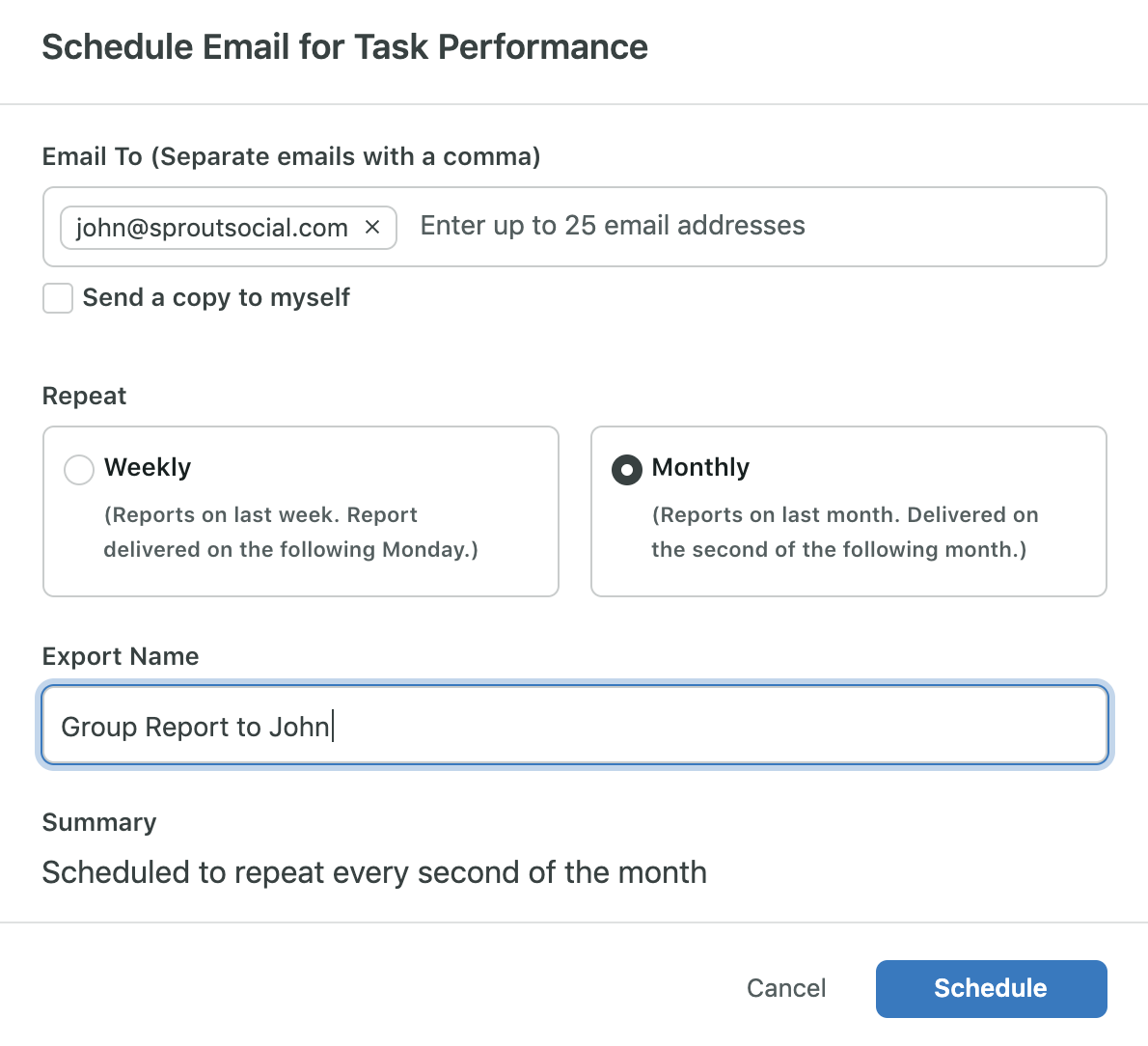
Encourage feedback between retrospective conversations by establishing a consistent reporting schedule. Monthly reports and check-ins provide a solid picture of your progress while creating an opportunity to gauge whether or not a client is satisfied with your efforts. Sprout users can set up recurring report delivery to key stakeholders on a monthly or weekly basis, for more time-sensitive projects.

Sprout's report scheduling feature


If you think your client might benefit from an additional retrospective, be sure to meet with your team before putting it on the books. Creating an opportunity for an open internal exchange will help ensure that you’re approaching clients with solutions in mind.

Show up with data

Fifty-four percent of agencies identify educating their clients on the value of social as a common pain point, according to the 2021 Agency Pricing and Packaging Report. Avoid leaving your success up to anecdotes or gut feeling by gathering powerful data points, actionable insights and strategic recommendations.

Kate Istead, Head of Operations at Giraffe Social Media, understands the value of using reports for an objective look at key accomplishments, for both clients and marketers.

“It’s very easy to look back at your work and say ‘I wish we would have done it like this’ or ‘We could have done this better’,” says Istead. “What matters is the goals that were set at the start of the project. It’s not fair to judge yourself based on a goal you didn’t actually set.”

Giraffe Social Media’s approach to anticipating their client’s needs and pivoting strategies in response to feedback helped them win Agency Partner of the Year at the 2020 Sprout Partner Value Awards.

“Our social media managers build custom reports based on client goals and objectives,” says Istead. “Not only do we use that data to improve our services, we also use it to change how we operate as an agency across all clients. There are always lessons to learn, whether it be what’s performing well organically or how we can get the most out of paid advertising.”

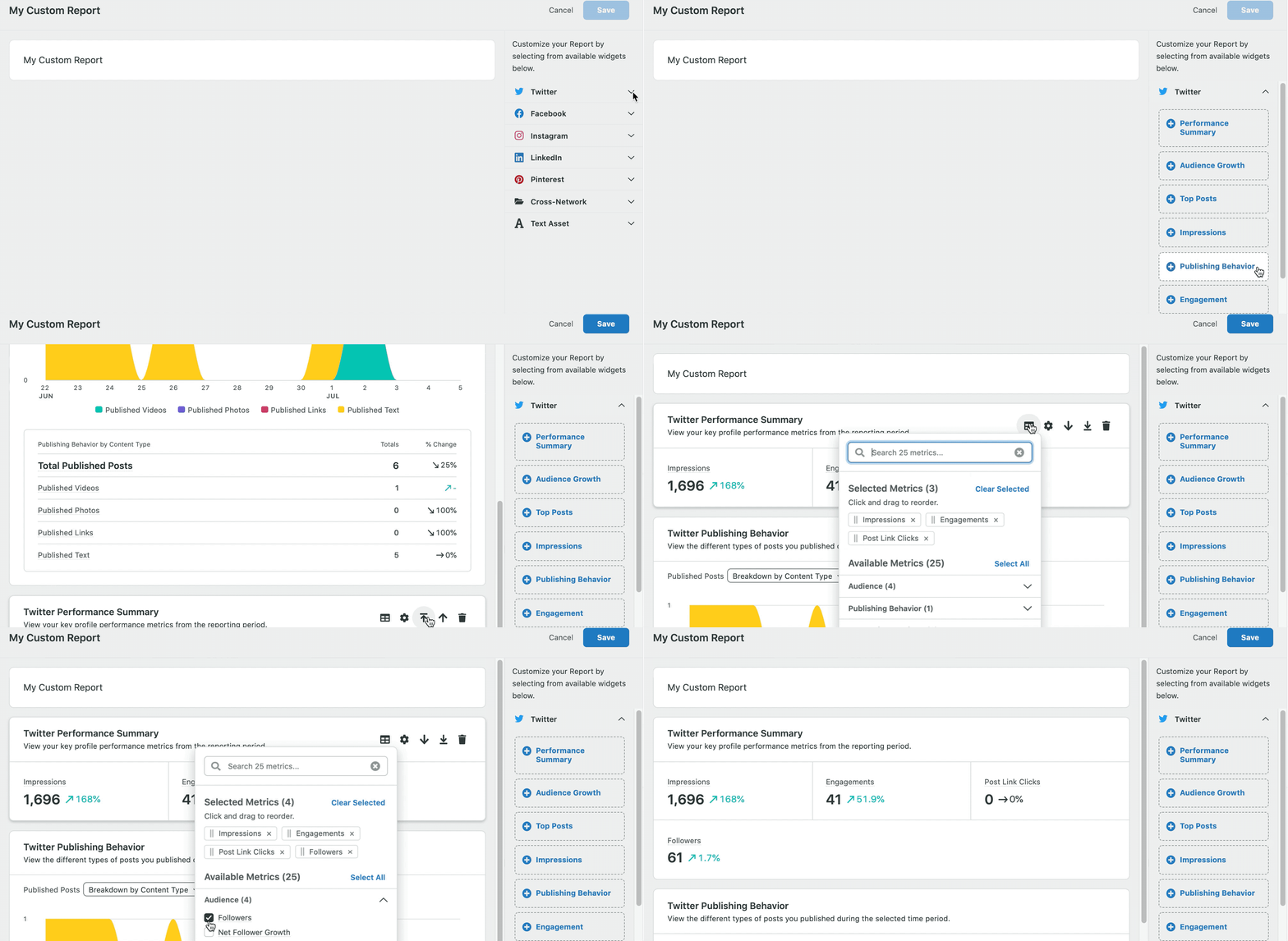
A walkthrough of Sprout's reporting features


Agencies using Sprout’s Premium Analytics can use the advanced Report Builder to create custom reports that align with client business needs. Centralizing and consolidating the information that matters most can help ensure clients come to retrospectives with a complete view of the work your team has done.

Don’t fear the retro

When agencies and clients grow together, it’s a beautiful thing. Agencies that use retrospectives to increase collaboration and communication create strategic partnerships with their clients that pave the way for new business down the line.

It’s time to go after those dream clients. Download our guide to using social listening to optimize agency operations today and find out how you can create a foundation for long-term growth.


The post Don’t fear the retro: How open communication strengthens agency-client relationships appeared first on Sprout Social.


from Sprout Social https://ift.tt/2STbx9W
via IFTTT

How to Grow your Email List with Instagram

How to Grow Your Email List with Instagram

As a small business owner, you already understand the importance of optimizing your marketing budget. And while there's no denying that Instagram and other social media sites can be excellent platforms for marketing your small business, what many business owners don't realize is that they can actually use these tools to grow their email lists as well.

So, what are some of the advantages of Instagram as a marketing tool and how can you harness its power to grow your email list? We've got you covered with some marketing tips and tricks geared specifically towards small business owners like you.

Why Instagram is a Valuable Marketing Tool

If your business isn't already on Instagram, you're missing out on some excellent marketing opportunities. Consider, for starters, that there are more than one billion active users currently on Instagram; this means that with the right marketing strategy, your reach is essentially limitless.

Instagram also makes it easy for you to engage directly with your customers (or prospective customers). By creating fun posts, generating likes, and using hashtags, you can interact with your target audience in ways that simply aren't available through other marketing platforms. And, strategic and creative hashtags can be used to boost your visibility and grow your brand awareness on Instagram.

Compared to other social media platforms (including Facebook and Twitter), Instagram also allows for a high level of creativity. From interactive videos to Instagram's "stories" feature, there are plenty of opportunities for creative marketing.

Why You Need an Email List

Instagram is great not just for your standard social media marketing, but for growing your email list as well. After all, there are many benefits to expanding your email list.

You Own It

First and foremost, your email list is the only communication asset that your business actually owns.

With social media alone, you have to rely on the platform's algorithm to show content to your followers. With an email list, you decide exactly what goes out to your list.

That content then shows up directly in your customer's inbox. And of course, you can even use segmentation to send out different marketing messages to different groups within your list.

It's Targeted

If somebody has signed up for your email list, they have already shown at least some interest in your company's offerings. This makes it easier to target your future email messages and tailor them to your audience's interests.

The more personalized nature of email makes it extremely effective, whether you're trying to make a sale or even get a potential customer to contact you for more information.

It Works

Simply put, email marketing is extremely effective. With more than four billion active email accounts across the globe, the potential for reaching new customers and clients is far-reaching with a great email list.

Strategies to Move Instagram Followers to an Email List

Now that you have a better understanding of how Instagram and email marketing can be an effective means of growing your business, you may be wondering how you can use Instagram to grow your email list.

There are plenty of simple and practical (yet effective) steps you can take to encourage your Instagram followers to sign up for your email list, if they haven't done so already.

Run a Contest

Contests, drawings, and giveaways are all great ways to use social media to its full potential. Not only can a contest be used to encourage more sign-ups to your email list, but they serve a dual purpose of increasing your number of social media followers and boosting your online presence.

Just make sure that it's clear to your followers that they need to subscribe to your email list (and include a link) as part of the contest participation requirements.

Offer Something Exclusive

Another option to get your Instagram followers signing up for your email list is to offer exclusive discounts, content, or other promotions.

Post on your Instagram page that followers can sign up for your email newsletter to receive free downloads, other exclusive content, and possibly even a one-time promotional code.

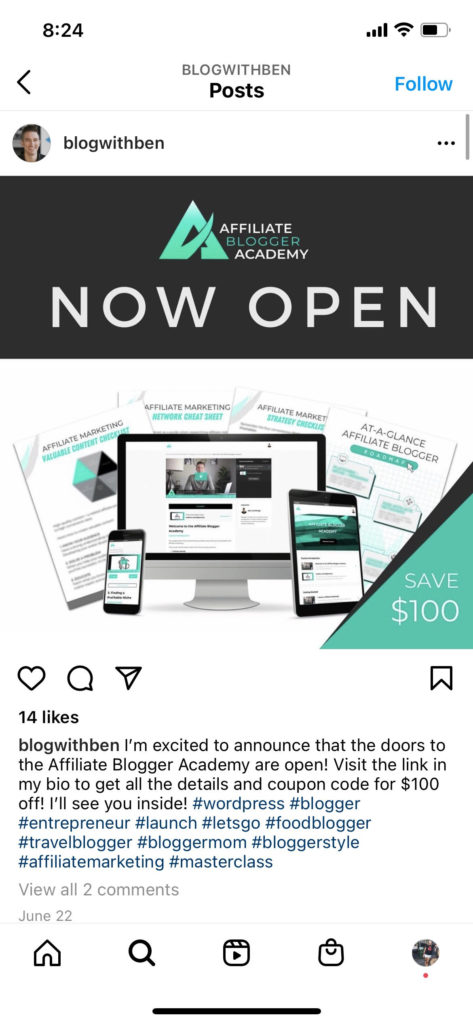
See how Ben Cummings of Blog With Ben offers his Instagram followers an exclusive coupon code to access his brand new course. This is a great strategy to drive social followers into subscribers (and even into customers).

Convert Instagram followers to subscribers with a coupon code

Don't forget to include a link to sign up for your email list in your Instagram bio. You might also include a specific call-to-action along with the link, encouraging your followers to subscribe.

Don't assume that a simple link to your sign-up page will suffice; a distinct call-to-action will greatly increase your chances of converting Instagram followers to email subscribers.

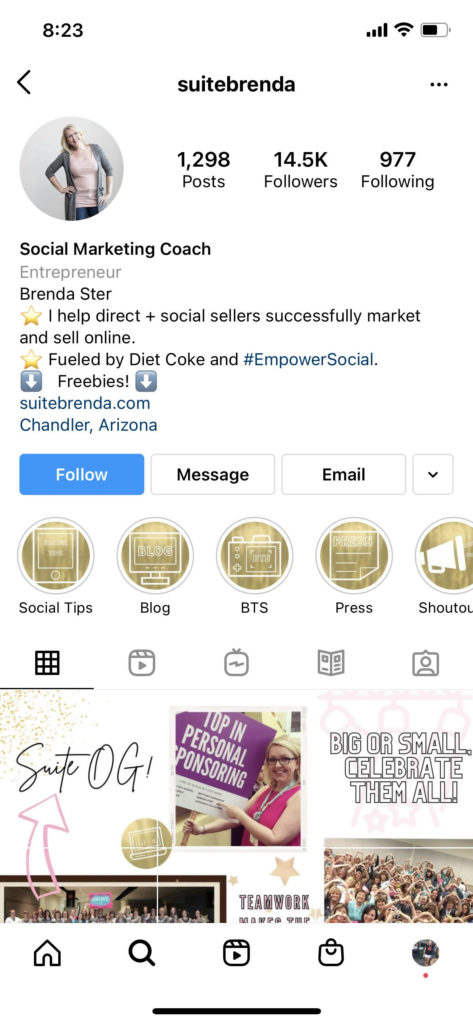
Take, for example, Social Media Coach Brenda Ster — Brenda uses freebies to encourage her Instagram followers to join her email list. Including a link in her bio that takes visitors directly to her freebies makes it easy for visitors and followers to take the next action.

Using freebies to encourage Instagram followers to join email list

Take Advantage of Stories

Depending on how many followers your business page has on Instagram, you can also use the unique "stories" function to promote your email list. Specifically, if your page has more than 10,000 followers, you'll have the ability to add links to your Instagram stories. This poses an excellent opportunity for you to market your email list by including a direct link.

Even if you don't have 10,000 followers, you can still create a unique story that encourages your followers to head over to your website and sign up for your email list without a direct link.

The Final Word on Growing Your Email List With Instagram

Instagram is an excellent marketing tool for small and growing business. Not only does it offer some creative marketing opportunities, but it can also be used to grow your company's email marketing list with the right strategies. One thing to keep in mind when trying to grow your email list with social media, however, is that you should be mindful of how much you're promoting your email list on platforms like Instagram. If you're pushing it too much, this can come off as "salesy" and could actually be a turn-off to some of your followers.

In general, there's nothing wrong with including a link to your email list in your Instagram bio and using one of the above strategies to promote your email list once every week or so. Just try to be mindful of how often you're mentioning it and try not to go overboard; at the end of the day, you know your followers best.

With a little careful research and creative effort, you can use your Instagram page to grow your email list. From there, your marketing can reach new levels of success!

Convert social media followers into subscribers

Want to convert your followers into subscribers — across your social channels? Then you need this guide.

Get everything you need to know about converting social followers into email subscribers and take back control of how you communicate with your audience.

Get the guide

The post How to Grow your Email List with Instagram appeared first on AWeber.


from AWeber https://ift.tt/3dPrchD
via IFTTT

Thursday, 1 July 2021

The complete guide to B2B SEO

The practice and industry of Search Engine Optimization (SEO) has been around for quite a while now. People generally tend to think about an SEO strategy in terms of ranking high in popular keyword searches. But for business-to-business (B2B) companies, the strategy shifts from a broad audience to a very specific one.

B2B SEO has a few basic areas that differ from B2C SEO. In this guide, we’ll outline those key differences and how you can better your own B2B SEO strategy.

What is B2B SEO?

B2B SEO is the online practice of using various techniques – like keyword research and a page’s metadata – to reach the decision-makers of a company. A successful strategy means that someone actively researching the product or service that you’re offering reaches your company’s website.

There are a few different elements to B2B SEO. Each one plays a role in your overall strategy. If you’re lacking in one area, it means you’ve still got room to optimize your site.

  • Technical SEO: These are the optimizations you make to the backbone of your website. It covers areas like your XML sitemap, load speed and a responsive design.
  • Content SEO: B2B content marketing for SEO is the practice of using research on user needs and search intent to create content. You go through the steps of research, ideation, content creation and promotion.
  • On-page SEO: This is the optimization of the content itself. On a page or blog post, it includes the meta description and title tag, alt text on images and structuring the content so information is relevant to both the user and findable by search engines.
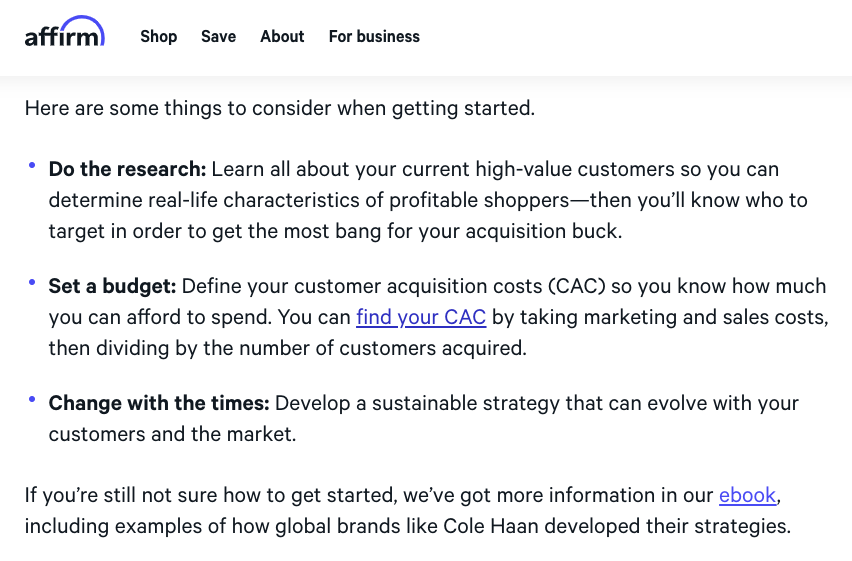
  • Off-page SEO: Also referred to as backlinks, having high-quality pages link to you on a specific topic increases your perceived expertise in said topic. It also includes engagement on the page or post. The links in the below blog post from Affirm show off an example of using off-page SEO.
affirm blog post

In a blog post about small business customer acquisition, Affirm links the phrase “find your CAC” to a HubSpot article on what a CAC is. For HubSpot, this is considered a backlink (or a win for off-page SEO) and a good one since it’s both a reputable website and a relevant keyword phrase.

These four SEO types combine to create your SEO strategy at a high level. Now we’ll go into more detail on how to apply these functions to a B2B marketing strategy.

What is the difference between B2B & B2C SEO?

Conceptually, B2B and B2C SEO have a similar basic goal: you want people searching for you to find you. But in practice, it’s a lot more complex and the strategic approach is different. Here are four key differences between B2B and B2C SEO.

1. More time in each sales stage

b2b marketing funnel

The B2B sales funnel has the same stages as a B2C funnel but the time spent in each one is much longer. In B2B, a decision-maker spends a lot of time in the research stage, collecting information about various offerings. There’s often a significant back-and-forth between the seller and the potential client where the prospective customer will read up on case studies, watch product demos and negotiate a contract. Because of this long period of time and the different needs of each step, a lot of different content is produced for each stage to entice the potential buyer.

2. Don’t ignore low-volume and long-tail keywords

Another difference in B2B SEO ideation is how you approach keywords. In B2C, you want a lot of people to search for your product type and then buy yours. Ranking high in common keyword searches is important. In B2B SEO, it’s often important to also target low-volume keywords. These are specific and entice only a small number of searchers. But these people are the ones who are most interested in the content you present. These highly specific phrases are often called long-tail keywords.

customer service chatbot search result example

In the above example, someone might be researching the benefits of using a customer service chatbot. The article from Intercom is an introduction to chatbots and how they can improve customer service. It’s the perfect article to show up for this search result. Motivated buyers are much more likely to search highly specific queries like this, compared to a broad but higher volume one like “what is a chatbot,” which might only be a general information search.

3. Low conversion rate

Going hand in hand with the long time in each sales stage is the conversion rate. Because so much time is spent gathering info, it means that a lot of content is also being consumed. But all that content isn’t going to immediately lead to a purchase. It’s rare for a business decision-maker to browse a page and then decide that’s the product they’re going with. This leads in to the need to approach content planning strategically for B2B SEO.

4. Content for decision-makers

b2b marketing funnel content planning approaches


When you write your blog posts or landing pages, you aren’t usually writing in a casual, playful, eye-catching manner like you would for B2C content. B2B content tends to veer into the more informative, professional and data-driven territory. Many different types of content are utilized with each one aimed for a different B2B sales stage. Oftentimes, the content is also specific. For example, someone searching for a PR agency won’t just search “PR agency.” They’re going to look for one in their industry or market such as “Houston restaurant PR agency.” Having content for each industry you serve makes each piece far more valuable.

Tips for creating an effective B2B SEO strategy

Now that you know the differences between B2C and B2B approaches to SEO, it’s time to set up or examine your strategy. Having every element of your SEO approach working together is most effective, compared to devoting all your resources to one aspect. Having content show up in a relevant search won’t do you any good if that page isn’t loading quickly. And targeting high-volume keywords at random won’t help you reach the right people without greater audience insight.

Create buyer personas

A key part of conducting B2B market research for your company includes creating buyer personas. Just like a customer persona, a buyer persona details who they are, which industry they’re in, what their position is, who they consult for making a decision and more. The more details you have about the buyer persona, the better you will be in crafting content.

buyer persona

Before you create a buyer persona, make a list of questions you need to know about each buyer. Make it a template so you can easily fill it in for each persona. In the above example, you can see how one company crafted a persona that includes education, responsibilities and sources they trust.

Conduct keyword research

Keyword research allows you to know how many people are searching for each given phrase. But more importantly, it helps guide your buyer persona, build your content strategy, conduct a competitor analysis and more.

keyword research


Keyword research is not limited to search engines. It includes social listening, where you can see what people are discussing online and evaluating your brand sentiment.

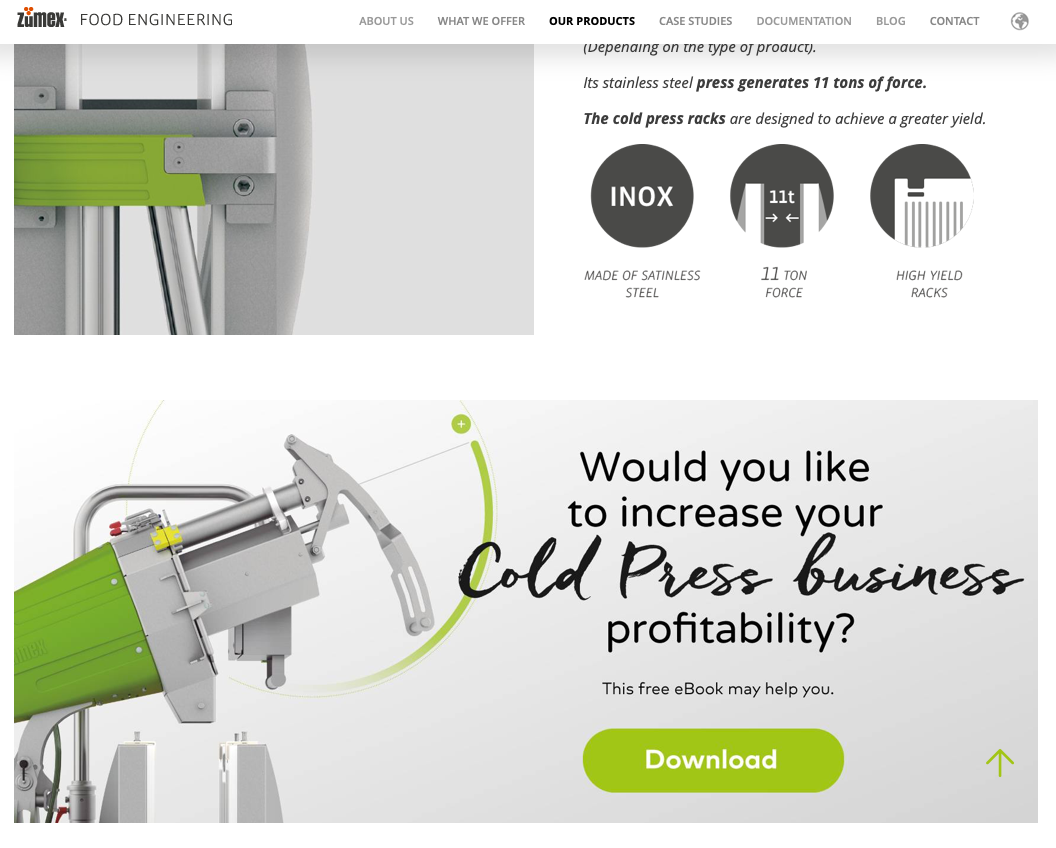
cold press ebook

In the above example, someone searching for commercial juice press machines would end up on this page. Mid-page, the company inserted a free eBook on a very relevant topic for their target audience. The ebook demonstrates the company’s knowledge about the subject and hopefully reinforces that idea in the buyer’s mind.

Optimize your website & pages

Work on that technical and on-page SEO. Depending on how your website is designed, it might already have built-in SEO enhancements or you might need assistance from developers to improve it. Sites built with WordPress have a wide array of SEO plug-ins to choose from. Sites built with out-of-the-box templates may be harder to edit the specifics you need to optimize your content.

Website and on-page optimization includes but is not limited to the below:

  • Image compression
  • Page load speed
  • XML sitemap
office printer search results
  • Page title tag, meta description, URL structure, the content’s header tags and image alt text. An example of the importance of image alt text is above. The search for office printers isn’t very specific so Google offers additional keywords to look for. But you’ll note that this search result already generates loads of product links and images of office printers.
    • Equally important is alt text’s role in accessibility. Search engines continue to prioritize an overall strong user experience. While accessibility may not be an ‘official’ ranking factor, having a poor site performance that segments of your audience simply can’t use will most likely lead to fewer links, clicks, shares and overall search visibility.
  • Linking to other internal pages.
  • Repeated usage of different keywords you want to rank for, including repeated–but natural–use of primary keywords (keyword density), using keywords in informative headers, and using variations or secondary keywords for readability and further search targeting.

Create relevant content for each sales stage

There’s so much content to choose from, what do you focus on? Start small by creating one piece of content for each sales stage. Enhance each one with SEO strategies and create for the buyer persona that you’re targeting.

buyer journey map

The above table shows examples of where each type of content can be used for each sales stage. As you create more content in each area, note down the data associated with each one. Are webinars gaining more attention than expected? Create even more in targeted topic areas.

If you already have content on your site, take a look at the older blog posts. If they’re still relevant, try updating them with fresh information or create a different content type on the same subject. A how-to video could easily be turned into an article with photos.

sprout menu

As mentioned earlier, being specific in your content is helpful for B2B SEO. Having a landing page tailored for each buyer persona or business type that you aim for makes that page more valuable than a generic one. In Sprout’s menu, you can see how business types and industries are divided up. The Travel and Hospitality link leads to a page that includes current travel customers, how a company would deliver customer care and testimonials from related brands. The copy is written specifically for someone who works in the travel industry and whose company serves travel customers.

Promote the content

Having great backlinks can only make your website seem more authoritative. Off-page SEO includes both website backlinks and social media posts. But this portion of B2B SEO is more difficult because it’s less within your control. Cold emailing a company and asking them to link to your blog post could be considered poor form and isn’t likely to be a good use of your SEO team’s time.
.

Instead, there are some other options you can consider. Craft a B2B social strategy that includes the promotion of your current content. How will businesses know about that great white paper you spent days working on if you don’t promote it everywhere? Don’t wait for a business to land on your site to finally share that piece of content. Similar to your approach to social media content, creating high-quality and informative content that is inherently share-worthy can help it gain links organically as audiences find it useful.

Also, using other resources like a PR agency or influencers can increase your chances of getting backlinks. Product reviews, social media recommendations and CEO interviews in articles are all ways to work on your off-page SEO.

Get started on your B2B SEO strategy

B2B and B2C SEO may have a similar marketing funnel, but the time spent in each stage and the content supporting the strategy differs. While much of B2C SEO is focused on getting a lot of people who are searching for a popular keyword to find your company’s website, B2B aims for lower volume results. The content is specific and informational, written with the company’s buyer persona in mind.

Your B2B SEO strategy will not be the type that you set it and be done with it. You’ll need to consistently optimize and update existing pages, develop new content update new pages with SEO, create new blog posts for different keywords and edit your buyer personas as time passes. To get started, check out our guide to developing B2B social media posts to start getting inspired on your content.

The post The complete guide to B2B SEO appeared first on Sprout Social.


from Sprout Social https://ift.tt/2UaXlcB
via IFTTT

5 types of social media content that can accelerate business success

Ninety-three percent of marketers acknowledge that social media accelerated competition within their industry in the last year. So, what’s one of the keys to standing out from the crowd? Content.

Content is at the heart of every social strategy. It’s how brands make their first and lasting impressions on social. It’s the essential ingredient for how brands communicate and connect with new and loyal customers.

In this article, we’ll walk through the most valuable types of social media content identified by marketers and how you can use social analytics to determine the best types of content for your business.

We’ll show you two ways to find the best types of content that will grow your business: the first is based on data from the Sprout Social Index™, Edition XVII: Accelerate, provided by marketers on their most valuable content types; the second uses social analytics to analyze your social data.

The types of social media content marketers find most valuable in 2021

Types of content marketers say are most valuable for social goals: Video, images, text-based posts, Stories and live video

1. Video

According to 54% of marketers, video is the most valuable content format for achieving social goals.

Despite the growing demand for video among consumers and the value of video in achieving social goals, marketers’ content strategies continue to favor photos and posts containing links. Findings from the Index reveal that overall only 14% of Facebook posts, 11% of Instagram posts and 5% of Twitter posts include video content. When looking at the breakdown of published video content, brands within a few industries are outdoing those benchmarks.

published video content by network, showing the most content published on FB and IG by media brands

Why video works on social:

Social video content is hot right now, and for good reason. No matter what your goals are for social, video can help you accomplish them.

An overwhelming majority of video marketers say video has helped increase sales, traffic to their website and users’ understanding of their product or service, according to Wyzowl’s 2021 State of Video Marketing Survey.

If your goals are more focused on community engagement, social video content can be a valuable resource to lean on. Instagram videos get 49% more engagement than photo posts. Tweets with video have 10x more engagement than those without. People are also twice as likely to share videos with their friends than any other type of content.

If the popularity of TikTok and Instagram Reels is any indication, successful videos don’t require unlimited time, resources or polish to create. Low-lift, creator-style videos can add a level of relatability that viewers appreciate.

In addition to being able to produce effective, low-lift videos without any major investment, video content can also be repurposed and spun into other content formats. Check out nine tips to get the most from your social media video content here.

Best social platforms for video content:

Facebook, YouTube and Instagram are the top three social media platforms that consumers use to follow brands and want to see brands using more. Instagram in particular has a variety of tools for creating long and short-form videos, which makes it a great arena for testing different video concepts and styles.

You might be wondering, what about TikTok? Individual creators run the show on the platform and brands have yet to really find the sweet spot, but there’s a lot that can be learned from TikTok trends.

4 ways Klarna gets video content right on Instagram

Klarna is a global fintech company that enables smooth shopping by allowing consumers to buy now and pay later. Departing from how you might think of traditional finance brands, Klarna is colorful, fun and killing the social video marketing game on Instagram. They post consistently and aren’t afraid to experiment with Reels, IGTV and video in Stories. Here are a few reasons their Instagram video content goes above and beyond:

  1. They collaborate with popular, yet relatable influencers and brand partners to create videos, making for a diverse collection of content.
  2. They leverage video series like Expert Q&As featured on the UK account, and “Let’s Kiki with Klarna” for Pride month in the US.
  1. The brand has several geo-specific accounts, for which all video content is tailored to those regions in the topics they touch on, influencers they partner with and the products they promote.
  2. They’re using their Instagram-first, #GetSmoooth campaign to test the waters on TikTok.
@klarna

After months of hibernating, @wisdm8 flexes his style. Use the audio and #GetSmoooth with Klarna. 😎

♬ Get Smoooth with ASAP Rocky – klarna

2. Images

Images are a very close second in the rankings of the most valuable content format. They’re also the most frequently posted content type across social networks.

Unlike most videos, still images can be absorbed and appreciated in an instant. The colors, composure, text or (lack thereof) and other details give social users an immediate impression of your brand.

Why images work on social:

I don’t know about you, but I’d rather look at a picture than read a thousand words. The majority of social media users will feel that way too, as they crave convenience, accessibility and brevity.

These days, mobile devices are equipped with high-definition cameras and editing tools, so anyone can embrace their inner photographer. That means social media marketers can take the reins on creating images for their content strategy without enlisting a ton of resources. It’s also opened the door for consumers to contribute high-quality user-generated content (UGC)  for their favorite brands.

UGC images add another dimension to a brand’s visual identity, while also building community and relatability between a brand and social users.

Best social platforms for images:

Marketers should include images in the content strategy for every social network they use, but Instagram and Pinterest naturally lend themselves to visuals and have a few unique advantages.

Though it has evolved to be much more, Instagram started as an image sharing platform. Data from the Sprout Social Index™ found that images make up 87% of Instagram content shared by marketers. Given that 48% of consumers want brands to use the platform more, consider increasing the frequency of the images you publish to remain competitive.

Only 20% of consumers follow brands on Pinterest, but that shouldn’t deter marketers from sharing images there. The majority of Pinterest users aren’t searching for a brand, they’re looking for inspiration. In fact, 97% of all searches on the platform are unbranded. Pinterest users go to the platform with an open mind and eyes peeled for visual content that sparks their interest (and future purchases). Both Pinterest and Instagram also have social commerce features that allow marketers to tag products, transforming images into shoppable content.

3 ways Williams Sonoma uses images to drive engagement and social commerce

Williams Sonoma, known for its kitchenware, home furnishing and gourmet foods, maintains strong followings, a clear, reputable brand identity and shoppable feeds across social platforms. They achieve that with sumptuous, vibrant images in the following ways:

  1. Recipes, dinner ideas and cooking-related searches are consistently among the top Pinterest trends. Williams Sonoma creates Pins and carousels that feature colorful dishes and recipes in captions. Click on the image and voila! You end up on Williams Sonoma’s website, where you can see which products you might need to complete the dish and become a master chef.

  1. On Instagram, users can simply shop product tags, so if they like what they see, they can get it with just a few taps.
  2. Across all platforms, captions enhance the visual details and always include a CTA linking to their blog or online store.

3. Text-based posts

It’s important for businesses to prioritize visual content, but they shouldn’t lose sight of the power of words. Nearly a third of marketers say text-based posts are the most valuable type of content.

Written content needs the same attention and consistency that you give other content formats and creative elements. Developing a distinctive brand tone and voice that aligns with your visual brand will help your written content stand out from the crowded social chatter.

Why text-based posts work on social:

Consumers want information—53% of consumers like or follow brand pages on social to learn about new products or services and 52% do so to stay up to date on company news. Text posts are the most direct way to give that to your followers.

When brands demonstrate an understanding of what customers want and need, 43% of consumers would choose that brand over a competitor. Written content can be extremely valuable for starting conversations that help you get to know your customers better.

Best social platforms for text-based content:

Reddit is a great platform to engage in Q&As and get conversational with your fans. LinkedIn is another natural place to share thought leadership, articles and engage with customers, SMEs, potential investors and more.

Marketers use plain-text posts on Twitter more than any other social media network. Visuals are still prominent on Twitter, but it’s mostly buzzing with conversations. According to David Herman, a Senior Manager for Twitter Sports Partnerships, joining Twitter conversations is the single best thing brands can do to increase their followers. Letting your voice be heard will expose your brand to new audiences, engage your community and let people know what your brand is all about.

4 ways McDonald’s uses Tweets to define its brand voice and start conversations with fans

Everyone knows McDonald’s as one of the most successful fast-casual food chains in the world with millions of customers served each day. On Twitter, the brand communicates with its fans at scale with a relatable, casual, humorous voice that brings the brand down to earth. Here are four reasons why McDonalds’ text posts are wildly popular on Twitter:

  1. They ask their fans questions and encourage them to engage in fun, on-trend ways.

  1. They use Tweets to collect and act on social feedback directly from their community.

  1. They don’t just post, wait for engagement and leave it at that. The brand adds to conversations threads for nearly every response they get.
  2. They cross-promote their text Tweets and reinvigorate them on other social platforms using graphic elements.

if u can do this u can have my job

Posted by McDonald's on Thursday, February 25, 2021

4. Stories

Stories aren’t necessarily going to supercharge brand awareness, but they are community engagement gold. Just over a quarter of marketers say stories are the most valuable type of social media content.

Why stories work on social:

In the US, 73% of people agree that Stories enable them to experience new things outside their everyday lives.

Across platforms, stories get top billing on social network interfaces. In addition to prominent placement, the interactive and timely nature of stories makes them highly engaging for consumers. For marketers, the variety of easy-to-manipulate stickers, interactive elements, filters and sounds gives total creative freedom and more room to express their brand personalities.

Best social platforms for Stories:

LinkedIn, Twitter, Snapchat, Facebook and even non-traditional social platforms like Slack have implemented a version of Stories, but Instagram Stories reign supreme. On most platforms, stories “self-destruct” after 24 hours. Instagram, however, allows brands to turn Instagram Stories into Highlights on their profiles.

Additionally, reactions and replies to Instagram Stories go straight to the brand’s DMs, which is a great opportunity to start or build on one-on-one conversations with your fans.

3 reasons to emulate GQ’s sophisticated Instagram Stories strategy

GQ, one of Conde Nast’s many monthly magazines, uses stories to create content that looks and feels like their magazine spreads. Here are some reasons to admire their approach:

  1. They give readers a sneak peek of their exclusive content so Instagram users are eager to swipe up and get the full story.
  2. They use interactive sticker elements like polls, questions and quizzes to creatively engage their audience, while simultaneously gaining insights about them, their preferences and needs.
  3. They are diligent and intentional about creating Instagram Story Highlights. The chic editorial design of each story frame and tap-friendly nature of Stories that seamlessly shifts you from one highlight to the next feels (almost) as if you’re flipping through the pages of a magazine.

5. Live Video

Ongoing digital transformation, accelerated by the events of 2020 and the inability to partake in in-person experiences, has businesses thinking differently about how they can engage with their customers in real-time. Live video came out a winner during the pandemic, but it’s here to stay.

Why live video works on social:

Live video enables businesses and creators to broadcast conversations, performances, Q&As, webinars and other virtual events. Unlike the asynchronous nature of waiting for responses to text or image posts, live streams give audiences a chance to ask questions, comment and react instantaneously.

Live and simultaneous viewing also give people a sense of community and togetherness, something people desperately craved during the pandemic.

On all social networks with live streaming capabilities, marketers can save the recording and repurpose the video to get more value from the content. Check out 10 ways to repurpose your live stream and get more from your content here.

Best social platforms for live video content:

YouTube and Facebook Live both experienced a boom during the pandemic. YouTube’s Culture & Trends Report found that 85% of its users had watched a live stream on the platform over the past 12 months. Facebook reenergized its live streaming capabilities, adding new creator tools, accessibility features and an audio-only mode.

LinkedIn Live is another streaming solution that brands can use to reach more professional networks. On average, LinkedIn Live videos get 7x more reactions and 24x more comments than native videos produced by the same brand.

Who’s doing it well:

Detroit Labs, a custom software development company, has found success through their recurring LinkedIn and YouTube Live series, “Labs Live.” Here are a few ways they’ve mastered the format:

  1. They stream Labs Live on a monthly basis. Between streams, they make sure to keep the series top-of-mind by promoting both past and upcoming sessions.

  1. Each Labs Live stream has a clear agenda, a list of guest speakers and descriptions that showcase the value for viewers.
  2. On YouTube, following the live stream, they add chapter markers to the video description so audiences can easily skip to points of interest.
  1. They showcase their own employees as thought leaders and also invite external experts to contribute.
  2. They have fun! Not all live videos have to be expert Q&As or buttoned-up webinars. For example, in March, Detroit Labs did a live version of bracketology, but for snack foods.

How to find your brand’s most successful types of social media content

Just because social media marketers ranked the five content formats above most valuable, doesn’t mean they will be the most successful for your own brand. Each company’s social goals will vary, so each content format’s effectiveness will as well.

Ultimately, you want to share content that your customers want—and for that, you first need to identify the best-performing types of social media content on your priority platforms.

Marketers who understand which content types yield the greatest return are better positioned to create content that stands out from the crowd.

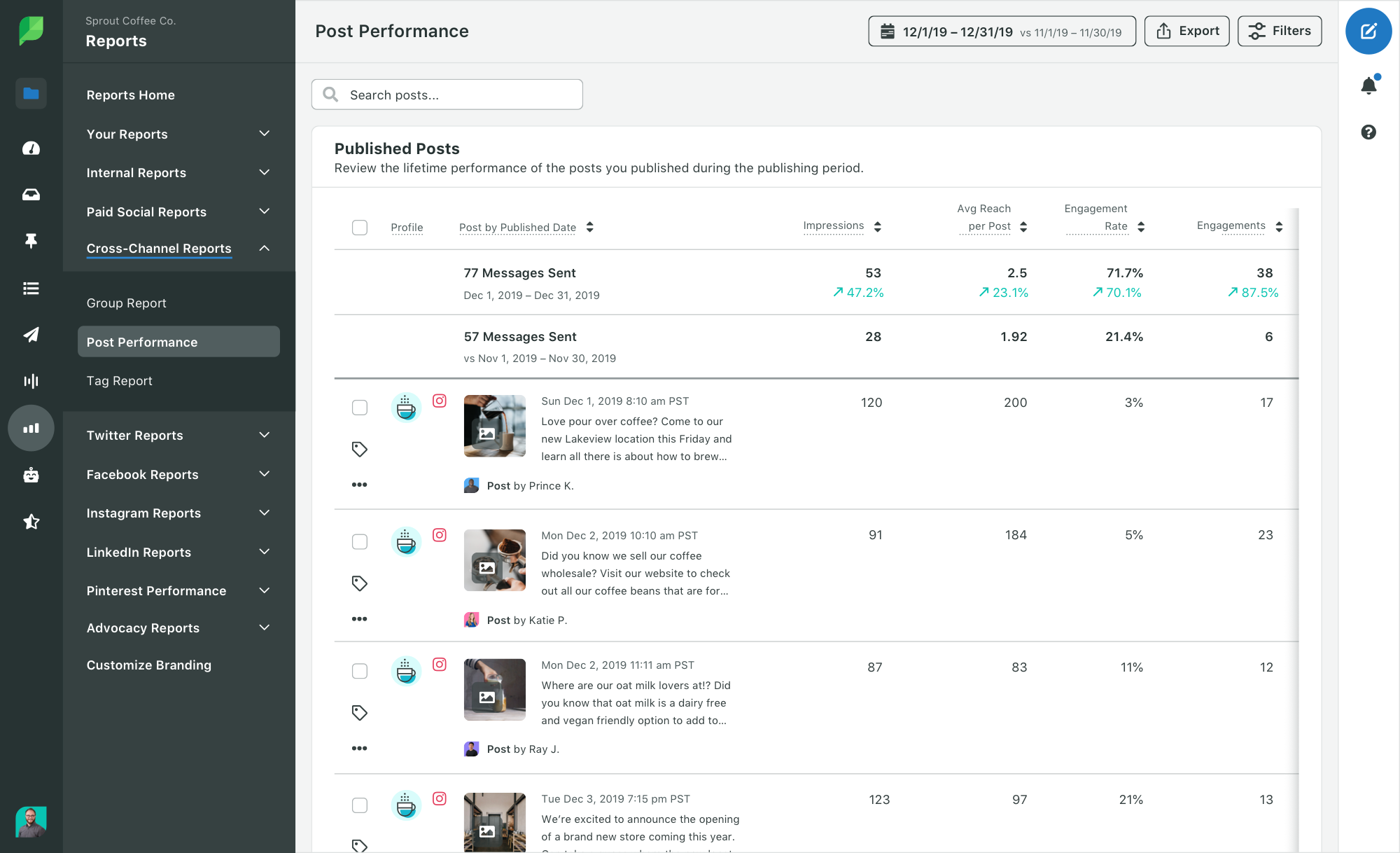
Sprout Social’s robust analytics tools make reporting on content and identifying which formats are most valuable simple. With the click of a button, Sprout’s Post Performance Report reveals a cross-channel performance analysis at the post level to understand what content resonates and why.

Applying Tags to content also gives marketers more granular insights about what compels their audiences to engage. For instance, if a brand wants to test if UGC performs better than official photography or vice versa, they can use the Tag Report to analyze that data.

sprout reporting on social media content

Accelerate past the competition with content

In a competitive and crowded social landscape, publishing content that’s built around your audience’s preferences is a must. Download The 2021 Content Benchmarks Report to dive deeper into data from the Sprout Social Index™ and shape a social content strategy that speaks directly to your audience.

The post 5 types of social media content that can accelerate business success appeared first on Sprout Social.


from Sprout Social https://ift.tt/3jz2ru0
via IFTTT