Tuesday, 5 October 2021

How to add a link to your Instagram Story

As Instagram Stories continue to maintain their popularity, many brands have used features like the swipe up link as part of their Instagram marketing strategy.

Adding a link to your Instagram Story swipe up allows you to be more tactical with your Stories, leading to even more clicks and conversions.

As of August 2021, Instagram has retired the swipe up feature and added a new link sticker for Stories.

Read on to learn more about the current state of linking on Instagram Stories and how to use it effectively in your strategy.:

What was the Instagram swipe up feature?

Instagram features move fast, so it’s no surprise if you feel like you’re missing a few details when it comes to Stories linking updates. Since Instagram doesn’t offer much in the way of adding links to posts, and your link in bio is best used for top landing pages, Stories swipe up links had become popular as a way to more freely link to individual pages and more timely pieces of content.

Most IG power users are probably still adjusting to the difference, but when a swipe up link was added to a Story, viewers could simply tap on the arrow at the bottom of their screen or swipe up on the Story to access the link right in the app.

Here’s a previous example of a swipe up link from Sprout Social’s Stories:

instagram swipe up - example of sprout social's instagram story with swipe up link

What link stickers in Instagram Stories look like now

With the update to add link stickers, you can forget the swipe up motion or bottom of the screen tap, and creators can now add a link anywhere in the Story space. Here’s an updated Sprout Story showing the much more visible placement.

sprout instagram story showing the new sticker link

To use link stickers, you’ll need access to the feature. If you’re not sure you have this, read on to the next section to learn more about the criteria. If you do have the link sticker, then you can find them available with the rest of your typical sticker options to add a link to your Instagram Story.

options for stickers including links in IG stories

How to get access to Instagram Stories link stickers

Similar to the previous Stories swipe up link feature, there still are some limitations on who can add links to their Instagram stories.

Right now, the criteria haven’t changed from swipe up. In order to guarantee access to Instagram link stickers, your account:

OR

In addition to these criteria, Instagram has been testing allowing these stickers for other users since summer 2021. It’s not completely clear how accounts are selected for the test or if a complete rollout of link stickers for all users will occur.

How to add a link to your Instagram Story

If you have access to Instagram link stickers, start creating your Story and tap the sticker icon to access the tray of sticker options. You’ll see the link option as one of the stickers you can use.

options for stickers including links in IG stories

Once you tap it, the window that allows you to add a link to your Story pops up. Add any link to your website, whether it’s a blog post, a landing page or a piece of curated content you’re sharing with your audience.

field to add link to a sticker on Instagram Stories

From here, you can finish up your Story with any other design details and publish as usual to include a link in your Instagram Story!

Ways to effectively use Instagram Story links

So you know, how you get access and add link stickers to your Instagram Stories.

Now let’s talk about various ways you can take advantage of this new feature to increase engagement from your Instagram account.

Get more tips on how to enhance your Instagram Stories with these guides:

Promote blog posts and content

Want to promote your recent blog post? Creating a graphic and sharing it on your Instagram Story is a great way to get even more social traction to your content! Just be sure you’re on top of Instagram’s Story dimensions when you create your visuals. Remember that not all mobile devices have the same dimensions, so it’s important to create graphics within the right guidelines.

When you create your graphics, be sure to include relevant visuals to your blog content and keep your imagery on brand. Here, America’s Test Kitchen highlights recent content with both a poll sticker and a link sticker to maximize engagement

example of link sticker and poll sticker in a story

Using similar fonts and colors to your overall brand helps with brand strength and recognition, especially when users are scrolling aimlessly through Instagram Stories.

You can keep track of your Story swipe ups in your Instagram insights.

Promote products

Another great way to use the Instagram link sticker feature is by promoting your products. After all, Instagram is a visual platform, so use it to share stunning, professional photos of your products with a direct link to their product page.

Take a look at how Equinox+ highlighted the link to their service prominently in their Stories with the new sticker option. Compared to swipe up, it’s easier to center the sticker and arrange design elements to highlight it visually.

link sticker on equinox plus story

Promote virtual events

If you’re putting on a virtual event and you’re trying to generate a larger turnout for it, use the swipe up feature to attract registrants. You probably already have promotional graphics for it, so share your graphics to your Stories and include a link to the registration landing page.

instagram stories virtual event example

You can easily share your Instagram posts to your own story by tapping the share icon and selecting your Story. This can be a great way both to add links to Instagram posts and get people who are viewing your Story to click to your feed.

Promote landing pages

Whether you’re creating a sales or service page or an informational landing page, it’s incredibly important to get it in front of your potential customers’ eyes.

These types of webpages are transactional pages, meaning their purpose is to reel visitors in and get them to sign up or make a purchase.

Take a look at this Instagram story promoting and linking to an online course sales and landing page.

Intentionally Designed's Instagram swipe up links to a campaign landing pages

Creating Instagram Story graphics (or videos about a service, or even sharing videos of other users as social proof) to link to landing pages should be a big part of your Instagram Stories strategy.

And by the way, as we can see with this example, past Stories, such as those saved in highlights, may still refer to swipe up. Don’t worry too much about this – Instagram has preserved the ‘see more’ clickable link at the bottom of previous highlight Stories so your viewers can still access links the way you originally intended.

Promote videos

Whether you recently posted a new video to IGTV, YouTube, Facebook or directly to your website, you can easily increase views by sharing a link on your Instagram Story.

Here’s an example of a user sharing a thumbnail of her recent YouTube video on her Instagram Story. The Story links directly to the video so her Instagram followers can immediately watch it.

A YouTuber uses her Instagram swipe up feature to promote her latest video

Once you unlock the Instagram Stories link sticker feature, you can bring your cross-platform promotional content and strategies to your Stories.

Simply create a graphic in Instagram story dimensions, upload it, add a link and publish. Voila! And now you’re able to send followers from Instagram to a video, another social network or your website.

Promote lead magnets

Trying to grow your email list? Promoting lead magnets and email list sign-ups is another great use of the Instagram Story link.

Or, invest in Instagram Story ads, like this example below, that adds an easy-to-use signup form, rather than a signup page that users have to navigate through.

Templafy uses the instagram swipe up feature to promote lead magnets and email signups

How to get more traffic from Instagram Story links

Now that you’re getting ready to take full advantage of links in your Instagram Story, it’s important to note a few tips that can help you to increase Story clicks to your website and other promotions.

Include a call to action

First, you should include a call to action right in your Story. While the link sticker is more visible than swipe up, users might still be used to the swipe up action so it doesn’t hurt to draw more attention to your link with graphics and design choices.

Post Stories often

As with any platform, the more consistently you post, the more reach and engagement you’re going to receive. If users watch your Stories often, your brand will appear towards the beginning of their Stories feed.

But if you take a long hiatus from posting Stories, you could lose your place in their feed, losing dedicated viewers and potentially loyal customers.

Once you start working on an Instagram Stories strategy, try to keep up with it so you don’t lose that hard work and viewership.

Start increasing clicks and conversions with Instagram Story links

Ready to start converting your Instagram followers? Learn even more about the benefits of using an Instagram Business Profile, and how its features can help you grow and promote your business.

The post How to add a link to your Instagram Story appeared first on Sprout Social.


from Sprout Social https://ift.tt/3gDcx9l
via IFTTT

One small step for brand: What marketers need to know about conscious—and increasingly skeptical—consumers 

Social justice movements, a global pandemic, climate change and other environmental disasters. Look no further than the news cycle to understand why consumers are becoming more careful about the businesses they support, the products they use and their impact on the planet.

Waves of corporations have responded by making pledges to uphold eco-friendly, socially responsible, antiracist business practices. Brands have made headlines for their gestures of goodwill—like when Calm paid Naomi Osaka’s fines for skipping press meetings to protect her own mental health and Airbnb introduced temporary housing plans for Afghan refugees.

Despite more frequent business pledges, consumers remain skeptical–52% believe brands that take stances on societal issues are just trying to drive sales.

We need some skepticism to keep businesses accountable, transparent and authentic. But businesses also need to continue showcasing progress, putting their values to work and being the change consumers want to see in the world.

As your brand embraces corporate responsibility, here’s what marketers need to know about building trust with conscious consumers.

1. Consistency and transparency are a must

There’s nothing wrong with building buzz around your business initiatives and achievements for the greater good. In fact, 50% of consumers want businesses to use social to share details about their social justice commitments and provide proactive updates on their progress. The keys to building trust in your communication are consistency and transparency.

Posting a Tweet that gives a vague indication that your company is committed to “doing the work” isn’t going to cut it. Consumers are quick to see right through hollow brand activism.

Patagonia is revered as one of the best companies that mixes business with activism and it’s easy to see why by looking at their social feeds. On Twitter, the brand shares content related to their values and commitments to causes nearly every day. In addition to sharing their own messages of activism, the brand consistently Retweets messages from activists, nonprofits, news sources and other brands with mutual values.

Patagonia’s transparency on social crystalizes where they stand on issues that their company and consumers care about. And the proof that consumers trust the brand is on social.

 2. Responsive brands breed trust

Thanks to social media and the internet, consumers are empowered to do their own research to verify that companies aren’t just talking the talk.

Seventy-eight percent of consumers agree that social media is the fastest and most direct way to connect with a brand. Additionally, responsive brands that offer strong customer service and engage their audiences are the brands consumers say are best in class on social.

That puts a lot of the burden on your brand’s social marketers to be on the front lines, answering questions about your business, products and purpose. Add that to growing the list of reasons social media marketers can’t operate in a silo.

Social media managers, influencers, creators and partners need to be empowered with the information necessary to accurately represent your brand, products and services. For instance, if your brand sells eco-friendly, vegan, cruelty-free products, you’ll inevitably get questions, especially as consumers grow skeptical of greenwashing. Brief social marketers on your brand’s product development practices, give them publicly available resources they can share with consumers and have a process for escalating messages to your company’s subject matter experts.

3. Employees’ and leaders’ voices matters

 It’s not only conscious consumers that expect businesses to act on societal, environmental or political issues—nearly 8 in 10 employees expect the same of their employers.

With a mutual interest in holding businesses accountable, consumers trust employees as a source of information about the companies they work for. Brands need employees’ help reinforcing their values, initiatives and goals on social. When employers follow through on commitments, and proud employees share the achievement with their own social networks, your brand’s credibility and overall perception are likely to move in a positive direction.

Screenshot of LinkedIn post by Cassandra Blackburn, Sprout Social's Head of Diversity, Equity and Inclusion. "As a means to driving equity across our communities and breaking down the barriers that have existed for too long, I am thrilled to share that Sprout Social, Inc., Inc. has contributed $100,000USD to the United Negro College Fund (UNCF) for the establishment of the Sprout Social Scholarship Fund. Through this Fund, we are awarding eight merit-based scholarships to Black/African American college seniors who exemplify strong leadership abilities and demonstrate interest in computer science or software engineering."

Businesses should also focus on leveling up your executive team’s social mastery. As pressure for executives to speak out and make their stances clear mounts, leaders need their social marketers for support. Not only do social marketers know your audience inside and out, they can help executives shape their presence, engage in dialogue and define their voice for social—which may be distinct from the “brand voice.”

For business leaders looking for inspiring examples, Alexis Ohanion, Seven Seven Six Founder and Former Executive Chair of Reddit, is a must-follow on social. He consistently uses his platforms to express his personal values, champion purpose-driven businesses and share updates about causes he supports.

4. Listen first and learn from conversations on social

Social isn’t only a microphone for sharing your brand’s corporate responsibility efforts, it’s a window into your audience’s reaction and a compass for where you should focus next. With social listening and community engagement, businesses can evaluate voice of the customer (VoC) data to gauge present-state perception and answer questions like:=

  • How was your last corporate responsibility-related announcement perceived? What insights can you take away from both the negative and positive reactions?
  • What concerns and societal issues are most present in conversations about your brand?
  • Are there any existing initiatives, pledges or company claims that people are skeptical about?
  • What FAQs does your brand receive regarding your company’s stance on certain issues?
  • In addition to staying informed about the social climate on a national or global scale, what laws, movements and social causes are top of mind in your local community? What differences can your business make in your backyard?

The answers may ultimately influence more product research and development, workers’ rights efforts, supply chain considerations, DEI commitments and the strategic direction of your business.

Meeting customers in the moment is important, but businesses also need to understand what consumers will care about in five, 10 and even 20 years. Social media channels are steeped in conversations and content that act as a weathervane for consumer interests and values. 

Don’t forget that small gestures can make a big impact

 Grand gestures and pledges to create a better world may end up in headlines, but brands shouldn’t forget about small acts that reinforce your values among your customers and partners.

Make brand authenticity and genuine community connection core qualities of your social strategy. Read this article (free worksheet included) to get started.

The post One small step for brand: What marketers need to know about conscious—and increasingly skeptical—consumers  appeared first on Sprout Social.


from Sprout Social https://ift.tt/3A70iu4
via IFTTT

How higher education social media has evolved in Europe

Pursuing higher education is one of the biggest investment decisions we make. But a degree is so much more than a product—it’s a personal choice that shapes peoples’ lives. This has forced educational institutions to rethink how they use social media, especially since the start of the pandemic.

How are universities and colleges using social media in the wake of remote learning and school closures? We spoke to three institutions across Europe and the UK to find out what the new social media landscape looks like for them.

How universities and colleges use social media

Visibility and brand trust

It can be difficult for students to get a feel for a place before they enroll, but social media offers insight into the personality behind an institution. For ESCP, a business school with six campuses across Europe, social media is a place for raising awareness of their brand and securing trust with future and existing students.

“We are essentially working on visibility and brand trust to help our audience understand what ESCP really is. We’re not just a business school, we have our own values about sustainability, and about inclusion and many other things,” says Tom Maccario, Head of Digital Communication and Social Media at ESCP.

“When it comes to social media, first it’s visibility and impressions, then engagement. We want our messages and posts to be delivered to the maximum number of people, but we’re not looking to touch everyone. We want to touch the right people and have a conversation with them.”

Have you ever felt the crippling fear of making the wrong choices? 😱 You are not alone! ESCP Professors and experts…

Posted by ESCP Business School on Monday, September 20, 2021

Attract top-level researchers

Attracting potential students is an important goal for many institutions, but it goes further than that. The University of Cambridge taps social media to reach researchers and potential staff too.

“We use it to attract the best people in the world, whether that’s potential staff, researchers, undergraduate students or postgraduate students,” says Anu Hautalampi, Head of Social and AV at the University of Cambridge. “We also use it to keep in touch with alumni, partners and donors, to protect and convey the Cambridge brand, and to broaden the perception people have of Cambridge.”

The institution itself is renowned as one of the oldest universities in the UK, but through social media, they hope to portray its focus on cutting-edge science as well as its increasingly diverse community.

Reputation management

Reputation is everything for universities and colleges. The competition is fierce, so even a minor crisis can have a damaging effect. “My role is to look after the university’s brand and reputation on social media,” says Hannah Keep, Head of Social Media at Cranfield University. “It encompasses content reporting, crisis management, student recruitment, and customer service as well.”

The university implements the 80/20 strategy, where 80% of its social media effort is spent creating content and building the university’s online personality, while the remaining 20% is spent on direct selling and trying to convert new students.

The changing role of higher education social media during the pandemic

COVID-19 impacted every single industry, but universities faced a unique situation since their students and staff are based all over the world.

“When we passed the global shock of the pandemic, we understood quickly that the education system would change drastically (and we had to communicate this),” says Maccario.

There’s no denying that higher education social media usage has undergone a massive shift over the past two years. It’s gone from being primarily a form of advertisement to a multipurpose tool, including a central customer service hub and internal communications channel.

Sharing more community stories

The pandemic was a lonely time for a lot of people, particularly students who might not have been with their families or even in their home countries. ESCP understood that people were keen to feel close to others, even virtually.

“When it comes to social media, we understood that many people wanted to share their stories about the pandemic and remote learning. We had many, many testimonials, and a series of videos on Instagram called ESCP at Home that works really well. We also ran a contest for students, where we asked them to share their learning habits as well as their new lifestyle habits,” says Maccario.

Universities have identified social media as a community-driven forum that is to be used by everyone, not just the marketing team. Throughout the pandemic, they have encouraged students, staff and faculty to share their own relatable stories. Cranfield University was particularly driven by this idea of community. They specifically used social media to direct people to support services, since they found a lot of students were reaching out via their social channels rather than email and other traditional methods.

Embracing an informal approach to communication

Universities and colleges are often deemed formal landmarks, and their social media channels reflect this. During the pandemic, things changed as institutions began to realise that students craved human connection.

Cranfield University identified this need and switched up its approach to social media, taking on a more informal tone. “Rather than emailing and waiting for a response, people were recognising that we were friendly on social media and approached us there. We always use our names so people know they’re talking to a real person,” says Keep.

The pandemic created room for institutions to experiment. Take Cambridge University, which launched a TikTok account to get in front of prospective undergraduates.

“I wanted to get Cambridge on TikTok for a while because there was an age group we weren’t reaching,” says Hautalampi. “Coming up with TikTok content during lockdown was challenging of course, because we couldn’t go anywhere or see anyone. But this just meant we had to repurpose existing assets—and it actually allowed us to get really experimental.”

Gaining a deeper understanding of their audience

Student priorities have changed over the past 18 months. Safety and human connections have become paramount, and universities and colleges are realising that to succeed on social media, they need to put their audience first.

“We understood that during the pandemic, there were many things we could post about, but a lot of it wasn’t relevant for the audience. Now we really want to focus on our audience relevancy and promote content that’s important to them,” says Maccario.

The goals of social media have shifted for institutions too. “When I first started at Cambridge, we were very focused on shares,” says Hautalampi. “We are now focusing a little bit more on reactions and we’ve started publishing content that’s more community-oriented.”

The pandemic raised a lot of opinions from students who expected their institutions to take action. It was a difficult time for social media managers who were trying to adhere to UK government guidelines, while communicating with students who had families in the worst affected countries at the time. Universities suddenly realised that social media was an instant barometer of what their students were saying, thinking, needing and expecting.

“When we were talking about what the Vice Chancellor might say in his video messages to students, I was able to show him what people were thinking and feeling. There was a time right at the beginning of the pandemic where social was really high up on the agenda,” says Keep.

Positioning social media as a customer service tool

Many companies—including those in the education sector—are discovering that social media can be used for much more than brand awareness. Social is a home for conversations with their audience, product feedback, competitive and market insights, and (most importantly during the pandemic) for customer service.

“Up until the pandemic, a lot of organisations had the luxury of never really being challenged on social media,” says Keep. But social channels quickly became an always-on way for students to get their inquiries, which meant institutions had to respond quickly if they wanted to provide stellar student support.

More than ever before, social media is a critical extension of institutions’ traditional support channels. “We are hoping to create a real community. We’re getting more and more messages on Facebook and Instagram asking questions like when it will be possible to join the next intake, or whether someone should study in Berlin or Madrid. Sometimes the answers aren’t always on the website, so the students ask us on social media,” says Maccario.

Uncovering a critical internal communications channel

The fast-paced nature of social media meant it quickly became a way for institutions to communicate internally with existing staff and students.

“We set up a Facebook group for staff,” says Keep. “It was at the point where suddenly everyone was going to be geographically dispersed. We debated creating one for years, and the pandemic gave us a reason to finally do so. It was so simple and easy for people to use, and it was a way of keeping the community together.”

Using social media as an internal communications tool was also a priority for Cambridge University during the pandemic.

“We started using social media to reach our internal community, who weren’t really a target audience beforehand,” says Hautalampi. “Because people went back home and weren’t physically in Cambridge, it was important for us to have a direct, real-time way to speak to our students and staff.”

Social media as the backbone of communication

“COVID brought into sharp focus the potential of social media channels, and the importance of having the right people managing them,” says Keep.

Social media has been the backbone of communication for many institutions during the pandemic. Colleges and universities quickly realised that Twitter, Instagram, Facebook and LinkedIn were not just places to advertise their courses, but also key platforms for getting to know their audience, collecting market insights, and carrying out stellar customer service. Social went from being a place to reach new prospects and push out marketing messages to a central community hub, both for students and staff.

Universities view engaging with their students and staff as more than simple customer service, and social media lets them create a vibrant community that adds heart—during both exciting and difficult times.

Hoping to transform your institution’s approach to social media? Download our higher education playbook for actionable advice on everything from goal setting to reporting and community management.

The post How higher education social media has evolved in Europe appeared first on Sprout Social.


from Sprout Social https://ift.tt/3FdLnlD
via IFTTT

Monday, 4 October 2021

6 Ways to Guarantee Nobody Misses Your Next Webinar

How to Promote a Webinar that Nobody Misses

To say there is a lot of content floating around online right now would be putting it mildly. So, if you want attendees at your next virtual event, you need to know how to successfully promote it. A webinar is a flop if no one attends. So, here are tips for marketing your next live webinar.

Establish the offer

First and foremost, you need to know exactly what value you are offering your audience. You have to also set goals. Ask yourself:

  • Who is my target audience for this webinar?
  • What will my audience take away from this event?
  • What do I want my webinar to achieve?
  • How can we measure results to determine success?
  • How will this help my business in the long run?
  • Why should my audience care (what pain point does this cover)?
  • What makes the audience want to attend in person?
  • How can I use the content after the event to increase value?

These questions will give you direction moving forward. It's difficult to be successful if you don't first understand your edge and goals.

Set up a webinar landing page

Get started by creating a landing page designed solely to promote the webinar as a registration page. The landing page should be cohesive with the rest of your site and branding, but it should only offer information about the webinar with a CTA (call to action) to attend in order to keep this the primary focus of the page.

The landing page should include all relevant data, including a link where attendees can get to the event if they've already signed up. Some attendees may revisit the page on the day they plan to attend. Searching for the link and finding the webinar link should never be a hurdle (i.e. include it everywhere!). Near the attend button, include a sign-up button for anyone who hasn't committed to the event yet.

The landing page is the central hub for this event. Even after the event, you can use this page to promote the webinar recording. That way people who missed the live event, can watch at a later date.

Get event signups

Once you have a landing page in place, you can set up event signups and get the ball rolling. 

Here are three ways you will want to increase your signups. Remember, keep your CTA strictly limited to signing up for the event and nothing else for each of these marketing methods.

Start email marketing

Email marketing should be a central part of your webinar engagement strategy. Start by checking out webinar email templates to find the right fit for your brand. You want your outreach to have a consistent feel for stronger event branding.

Reach out to all of your existing contacts with a webinar invitation email. 

Keep the email content customer-centric, conveying why the webinar should matter to them and what they will get out of it. Organize your list and change your message focus based on your audience segment to targeted people effectively.

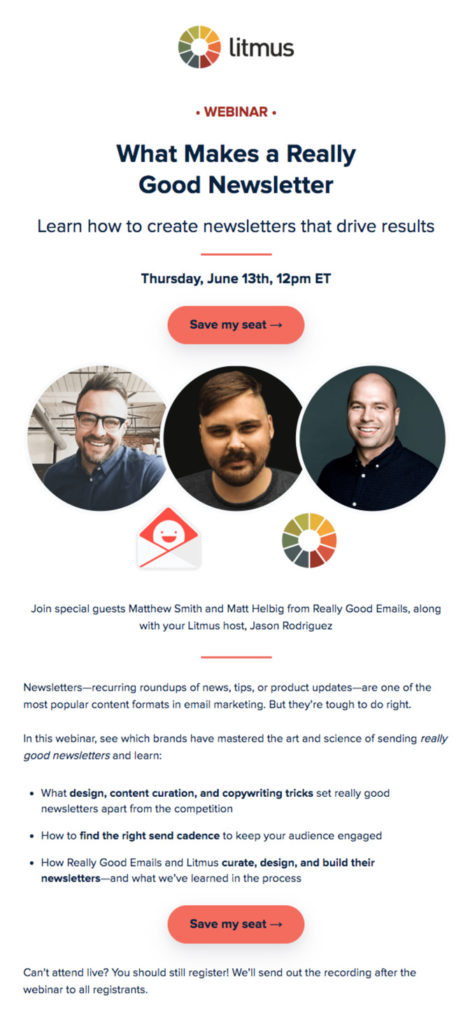
This example from Litmus does a great job grabbing a readers attention by putting the main information at the top of the email, along with the call to action.

Webinar email example from Litmus
Image courtesy of Really Good Emails

Create a campaign for each segment of your market with distinct appeals to reach the largest number of people:

  1. Make a value appeal that leans on excitement and hype.
  2. Send out a factual email that appeals to their logic.
  3. Send out a time-sensitive email that uses scarcity to trigger a fear of missing out.

You might even want to send the last email out in a 3-part series that leads up to the week, day and final hour before the event.

As soon as someone signs up for the event, exclude them from future signup prompts for this event to avoid irrelevant content. Instead, put registered attendees on the event promotion list we will discuss further down under automated reminders.

Run social media ads

Social media offers a great way to target the audience interested in attending your event. You can target those who have never visited your site but have certain things in common with your current audience. 

You can also retarget people who have visited your website or social page in the past. You can even set up a special remarketing ad for those who have been to the webinar page itself but didn't complete the registration.

Webinar promotion on social media will require a captivating image to grab attention. Choose an image that sparks emotion—like excitement or curiosity. While an image might be the last thing you think about for a webinar campaign, it's often the biggest reason people stop their scroll. Don't just choose a boring stock photo; really think out how the image will grab attention, communicate value and reinforce your message.

Create site popup or banner

Use your website to help funnel more users towards your event. When people visit your website you can have a banner ad or popup to help promote your event. The link for each of these strategies should send the visitor to your webinar landing page.

See how AWeber uses a banner at the top of our homepage to promote our Sell Something Challenge.

Banner on AWeber's website showing the Sell Something Challenge

Use the banner you create on other sites too. Do you have a partner site that targets a similar audience but offers a completely different (perhaps complementary) product? Are there other event sponsors or featured speakers who could promote this ad as well?

Spreading the word is the first step towards getting a large number of attendees. However, trying to guilt-trip someone into attending isn't typically an effective method. So, keep all messaging focused on what the attendee is going to gain from the event.

Automate reminders and remarketing

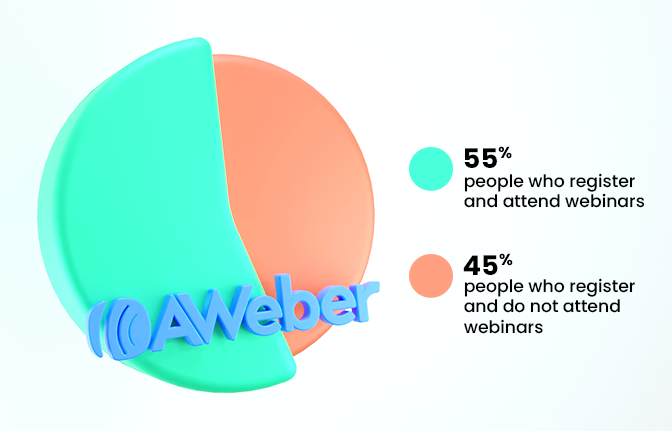
Once you have signups for your event, you will need to get them to actually attend. According to research by letter.ly, only 55% of people who register actually attend a webinar. So how can you ensure more than 55% of registered people attend?

Percentage of webinar registrants who actually attend webinar

Here are four things you should do to increase attendance at your webinar.

Email marketing reminders

Set up an automated email campaign to send out reminders leading up to the event. This is the most common way to ensure high attendance. 

Once someone signs up for your webinar, tag them as “webinar”. This tag will then be used to start the automated webinar reminder email series.

The emails should focus on preparation—offering value and tips to get the most out of the webinar. You may send an itinerary if the webinar is longer. Send out prerequisite information containing certain concepts or facts your audience needs to know before attending the webinar.

Use these emails to help provide value and serve as timely reminders. Set them up well in advance, scheduling them to go out during the times of highest engagement for your audience. 

When choosing an email template, it should remain the same for all information on the event to help with cohesion and clarity. Automated webinar email examples include:

  • Thank you for signing up – include the date, webinar topic and link to upcoming event page.
  • Webinar Reminder email – webinar is X days away, including information needed and link to your webinar.
  • Webinar it today, email #1 - send first thing in the morning, reminding attendees that the webinar is today. As usual, include a link to the event.
  • Webinar is today, email #2 - yes, a second email. People get busy or distracted. Send a final reminder within an hour of the webinar. 
  • Thank you for attending the webinar email (or "We missed you...") – segment by attendees.

SMS reminders

When your attendees sign up for the webinar, you can have them opt-in to one-time reminders solely for this event. While you could ask if they want to join your SMS list, you are more likely to get the opt-in if you promise to only use the number for this event.

After the event is over, you can always ask if they would like to keep receiving texts from your company.

For SMS texts, you will only send out a reminder a couple of days before and then the day of the event. Unlike email, you want to avoid sending multiple texts since this can quickly become a source of annoyance and feel like an invasion of privacy.

Remarketing ads

If event attendance is a really big deal, run remarketing ad campaigns to target people who have signed up for the event as well as those who haven't. You can run these ads on social media to help remind people of the upcoming event. Use the ads to ask them to join your brand page, where your target audience will also see event updates as you post them. Use the remarketing strategy close to the date of your event, so they are getting a timely reminder to attend.

Many people turn to social media for information and updates, so make sure you post your event details to your social media the day before the event. This way, those trying to attend can easily find the event information if they get confused. Always provide social updates (as well as email) if anything changes with your event.

Webinar follow-up email

After the event it’s important that you send a thank you email with a link to the recording. This will lead to an increase in the number of people who see it.  

You could make this part of your automated webinar email campaign or you can set up the email after the event.

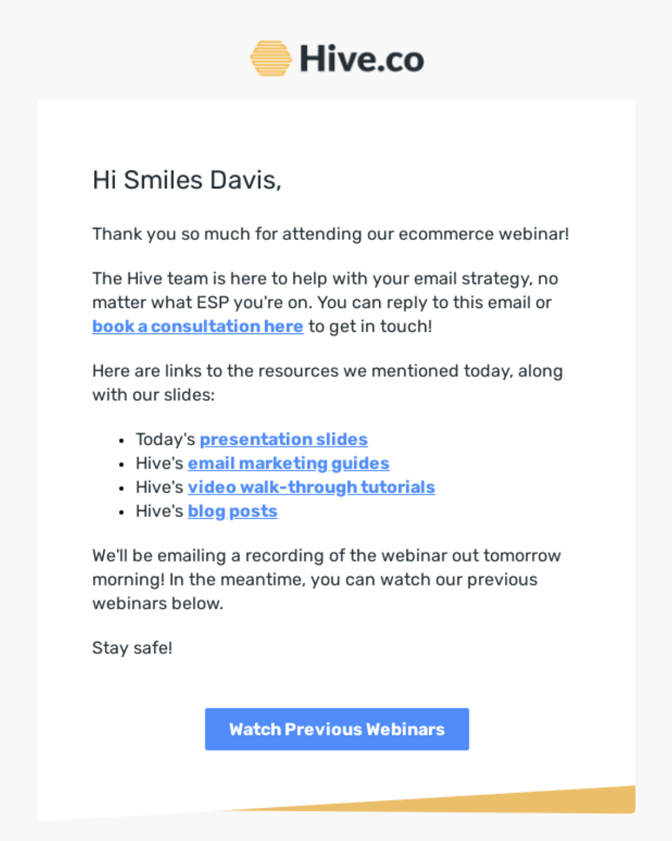
Here's a great example from Hive.co, where they think the attendees and share links to the resources they mentioned in the webinar. And to keep their audience engaged, they reference a second email which will be sent the next day that includes the recording.

Thank you for attending webinar email example from Hive.co
Image from ReallyGoodEmails

The webinar could be available for a limited time, or it could be a free resource you are sending out as a download or including on your site. In your email follow-up, you can highlight what your audience missed and promote future events.

Before sending out the email follow-up, you need to determine your goals. What are you hoping to accomplish now that the event is over? While this is still part of your webinar marketing, the focus should now shift to thinking about the next goal that this content can help you accomplish.

Continue engagement

Keep the momentum going after your webinar follow-up email. This group has expressed clear interest in your webinar topic, so create a new email segment by tagging those who attended and send relevant content accordingly. 

Also, send out a survey to understand how people perceived the webinar value and gauge interest for future topics.

This is your opportunity to capitalize on a major event for your company. While you are fresh in the minds of your audience, you can start building a more robust relationship and establish yourself as an industry authority.Are you planning a virtual event? Check out these landing page templates to start designing your webinar page today!

Bonus tip

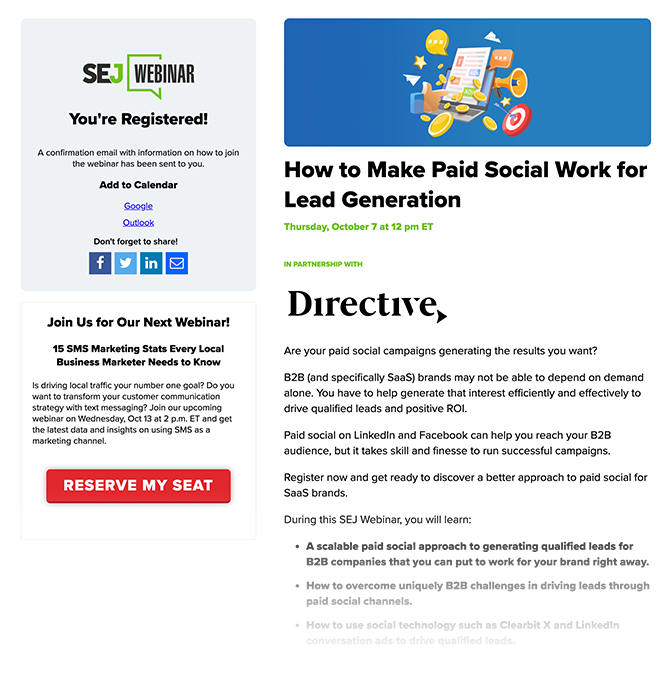
It's never too early to promote your next webinar. Check out this example from Search Engine Journal. Once I registered for their event "How to Make Paid Social Word for Lead Generation", below my registration confirmation, they are asking me to "reserve my seat" (great call to action, makes it appear as if seats may be limited) their next webinar.

webinar cross-sell for next event

The post 6 Ways to Guarantee Nobody Misses Your Next Webinar appeared first on AWeber.


from AWeber https://ift.tt/2YnPZoA
via IFTTT

Analyze earned and owned data to measure the true impact of social on your business

Social data has become a critical source of strategic insights for businesses of every size and industry. Whether you’re measuring brand health, benchmarking against competitors, or assessing market opportunities, social data provides real-time consumer insights that no other data source can provide.

Social data stands to have a monumental impact on businesses—but only if marketers start tapping into its potential now. Most (89%) executives agree their company’s success will depend on how effectively it can use social data to inform marketing strategy, according to research conducted by the Harris Poll on behalf of Sprout Social But currently, only 55% of marketers use social data to understand their target audience, 32% to analyze trends and 10% to inform business decisions, demonstrating that there is still a huge opportunity for improvement.

In this article, we’ll break down best practices for measuring both your earned and your owned social data, how you can use this comprehensive perspective to inform strategy decisions across the business, and how you can do it all with a tool like Sprout.

What is owned and earned data?

When assessing your social data, you need to evaluate the full spectrum of earned and owned data. Owned data measures the performance of content you publish across your brand’s social profiles. This includes both organic content that you create, as well as paid content that you sponsor, promote or pay for. While your owned data serves as a critical input for your social strategy, it’s not telling you the whole story.

To get an accurate picture of your performance, you also need to assess your earned data. Earned data quantifies the larger conversations and trends happening across social, in relation to your audience or brand. Earned data provides important cultural context to help you understand the “why” behind your performance and how your brand fits into the larger picture. Using social listening tools, you can better understand what your audience is talking about, what they care about and how they feel about your brand.

How to measure owned data

The first step is evaluating your organic data, or the performance of social content that you publish from your brand’s social profiles, across all of your networks. Key metrics here include impressions, engagements and click-throughs. You’ll also want to measure overall audience growth to ensure you’re increasing your followers at a healthy rate.

As you dig into your organic data, there are various ways to slice the numbers to get a deeper and more focused understanding of your performance.

Assess performance by network

Every network has its own unique audience, tone of voice and “culture.” You could say that (in general) Twitter is more focused on pithy, short-form comments or conversations with a real-time cadence, while LinkedIn is focused on quality, long-form content targeted to a business-minded audience. These differences impact how you should approach content strategy and how you should interpret your performance metrics.

In addition to our cross-network reports, Sprout also provides network-level reports so you can get that more granular view across each individual network. You can view daily performance or evaluate trends over a longer period of time. Evaluating at the network level can help you understand which audiences you’re resonating with and why, and help you identify where you should be investing more effort going forward.

sprout profile performance report

Dig into the details at the profile or post-level

Digging into individual profiles and post performance can provide illuminating insights into what’s working—and what isn’t. Looking back at content that performed particularly well (or poorly) and assessing the details (e.g., the topic, format or hashtag) can help guide smarter content creation.

Sprout’s Post Performance Report pulls the top posts (across every network) for a given time period by engagement, giving you a way to identify patterns in what grabs your audiences’ attention.

Analyze by content type or topic category

On that note, breaking down your data by category or content type is essential to optimizing your content strategy and performance. For example, you might notice that video content performs significantly higher than other formats, which could help justify a larger production budget for your content team. Or you might notice that a certain topic, such as a product launch or industry conference, is getting more traction than others, and you can adjust your content strategy accordingly.

Sprout’s tagging feature makes this type of analysis easy. Using tags, you can categorize your content in a way that makes sense for your business. For example, you could use tags for specific product lines, sentiment scores or customer care, and use the Tag Performance Report to track the results.

sprout tag report

Benchmark against competitors

It’s not enough to measure yourself in a silo. You need to benchmark your performance to contextualize the impact social media has on your business. One of the simplest ways to do this is by evaluating the social performance of your biggest competitors against your own. Metrics like follower size and growth are easy to compare at a glance and can give you a sense of where you stand. Sprout’s Competitor Reports allow you to monitor your competitor’s performance across Facebook, Instagram and Twitter.

Parse your paid performance 

Many marketers know how effective paid social media can be in boosting the reach and impact of your social posts. And with more dollars going towards these efforts, it’s important to measure your ROI both at a high-level and for each social network. Sprout’s Cross-Network Paid Performance Report provides a comprehensive overview for your paid performance across Facebook, Instagram, LinkedIn and Twitter. You can also dig into the details with our network-level paid performance reports. Premium Analytics customers can customize the data to compare your organic and paid performance in one integrated report.

sprout paid performance report

How to measure earned data

The next step in measuring social media’s impact on your business can be accomplished through social listening. Listening has become increasingly important as executives turn to social for real-time insights about their brand, customers and competitors. This earned data complements your owned data, helping you understand the cultural context and the “why” behind your social performance.

Measure brand health

One of the most popular use cases for social listening is measuring your brand health. Using Sprout’s Listening tool, you can evaluate several important metrics to understand where your brand stands:

  • Measure how many times your brand or brand-related keywords or hashtags (products, events, etc.) are mentioned in larger conversations
  • Compare your share of voice against other competitors and products
  • Learn how your audience feels about your brand using sentiment analysis
  • Get to know your audience on a deeper level with demographic information such as age, gender, device type and geographic location

Gather competitive intelligence

Measuring brand health may be the most popular application of social listening, but there are a myriad of other ways you can use earned data to glean powerful business insights. Another highly common use case is competitive intelligence. According to the Sprout Social Index™, Edition XVII: Accelerate, 90% of marketers agree that data from social enables them to stay ahead of their competitors, and 86% say they use competitor insights from social to identify new business opportunities.

sprout share of voice report

Sprout’s listening tool provides out-of-the-box templates for brand health and competitive intelligence topics, along with templates for industry insights, campaign analysis and event monitoring, making it as simple as possible for you to pull the insights that matter for your business goals.

Identify industry influencers or partners

You can also use earned data to uncover industry influencers who have clout with your audience (and could become valuable partners in extending your reach).

The NFL Players Association, for example, uses listening data and their owned analytics to track the impact of campaigns with critical partners like Lowes. “If one player’s post is surging, we’ll dig deeper to understand why. Maybe it was the time of day that they posted or the number of followers they have,” said Kasidee Karsten, Social Media and Content Manager for the NFLPA.

“Being able to share metrics and insights with stakeholders in our organization, our partners and the players is a win-win for everyone. We’re constantly learning from our efforts, which emboldens our collective strategy and strengthens our partner relationships.”

These examples provide a small glimpse into how you can apply earned data to your social strategy. It builds on your owned data, illuminating new insights, feedback and opportunities that brands may miss if you’re only paying attention to your owned social strategy.

Karri Carlson, co-founder at social media agency Leadtail, believes communicating these insights is the key to elevating the role of social in your organization. “Social media managers need to focus on the real opportunity they have to see social data as the key that unlocks. Instead of saying ‘I know what the customers want,’ you need to show the data,” says Carlson. “Social data tells you what people care about, in relation to and beyond your brand, and who is shaping that option. When you bring that data back to your stakeholders, that’s when you have a real say in business strategy.”

Unlock the full power of social data

Individually, owned and earned data are essential inputs for your social strategy. Together, they paint a complete picture that helps you understand the “why” behind social performance and the “what if?” opportunities to elevate your strategy.

To unlock the full power of social data, you need to share these insights with your stakeholders in a clear, digestible way. Sprout’s Premium Analytics feature enables you to create custom reports, so you can pick and choose the metrics that matter to specific stakeholders and teams, and send them via shareable link or pdf. As of August 2021, Premium Analytics users can now include key Listening metrics (such as engagement, impressions and sentiment) within your custom analytics report so you can see your earned and owned data in one place.

If you’re interested in learning more about how social data can elevate your business strategy, click here to request a demo from a Sprout representative. If you’re already a Sprout customer, reach out to your representative for access to a demo or free trial experience for both Premium Analytics and Listening.

The post Analyze earned and owned data to measure the true impact of social on your business appeared first on Sprout Social.


from Sprout Social https://ift.tt/3l8AeKL
via IFTTT

Friday, 1 October 2021

Apple iOS 15 Mail Privacy Protection Open Rate Trends

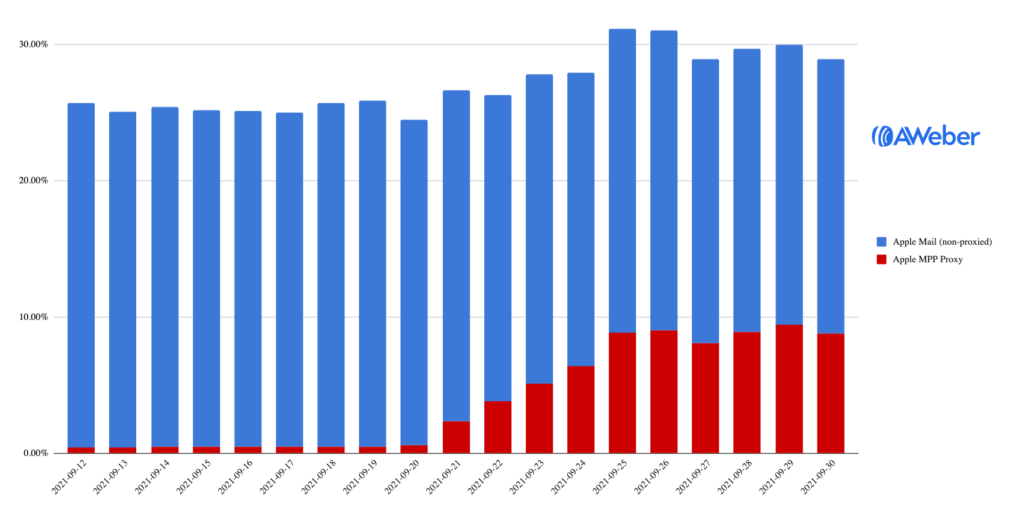
Apple’s Mail Privacy Protection (MPP) rollout in iOS 15 has caused fascinating changes in open rate metrics. The most interesting of which is the change in behavior of when we see opens being detected.

Let's dive into a few charts using data from hundreds of millions of delivered messages.

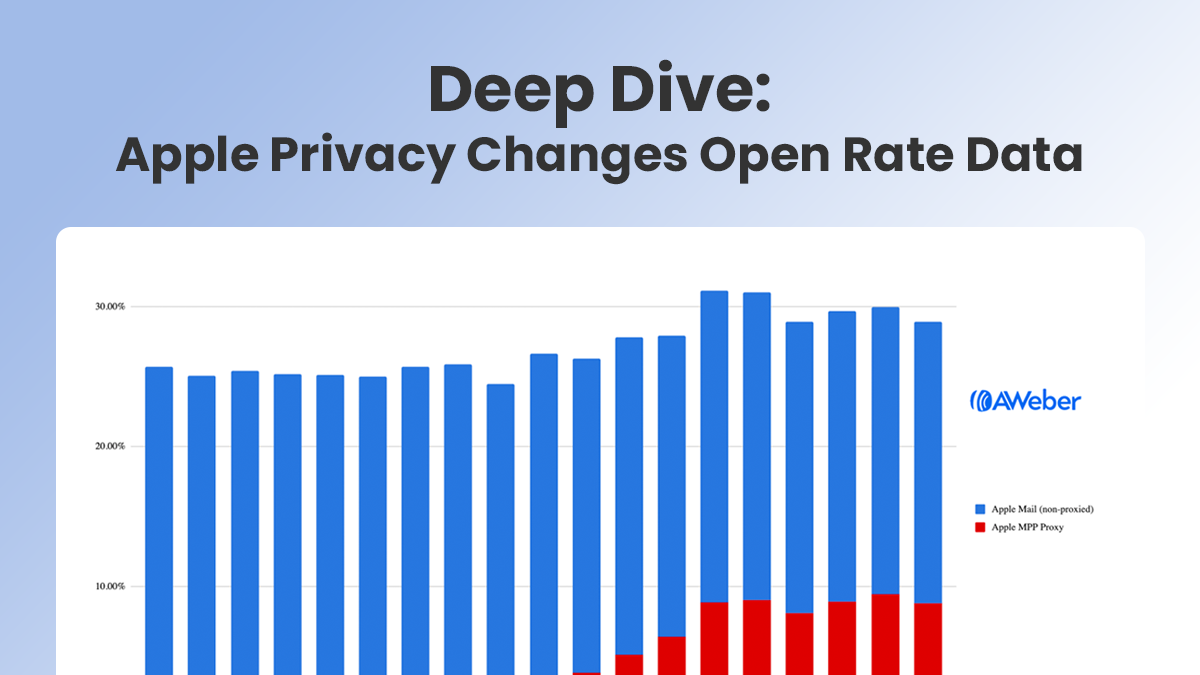
Apple Mail open trends by a percentage of total mails sent after Apple's iOS 15 Mail Privacy Protection roll out (MPP)
Apple Mail opens by a percentage of total mail sent

Below you'll see the raw volume trends of user opens as Apple iOS 15 is adopted on an hourly basis.

Raw email opens by hour as Apple iOS 15 is adopted
Raw opens by hour as Apple iOS 15 is adopted.

More Night Time Readers?

Look closely and you'll see the peaks and valleys are different on older iOS versions vs. Apple’s new MPP proxy in iOS 15. Putting proxied iOS 15 traffic on the right axis highlights the trend.

Why does this happen?

iOS 15 only does the image caching in the background when devices are plugged in and on WIFI. What happens in the evening? People go to sleep and charge their phones.

Nighttime opens are increasing as iOS 15 downloads images while your device is charging overnight.
Nighttime opens are increasing as iOS 15 downloads images while your device charges on your bedside table.

Nighttime Dominates

When you aggregate all opens for each type over a 24 hour period and look at the percentage of opens that happen in any given hour during that day, the trend becomes very clear. The overwhelming majority of opens from iOS 15 are detected in the evening, not from human activity but from caching while your phone charges.

While your iPhone charges it "opens" and downloads each of the images in the messages you've received but haven't yet looked at. This caches the image and stores it for later so you can view the message faster. This creates an artificial open, but one that's still seen in the metrics.

Nighttime image download trends
Nighttime image downloading trends.

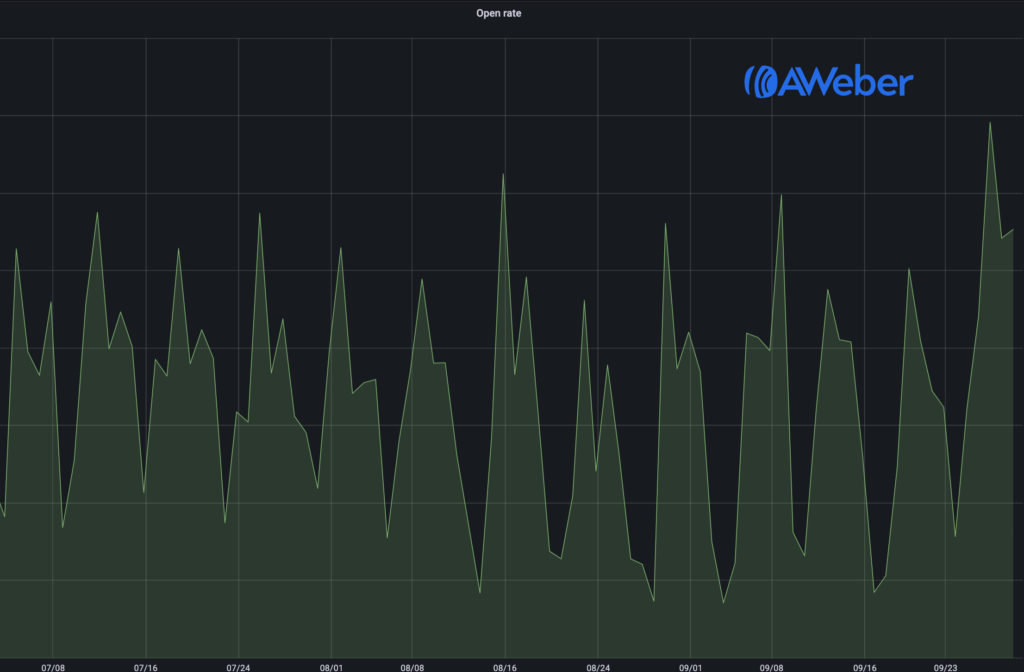
Global Open Rates

The iOS 15 MPP caching is already having a slight impact on global open rates in the past few days. Nothing dramatic, but it does show up on graphs.

AWeber Global open rates as iOS 15 rolls out
Global open rates as iOS 15 rolls out.

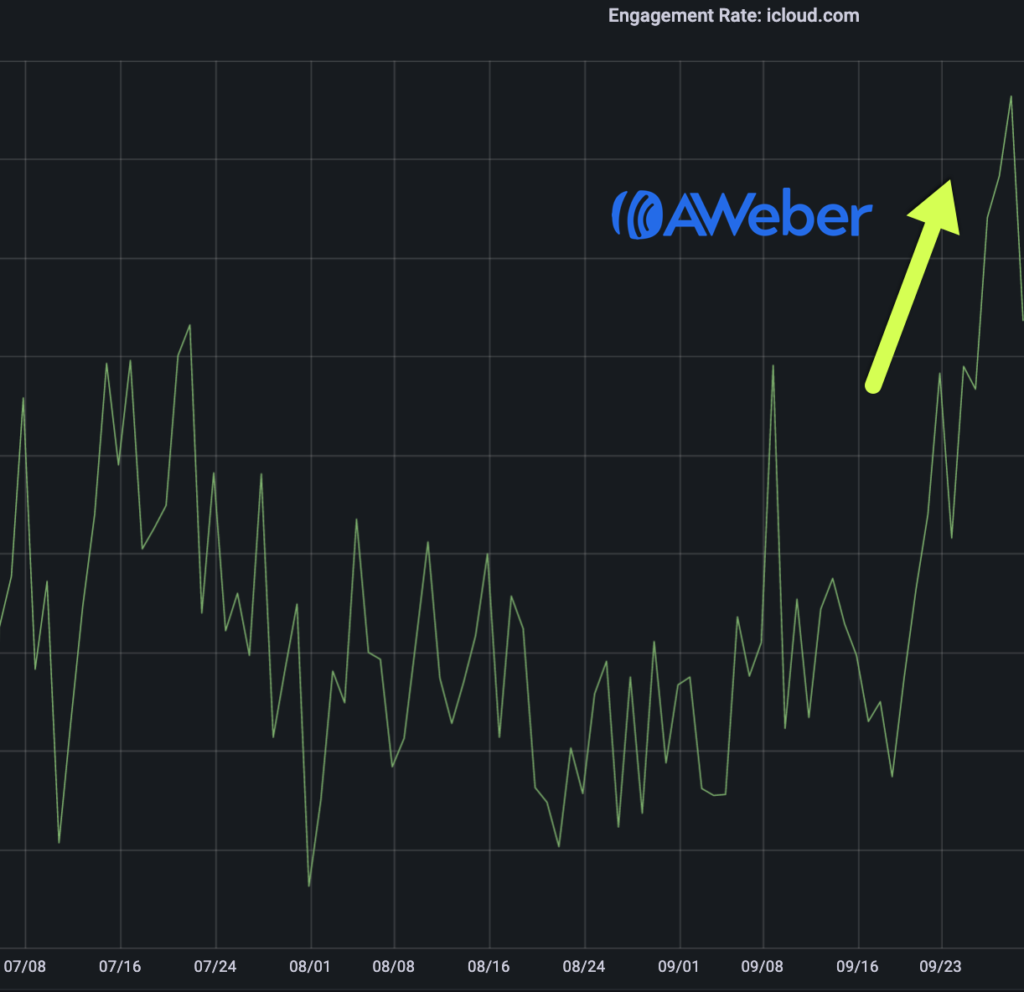
iCloud Open Rates

That impact is clearer when you drill into icloud.com opens for an audience that’s much more likely to be viewing their email exclusively on Apple devices. Open rates have shown a growing trend but not one that yet impacts how most marketers need to think about using open rates.

iCloud.com open rate trends with an upward trajectory after iOS 15.
iCloud.com opens trend up

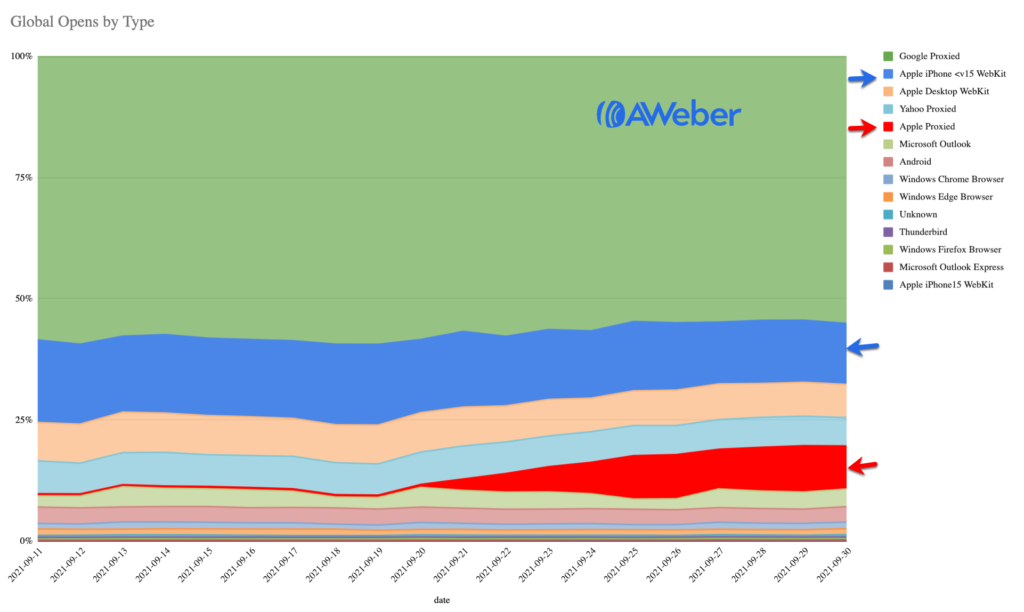
Apple's Influence on Global Opens

I expect the volume of older iOS traffic to continue gradually dropping off, but it’s obvious when you look at the wider email ecosystem that Google still dominates with Gmail proxied requests. The volume from older pre iOS 15 devices will continue to drop, and the slice of red from iOS 15 devices will grow with the automated image downloading.

Global opens by browser type

I wrote about Apple iOS 15's Mail Privacy Protection in June and what I wrote then still holds true. Apple's changes

  • make open rate tracking less reliable, but still gives you useful information.
  • hides users IP addresses behind a proxy service.
  • has zero impact on how people read and view your emails.
  • gives Apple a TON of data on their users that they didn't have before.

If you enjoyed these charts, you should:

  1. Subscribe to this free weekly newsletter, where we analyze the world of email, web push, ecommerce, and landing pages to help you better build and engage your community more effectively. 
  2. Follow @AWeber and @TKulzer on Twitter where we regularly tweet interesting data from billions of users.

The post Apple iOS 15 Mail Privacy Protection Open Rate Trends appeared first on AWeber.


from AWeber https://ift.tt/3zVUIdW
via IFTTT