Organic content and paid ads often attract local customers, but social search is changing how customers find your business. According to the Sprout Social Q2 2025 Pulse Survey, over one in three consumers skip search engines and instead use social media to find answers to buyer-intent questions.
Yet, 76% of users say social content influenced a purchase within the last six months. So, if your business isn’t visible across both social networks and Google, you’re missing out on valuable traffic and customers.
Local SEO strategies extend beyond maps—it’s an omnichannel race for visibility. It improves discovery, strengthens engagement signals and boosts marketing ROI.
What is local SEO, and why do you need it?
Local SEO (Search Engine Optimization) is the strategic process of improving your business’s visibility in local search results on Google and beyond. For example, if someone searches for a pizza shop in Tampa, they’ll see local options nearby. But if that same person travels to Madrid, the results will automatically adjust to show local restaurants there.
Here’s how it looks when a user searches for paint services in Baton Rouge:
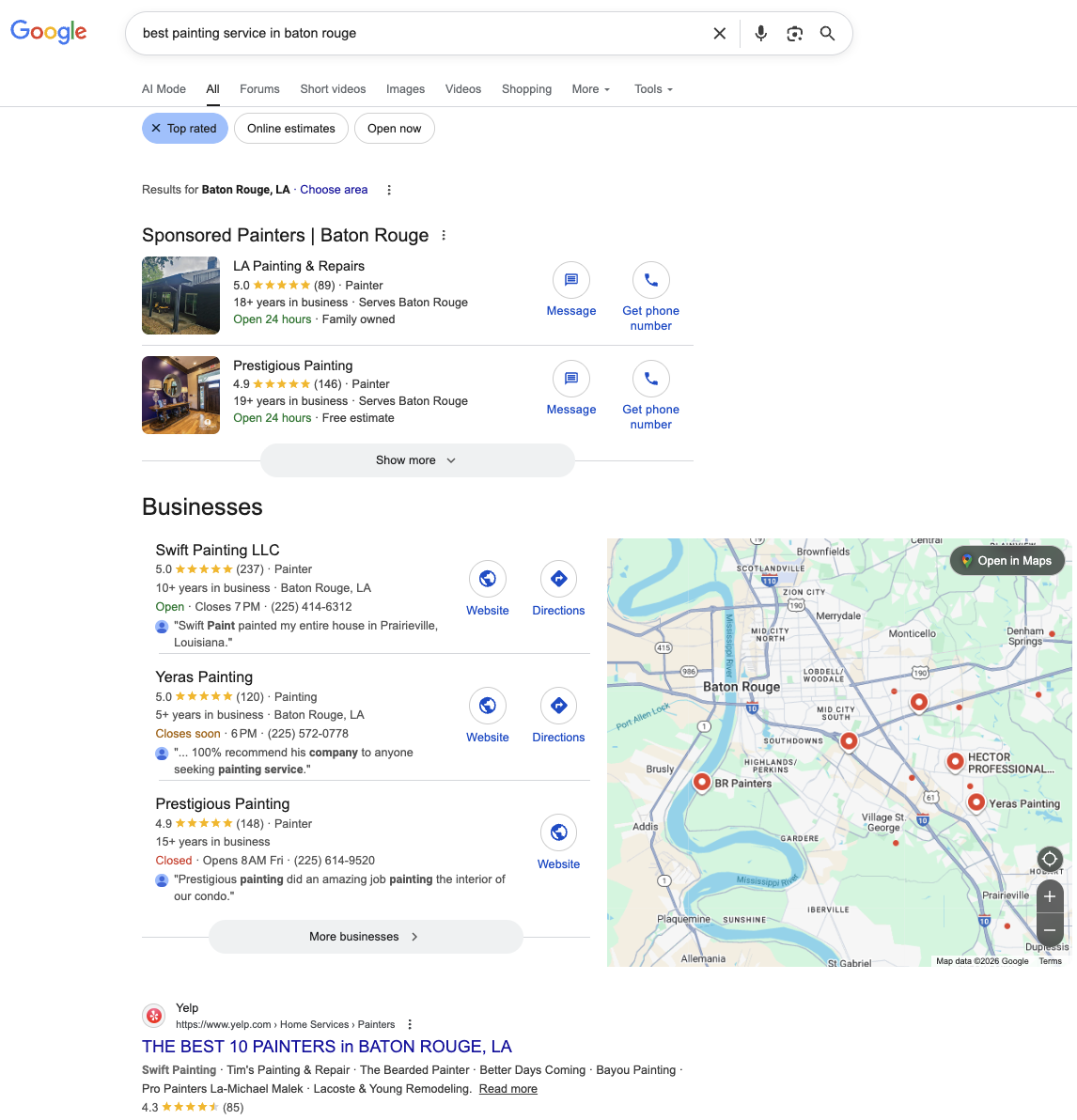
(Source: Google)
A lot has changed, however, with modern SEO. Many professionals now call it search everywhere optimization. Traditionally, users went to Google or Bing to find answers. Now, they increasingly use ChatGPT, Google AI Overviews, social review sites like Yelp and social media networks like Facebook, Instagram, TikTok and X.
Local SEO is crucial because it helps you meet the following goals:
- Boosting your online visibility
- Bringing in more foot traffic to your brick-and-mortar location
- Attracting more targeted traffic, which improves your chances of conversion
- Enhancing your credibility and building trust
Organic search results vs. local pack
Local SEO targets two distinct areas on the search engine results page (SERP):
- The Local Pack (Snack Pack): The local pack is the box containing a map and three top business listings that appears at the very top of Google results. It’s powered by your Google Business Profile (GBP) and is highly dependent on proximity and reviews.
- Organic local results: These are the traditional blue links that appear below the Snack Pack. These are powered by your website’s content, keywords and technical health.
The appearance of these local search results can vary based on the search term. Sponsored listings, for example, appear at the top of the page with an “Ad” or “Sponsored” label, and unlike organic results, they come with an advertising cost.
The local pack appears in a box that highlights the top business listings related to the particular search, alongside an interactive map. This feature shows up more prominently than organic local search results, which means you have better visibility if Google features you.
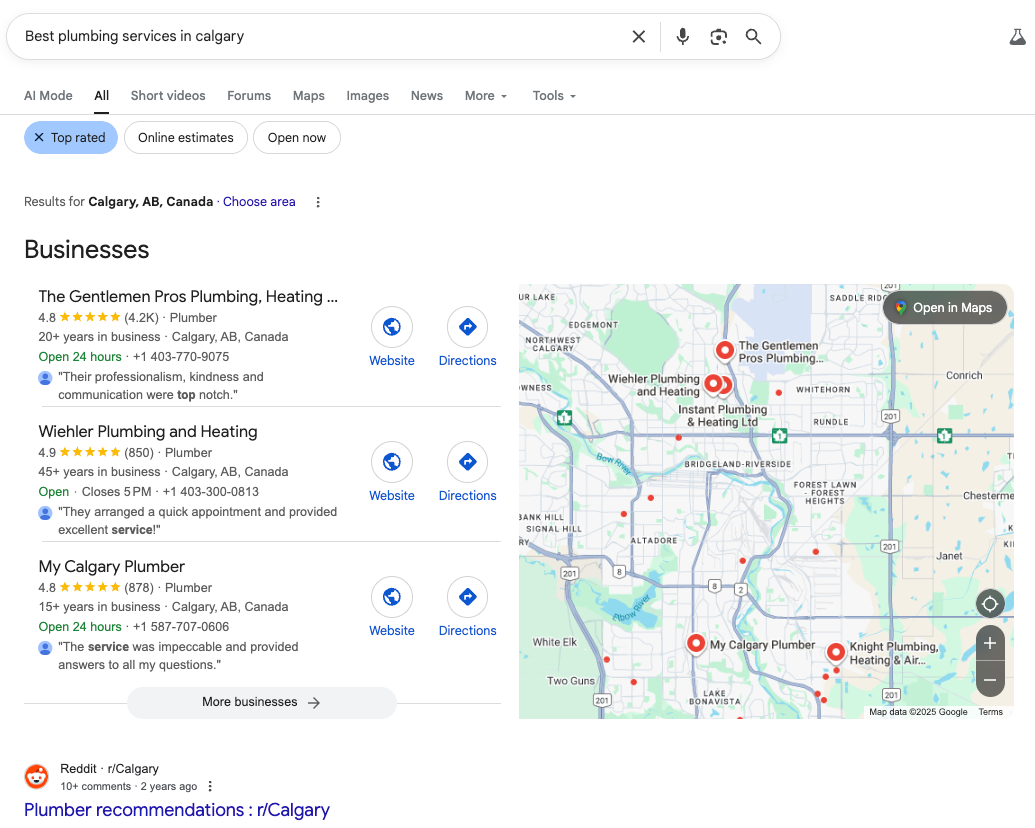
(Source: Google)
The organic results are further down, below the local pack results. So even if you rank on the first page of local search results, you might not show up as prominently as the businesses that manage to get featured in local pack results.
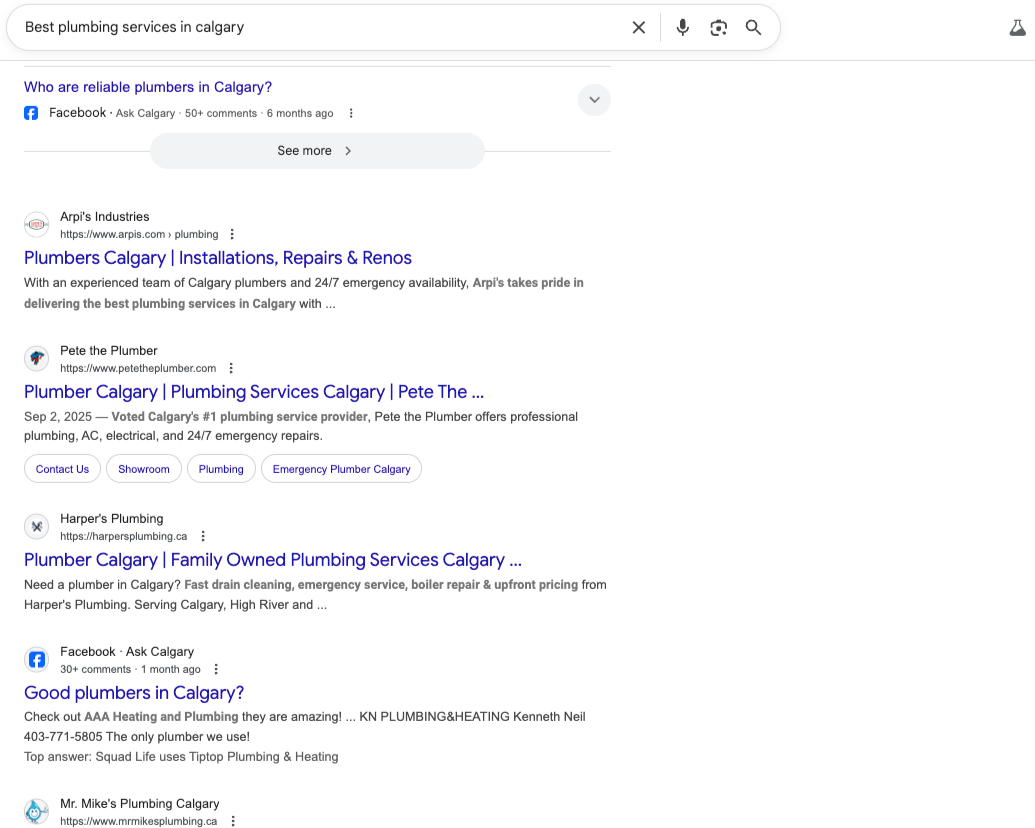
(Source: Google)
The goal of your local SEO strategy should be to rank for both organic searches and in local packs. This ensures optimum visibility and improves your chances of attracting targeted traffic.
Nat Miletic and his team at Clio Websites, for example, have been successful in ranking locally in Calgary. According to Miletic, “We achieved top rankings for ‘website maintenance Calgary’ and similar keywords by focusing on rigorous Google Business Profile optimization, securing high-quality local citations and building dedicated, localized service pages.”
Why local SEO matters for every business
Local SEO acts as a bridge between online intent and offline revenue. It builds the trust required for a transaction to occur.
- For small businesses: It levels the playing field, allowing you to compete with big box retailers based on proximity and reputation.
- For enterprise or multilocation businesses: It ensures brand consistency. A bank with 500 branches needs every location to display accurate hours and data to maintain consumer trust.
Today, social networks play a critical role in that discovery journey. According to the 2025 Sprout Social Index™, 30% of users plan to increase their social media use, and 56% plan to continue using it at the same level they do currently.
As engagement and search activity rise, strong social media optimization helps local customers find and choose your business more easily. Your content, for example, can show up within a social network or in a traditional Google search with local keywords. This aspect is critical since users want to find and validate your business online, whether you run a small shop or an enterprise like a hospital or bank.
Here’s an example of a user searching for Mexican restaurants in Nashville. Along with organic search results, notice that Instagram also provides an AI summary, which is another space with potential for brand mentions.
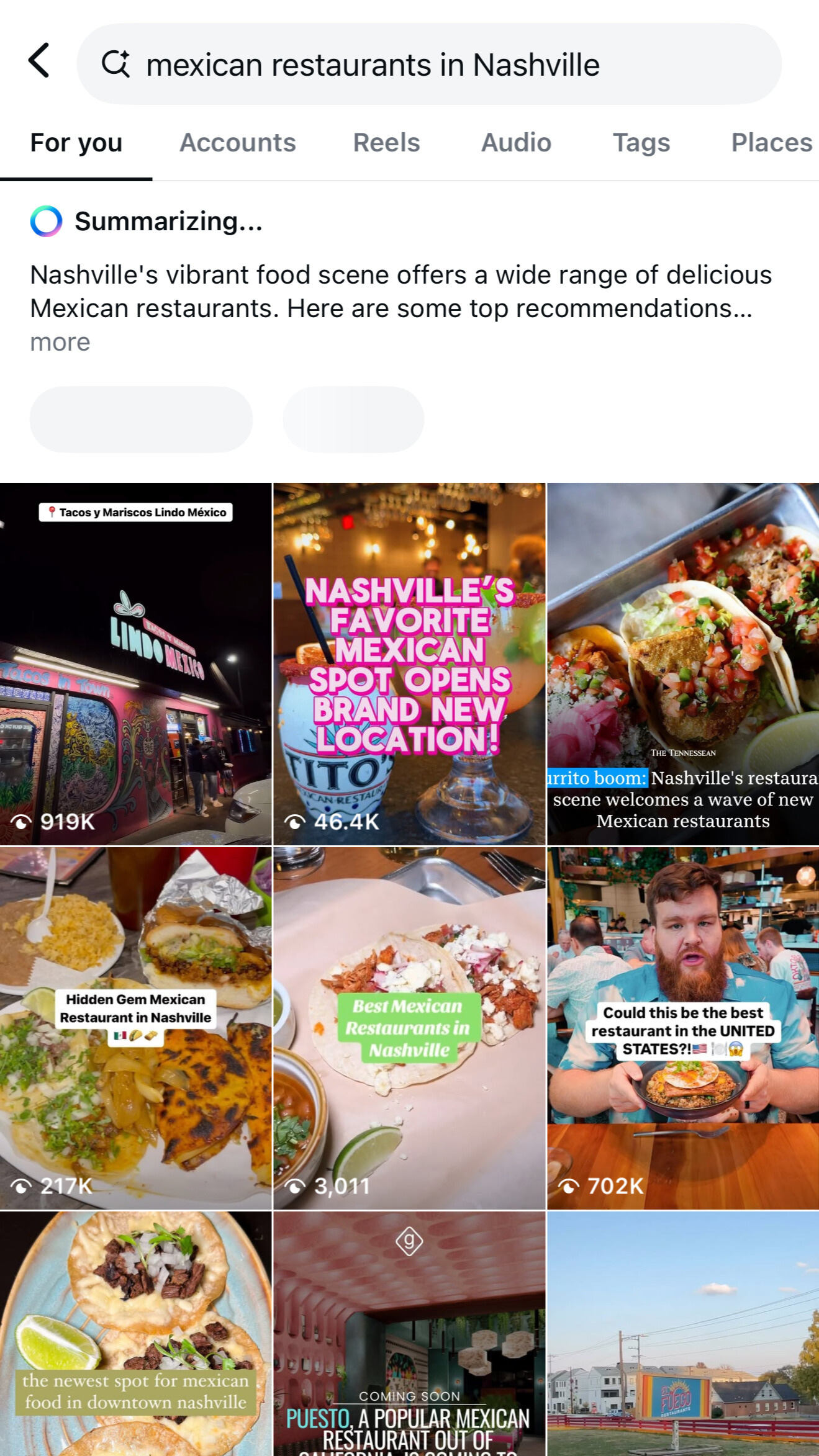
(Source: Instagram)
AI social search, like Grok and Reddit Answers, also provides opportunities for local visibility. In response to this search on Reddit Answers for Mexican restaurants in Nashville, Reddit comes up with an answer based on user-generated content with citations:
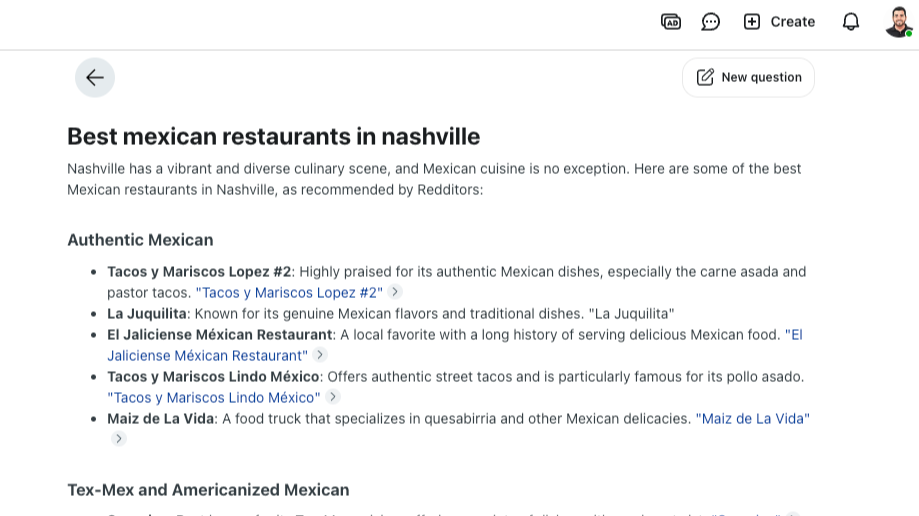
(Source: Reddit Answers)
The modern local SEO playbook: 9 signals that shape search and social visibility
Successful local search engine optimization requires a strategic, multilevel approach that combines technical processes, keyword research, great content, link building and authentic engagement.
Here are nine ways to improve your search results on social media networks and anywhere your audience searches.
Traditional search ranking signals still matter—but they’ve evolved
While the foundations of local SEO haven’t disappeared, they’ve evolved to reward accuracy, responsiveness and credibility. Here’s how to improve your traditional local SEO strategy with Google.
1. Google Business Profile listing
Google Business Profile, formerly Google My Business, is the most critical part of your local SEO strategy. This Google tool allows you to create free business listings. And according to Moz, it’s one of the top factors that Google considers when ranking businesses in organic local search and snack pack results.
Despite new search channels like AI and social media, Google remains the primary source of truth for local relevance and proximity signals, which feeds other sources. Google Business Profile can quite literally put you on the map.
For optimal local rankability success, go to your Google Business Profile to claim or create your listing.
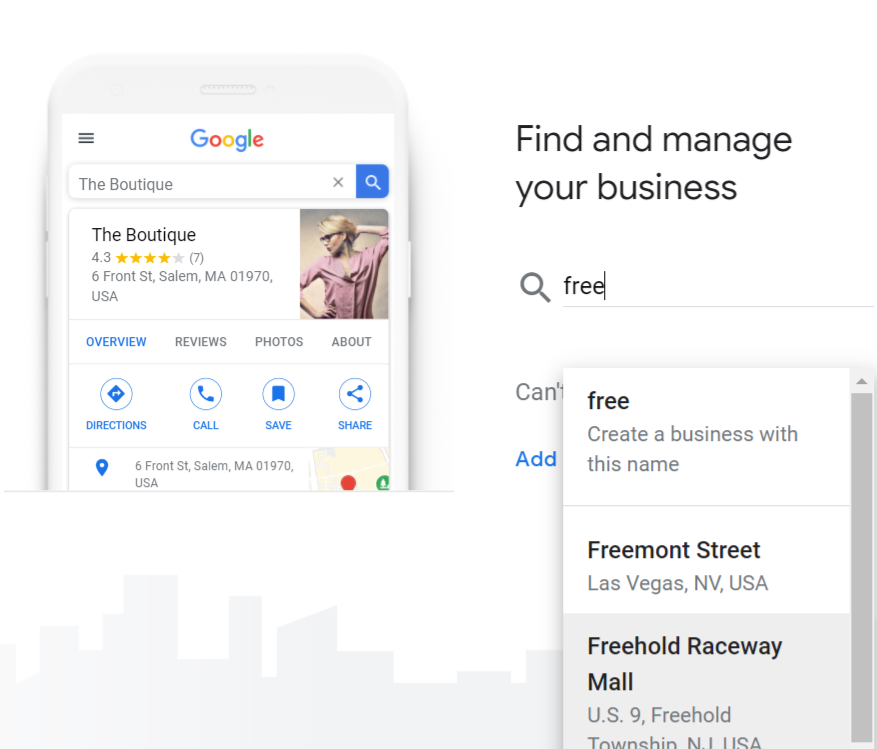
(Source: Google)
Google asks you to provide the following details for your listing:
- Your full and correct business name
- Your physical store or office address
- Your exact location on a map
- Your business category
- Your phone number and website (if applicable)
Once your local listing goes live, you’ll need to verify it, usually through a phone call, a video, images or a postcard.
Here’s how to optimize your Google Business Profile after verification:
- Upload photos of your business. They could be photos of the inside of your store or office, or even around the premises.
- Provide your business hours.
- Add additional categories that may be relevant to your business, such as wheelchair accessibility, or list products.
- Include additional phone numbers if available.
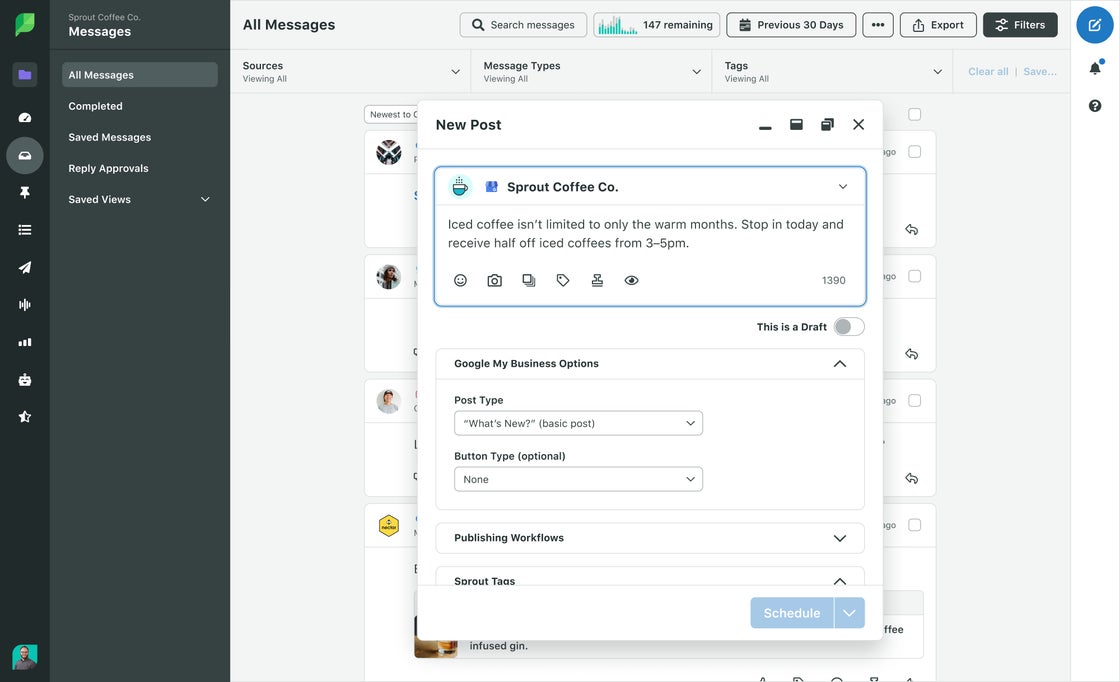
To further optimize your Google Business Profile, share business updates and fresh content regularly. Sprout Social’s Google Business Profile integration allows you to publish updates directly to your Google Business Profile, including multiple locations simultaneously. This capability helps you connect with your customers on a deeper level while also boosting your visibility in local searches.
2. Reviews and reputation management
Google wants to promote the best search result by user proximity, and your reviews and online reputation directly affect this local visibility. To improve your positive signals for SEO, you need recent, frequent Google reviews and authenticity signals, like user-generated images and review engagement, to improve your discoverability.
This local ranking potential doesn’t mean you should start paying for reviews or pressuring customers to say something nice. That goes against Google’s rules and could get you in trouble.
To increase the chances that customers will leave a review, follow these steps:
- Providing a remarkable service so customers organically want to share a review
- Making leaving reviews easy by providing accessible links and QR codes
- Encouraging reviews when a customer enjoys their experience
Additionally, responding to customers through review management encourages others to share feedback, too. Here’s an example from a cat cafe that responds to its reviews quickly, contributing to its 4.9 rating, 244 reviews and top placement for “tea near me” in its area.
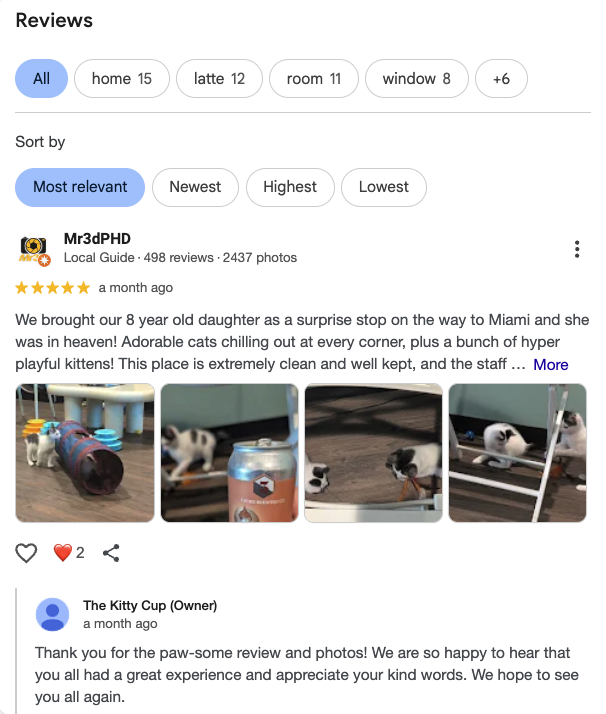
(Source: Google)
3. Local citations and NAP consistency
NAP stands for Name, Address, Phone Number. Google cross-checks your business details across directories, maps and social networks. That’s why consistency matters. Keeping your information accurate and up to date, especially after changes like a new address, helps you maintain your credibility and prevents visibility drops in local search. So, if your hours on Facebook differ from your hours on Google, it lowers your trust score.
To avoid mismatches between your business and old information:
- Audit your presence on major data aggregators.
- Eliminate duplicate listings.
- Ensure your website footer matches your GBP data.
Along with NAP consistency and local brand citations, increasing backlinks also improves your rankability. Coordinate with local contacts and resources to get featured on news, social media groups and websites to earn a link back to your website. Doing so supports E-E-A-T, and it’s also one of the most impactful tools to boost your rankability.
4. On-site and technical factors
Modern local SEO calls for optimizing every location and format. How you structure your website and format your content directly shapes your visibility. This includes mobile responsiveness and schema markup, which is code that helps bots understand “this is a restaurant” or “this is an event.”
For example, your local content may appear in social media searches, voice assistants (like “near me” queries on Alexa or Siri), AI search engines and more. Each of these tools reads structured data and mobile experience as signals of credibility. By optimizing your site’s technical foundations, you help both search engines and people trust your brand, which boosts visibility across Google Maps, directories and social channels.
Here’s how to improve your schema markup:
- Start with LocalBusiness schema and include essential details like business name, address, phone, hours and service area.
- Incorporate review and rating markup to surface stars and snippets that boost click-through rates.
- Link verified social profiles with sameAs properties to strengthen your brand authenticity.
- Add event or service schema to highlight location-based offerings in map and event results.
- Run regular validation checks using Google’s Rich Results Test to maintain accuracy.
- Structure for voice and AI search so assistants and models can deliver precise, trustworthy answers.
New social signals and search synergy
Building the foundations of effective local SEO helps your team optimize social search––the new frontier of local discoverability. Consumers, for instance, are finding, validating and trusting brands on social before they ever reach Google. And Google and AI engines now look to social media to validate if a business is “real” and culturally relevant. Because of this, it’s essential that you make sure to show up when consumers are ready to shop.
Here are some ways to improve your social media search optimization.
5. Engagement signals amplify brand authority
Consistent social media engagement, through quality content and genuine responses (e.g., likes, shares and comments), signals relevance to social networks and search engines. As your posts gain traction, they boost organic visibility and attract backlinks and secondary mentions that extend your reach even further.
The most effective way to increase engagement is to know your audience well and build community. Studio MDH, for example, published a perfect TikTok post that played off an old post where the salon had posted a haircut that users criticized as “botched.”
This post features the same person, and the stylist laughs about the moment while providing a new (revised) cut. This encouraged engagement, and it’s one of the reasons why the brand gets significant reach on local social search. Notice that the salon also includes hashtags, which help with SEO visibility.

(Source: TikTok)
6. User-generated content drives authenticity
When users post about your brand, it increases authority and reach for search results. Each user-generated post acts like a modern citation or backlink for your business on social media. Mentions like photo tags, customer reviews and social media check-ins also create rich, indexable signals.
If you have a brick-and-mortar business, events are a great way to boost user-generated content. For example, a coffee shop that hosts a karaoke night could set up a photo backdrop with a hashtag sign to encourage posts. As guests take a picture and share it with your hashtag, it connects the event with you and your brand. Also, when your team posts about the event, include the location tag as well, which will encourage other users to do the same.
Along with events, taking pictures with customers and tagging them, mentioning users in posts based on social media comments, and promoting contests and giveaways all help encourage more user-generated content.
If you don’t have user-generated content yet, think of a loyal customer and publish a story about them. This type of user-inspired content also generates authenticity.
For example, the Cleveland Clinic, a hospital and health company, shared an inspiring story about a cancer survivor on its Florida X account, with a link to its website for the full story. The post also includes user-generated pictures.
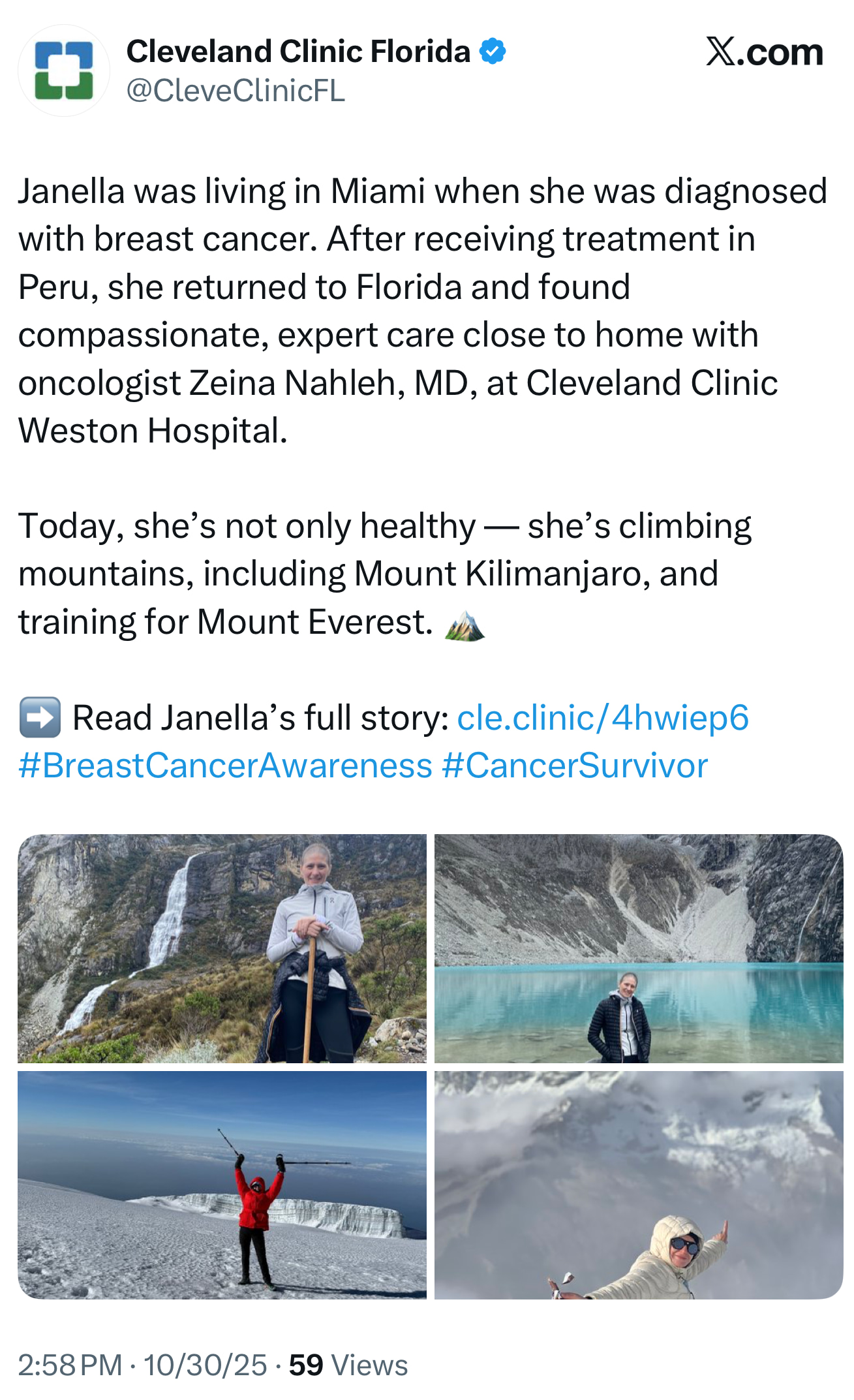
(Source: X)
7. Social network-specific intent matters
In SEO, intent matters even more than a high-volume keyword. You want to attract your exact target audience, at the right time, with content that matches their needs. But with social media, intent and behavior look different from a traditional search. Here’s an overview of the two types of search:
- Traditional SEO intent focuses on meeting a user’s exact need, whether it’s informational, transactional or navigational, to attract the right audience at the right time. It’s about matching content to search purpose for relevance and conversion.
- Social media intent, on the other hand, prioritizes engagement and discovery. Algorithms surface content based on user behavior, hashtags and trends, and they reward brands that create visually engaging, shareable posts people connect with, not just search for.
Users search differently on each social media network with different intents. For example:
- TikTok and Instagram center on emotional connection and visual discovery through short, trend-led content that sparks instant engagement.
- YouTube and Reddit encourage long-form learning and peer validation by creating spaces for deeper education and authentic community feedback.
- LinkedIn builds professional credibility and thought leadership, which is especially valuable for enterprise and regulated industries.
- Facebook and X (formerly Twitter) support content sharing for relationship building, real-time updates and broad audience engagement.
- Pinterest inspires discovery through visual storytelling and helps users explore ideas, aesthetics and niche interests.
Whether you’re planning for YouTube SEO, Twitter SEO or Pinterest SEO, these network-specific intents will help you increase your search visibility by connecting with audiences the way they like to engage.
8. Influencers expand brand reach and topical authority
Influencers increase your reach with their earned audiences, which improves your authority for E-E-A-T. Collaborating with local micro-influencers creates high-quality backlinks and social citations, allowing you to target your community-specific audience. For high-compliance industries, micro-influencers or local advocates help boost trust without risk since you’re working with experts in their fields. These partnerships create new audiences and authentic content.
To start your influencer strategy, partner with credible micro-influencers who already engage with your target audience or community. Co-create an educational or local-interest piece, like a joint blog, video or interview, that lives on both your site and theirs.
To find local influencers, search where your community is online. For example, search for your local term (with the city in the field). Using this search, spot popular posts from content creators in the area.
Here’s an example of an Instagram search for “london cookies,” with results from influencers on journeys to spot the perfect treat.
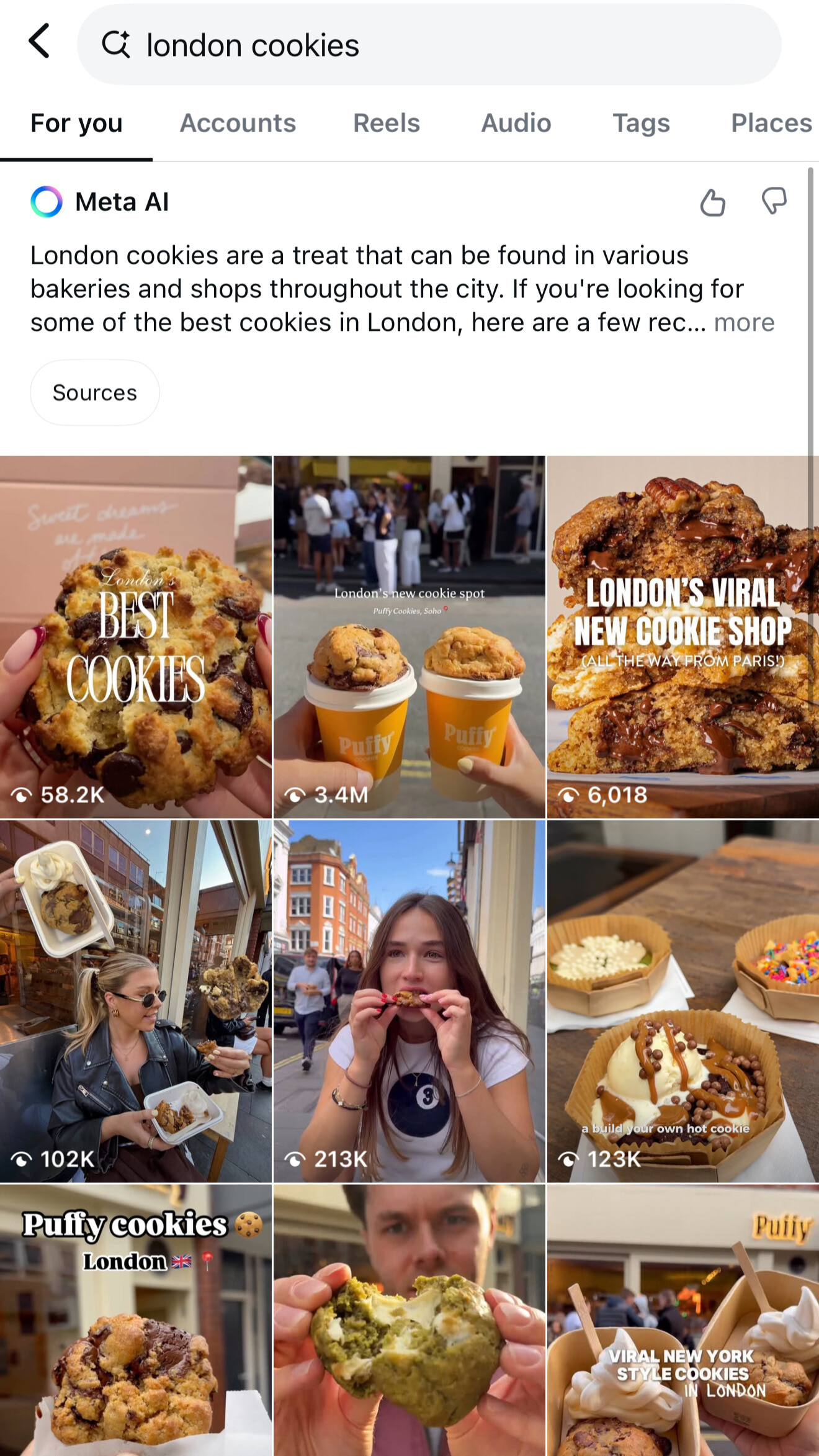
(Source: Instagram)
9. AI search values social validation
Once you’ve built your human signals for E-E-A-T through engagement, matching intent, expanding reach with influencers and fostering user-generated content, you’ll benefit from AI search visibility. AI engines like Google’s Gemini, ChatGPT and Perplexity rely on a “consensus” of data. They scan Google Business Profiles, Reddit threads, TikTok captions and news sites to answer user queries. If your social presence is silent, AI may deem your business inactive. An active social footprint provides the fresh data AI needs to recommend you.
Here are some key ways to boost your authority and rank on AI search:
- Set up your Business Profile page on Google and similar engines.
- Boost engagement and reach with social media marketing.
- Earn relevant backlinks through social media content and traditional SEO efforts.
- Invest in Reddit SEO and similar forums and user-generated sites.
- Produce and repurpose content across social media channels and your website.
Here’s what it looks like when a user searches for e-bikes on Perplexity AI. The user asks for e-bike recommendations and where they can buy them in Buenos Aires. The result then shows shops in the city, along with their addresses and websites. This example shows how searchers now use AI to get local, personalized results.
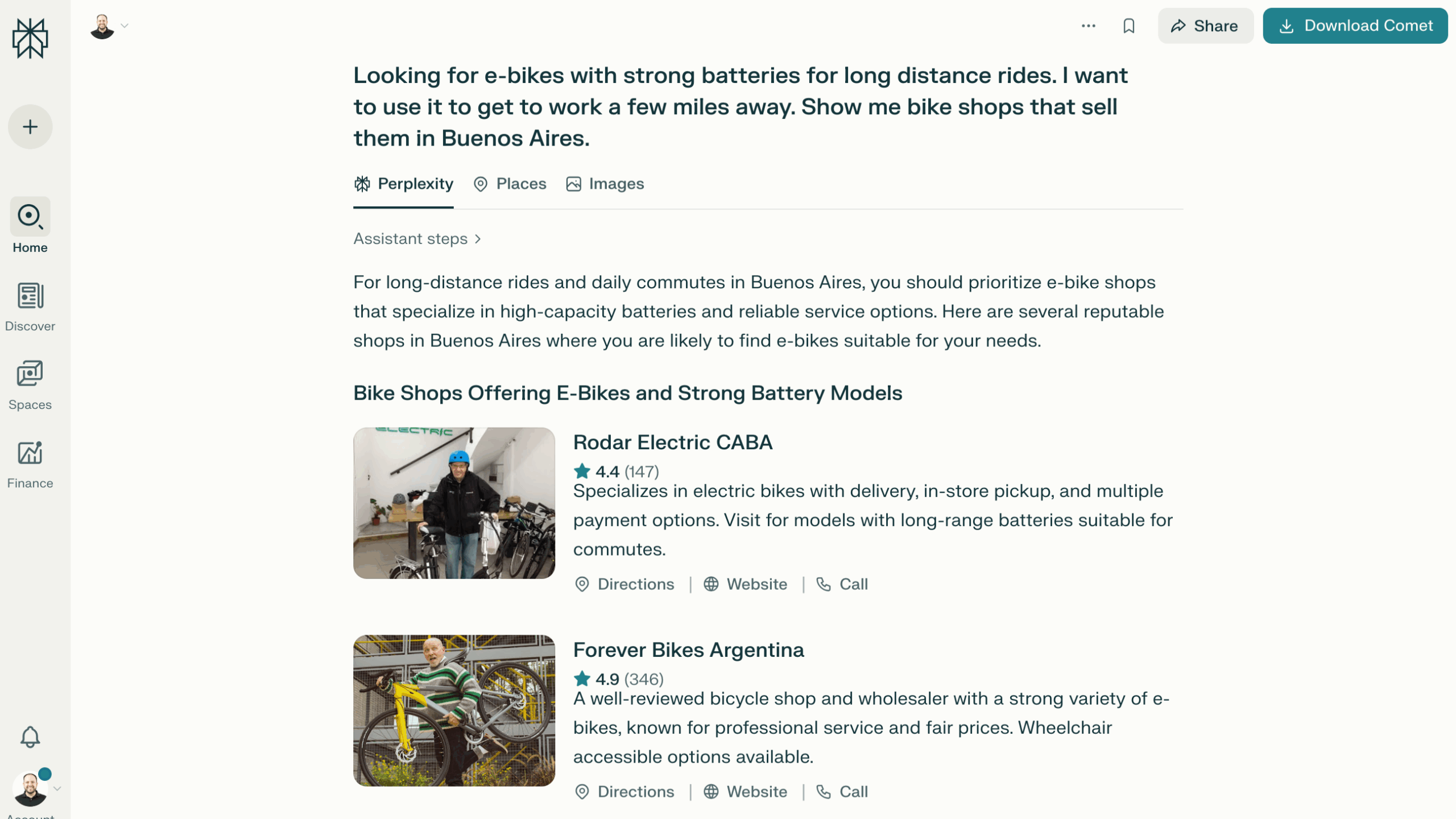
(Source: Perplexity)
Put your local SEO strategy into practice by industry
A local coffee shop in Portland has different SEO needs than a national healthcare network based in New York. While ranking signals (reviews, consistency, content) remain the same, the execution changes based on your industry’s size, compliance regulations and competition levels.
So, let’s discuss how to launch your SEO strategy based on your business type.
Small and mid-sized businesses: Automate visibility and review management
Small businesses often lack the bandwidth to log into Google, Facebook and Instagram separately. This inconsistency hurts local rankings and limits discovery. If you manage social media marketing for an SMB, streamlining your production and responsiveness is the fastest way to build the authority needed for local SEO.
Sprout Social unifies these channels to make social media management easy. The Google Business Profile integration enables marketers to publish updates, offers and events directly from Sprout alongside other social posts. This ensures your listing stays active and fresh, which are key signals Google rewards.
Crucial for the “search everywhere” landscape, Sprout’s Smart Inbox aggregates Google Reviews alongside your social messages from Instagram, Facebook, TikTok and other social networks.This allows you to quickly engage with your audience to boost engagement regardless of where they find you.
Filter the Smart Inbox by profile or by Reviews to ensure no customer feedback goes unanswered, or monitor social comments to validate your brand for users searching on social apps. This responsiveness boosts your local engagement signals and builds trust without increasing headcount.
Healthcare: Centralize patient feedback and maintain compliance
For healthcare providers, local SEO is about trust. Inaccurate office hours or ignored patient reviews can hurt a clinic’s reputation and search rankings. Patients now use social media to validate providers they find on Google–looking for signs of responsiveness and care, which makes healthcare social media more important than ever.
However, managing multiple clinic pages manually is a compliance risk. That’s where Sprout comes in. The platform helps healthcare organizations centralize local management and build authority and consistency through a unified workflow.
When a healthcare social marketer logs into Sprout, they can use Groups to organize profiles by location or facility type. This ensures that local content reaches the right community while maintaining the brand standards of the larger health system.
With these capabilities, teams connect with local audiences anywhere while maintaining the authenticity of a neighborhood practice. Standardizing communications with Saved Replies and Asset Library also streamlines collaboration, but the Smart Inbox is where reputation is protected. You can route patient reviews and sensitive feedback directly into Cases for a specific team or team member to address.
Here is what the Cases tab looks like. This capability allows a healthcare social team to make sure contacts are answered securely and efficiently, creating a track record of care.
These practices support trustworthiness (the “T” in E-E-A-T), which is an essential principle not only for SEO but for healthcare brands as well.
Finance: Strengthen authority and compliance
Finance industries, like healthcare organizations, face a unique local SEO challenge: balancing hyper-local engagement with strict regulatory compliance. Audiences want to know they’re in good hands and that your company protects their privacy and makes the best decisions for their investments. A local branch manager cannot simply “post whatever they want” without risking fines or brand damage. As a result, many banks leave their local pages dormant, hurting their visibility. Investing in financial social media strategies and local SEO should be a top priority.
Sprout helps financial institutions manage and build their brands, which establishes local authority across digital channels like LinkedIn and Facebook. With Approval Workflows, local teams can draft content relevant to their specific community—proving the Authority and Expertise in E-E-A-T—while ensuring safety.
For example, a branch manager can draft a post about “New mortgage rates for [City Name] homeowners”. This content is highly relevant for local search, and Sprout can automatically route it to the corporate compliance team for review before publishing. This allows for hyper-local content scaling without the risk.
Additionally, use social listening to find regional trending topics for financial audiences, especially as markets and trends move so quickly. If Listening data shows a spike in “small business loans” discussions in a specific region, you can tailor your local SEO content and social posts to meet that demand. This ensures your content strategy aligns with what your local audiences are actually searching for.
Multi-location and enterprise brands: Align teams to strengthen brand performance
Just because brands have many locations doesn’t mean it’s impossible for them to feel local. For franchises and enterprise brands, the challenge is seeing the forest and the trees. You need to maintain brand consistency at a global level while empowering individual locations to build a community presence.
Sprout helps enterprise or franchise brands maintain accuracy, performance visibility and brand alignment across hundreds of locations. With Tagging, you can tag outbound posts and inbound messages by location or region, such as “Northeast Market” or “Southwest Market.” These tags automatically feed into our Analytics reporting dashboard, creating a clear picture of performance across your entire footprint. Now, you can view roll-up reports to pinpoint exactly which regions are lagging in engagement or response rates, allowing you to intervene and improve local signals where it matters most.
Then, use Listening Topics to help you close the relevance gap. By analyzing sentiment shifts in that specific region, your enterprise social media teams can empower local teams to create content that directly answers their unique community needs, driving deeper connection and search relevance.
Local visibility now means accuracy plus authenticity
The future of local SEO belongs to brands that integrate precision with personality. When audiences are able to connect with your brand on a local level through discoverable channels, you will expand your reach and boost growth.
But local SEO doesn’t have to be a guessing game. Instead, Sprout Social allows your team to listen for trends, streamline workflows and build reportable SEO strategies that drive growth locally and abroad.
Modern local SEO is about visibility, trust and connection. Try the free demo today to explore how Sprout helps you manage all three in one place to increase your marketing ROI.
The post What local SEO is and how to improve your local ranking appeared first on Sprout Social.
from Sprout Social https://ift.tt/nLkCqZM
via IFTTT

No comments:
Post a Comment