YouTube’s algorithms are complex and constantly shifting, making it difficult to move beyond surface-level content trends. Fortunately, strategic competitive analysis provides your team with the opportunity to convert raw metrics into actionable insights that eliminate the guessing game.
How it works: A YouTube competitor analysis leverages listening and analytics tools to track key conversations, identify emerging creative trends and translate YouTube insights into an improved social growth strategy. Here’s how to build your own.
What is YouTube competitor analysis?
A YouTube competitor analysis is the process of evaluating the channels, creators and brands in your industry to understand what’s working for them—and where you have opportunities to outperform them. It goes beyond simply “watching what others post.” Instead, it’s a structured, data-informed review of your competitors’ content strategy, audience engagement, publishing cadence, video optimization and overall channel performance.
A strong competitor analysis helps you uncover the strategic patterns behind their success. This includes identifying:
- Top-performing video formats: Tutorials, Shorts, long-form explainers, interviews, product reviews, livestreams and more.
- Content themes and topic gaps: The subjects your competitors consistently cover and the valuable topics they’re missing.
- Audience engagement signals: Likes, comments, shares, watch time trends and community sentiment.
- Posting behavior: How often they upload, what days/times perform best for them and how they leverage Shorts vs. long-form content.
- Optimization tactics: Titles, thumbnails, keyword usage, tags, video structure, playlists and end screen strategies.
- Brand positioning and storytelling: How they use tone, personality, visuals and narrative to build trust and loyalty.
By analyzing these elements, you gain clarity on the competitive landscape so you can make smarter decisions about your own YouTube strategy.
Most importantly, a YouTube competitor analysis helps you stay relevant. Trends shift fast, and understanding what resonates in your space ensures your channel evolves with your audience. Instead of reinventing the wheel, you learn from proven patterns and then create content that’s differentiated, optimized and uniquely valuable to your viewers.
Why YouTube competitor analysis matters for social teams
Social media engagement continues to surge. In fact, 86% of users planned to maintain or increase the time they spent on social networks this year, according to the 2025 Sprout Social Index™. For social media practitioners, YouTube competitor analysis becomes a foundation for understanding why content performs—not just measuring what performs—so you can build smarter campaigns, refine creative decisions and inform high-level reporting that actually moves the business forward.
YouTube is a critical business driver, with billions of monthly logged-in users and 70 billion views each day. Instead of approaching the network reactively, a systematic competitive analysis captures this engagement by revealing what competitors are doing, why it works and how you can adapt those insights into your own strategy.
When you analyze your competitive landscape, you gain the power to meet the following goals.
Validate content decisions and build stakeholder trust
YouTube production is inherently resource-intensive, often requiring days or weeks of work. Competitive analysis helps identify proven formats within your industry, significantly reducing the risk of investing heavily in content that will not resonate. If competitors consistently see higher retention with tutorials versus vlogs, you can prioritize your budget accordingly and avoid costly creative dead ends.
Additionally, competitive benchmarks provide essential context for your key metrics. These benchmarks can aid in your decision-making process with stakeholders. Once you see results from these content decisions, you can use reportable ROI to prove your YouTube investment drives results. This data-driven marketing helps secure continued investment and creative freedom.
Align cross-team collaboration
YouTube insights don’t exist in isolation. When teams share competitive intelligence across departments, they build a unified content ecosystem where insights from one channel amplify performance across all others.
For example, social teams can use high-performing thumbnail designs to inspire Instagram ads. They can apply keywords from competitor descriptions to strengthen SEO strategies. They can adapt storytelling hooks that retain viewers in the first 15 seconds for high-impact content on TikTok or Reels.
Decode algorithmic positioning
Understanding which creators appear alongside your content in suggested videos reveals your true competitive set. Analyzing these algorithmic competitors helps you optimize for discoverability, ensuring your content appears in the correct recommendation flows to reach qualified audiences.
Map formats to business objectives
Different content types serve distinct goals. YouTube Shorts may drive top-of-funnel awareness, while long-form tutorials might convert consideration-stage prospects.
By analyzing which formats competitors strategically deploy throughout their content mix, you can design a balanced strategy that moves audiences through your marketing funnel more effectively. This strategic approach ensures every piece of content serves a clear, measurable business purpose.
How to conduct a YouTube competitor analysis
This five-step workflow combines YouTube’s native analytics, manual research and Sprout Listening and Premium Analytics capabilities to help you scale your findings into action.
Step 1. Identify your true YouTube competitors
The first step is defining who you’re really competing against. While it’s easy to fixate on the largest channels, the most meaningful insights often come from creators serving the same audience size or intent.
Start identifying competitors with these core practices:
- Search for your primary keywords
- Note the top competitors that appear consistently
- Review YouTube’s “related channels” section for overlap
- Analyze which creators appear in your “suggested videos” sidebar
As you conduct your research, look beyond surface-level competition by identifying shared audience preferences and keyword clusters. Tools like YouTube’s search suggestions, Google Trends and community tabs help surface brands and creators with overlapping viewers. Paid platforms such as OutlierKit and VidIQ offer even deeper insights, helping you uncover additional competitors and viewer overlap. This process is called competitor mapping.
Here’s an example of what you see when you search for “handbags for the office.” The auto-suggestions show different brands and valuable keywords.
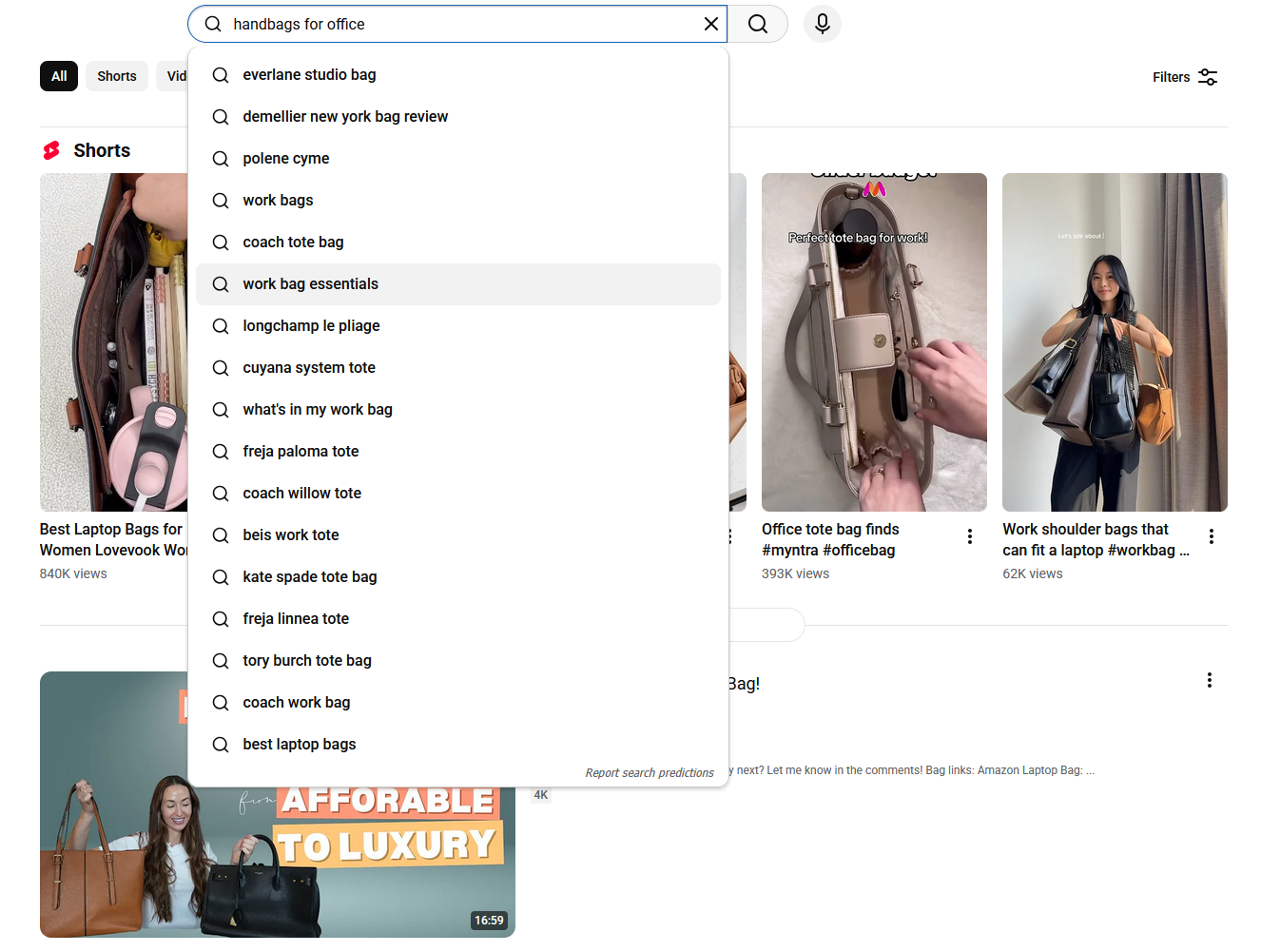
(Source: YouTube)
Notice, in the search results below, there are “suggested products” showing up as sponsored ads. This shows which brands invest in YouTube paid ads. In the video results, you’ll find influencers and user-generated content presenting competitor products. As you scroll down, you’ll spot brands posting as well.

(Source: YouTube)
Step 2. Benchmark performance and posting cadence
After establishing your competitive landscape, prioritize a comparison across these essential metrics for a comprehensive competitive analysis:
- Average views per video (last 10-20): This benchmark helps you assess content resonance, gauge algorithm momentum and compare audience reach against active engagement.
- Views in the first 48-72 hours: This metric is crucial for determining immediate audience demand, quantifying algorithmic push on the day of publication and identifying accelerated growth momentum.
- Upload frequency and consistency: Analyzing this indicates their investment level, determines the strategic balance between volume and quality and reveals the strength of their feed presence.
- Engagement rate (likes + comments ÷ views): Comparing your rate against theirs uncovers key differences in emotional resonance, validates content quality and exposes the true strength of community connection.
- Video length pattern: This analysis identifies optimal content formats (long-form vs. mid-form), signals viewer expectation (deep storytelling or rapid value delivery) and establishes if video length directly correlates with performance.
- Keywords or tags: This reveals precise optimization strategies, identifies high-value search terms they prioritize and unearths consistent keyword themes or topical clusters for targeting.
- Subscriber growth trend (past 30-90 days): This data is critical for assessing overall audience health, validating brand strength and determining the long-term viability of their content strategy.
- High-performing and trending videos: These assets are your best resource for identifying breakout content opportunities, pinpointing emergent trends and sourcing formats or topics ripe for testing.
When comparing, always benchmark with context; YouTube channel size, topic complexity and audience behavior all influence results.
Step 3. Analyze content themes and creative hooks
Beyond raw metrics, your most actionable insights sometimes come from dissecting what competitors say and how they say it. Look for repeatable patterns in themes, formats and storytelling devices that consistently drive views.
Use this checklist to break down competitor creative hooks:
- Identify their recurring themes. Look for repeated story angles (e.g., tutorials, myths, challenges, niche breakdowns) to understand what their audience reliably engages with.
- Examine hook structures. Note whether they use open loops, bold claims, problem-first intros, quick outcomes, personal stories or high-tension statements.
- Evaluate the strength of the first 5–15 seconds. Categorize how they earn attention: pacing, visuals, voiceover, text-on-screen or immediate value statements.
- Track consistent opening phrases or formats. Competitors often reuse hooks (“Let me show you why…”, “The biggest mistake…”) because they convert well.
- Analyze emotional triggers. Determine whether hooks lean into curiosity, urgency, controversy, empathy or authority—each attracts different segments.
- Study how they position the viewer. Identify if the hook sets up viewer identity (“If you’re a beginner…”) or situational relevance (“If you struggle with…”).
- Note visual hook techniques. Look for jump cuts, quick demos, surprising visuals, text callouts, or pattern-breaking shots used to hold attention.
- Watch how they transition from hook to value. Strong channels maintain momentum; weak ones drop energy immediately after the hook.
- Use Sprout Social Listening for large-scale analysis. While manual analysis is key for creative hooks, Sprout Listening can help you gather and analyze text at scale. Track keywords and themes mentioned across competitor video descriptions and comment sections to uncover underlying audience demand, strategic keyword usage and content trends you might otherwise miss.
This analysis helps you reverse-engineer what earns attention in your industry and informs which creative patterns you should adopt, evolve or avoid.
Step 4. Understand audience sentiment and engagement quality
Key metrics reveal what happened. Sentiment reveals why.
To truly understand audience perception, analyze competitor comment sections for tone, recurring phrases and engagement intent. YouTube’s comment environment often reflects emotional reactions more vividly than numerical data alone.
Comments, reactions and interaction patterns also reveal whether a channel is building trust, delivering value and meeting audience expectations. Start by scanning top comments across several recent videos to identify recurring themes—what people appreciate, what they criticize and what they request more of.
Pay attention to the why behind positive feedback, noting whether viewers respond to clarity, entertainment, depth, relatability or problem-solving. Likewise, track negative or frustrated comments that point to gaps in pacing, clickbait tendencies, missing information or misaligned expectations.
Beyond sentiment, look at the quality of engagement. Substantive comments that reference specific takeaways signal deeper audience connection than generic praise. Compare engagement patterns across a competitor’s top-performing and average videos to understand what consistently resonates versus what falls flat.
Also, be discerning about the comments you analyze. Quickly learn to spot bot activity, spam or trolling comments. These non-genuine interactions can inflate engagement numbers but offer no valuable insight into actual audience sentiment. Ignoring these irrelevant comments will ensure you focus your analysis on the feedback that truly matters for your strategy.
Use engagement rate (likes + comments ÷ views) as a directional indicator of how actively their audience participates relative to overall reach and pay attention to whether viewers interact with each other or if the creator replies—both signs of a healthy community. These observations help you identify where competitors excel, where they fall short and how you can strategically position your own content to deliver more meaningful value.
Step 5. Turn insights into strategy
Data without application is just noise. The final step of competitor analysis is turning your findings into an actionable plan that improves content performance and drives business outcomes.
Once you’ve gathered performance benchmarks, creative patterns and audience cues from your competitors, the next step is translating those observations into actionable strategy for your brand. The goal isn’t to copy competitors. It’s to identify what works in your industry, where the gaps are and how you can differentiate with purpose. Use the following framework to convert insights into a clear, brand-aligned content strategy:
- Identify what consistently performs above baseline. Pinpoint competitor topics, formats, lengths and hooks that outperform their average. These patterns indicate audience demand you can capitalize on with your own unique angle.
- Spot strategic content gaps. Look for questions in comments competitors aren’t answering, topics they haven’t covered or formats they haven’t explored. Gaps often reveal opportunities to lead the conversation.
- Assess what underperforms and why. Notice themes competitors attempt but fail to gain traction with. Slow velocity, low engagement or critical sentiment can signal what to avoid or reimagine differently.
- Refine your content pillars. Use competitor patterns to sharpen or validate your own pillars. Add pillars where you see opportunity and strengthen ones where competitors are weak or inconsistent.
- Adopt high-performing creative behaviors. This includes hook structures, storytelling flows, pacing, thumbnail styles or value framing that consistently win in your industry—adapted to your brand voice.
- Build your competitive differentiation. Determine how you’ll stand apart: deeper explanations, more polished visuals, stronger thought leadership, clearer show formats or a more relatable personality.
- Inform your publishing cadence. Benchmark upload frequency, and find a sustainable cadence that keeps you competitive while protecting quality.
- Prioritize experiments based on evidence. Let data guide your next tests—topics that show momentum, formats gaining algorithmic push or hooks tied to higher engagement.
By translating competitor signals into clear strategy, you position your brand to produce content that’s not only competitive but genuinely differentiated, audience-centric and designed for long-term channel growth.
Pro tip: Once your new, competitor-informed strategy is complete, Sprout Social is where you centralize execution and measurement. Use Sprout’s Content Calendar to schedule your new YouTube videos alongside all your other social content for a cohesive cross-channel strategy.
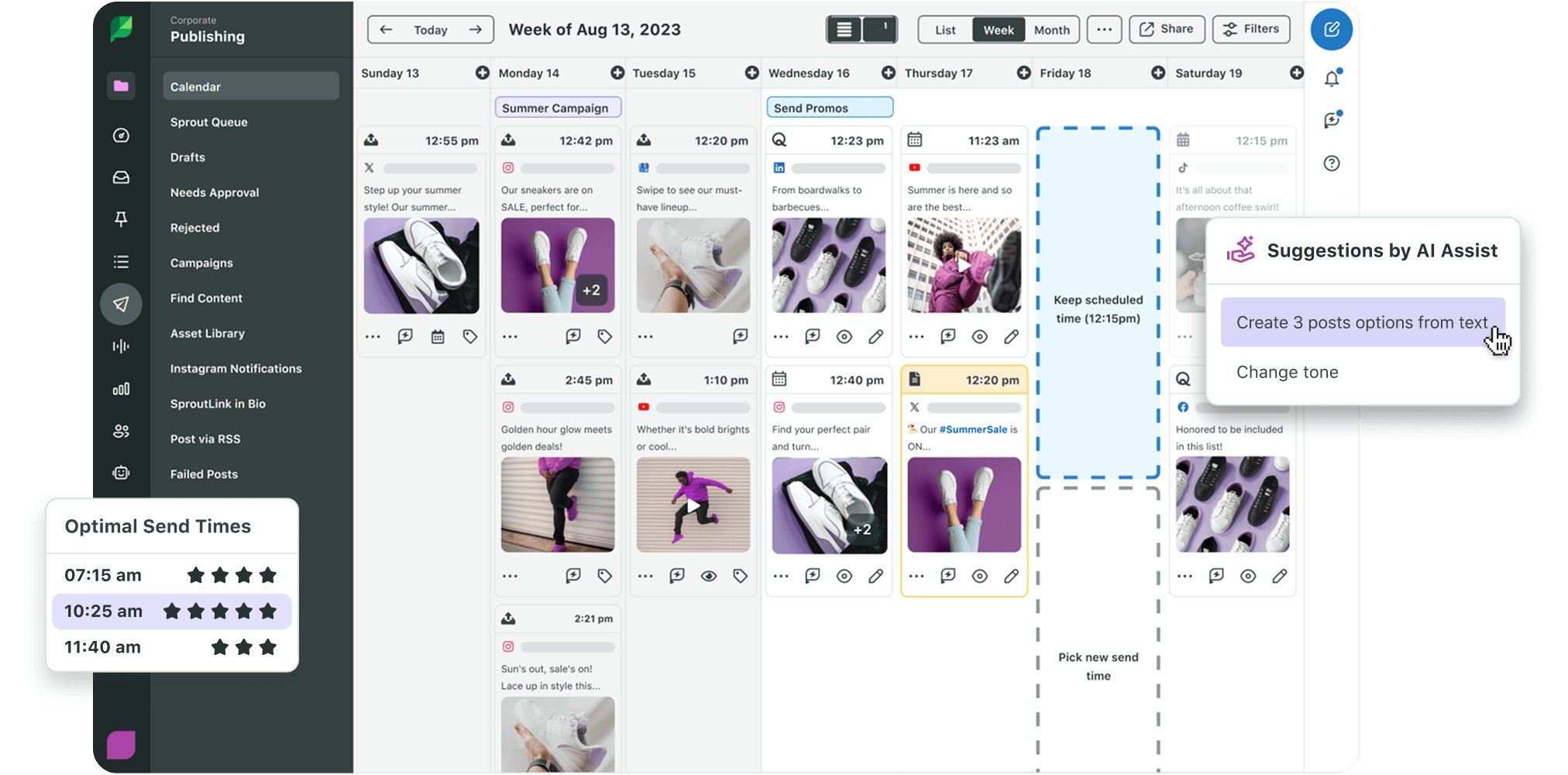
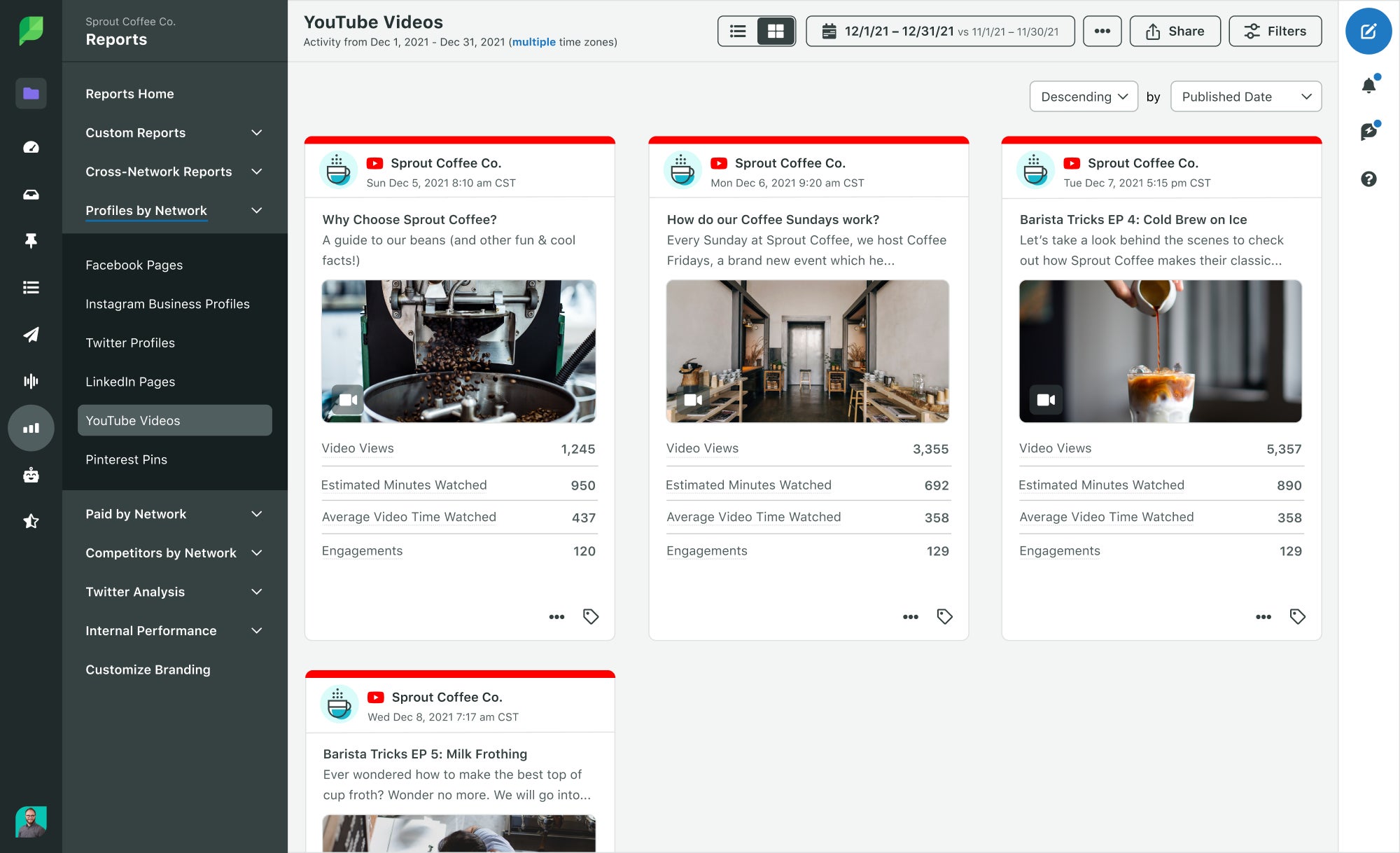
Then, leverage our YouTube Analytics to track your new content pillars, optimize your publishing times with ViralPost® and continually benchmark your channel’s performance to ensure your strategy delivers the intended business outcomes.
The metrics that actually matter for business impact
While most YouTube metrics measure content performance, brands need to focus on the signals that tie directly to business outcomes, not just video-level success. These metrics reveal whether your YouTube strategy is supporting awareness, authority, demand or customer trust, which are key drivers that matter to leaders far more than views alone.
Content efficiency
Consider how many videos competitors publish relative to the results they earn. If they upload weekly but only a handful of videos outperform their average, it suggests inefficiency that you can outpace with smarter, more intentional content rather than with volume. Leaders value this metric because it directly influences resource allocation and cost-effective reach.
High-intent topic performance
Look at which competitor videos attract search-driven or problem-aware viewers. These audiences are closer to taking meaningful action, whether that’s researching solutions, subscribing, sharing or purchasing. High-performing, high-intent topics show where your brand can win visibility that aligns with real demand.
Community depth signals
Analyze substantive comments, recurring viewer names, audience discussions and how often the creator replies. These signals reveal whether a channel builds trust and authority over time. A deep community strengthens long-term brand equity rather than simply boosting algorithmic performance.
Thought leadership strength
Identify competitors who simplify complex topics, offer clear frameworks or provide unusually strong expertise. These creators often earn disproportionate brand preference and credibility. This matters because authority-focused content shapes how audiences think and who they ultimately trust.
Momentum indicators (growth trajectory, not snapshots)
Rather than looking at standalone metrics, track consistent upward trends in subscriber growth, recurring viewer patterns or rising view velocity over time. Momentum shows whether a competitor’s strategy is gaining traction. Brands are not competing against where a competitor is today, but where that trajectory leads.
Conversion-adjoining signals
Observe how competitors use CTAs, lead magnets, description links, pinned comments and product mentions. Even without seeing final conversions, these behaviors signal intent to capture demand and expose gaps in your own funnel strategy. Channels that guide viewers toward deeper engagement are often building meaningful impact beyond YouTube.
By focusing on these business-oriented metrics, brands can make YouTube decisions that ladder up to revenue, reputation and strategic advantage, not just algorithmic performance.
Turn your findings into stories that your leaders will approve
Turning competitive insights into a compelling narrative is where your analysis becomes actionable for the business. Leaders want clarity, confidence and a strong connection to organizational goals. Your job is to present a focused story that shows how YouTube can create meaningful impact and why your recommendations deserve investment.
Establish the competitive landscape and opportunity
Start by grounding leaders in what is happening in your industry. Summarize where competitors are gaining traction, which topics or formats consistently perform and what audience sentiment reveals about unresolved needs. Then highlight the gaps competitors leave open, such as underdeveloped content areas, weak educational resources or audiences asking questions that go unanswered. This combination of landscape and opportunity creates a natural case for why your brand should step in.
Translate insights into strategic pillars
Organize your findings into a small set of content pillars or themes that define what your channel should focus on and why. These pillars should directly reflect what your analysis surfaced, such as high-intent topics competitors underutilize, formats that consistently resonate or creative approaches that differentiate your voice. Leaders respond well to clear frameworks that demonstrate intentionality and show how YouTube will support broader brand and marketing priorities.
Tie your strategy to business outcomes
Explain how each pillar connects to what matters most to the business, including improved brand authority, stronger top-of-funnel demand, clearer customer education or greater competitive positioning. This step is crucial because it shifts YouTube from feeling like a content initiative to being seen as a driver of measurable business value. Leaders want to see not just what you will make but why it moves the organization forward.
Present an actionable, measurable roadmap
Close by outlining a realistic plan for execution, such as a phased 30-60-90 day approach or a quarter-by-quarter rollout. Include what you will publish, the support you need and how you will measure success. Focus on business-oriented KPIs like recurring viewer growth, depth of engagement, high-intent topic traction and improvements in authority signals. Then make a clear ask for alignment or resources. This gives leaders confidence that your strategy is both achievable and anchored in meaningful results.
By shaping your findings into a structured, business-aligned narrative, you position YouTube as a strategic opportunity rather than a content experiment, making it far easier for leaders to support and invest in your plan.
Let competitor insights guide your next move
YouTube competitor analysis turns uncertainty into clarity. By studying the formats, themes and audience behaviors that drive success in your industry, you uncover patterns you can adapt and opportunities your brand can own.
When these insights are transformed into a focused, business-aligned strategy, YouTube becomes a growth engine that supports awareness, authority and measurable impact. Consistently applying these insights ensures your brand stays relevant, differentiated and positioned for long-term success.
Ready to see how Sprout can make competitive insights easier to uncover? Request a free demo.
The post YouTube competitor analysis: Turn insights into strategic growth appeared first on Sprout Social.
from Sprout Social https://ift.tt/SGDJxkH
via IFTTT

No comments:
Post a Comment