Thursday, 6 July 2023

Social media management costs for businesses in 2023

Investing in social media management increases your brand’s awareness, generates leads, drives traffic to your site and boosts community engagement. While that sounds great to executives and stakeholders, they may not understand how the costs associated with social media translate to business objectives.

If you need help getting buy-in for your social strategy and building your budget, this social media management costs guide will help you get started.

We’ll walk you through what is normally included in the cost of social media management, how the cost of agencies compares to freelancers and the average amount a business should spend. Let’s dive in.

Social media management costs overall

First, we need to be clear. There is no one-size-fits-all social media management cost. Brands will spend differently depending on their unique goals.

Based on average costs, we determined a comprehensive social media management program is roughly $12,300 per month. That number includes all costs related to content creation, advertising campaigns and social media management software.

  • Content creation: $7,950 per month
  • Social advertising: $5,000 per month
  • Platform management: $5,000 per month
  • Total: $17,950 per month

However, as a rule of thumb, a more basic program costs anywhere between $500–$5,000 per month.

Here’s a breakdown of how we calculated this figure.

Cost of launching on a new social channel and creating content

Although launching on a social channel is technically free, running the profile and creating a content calendar costs a brand anywhere from $500 to $10,000 per month.

The estimated social media management costs depend on factors like talent sourcing (in-house talent vs. outsource) and third-party tools. For example, at Sprout, our content and social management is driven by our internal team members but we contract content creation too.

Here are the average rates for both:

  • Social Media Specialist salary: $3,800 per month
  • Social Media Manager freelance rate: $20–150 per hour, based on experience
  • Creator compensation: $150–$500 per post or video

Cost of social media ad campaigns

To run a successful platform-specific advertising campaign, you should plan to invest at least $5,000 per month, according to Sprout’s Manager of Digital Marketing, Maggie Anderson. She points out that often the cost can be much higher, so you should consider this number a starting point.

Anderson explains, “Before finalizing your social ad campaign budget, pinpoint your goal, campaign duration and audience. These factors will help you choose target strategies and platforms that will work best for your campaign—which ultimately determines your budget.”

As you incorporate more platforms and run longer campaigns, expect the overall expense to increase.

A screenshot of Sprout Social's Paid Performance Report. The report illustrates key performance indicators of an example ad campaign, including impressions, engagements, clicks and conversions.

Your campaign metrics will reveal ways you may need to optimize your strategy to reach your desired goals, so leave room in your ad budget for flexibility.

Platform management costs

Whether you manage multiple platforms through a social media management tool, an agency partner or both, you will pay around $500–$5,000 per month.

The price is influenced by the number of profiles you manage, the volume of inbound messages and mentions you receive, the size of your community and the features you use.
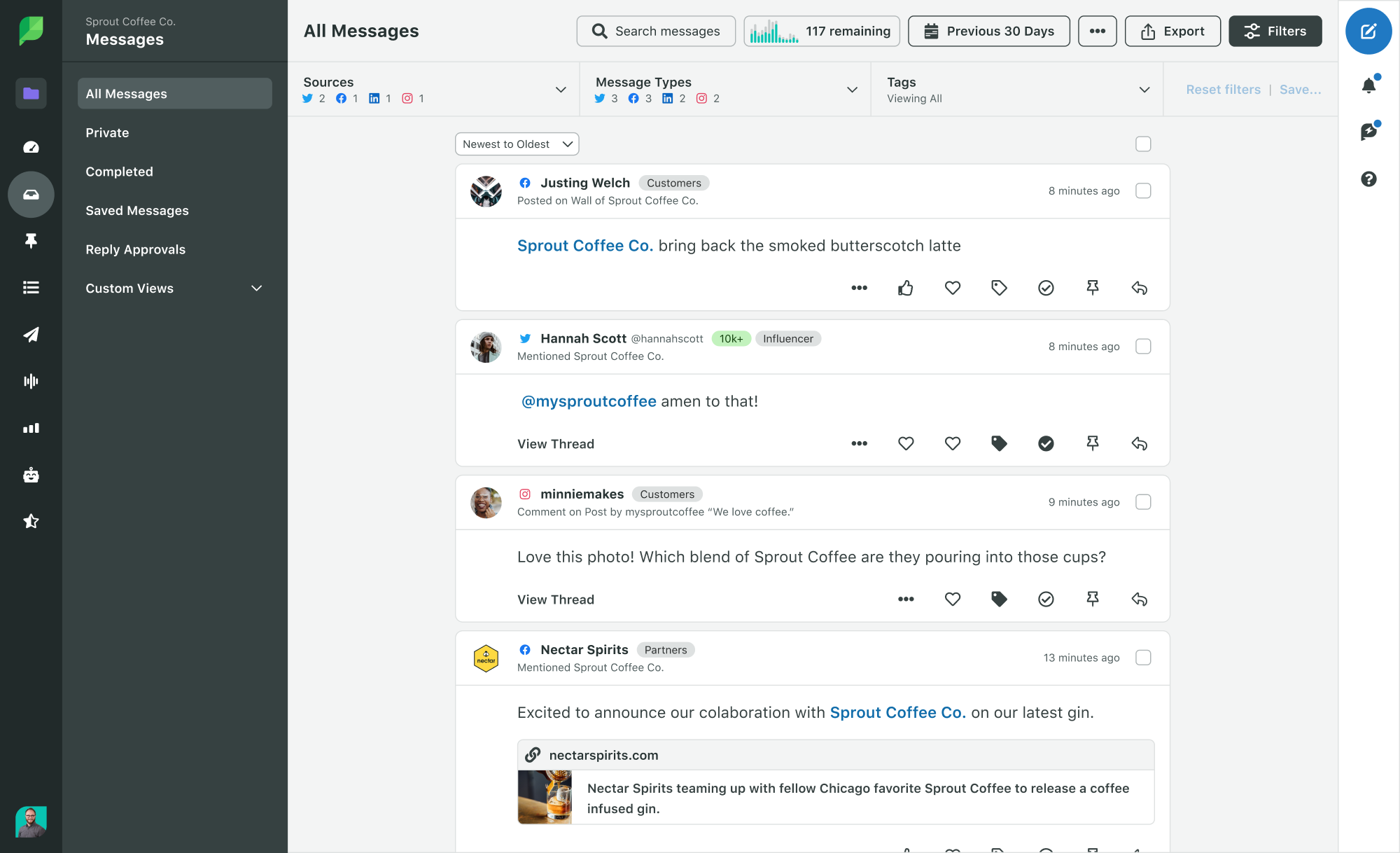
A screenshot of Sprout Social's Smart Inbox, an inbox within the platform that consolidates all incoming messages and mentions into one place.

Continue reading to learn more about the costs of working with a social media management agency and using a social media management tool.

Social media management agency pricing

Some brands use agencies to complement their in-house social teams, while others use them to outsource all their social media management tactics. If you decide to work with an agency, here are the parameters for social media management costs you should plan for.

We asked 228 agencies how much they’re charging for their social media services. About 33% of the respondents said they charge an average of $1,501–$3,000 per month, while 27% of agencies are charging $501–$1,500 and 12% more than $5,000.

A graphic from Sprout Social's Agency Pricing and Packaging Report that illustrates the cost ranges of agencies from $500-$5,000+

While the services offered depend on the agency type, they often entail:

  • Platform management
  • Social strategy
  • Content development
  • Social analytics
  • Running paid social campaigns
  • Engagement and community management

Keep in mind the scope of your social media management needs will impact cost. Prices vary depending on your goals, service term and the number of tasks the agency performs.

Social media management freelancer pricing

If you opt to work with freelancers, you will need to budget that into your social media management pricing. Freelancer costs shift based on their experience level and the extent of your project. On average, freelancers charge between $500–$10,000 per month. Many freelancers also offer hourly rates.

Once you determine your goals and budget, search for freelancers with the skills you need who fit your price range. Here’s a list of marketplaces you can use to kickstart your search:

  1. Upwork: A freelancing platform and independent talent workforce that helps you scale faster and transform your business. Upwork is a great option for larger projects that require subject matter expertise.
  2. Fiverr: A global online marketplace for freelancer services. Known as a cost-efficient choice, Fiverr helps brands bridge gaps in their overall social media management and achieve platform-specific goals.
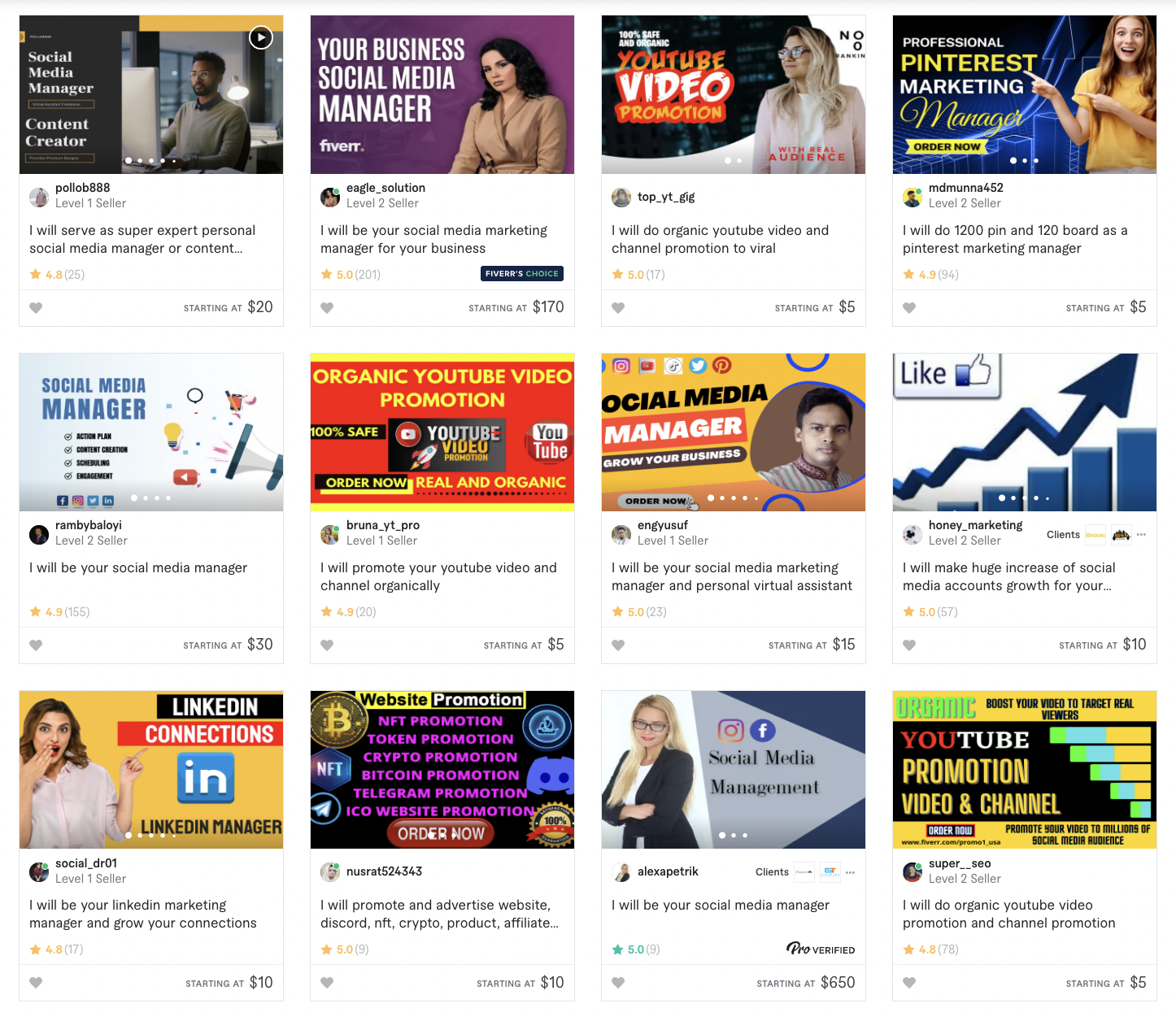
A screenshot of Fiverr global online marketplace. Here, freelancers advertise their services with copy and thumbnail images that include their headshot.
  1. The Mom Project: A freelancing platform specifically designed to employ mothers and help over 650,000 talented women stay engaged in the workforce. The Mom Project’s Maternityship® program provides companies with coverage for resource gaps created by parental leave.

If your team opts to work with freelancers, we recommend starting with smaller tasks. Make sure their work aligns with your goals and expectations before partnering on large-scale, critical projects.

Social media management software pricing

Today’s social media managers know publishing, scheduling and reporting from the native platforms would be inefficient (and, in some cases, impossible). Social media management software simplifies the hard work of social media so you can focus on connecting with your audience and building insights-driven strategies that elevate your brand.

For a robust social media management platform, you can expect to pay up to $1,000+ per month to cover end-to-end needs. For less robust platforms built to support specific tasks, you can expect to pay the same amount or less.

A screenshot of Sprout's pricing per plan

Here’s an overview of our pricing models.

 Standard

  • $249 per month
  • Manage up to five social profiles
  • Access to the all-in-one Smart Inbox and social content calendar
  • Manage reviews
  • Scale engagement with tasking and social CRM tools
  • Analyze group, profile and post-level reporting

Professional 

  • $399 per month
  • All the benefits offered by the Standard Package
  • Manage unlimited social profiles
  • Use incoming and outgoing message content tagging
  • Schedule posts with Optimal Send Times powered by the ViralPost® algorithm
  • Find more reports, including paid social reporting and response rate and time analysis
  • Employ custom workflows for multiple approvers and steps
  • Take advantage of Helpdesk, CRM and Social Commerce integrations

Advanced

  • $499 per month
  • All the benefits offered by the Professional Package
  • Receive message spike alerts for increased activity
  • Set up chatbots with automation tools
  • Use the Inbox rule builder for automated actions
  • Employ Automated Link Tracking
  • Stay organized with a digital asset and content library

Customers can use bonus features like Listening, Premium Analytics and our employee advocacy tool for an additional cost.

By using a management platform like Sprout, your social and customer care teams save time and increase productivity. Sprout’s integrations will make your team more informed and efficient, so you can spend most of your time growing and maintaining customer relationships and fine-tuning your strategy.

Cost of other software that can help with social media management

In addition to a social media management platform, you might need other tools to supplement your social media strategy. Here are two examples of platforms that can help you track your customers’ journey and generate new content ideas.

1. HubSpot

HubSpot’s integrated CRM platform helps you monitor social engagement in the context of your customer relationships.

The platform gives you a detailed understanding of your customers’ social interactions and how many marketing-qualified leads you’re generating from specific platforms—which makes it easy for you to prove the return on investment (ROI) of your social campaigns.

A screen capture of the HubSpot Marketing Hub tools which demonstrates impressions from Facebook and LinkedIn.

Cost: $800/month (Professional)

2. Post Planner

Post Planner curates articles, images and custom content feeds so you always have something fresh for your followers. The platform identifies your most popular posts and has automated features to repurpose and recreate top-performing content.

Cost: $47/month (Business)

Invest in long-term social media success

Designing your social media management budget requires thinking critically about the resources you need to reach your goals. While the upfront social media management costs might seem expensive, finding the right mix of tools will set you up for future success.

After all, growing your social media presence is a marathon, not a sprint. The investments you make in your management strategy today will accrue and deliver long-term gains.

Tap into the robust power of social by starting your free 30-day Sprout Social trial today.

The post Social media management costs for businesses in 2023 appeared first on Sprout Social.


from Sprout Social https://ift.tt/TODUQws
via IFTTT

How to collect and mine your social media data for growth

Virtually all business leaders believe social media data and insights have a profound impact on top business priorities, according to The 2023 State of Social Media report. From building brand reputation to understanding customers and improving competitive positioning, social data is the missing piece you need to solve your leadership team’s most pressing challenges.

A data visualization that reads: Impact of social media data and insights on business priorities. The visualization lists building brand and reputation loyalty, improving competitive positioning, gaining a better understanding of our customers, predicting future trends and moving business forward with reduced budget as business priorities more than three quarters of leaders agree are positively impacted by social media data collection and analysis.

But raw data points without context don’t tell the full story. To prove how social fulfills business objectives, it’s essential to dig deeper.

In this guide, we break down the benefits of social media data collection, how to mine for meaningful data and tools you can use to automate your data collection workflows. No matter your internal audience or business focus, a data-driven approach to social media delivers transformative insights.

What is social media data?

Social media data is information collected from social media networks that demonstrates how users share, view or engage with your content or profiles, and the content or profiles of your competitors. Raw social data includes:

  • Shares
  • Likes
  • Mentions
  • Impressions
  • Hashtag usage
  • URL clicks
  • Keyword analysis
  • Follower count
  • Comments
  • Message volume
  • Message response rate and time

Social media data also includes the insights you glean from social listening when analyzing conversations and trends related to your brand. These include conversations relevant to your company, competitors and industry at large, and often hold the answers to questions the C-suite asks (example: how are people talking about our brand online?).

A green graphic that reads, What is social media data? Information collected from across social media networks that demonstrates how users share, view or engage with your content or profiles, and the content or profiles of your competitors. It also includes insights gleaned from social listening.

How does analyzing social media data work?

Collecting raw social media data and measuring it against your goals and objectives is the process of social media data analysis. This is a vital step that reveals what is and isn’t working—both for you and your competitors.

While raw social media data can be powerful, what’s most influential is the value you provide when you make sense of the data and analyze the metrics in compelling ways. For example, many CFOs aren’t well-versed in the business impact of increased impressions or engagements. But when you share social data in the context of org-wide impacts and combine it with other data sources, you help future-proof your company and propel your business forward.

Through Sprout Social’s integration with Salesforce and Tableau, you can present social data alongside metrics from other digital channels. This customizable dashboard gives you visualizations of social, ad and email performance data without requiring time-consuming work.

A screenshot of a Tableau dashboard populated with Sprout Social data and other marketing data.

What are the benefits of social media data collection?

Social media data collection has far-reaching benefits that extend to every area of your organization. According to The 2023 State of Social Media report, most business leaders agree that social media data and insights play a pivotal role across companies—including PR, trendspotting, competitor analysis, proactive crisis management and communication functions.

A bar graph in the shape of a circle with the header: Business leaders agree that social media data and insights... The data lists PR strategies, identifying industry news, competitor analysis, proactive crisis management and primary communication tool as benefits of using social media data and insights.

When social data is presented in an influential way, here are some specific ways it can improve your brand’s performance, prove the ROI of social to stakeholders and provide value to other teams.

Track metrics and KPIs

By regularly collecting social metrics, you can assess your performance to test if your strategy successfully meets your KPIs. This empowers you to make adjustments to your content and workflows on a regular basis—whether it’s quarterly, monthly or even weekly—and share reports with stakeholders to keep them informed of your progress.

Benchmark performance

Collecting social media data enables you to benchmark your content and customer care performance. With these metrics, you can compare your performance to your past data, industry averages and competitors to make sure your brand stays on track.

Understand your audience better

Insights from social provide a direct line to your target audience that will help you rise above your competition and ensure the long-term health of your business. Not only will you learn what is going well regarding your social performance, you will also better understand what your customers need from your brand and products. Essential intel you can pass along to your brand and R&D teams.

Find your best time to post

​​Though there are general best times to post on social media, you should consult social data to find your unique best practices. Through analysis, you can discover when your target audience is active and most likely to engage, and adjust your posting schedule accordingly.

Because this can be a heavy lift, try automating it to unburden your bandwidth. Sprout’s ViralPost® feature calculates your best times for you—so you always publish at optimal times without stretching your team too thin.

Screenshot of Sprout's Publishing Calendar in list view, with the compose flyout box and the mouse curser over the ViralPost Optimal Send Times feature.

Improve ROI

Social data is a primary source of business intelligence that can help move your business forward. By regularly collecting social data, you can calculate and share your social media ROI—proving how essential it is to invest in social even if you face a tight budget or looming economic uncertainty. By demonstrating the value social provides your company, you set yourself up to gain critical leadership buy-in for additional tools and resources in the future.

Help reach organization-wide goals

Social data is a source of truth that will help your company refine product development, strengthen your employer brand and recruit top talent, and directly drive revenue—essential steps toward growing your bottom line. Used correctly, social insights make it easy to prove organization-wide value and facilitate cross-collaboration.

Need help presenting your social data in a captivating way? Read our Senior Social Media Manager’s tips for telling impactful data stories.

3 social media data collection methods

Let’s get into the details. Here are actionable ways to collect meaningful social media data that actually delivers the metrics you need.

1. Ask specific questions

Your social media data collection is only as good as the questions you ask. Simple questions like “how many followers do we have?” might be relatively easy to answer, but they don’t usually provide attention-grabbing insights or get to the root of what you can learn about your customers.

To ask the right questions, the social team needs a seat at the table.

As Jamie Gilpin, Sprout’s CMO, explained at a recent LinkedIn Roundtable event, “If you don’t know your organization’s most important business priorities or objectives, how can you deliver results that matter to leaders?”

If you aren’t already briefed on your company’s goals, now is the time to meet with leaders and develop a regular discourse. Or, if you don’t have direct access to your leadership team, seek support from other stakeholders who can help you uncover the information you need. Find out what keeps your CMO up at night. Learn what challenges the revenue org is facing. Discover the insights R&D wishes they had.

Through this exploration, you will uncover the right questions to ask and jumpstart high-impact data mining.

2. Find your core social media KPIs and metrics

Based on the insights you learned in step #1, you need to define core KPIs that ladder-up to your organization’s goals and keep a pulse on your social performance. These metrics will be the foundation of how you define success for your business on social. By evaluating these metrics consistently, you get the intel you need to offer thoughtful and deep understanding of your audience and the future of your business.

For example, some common KPIs for brands include audience reach, customer engagement, response times and social listening volume. You will notice these metrics aren’t always easily accessible in native social platforms.

By using a platform like Sprout Social, you can fully leverage all the data available on social and swiftly prepare presentation-ready reports. Some of our platform’s analytics highlights include:

  • Cross-Network Performance Reports: Aggregate data across networks from your profiles and posts. From these various reports, you can access an overview of key metrics like impressions, engagements, video views, clicks, audience growth and message volume. You can also export granular data points to dig into day-to-day performance and compare your performance across different date ranges.
A screenshot of Sprout's Cross Network Profile Performance report. It displays impressions, engagements, post link clicks and audience growth by network.
  • Inbox Activity Report: Sprout’s Smart Inbox unifies your social channels into a single view so you can quickly monitor incoming messages, cultivate conversations and respond to your audience. The report gives a comprehensive overview of your team’s social care efforts. It shows trends in message volume and identifies how quickly and frequently your teams respond to messages.
A screenshot of Sprout's Inbox Activity Report. In the report, you can see a summary of all key performance metrics for received messages and inbox actions and a change over time in inbox volume.
  • Listening Topic Insights Summary: AI-driven technology does the hard work for you by combing through billions of data points to find trends related to your brand. The report pulls total volume, engagements, impressions, unique authors and sentiment of specific topics and keywords—whether it’s your branded hashtags or the name of your new product.
A screenshot of Sprout's Performance Summary tool which demonstrates key metrics (like volume, engagements and impressions) related to a Topic.

3. Track conversations around your brand

Social is like a 24/7 focus group. Your audience is always sharing things they’re excited about, their challenges and their favorite products. They even share unfiltered thoughts about you and your competitors. But trying to sift through the noise to find these valuable insights can be frustrating.

Social listening can help you zero-in on this earned data and give stakeholders the answers they’re looking for. Set up a social listening query to start tracking what discussions are trending in your industry, what your audience cares about and to figure out the “why” behind you and your competitors’ performances.

Sprout’s listening solution uncovers critical insights in seconds, including:

  • Listening Topic Conversation Insights: The Conversation tab of the Listening topic mentioned above provides details about the top keywords, hashtags, mentions and emoticons popular with your audience. The Smart Categories feature automatically groups trending people, places and things being discussed together, and shares performance metrics for each subject group.
A screenshot of the Sprout Word Cloud that shows popular keywords mentioned around a topic using Sprout's social listening tool.
  • Competitive Analysis Listening tool: Compare your competitors’ fundamental metrics side-by-side with your own—including audience growth, engagement, share of voice, sentiment, impressions and post volume for each network.
A screenshot of Sprout Social's Competitive Analysis dashboard that demonstrates how three competitors compare in share of voice, impressions, engagements and sentiment.

6 social media data collection tools

Here’s a recap of the data benefits Sprout Social offers, and a look at some of the most popular native social media data collection tools.

Sprout Social

Sprout Social empowers you to give metrics meaning. Quickly gather, explore and share detailed data from one platform. With Sprout, you have the tools you need to demonstrate impact and influence decision making, and more time to focus on ways to reach your KPIs, fortify your strategy and prove ROI.

The Sprout Social dashboard, which gives you an at-a-glance view of today's publishing calendar, to do items, recent post performance and engagement trends by day.
  • Analytics: Sprout’s built-in and Premium Analytics enable you to speed up and automate data collection and reporting so you can illustrate the full value of social to stakeholders, colleagues and clients alike. Hone in on performance at the post level or zoom out to focus on your holistic impact, and easily share recurring and customizable reports everyone can understand.
  • Listening solution: Harness the power of global conversations with Sprout’s powerful enterprise-ready social listening solution, built on intuitive workflows and proprietary AI-driven technology. Go beyond easily accessible raw metrics, and incorporate insights from Reddit communities, Twitter DMs, LinkedIn mentions and TikTok comments into your social data.
  • Business intelligence integrations: Through Sprout’s integration with Tableau, customize your social data in an omnichannel view to pull business insights and performance metrics from a single source of truth. These dashboards contextualize social data and provide teams a more complete view of all data, making it easier for social data to influence business decisions.

Meta Business Suite analytics

Meta Business Suite consolidates the results of your organic and paid social media efforts across Facebook and Instagram in one place. You can also access the data in each of the individual apps.

With these insights, you can see metrics, trends and visual reports that can help you understand which Facebook Page and Instagram strategies work well and where to make improvements. Gain insights about your account, platform and post level, such as:

  • The performance of your Facebook Page and Instagram business profile, like trends in reach.
  • Your ad account’s cross-platform spend.
  • Organic and boosted post content engagement, including likes and comments.
  • Demographic and geographic summaries of people who like your Page and follow your Instagram business profile.
A screenshot of Meta Business Suite. In the image, you can see a pop-up giving you instructions for how to export insights data. You can select data type, date range and file format.

TikTok analytics

TikTok analytics help you track the performance of your videos. The platform offers video metrics, such as views, likes, comments and shares, as well as information about your profile and followers.

This data enables you to refine your content topics, identify your best posting times and find relevant trends and creators to partner with.

A screenshot of the Analytics tab in TikTok. In the image you can see the Overview which provides engagement data including video and profile views, likes, comments and shares.

Twitter analytics

Twitter analytics collect and analyze audience actions on your posts or profile, such as clicks, follows, likes and expands. This data helps you track performance and improve your strategy. It’s critical for understanding who’s interacting with your Tweets and how your account is performing overall.

A screenshot of a Tweet Activity dashboard on Twitter. The metrics demonstrate number of Tweets, impressions, profile visits, mentions and follower count. The dashboard also features Top Tweets, mentions, followers and a monthly performance summary.

LinkedIn Analytics

LinkedIn analytics is a collection of metrics that helps you measure the effectiveness of your posts, updates and strategy on the platform. From the Analytics drop-down in the platform, you can track a variety of analytics, including:

  • Visitor analytics: Page views, unique visitors, demographics
  • Follower analytics: Followers, follower trends, organic followers, sponsored followers, demographics
  • Engagement analytics: Impressions, views, reactions, comments, shares, CTR, follows, engagement rate
A screenshot of the LinkedIn for Business Analytics dropdown menu. You can select metrics including visitors, followers, leads, content and competitors.

Google Analytics

While it’s not strictly a social media data collection tool, Google Analytics can track the conversion-generating rate of social content, which ultimately helps prove ROI.

You can set up specific reports to see how much traffic comes to your website from each social network, or use UTM parameters to track specific social media campaigns. From your dashboard, you’ll be able to keep track of metrics such as impressions, clicks, conversions, CTR, revenue per click and more.

A screenshot of traffic acquisition metrics displayed in Google Analytics. A line graph displays users by organic social, direct, organic search and unassigned sources over time. The same data is displayed in a bar graph.

Start collecting social media data today

Social data has massive potential for informing business decisions. Yet, much of it goes untapped. Social networks have inconsistent reporting styles that make it difficult to manually mine data effectively, and surfacing data when you aren’t tagged or mentioned is like navigating a labyrinth.

If organizations want to capitalize on all that social offers, they must refine data collection processes and tools. Using a sophisticated platform like Sprout Social to collect and analyze data empowers organizations to access real-time social insights quickly—giving companies a holistic view of their customers and a competitive advantage.

For more on commonly overlooked ways to use social data, download our guide to the 40 best ways to use social data.

The post How to collect and mine your social media data for growth appeared first on Sprout Social.


from Sprout Social https://ift.tt/IE63Him
via IFTTT
12 Creative ways video email marketing can increase your engagement

Creative ways video email marketing can increase your engagement

Are you looking for a game-changing strategy to captivate your email subscribers and boost your marketing efforts? Look no further than video email marketing! 

Incorporating a video in your emails has the power to mesmerize and engage your subscribers in ways that traditional text-based emails simply can't match. 

As humans, we are naturally drawn to visuals, and videos provide a visually compelling and immersive experience that can leave a lasting impression. The data supports this, viewers say they retain more information (95% of a message) after watching a video. 

So are you ready to embark on this exciting journey of video email marketing? 

Then it’s time to unlock the power of videos to connect, engage, and convert your email subscribers like never before. So grab your popcorn, sit back, and get ready to discover the magic of video email marketing!

But first, let’s define what video email marketing is…

What is video email marketing?

Video email marketing is simply incorporating videos into your emails. Video marketing is a powerful way to connect with people on a deeper level. And, as we’ve already mentioned, people love watching videos to learn about a brand or topic.

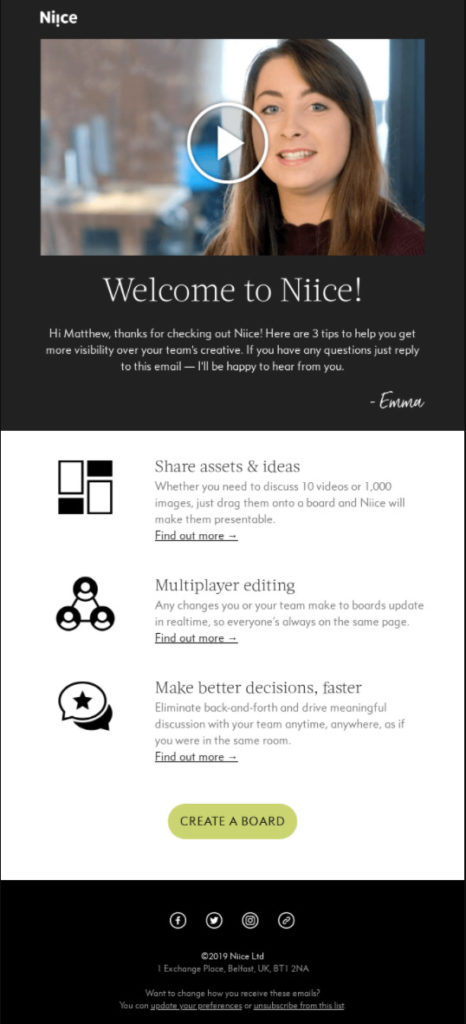
Typically, videos are displayed in emails like the one below from Niice:

Example of a video in an email

While videos won’t play within the inbox due to Internet Service Provider restrictions, displaying a thumbnail like the one above tells a viewer instantly that it is a video. 

In order to watch, viewers will need to click the thumbnail image and watch the video from the hosting platform. 

12 Creative ways to use videos in email marketing

From product demonstrations and customer testimonials to behind-the-scenes glimpses and educational tutorials, the possibilities are endless when it comes to leveraging videos in your email marketing campaigns.

Here are my picks for the most creative ways to use videos in emails.

1 - Show 'em how it’s done

Would you rather read a step-by-step process for getting started or have someone guide you through that process.

For me, that’s an easy question. Watching a video allows me to see first hand what to do.

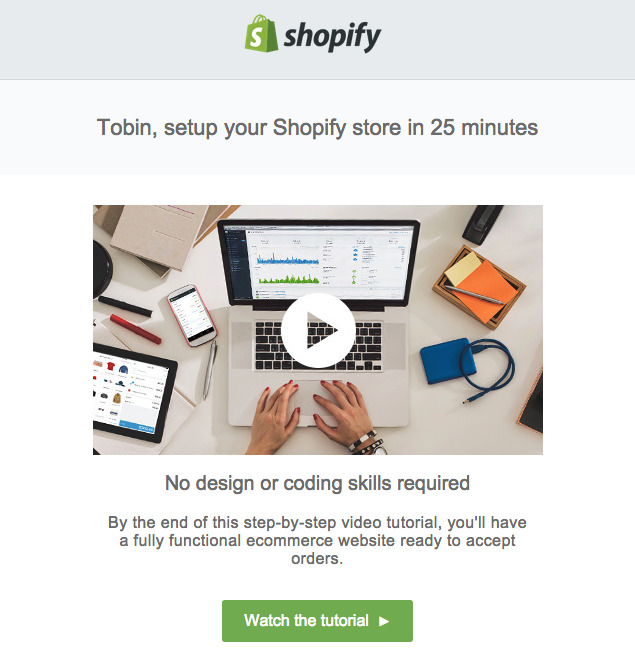
Shopify includes a tutorial video helping new users set up their first store.

Shopify email example using a video

2 - Get customers excited about a product

Use videos to showcase your products or services in action. 

Show how it works, highlight its features, and demonstrate the benefits to engage your audience.

Jot Coffee shares a colorful and exciting video highlighting their product and the different ways you can make coffee.

Jot using video email marketing to show how easy their product is to use

Here’s the video they add to their email.

3 - To celebrate special occasions or holiday greetings

Create personalized videos to send festive greetings or celebrate special occasions with your subscribers. This adds a personal touch and strengthens the relationship with your audience.

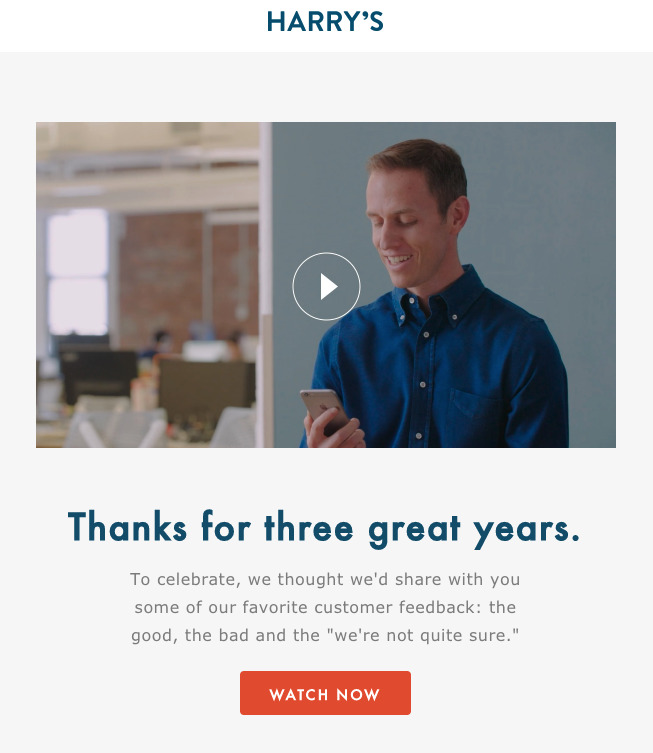
After men’s shaving company Harry’s celebrated three years, they sent an email to their customers where their employee’s read actual customer reviews (I’m assuming they were actual, some were pretty out there).

Celebration email with embedded video

Check out the video for yourself:

4 - To educate

Deliver valuable knowledge and insights to your subscribers through informative video tutorials, demonstrations, or expert interviews, making complex concepts more accessible and engaging for a highly impactful learning experience.

This marketing firm included a video educating their clients on how to use keywords in their content strategy. The purpose for this email was to help their clients with search engine optimization and to further establish themselves as thought leaders.

Building Designs include a video in their email to education audience

5 - Highlight how awesome you are

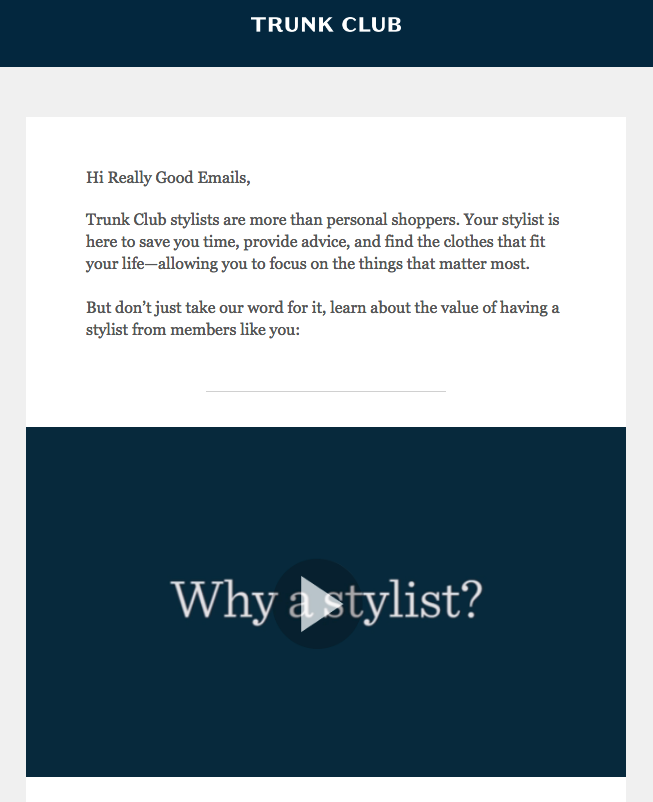
Include video testimonials from satisfied customers to add credibility and social proof. Highlight the challenges your customers face, how your product/service helped them overcome those challenges, and the results they achieved.

You can use your Google reviews to pull those testimonials.

Hearing real people speak about their positive experiences can be highly persuasive.

The Trunk Club includes a customer testimonial video in their email

6 - Getting started

Welcome new customers with open arms and help them get started seamlessly by incorporating a helpful onboarding video into your welcome email series. Guide them through the initial steps, demonstrate key features, and provide tips to ensure they have a smooth and successful experience with your product or service.

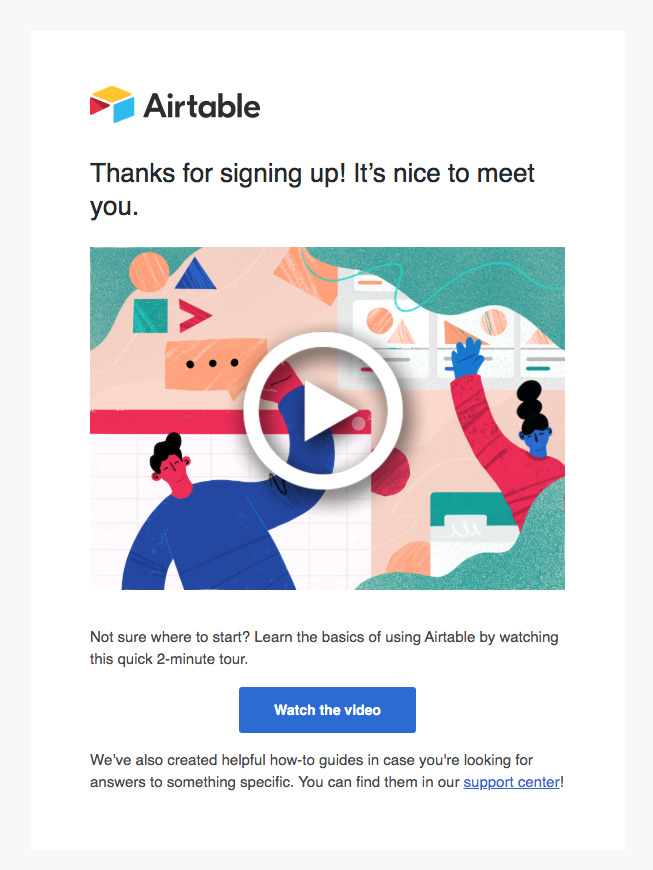
Airtable includes a quick 2 minute video showing new users exactly how to get started with their platform.

Airtable getting started video embedded in their welcome email

This video helps new users understand those first key steps needed to start using Airtable. Check it out:

7 - Promote your most recent YouTube videos

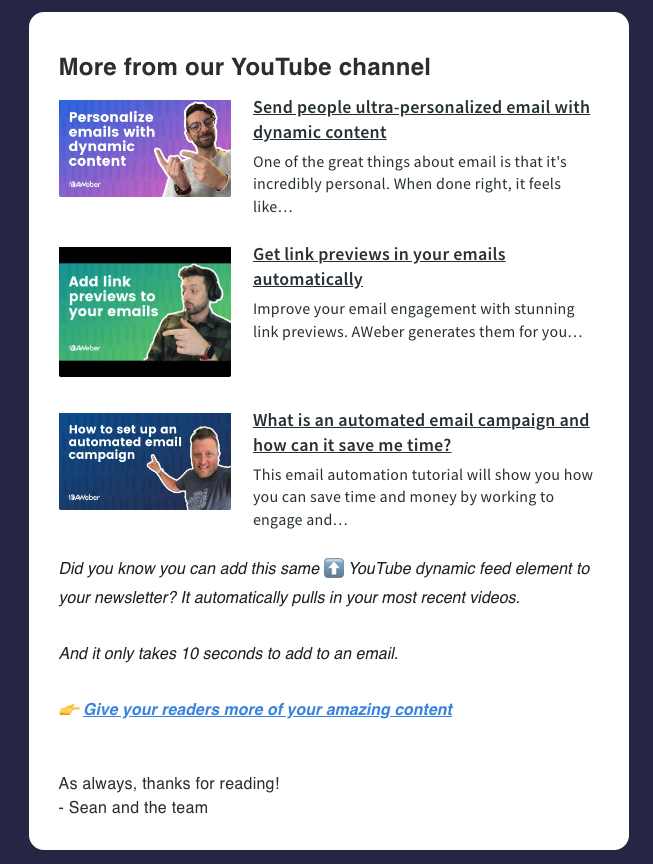
Promote your latest YouTube videos by leveraging the power of the feed element in AWeber. 

With this feature, you can automatically pull in the thumbnails, video names, descriptions and more from your YouTube channel, creating visually appealing and engaging email content that showcases your most recent videos and entices subscribers to click and watch. 

This is an easy way to increase your video view. See how we used it in the bottom of this email.

AWeber's RSS Feed element for YouTube

8 - Event recap

Relive the excitement of your recent event by incorporating a video recap into your email marketing. Take your subscribers on a journey, highlighting key moments, speaker highlights, and attendee testimonials, allowing them to experience the event's energy and value firsthand, even if they couldn't attend in person.

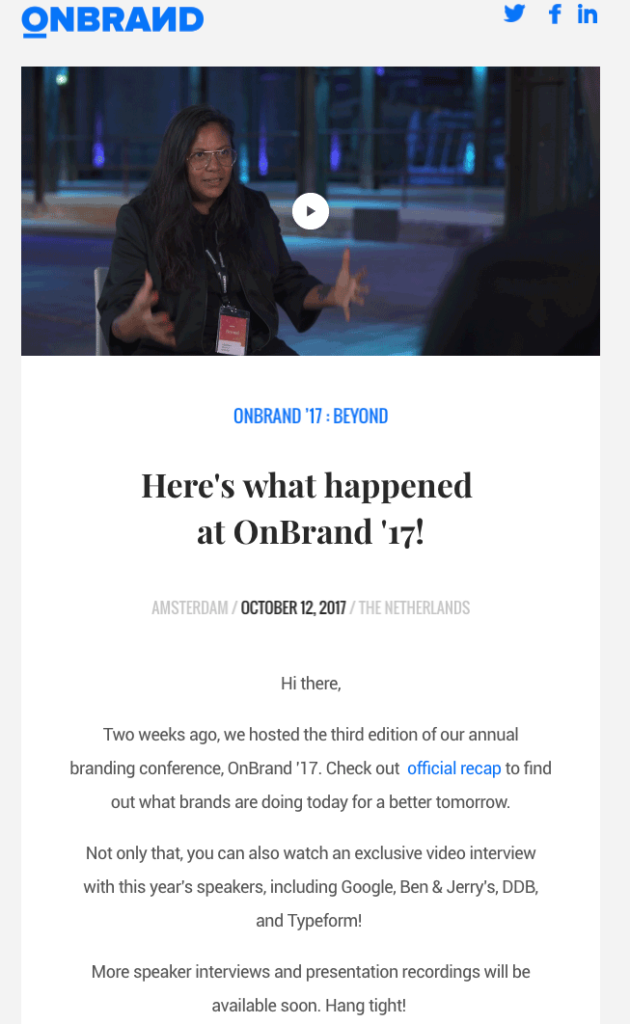
All your customers may not be able to attend an event, so let them know all the exciting, knowledgeable information they missed. OnBrand decided to recap each of their events. This strategy is a great way to create FOMO (the fear of missing out) and is a great way to increase attendance at future events.

Onbrand recaps a conference in an email

9 - Monthly summaries

Wrap up each month with a dynamic video in your email marketing, providing a summary that highlights your latest product releases. 

Engage your subscribers with a visually captivating recap that showcases your progress and sets the stage for an even more exciting releases in the coming months.

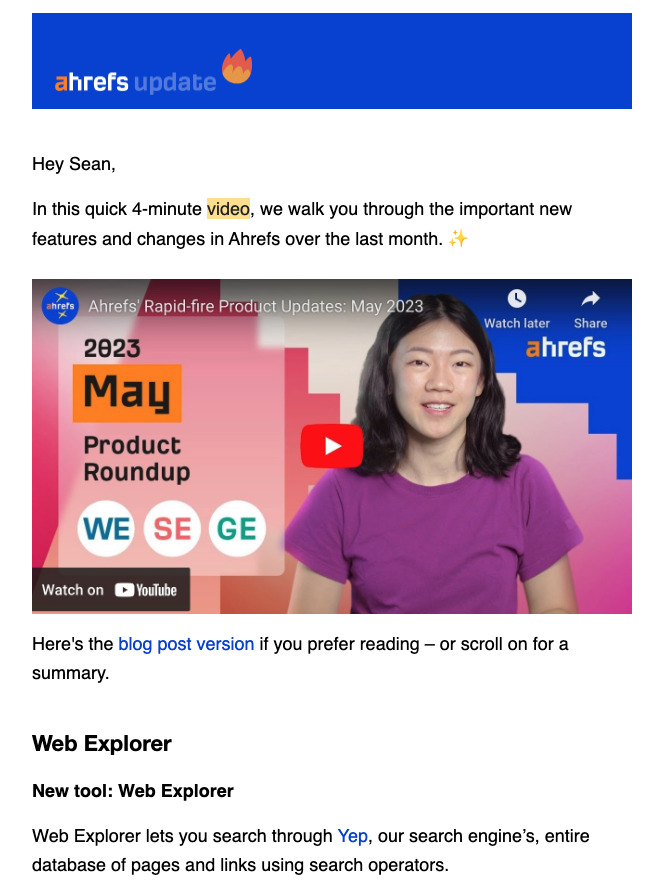
Ahrefs provides a monthly product roundup to all their customers. These emails always start with a video, but they all include a written summary of product releases.

ahrefs monthly recap email with video

10 - PSA

Engage your audience with a compelling public service announcement message that conveys vital information, educates, and inspires action, amplifying the impact of your message and raising awareness for the cause.

When the pandemic hit a few years ago there was a lot of fear and uncertainty especially when it came to air travel. So instead of a plain text email, the CEO of AmericanAirlines sent a video email to update their customers.

PSA video from AmericanAirlines

11 - Share a success story

Bring your customer success stories to life through videos in your email marketing. Showcase the journey and achievements of satisfied customers, allowing their authentic experiences to resonate with your audience and build trust in your brand, ultimately inspiring others to achieve similar success.

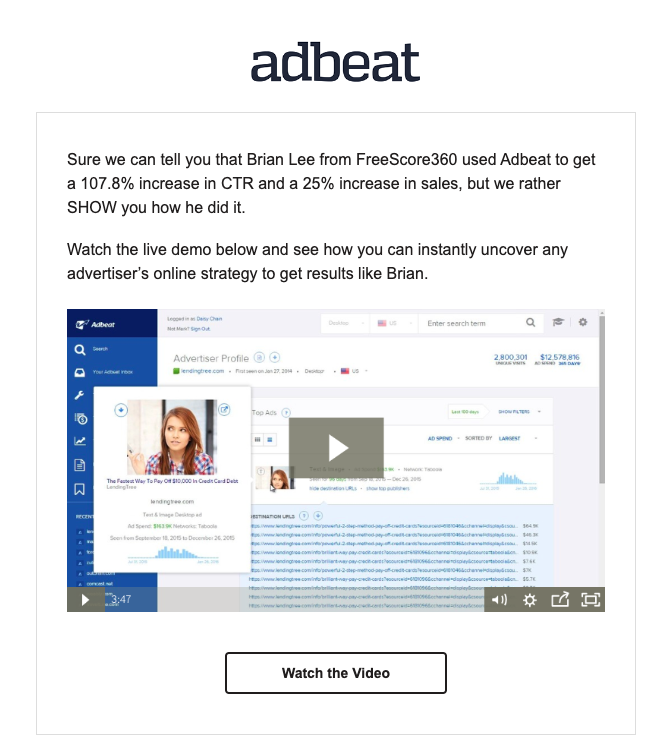
Adbeat does a great job transitioning from a success story into a video show the steps that customer tool to increase their results.

Success story video email example

12 - Summarize your email or blog

Make your content more engaging and easily digestible by using video in your email marketing to create short summaries or highlights of your email or blog posts. 

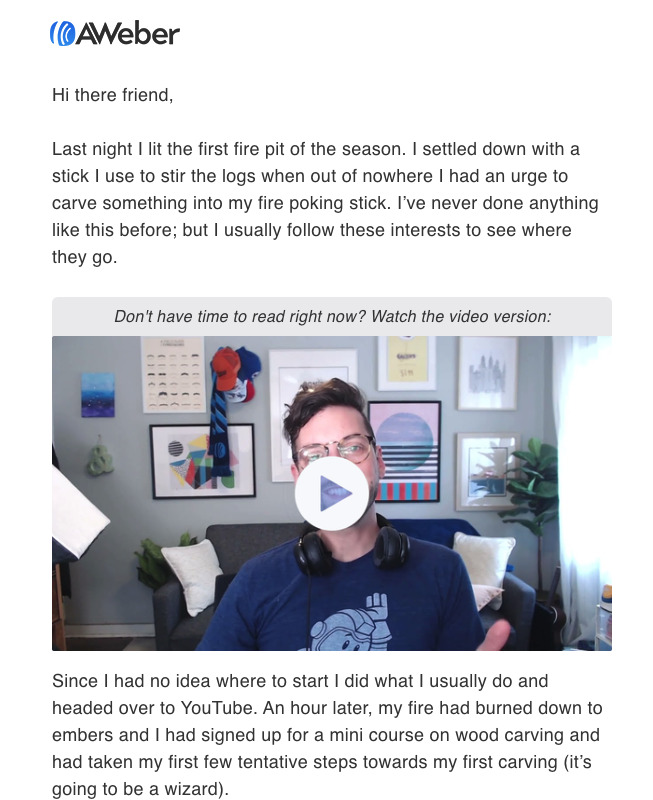
We sent a long format email to our subscribers but we recognized that people consume content in different ways, so we include a video highlighting to key benefits of that email.

AWeber email summarizing an email in a video

Benefits of video emails

Videos hold the power to increase email engagement, but there are so many other benefits for adding videos to your email messages. Here are the top benefits for including a video in your emails.

Higher click-through rates

Videos can help capture attention, conveying messages more effectively, and enticing viewers to engage with your content.

Increase sales

By creating a more immersive and persuasive experience, showcasing products or services in action, can result in viewers making a purchase.

Saves you time

Instead of writing a long email, summarize your message in a video.

Shareable

They increase the chances that your email might be shared. Funny, quirky videos work well for this.

Here’s a great example from men’s shaving company, Harry’s.

Harry's example for using video in their emails

Growing your email list

Detailing why someone should sign up, and what they’ll get out of your list

Building a relationship 

A behind-the-scenes video helps you connect with your audience

Evoking a feeling 

The feeling you leave your audience should connect to your goal. If you want your audience to take action and do something (like add a video into an email), perhaps the feeling you’re going for would be “motivated,” because you’re using your video to hook someone’s interest and motivate them to do something.

Going viral 

If you want to have your videos shared a lot, you might want to evoke a feeling of “delight” instead. You might even find that you want to evoke a combination of feelings instead of only one.

How to add a video to your marketing email?

With a reputable email marketing tool like AWeber, including videos in email is incredibly easy. 

If your tool has a drag and drop editor, all you need to do is drag the video element into your message editor, include the hosted video’s link, and voila! All that’s left to do is press send. 

Get started with video email marketing

Now that you're equipped with the knowledge of video email marketing, it's time to take action and revolutionize your email campaigns. Don't let this impactful strategy go to waste – start implementing video emails to drive remarkable results.

Begin by identifying opportunities in your existing email campaigns where video can add value and enhance your messaging. 

Are you ready to harness the potential of video emails? Start creating, sending, and converting today!

The post 12 Creative ways video email marketing can increase your engagement appeared first on AWeber.


from AWeber https://ift.tt/KediWa1
via IFTTT
Wednesday, 5 July 2023

How to create content for Instagram that drives engagement

How to Create Content for Instagram that Drives Engagement

The idea of using social media for small businesses isn't new. 

According to the State of Small Business Digital Marketing Report, 72% of small businesses invest in social media marketing, and they find social media platforms most valuable when it comes to business promotion and building relationships with customers.

But when you run your own business and you have a lot on your plate, it's nearly impossible to show up on every social media platform. With 2 billion active users, 90% of whom follow at least one business account on the platform, it's no wonder that small business owners opt for Instagram.

When done right, Instagram helps small businesses boost brand awareness, increase trust, create a strong connection with potential customers, and even generate more revenue.

Yes, having Instagram presence is a great idea for small businesses these days, but it's not enough to succeed; you should also understand how to create content for Instagram that drives engagement.

If creating content for Instagram is high on your list, keep on reading this article.

But first, let’s understand the role of high-quality Instagram content for higher engagement and why it’s so important for small businesses.

The role of high-quality Instagram content for higher engagement

For small businesses, it can be hard to compete against larger companies and fellow small businesses to cut through the noise on Instagram. Around 200 million businesses use Instagram to market their products and services, hoping for the attention of active users. 

Plus, the Instagram algorithm prioritizes content from profiles whose content draws views, comments and likes – these are widely considered to be the platform’s biggest engagement signals. It therefore takes time and effort to prove that your content (and Instagram profile) deserves to surface in the newsfeed of your followers.

When you optimize your Instagram activity for engagement and create content that resonates with your audience, it sends signals to the algorithm that your content can keep users engaged for more extended periods. All in all, it leads to small business growth.

That's why it's important to know how to create content for Instagram that grabs the attention of your audience.

So, how can you create content for Instagram that drives engagement? Check out seven proven strategies below.

1 - Piggyback on social media trends

Social media trends are constantly changing, but if you can keep up with the current ones, it helps to create engaging content for Instagram. Here's how being familiar with trends can help you to create engaging Instagram content:

  • Know popular topics on the platform
  • Brainstorm new content ideas
  • Meet the expectations of your audience
  • Grab the attention of Instagram users

What’s more, when you piggyback on social media trends, you can hack the algorithm. For example, it's no secret that Instagram is rebranding itself into a video platform, so the newsfeed heavily favors its new vertical video format, Instagram Reels.

Case in point:

With the growing popularity of vertical videos, Later decided to embrace Instagram Reels as a part of their Instagram strategy, and the company saw a 500%+ increase in its engagement rate.

As a small business owner with limited time and budget, you can also learn from Cluse, a company that reposts fan-made Reels to its profile to make good use of the trend.

Using trends to create Instagram content

To learn more about the current trends, you can check out the latest Instagram Trend Report. Here are some Instagram trends you might do well to focus on: 

  • DIY fashion
  • Activism
  • AI beauty and fashion
  • Instagram monetization

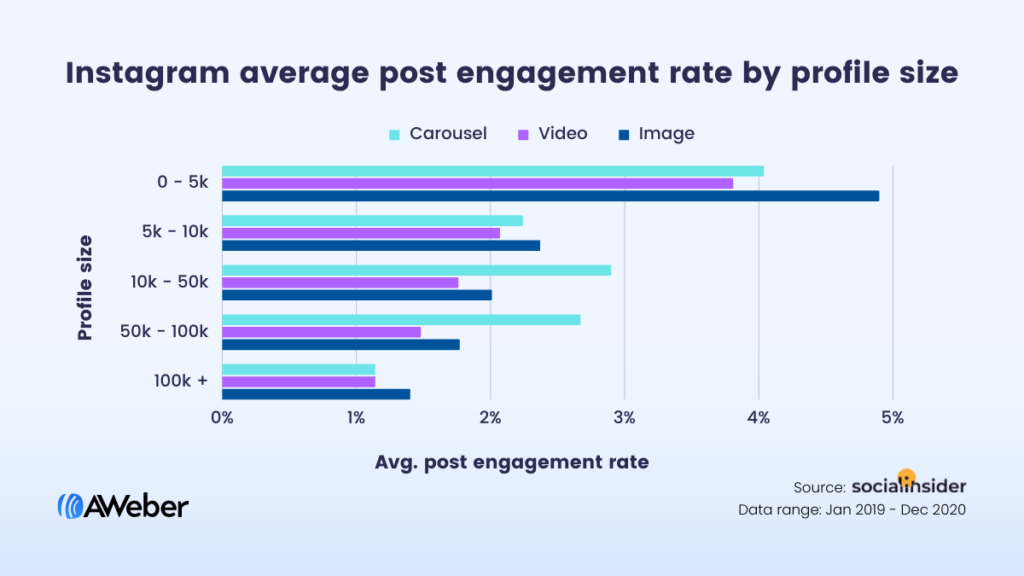
Additionally, always test which content type works best for your audience. The following infographic can help you make the right decision, based on your profile size.

Instagram average post engagement rate

2 - Lay a bet on eye-grabbing visuals

People are visual learners. As specified in one report, 90% of the information our brains receive is visual, people retain 65% of what they have seen, and social media posts with images get 650% higher engagement. 

Instagram is all about visuals. As a social media platform with a strong focus on visuals, eye-grabbing content matters. 

If you follow social media design trends, that's great. But if you want to make your life easier and create eye-catching Instagram content with ease, it's important to make good use of graphic design tools that allow non-designers to make appealing visuals with ready-to-use templates on the go.

Looking for a good option to give it a try? Consider using Photoleap (iOS & Android), an AI-powered photo editing app from Lightricks that has all tools and features to tell brand's stories with visuals. From features like double exposure and layers to the library of assets and quick filters, there are hundreds of ways to unleash your creativity and stand out from the crowd.

Let's take a look at one Instagram creator who uses Photoleap to make eye-grabbing Instagram visuals and promote products on his profile:

Instagram creator who uses Photoleap to make eye-grabbing Instagram visuals

Now let's take a look at the entire profile. It looks eye-catching, creative, and interesting! When you take care of the Instagram grid, you can create a cohesive feed that keeps users engaged. 

Instagram grid using eye-catching colors

3 - Make sure your content delivers value

In the last decade, Instagram has become a popular platform for businesses and common people to express themselves. On average, users upload 95 million posts daily, and content bombards us from all sides.

There's too much content on the platform, so users pay close attention to useful content.

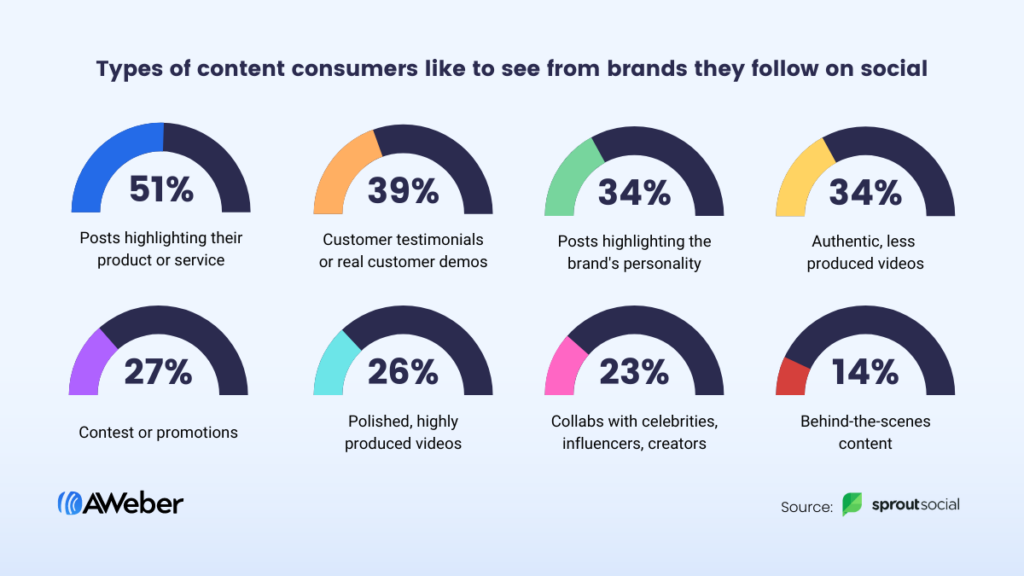
First, you need to understand your audience and their expectations. For example, you can produce the right type of content your followers want to see from you.

Graph showing type of content consumers like to see from brands they follow on social

Second, your content should focus on solving your buyers' problems, not selling your product. 

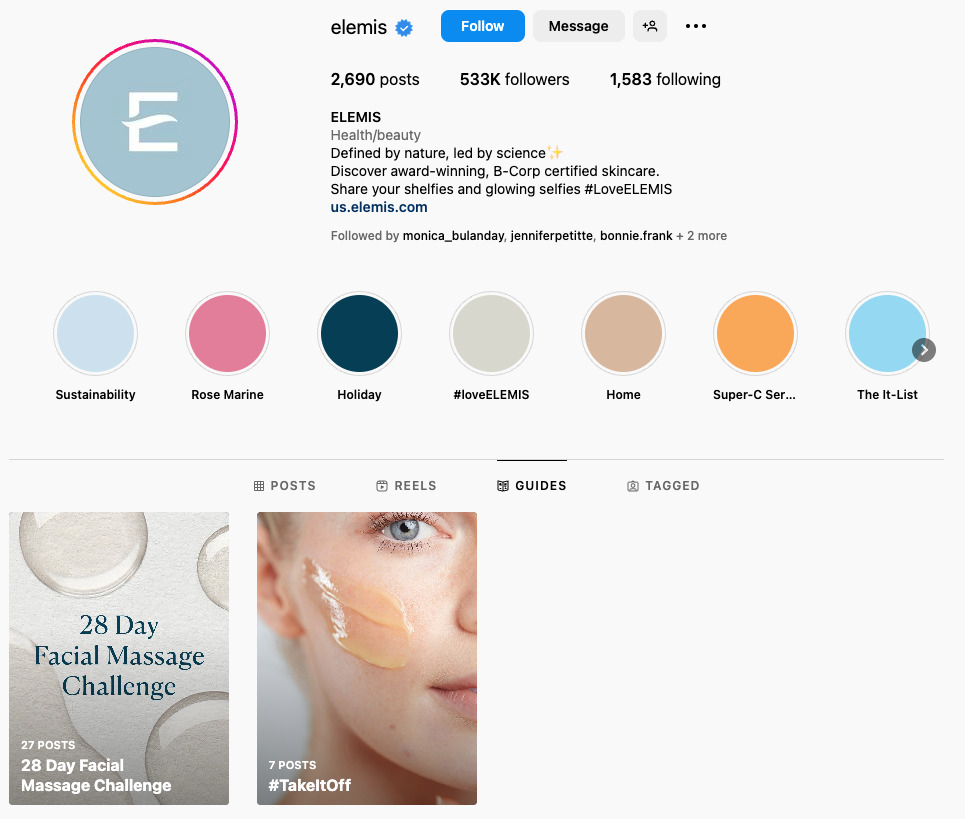
Here's a great example of this strategy from beauty brand Elemis. Instead of promoting its skin treatments, the company launched a 28-day facial massage challenge, where its expert shared massage moves on a daily basis, to help the target audience learn more about facial self-care in a wider context.

Example of Instagram content that delivers value

Want to know the best part? Your Instagram content can become effective for small business lead generation. When you offer something that delivers value and helps followers solve their pain points, you give people a solid reason to become leads or even loyal followers who stay tuned for more.

Pro tip: If you use email marketing, you can always repurpose email content that works for your audience and post it on your Instagram feed. It helps to save time and effort when creating content for Instagram that drives engagement.

4 - Work with proven content creators and influencers

Instagram influencer marketing has become an effective tactic for businesses of all sizes and niches to enter an already-established community of potential customers and market their products or services through peer recommendations.

For small businesses with limited budgets, working with Instagram influencers can be another way to create content that drives engagement. Once you find an influencer for your brand, you can ask him or her to review your product and then repost these posts to your feed.

When done right, influencer-driven campaigns deliver wonderful results. Check out the following example of collaboration between Reign Judge and SweetGreen.

Example of Instagram influencer campaign

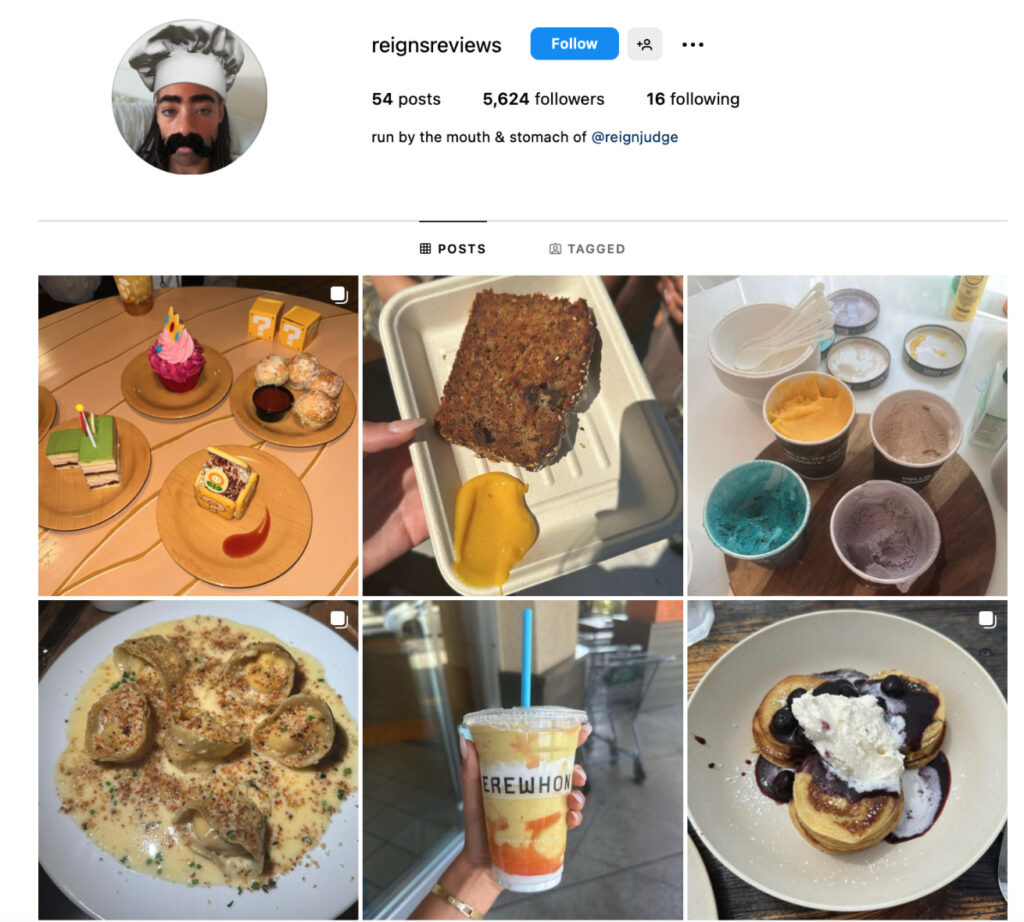
Not only does Reign have a solid and loyal following to promote Sweet Green, but she also has a separate account for restaurant reviews, which makes this collaboration even more effective for the small business.

Instagram postings from small business Reign

When influencers use an Instagram creator account, they can give you permission to show their content on your feed or promote their influencer endorsements as ads. As a result, you can create authentic paid ad campaigns and reach a wider audience of users who show interest in your product.

Pro tip: To protect your brand from reputation risks and make a content creator or an influencer meet the requirements, create and fill out a collaboration agreement that defines the terms of your partnership.

5 - Leverage the power of storytelling

In the context of marketing, storytelling is the art of sharing transformative narratives, beliefs and values that impact human emotions and therefore affect buying decisions. 

It has also become one of the most effective content marketing best practices, largely because when you leverage the power of storytelling, you create content that drives engagement.

In honor of Black History Month, Ralph’s Coffee posted a video that tells stories of love, joy, and hope within Black communities. With the power of storytelling, it takes a stand on social issues and therefore creates an emotional and deeper connection with the audience.

Ralph’s Coffee posted a video that tells stories of love, joy, and hope within Black communities

Ready to use storytelling on Instagram? Here are some tips for you to tell stories with Instagram content:

  • Create a series of posts around one topic
  • Make an Instagram video
  • Lay a bet on descriptive captions
  • Share your customer success stories
  • Tell visual stories with a carousel post

6 - Get inspired by your competitors

Wouldn't it be great if you could predict what new types of Instagram content might work best for your audience?

Keep an eye on your competitors to see what they publish on Instagram and how your target audience interacts with this content to make better business decisions. Simply put, get inspired by your competitors to get your Instagram marketing to the next level.

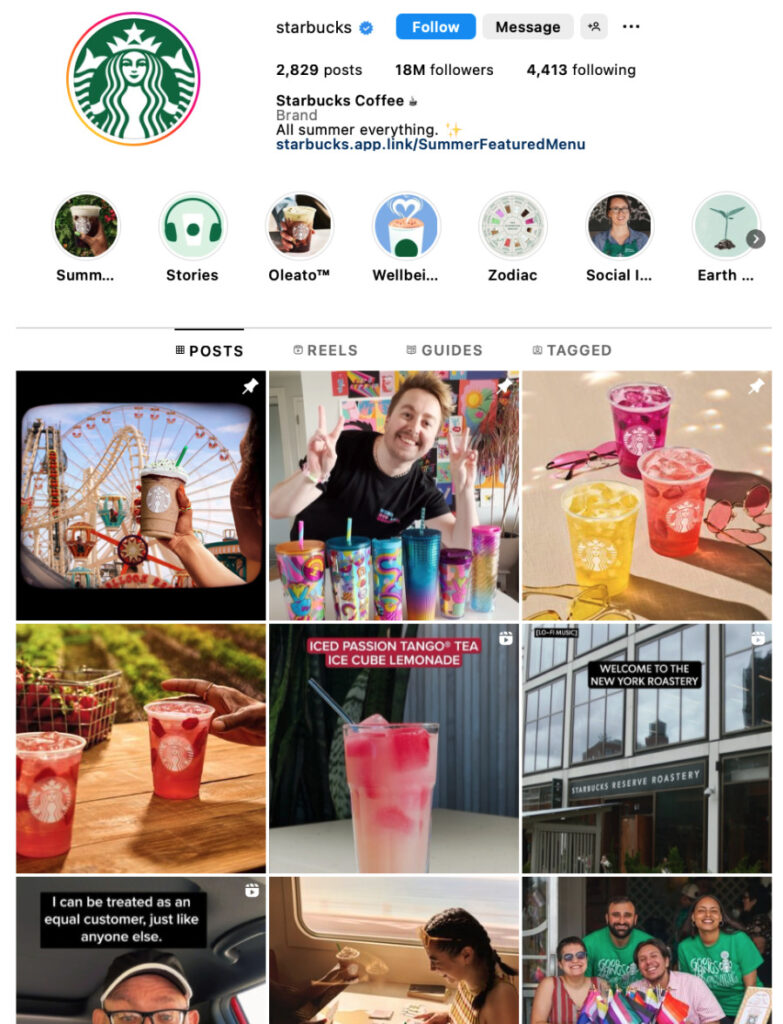
As a small business owner who seeks inspiration, the best way is to follow larger corporations in your niche that often set trends on social media. For instance, if you work in the coffee industry and you run a local coffee shop, it's a smart idea to draw inspiration from Startbucks:

Starbucks Instagram page

There are a few things around Instagram content that drives engagement you can learn from Starbucks:

  • Combine branded content with fan-made visuals on your feed
  • Take followers behind the scenes
  • Create seasonal content

7 - Track your content performance

So, you've put much time and effort into creating content for Instagram, but it still doesn't drive user engagement. What should you do? Track your content performance!

When you know your following, their behavior and preferences, you can measure the impact of your marketing efforts and make better decisions like choosing the right time for posting or experimenting with content formats and storytelling strategies.

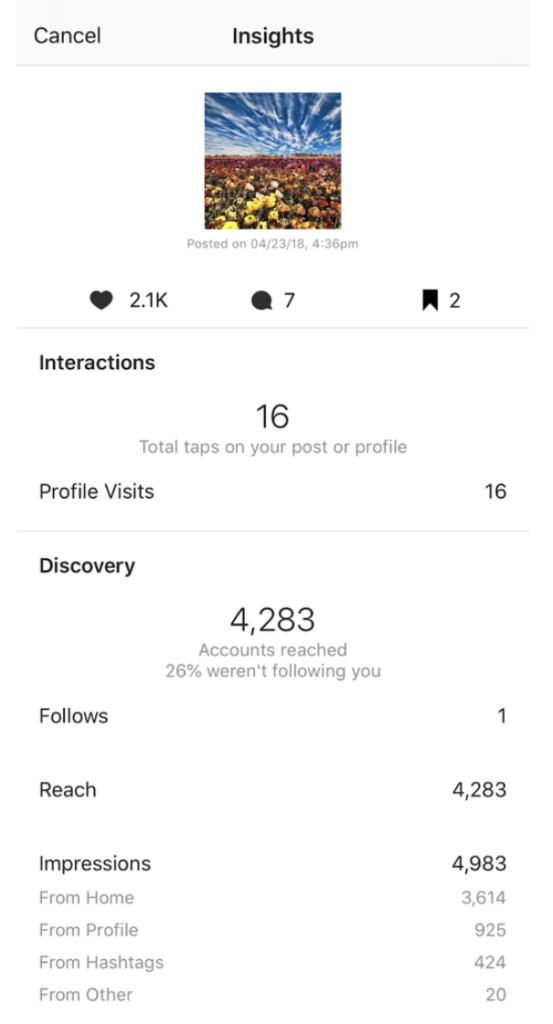
Luckily, Instagram has an in-built feature for users who care about content performance: Instagram Insights.

To get a better understanding of your content performance, there's no need to have the business vs creator Instagram account debate, as both profile types have access to Instagram Insights, where you can see how your content performs.

Check out how it looks in action:

Example of an Instagram insight page

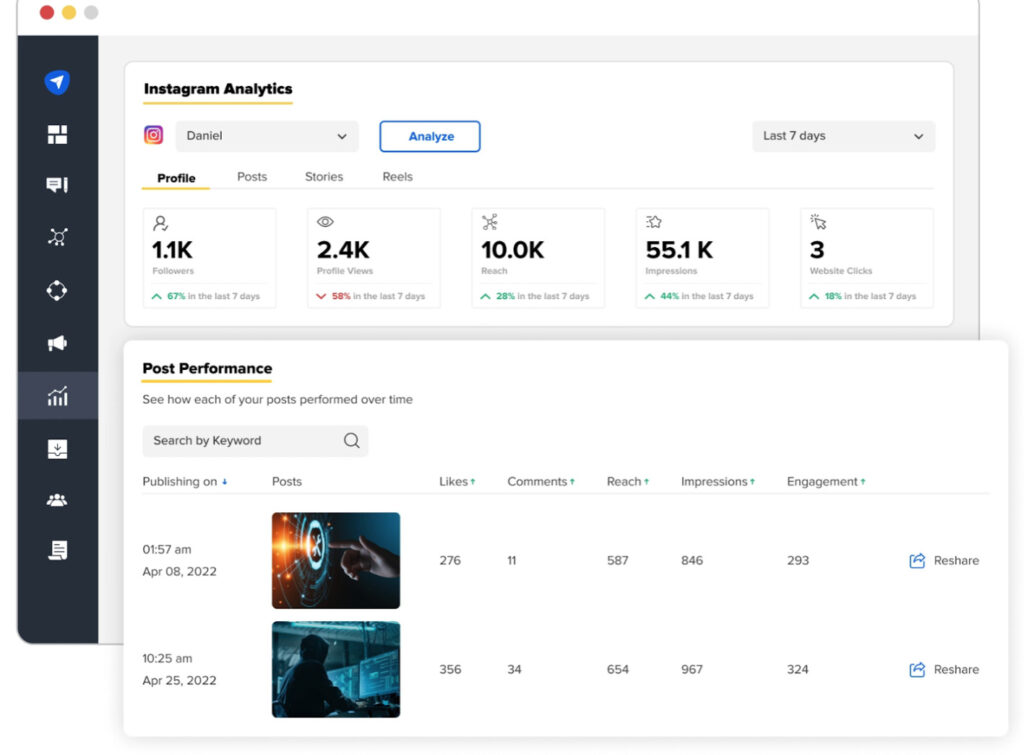
But if you want to dive deeper into analytics or work with other team members on your Instagram content strategy, it can be a smart idea to rely on Instagram analytics tools.

For example, Socialpilot allows users to keep track of valuable insights and get reports that help to make informed decisions to content creation. It also has a user-friendly interface that makes it easy for non-marketers to analyze various data in one place.

Example of Instagram analytics on Socialpilot

Start creating content for Instagram that drives engagement

Instagram remains one of the hottest social media platforms for users, creators, and brands. 

The competition is getting higher every day, so it's crucial to know how to create content for Instagram that drives engagement. When people interact with your content, this means your audience finds it relevant to their needs, wants, and concerns. This makes it easier for you to establish a connection with your target audience, but it can also send signals to Instagram that your content is worth surfacing to even more people in the feed. 

Use these hacks and tricks to start creating content for Instagram that drives engagement and let us know what works best for your audience.

The post How to create content for Instagram that drives engagement appeared first on AWeber.


from AWeber https://ift.tt/KA4IgJN
via IFTTT