Tuesday, 27 April 2021

How to get Yelp reviews & improve your online standing

Founded in 2004, Yelp’s platform has evolved to be a go-to site for consumers to research and express their opinions on the businesses they frequent. Since the founding, other review sites have been introduced but Yelp still leads the pack at more than 178 million unique visitors every month.

When your business is searched for online, these review sites show up in the first page of results. Having an online review management strategy is another essential part of the larger digital marketing toolkit. For any business, you want to have a positive brand sentiment because happy customers refer other customers and become brand advocates. With the reach and visibility of Yelp, it’s particularly important to know your way around the platform and how to manage your reviews there.

Why are Yelp reviews so important?

For businesses in industries like food and beverage, local services and medical, reviews can make a significant impact on brand sentiment. Whether people are praising your brand or criticizing it, you want to be around to address them head-on.
yelp reviews by category
According to Yelp’s own data, the top three reviewed business categories are home and local services, restaurants, and shopping, making up 52% of the total categories covered.

In a BrightLocal consumer trend report, 87% of consumers reported reading online reviews for local businesses in 2020, up from 81% in the previous year. This may not translate into an obvious takeaway at first glance, but it’s what happens after potential customers read reviews that really matters to brands.

how consumers feel about reviews

Reading positive reviews or negative reviews play a role in a consumer’s decision to use the business: 94% say that positive reviews make it more likely for them and 92% say negative reviews make it less likely.

After reading positive reviews, consumers say they will head to the business’ website (31%), search for more reviews (28%) and even visit the business (17%). Having reviews makes an impact on whether or not you’ll have potential customers.

How do you get these reviews? Yelp offers up some guidelines for this.

How to get Yelp reviews without violating policies

Let’s start first with what you can’t do. Yelp’s review guidelines are very clear in how businesses can’t obtain reviews.

  • Don’t ask for reviews: not in-person, not online, not on your newsletter, not even from your grandmother
  • Don’t offer anything in exchange for reviews: no discounts or freebies in exchange for them posting a review.

The idea behind the guidelines are that posted reviews are unsolicited and represent the genuine and unbiased opinions of the customers. So, now that you know what you can’t do, let’s explore what you can do instead to encourage a healthy amount of reviews for your business.

Best tactics for getting Yelp reviews

You can’t ask for reviews? Is there anything left to do? The short answer is yes and we’ll cover a number of tips to get you situated. Considering Yelp’s guidelines, your focus as a brand should be in demonstrating such great service that the customer has no choice but to share their experience on Yelp. Awareness is also a key factor: they won’t know you’re on Yelp unless you tell them.

To get started with these tips, it’s important that you’ve already claimed your page for your business.

Fill out your business page

Make sure that all of your business information is updated, including any temporary hours or methods of operation. Platforms add new spaces for additional information all the time, so it never hurts to check on your profile. It’s never fun to arrive at a business only to learn that, for example, they’re cash only and you hadn’t planned for that.

example of book appointment CTA on Yelp

If you offer a service or food service options like delivery, connect those features so clients can easily book from your page or order food. The more seamless the customer experience is, the more likely they’ll leave a positive review.

Place a Yelp badge on your website

Alongside your social media icons, place the Yelp logo so customers know that you are present on the site. For additional Yelp branding that detail your review count and star rating, head to your business account to find the review badge.

yelp badge example

Use Yelp branding in-store

Connect the physical with the digital by ordering a free window cling from the company. You’ve likely seen these before. They’re stuck right by the front door or the menu in the window. When deciding on a location, the cling should be noticeable when entering and leaving the business.

yelp window cling example

Yelp offers a few paid branded materials like hours signage on their print shop. These additional stickers serve to reinforce the reminder to your customers that you’re on the platform.

Share your Yelp reviews on social media

You can’t ask for new reviews but you can certainly post your existing ones. Think of reviews as content. Quote the best reviews, place them into an attractive social media graphic and then post them. There’s nothing wrong with sharing how much your customers love you.

Respond to Yelp reviews

Yes, even the good ones. It can be tough to respond to critical reviews and while every business would love a perfect five-star rating, the reality is that you’ll have unhappy customers from time to time. One survey found that 89% of consumers read local businesses’ responses to reviews and they will spend up to 49% more at a business that replies to reviews.

To help with writing these responses out, take a page out of your crisis plan. Having a plan in place prevents you from writing a heated response. The customer isn’t always right but you can certainly manage how you respond to them to ensure that the interaction leaves a positive impression.

Create check-in offers

One way around the no-freebie rule is to take advantage of Yelp offers. These are deals that appear for users when they browse the site.

yelp offer example

This business is offering a free drink for Yelp customers that claim this offer on weekdays. The offer has a two-fold benefit: weekdays are likely slower so the offer might generate more orders,  and customers will typically want to make a larger order that includes the item on offer.

Post updates from your business

Getting more into the social media sphere, Yelp offers businesses the ability to post updates. Think of these as social media posts but for big news that you want to share with your customers. Some examples include menu updates, new dishes, new services and any logistical changes.
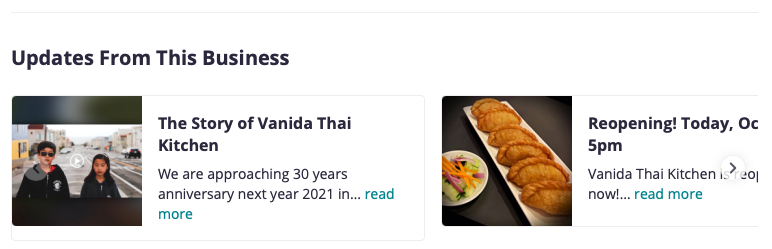
yelp business update examples

This business posted two important updates recently: the fact that they’re celebrating 30 years and that they’ve reopened. Seeing fresh updates from businesses lets the customers know that you’re paying attention to your Yelp page and they can trust the info on it is current.

Run an ad

Businesses that place ads on Yelp show up first in search results or in the sidebar. The benefit of this is that it makes you stand out a little more from your nearby competitors.
sponsored yelp result
For example, when you search for an auto service, the fastest-responding businesses who run ads are listed first, followed by those who have paid to show in the sponsored results section and finally by all results. Depending on how competitive your industry is, it might take several scrolls to get to the organic results section and by then, the customer might’ve already decided on which one to go with.

Utilize review management software

Are you getting more reviews across various sites than you anticipated? It can be overwhelming and time prohibitive to constantly check multiple sites and respond to reviews on them. Instead, use review management software like the one that’s offered with Sprout Social, to collect reviews from TripAdvisor, Glassdoor, Google My Business and Facebook.

While having a software solution doesn’t directly help you collect reviews, it does help you manage them for quicker responses, leading to happier customers.

Next steps for managing Yelp reviews

Reviews, whether they’re in person from your friend or online from a stranger, are part of the consumer experience. As more businesses continue to grow in various industries, the competition for brands is only increasing, while consumers gain an even wider array of options. The best way to figure out where to eat next or which spa gives the best massages is to conduct research. And these come in the form of reviews.

While you might not be able to ask directly for reviews on Yelp, there are a number of other options that help you raise your brand’s visibility both in-person and online. Instead of worrying about shady tactics to ‘get around’ these guidelines, focus on offering a great experience and increasing customers’ awareness of the option to leave reviews and support your business. Ultimately, doing this only helps reinforce the legitimacy of your business in a time when consumers are getting more and more savvy about paid reviews elsewhere online.

Now that you’re armed with some ideas, it’s time to put them to use on your Yelp page and explore additional reputation management tactics.

This post How to get Yelp reviews & improve your online standing originally appeared on Sprout Social.


from Sprout Social https://ift.tt/32PmgDN
via IFTTT

Monday, 26 April 2021

US Supreme Court to decide if schools can punish kids for social media posts


A teenage cheerleader’s Snapchat post will feature in an upcoming Supreme Court ruling to decide whether children have a right to free speech in the US. A 9th grade girl took to Snapchat to vent her frustrations after learning she hadn’t been selected to the varsity cheer squad at her Pennsylvania high school. While her message was explicit, “fuck school fuck softball fuck cheer fuck everything,” it certainly didn’t appear threatening. However, when one of the cheer coaches was made aware of the post via a screenshot (Snapchat posts are intended to be temporary, lasting only 24 hours), the girl…

This story continues at The Next Web

from Social Media - The Next Web https://ift.tt/3dXNrmh
via IFTTT

Thursday, 22 April 2021

Social Spotlight: Hilton’s pandemic strategy proves the business value of social

Overview

For more than a century, Hilton has built its reputation on raising the standards of the guest experience. In fact, many of the staple offerings in the hospitality industry today—room service, the minibar, central reservations systems—were once Hilton innovations.

And even though it’s been four decades since minibars made their glorious debut, Hilton continues to innovate. Several years ago, they introduced their Hilton Honors app and Digital Key technology to provide guests with a contactless check in/check out experience. Their Five Feet to Fitness™ offering includes 11 different fitness equipment and accessory options so guests can work out in the privacy of their room. And their recent CleanStay program promises guests more rigorous cleaning and inspection protocols in the wake of the pandemic.

As an industry pioneer, many brands look to Hilton as a shining example of how to address the evolving needs of today’s traveler, and rise to the challenge of reinventing the hospitality experience.

Challenge

While the effects of the pandemic have been devastating across the board, one of the hardest hit industries was Travel and Hospitality. Like most hotels, resorts and other travel destinations, the initial challenge for Hilton was managing the fallout from cancellations.

But as time went on, the challenge became (and still remains) the general sentiment toward travel. In addition to the everyday challenge of standing out among other hotel choices, Hilton also needed to overcome new hesitations and objections about travel during a pandemic. Their business depended on it. So, what did they do? In short, they listened.

Strategy

Hilton’s strategy to inspire renewed trust and confidence in both travel and their brand appears to include three insight-driven pillars: product innovation, marketing creative and customer connection. Let’s unpack each pillar and discover how your brand can use social insights to drive similar business strategies.

Product innovation

During a pandemic, travelers’ priorities change. When they’re searching for a hotel, they care less about amenities and service, and more about cleanliness and protection. In order to compete with the comfort and safety of people’s own homes, Hilton created a program that would ensure the same diligence and care in cleaning their hotel rooms. In partnership with trusted household cleaning brand, Lysol, the brand launched Hilton CleanStay in select hotels.

Most notably, the program featured the Hilton CleanStay seal, a product innovation that let guests know their room was professionally deep cleaned since the last guest—and that no one had entered their room since that cleaning.

To promote the program, Hilton shared the announcement on its social channels, as well as a video showing the cleaning protocols in action. Judging by some of the comments, this program had a direct affect on loyalty and revenue.

Using social to drive product innovation: 

Insights gleaned from social can tell a brand a lot about what their audience is thinking, feeling, wanting, needing, using, doing, etc. Although a desire for clean rooms may have been a no-brainer in the context of the pandemic, the knowledge of which cleaning brands Hilton’s audience trusted most and the desire for a visual cue could have come from social listening.

By listening to social conversations that included keywords like cleaning, hotels, virus protection, etc, Hilton may have discovered the insights that folks trust Lysol, and don’t always trust someone’s word that something’s been cleaned—leading to their choice in brand partnership and the innovation of the physical seal.

With a sophisticated listening tool, your team can set up queries to monitor specific topics and keywords, as well as sentiments toward your brand and others. These insights might just reveal a gap in the market or new opportunity to create something new for your customers.

Marketing creative

In October of 2020, Hilton announced its global marketing campaign, “To New Memories.” The initiative was driven by a customer survey revealing that nearly nine in 10 travelers say travel memories are some of the happiest of their lives, 95% of those who travel are missing it and 90% believe we are currently experiencing a travel memory deficit.

The campaign was created to reignite people’s passion for travel by reminding them of what vacations, adventures and getaways feel like. It appealed to Hilton’s audience’s emotions at a time when they were missing travel and the memories it created the most. Long story short: They used FOMO to inspire desire and action.

Using social to drive marketing creative:

For folks who aren’t as motivated by the promise of a clean room, Hilton went a layer deeper with this campaign by appealing to the emotions of their audience. In order to do that, they first had to find out how their audience was feeling.

While Hilton used an actual customer survey to glean insights around travel sentiment, not every brand has similar resources. That’s the beauty of social listening. You don’t need a lot of time or money to discover what your audience is feeling at any given time. People are telling us everything we need to know on a daily basis through their social activity. We just need to make sure we’re listening.

And when it comes to marketing campaigns, that emotional insight and connection is what will lead to messaging and creative that resonates deeply enough to inspire your audience to take action. It’s the difference between selling them on what you’re offering—and why you’re offering it. The “why” is always more impactful.

Customer connection

With so many folks working from home during the pandemic, Hilton identified an opportunity to provide their guests with a distraction-free environment for more productive remote working. The initiative is called Workspaces and offers day-use rooms that include a spacious desk, ergonomic chair and enhanced WiFi.

To promote Workspaces on social, Hilton asked their followers to send them a photo of themselves in their everyday workspace using #UpgradeYourView, and in return they’d upgrade it to reflect the “travel background of their dreams.”

Even though it was only a day-long initiative, the images created were highly-shareable, and gave the brand the opportunity to engage with their audience, promote their new program and stay top of mind during a decline in travel.

Specific Hilton hotel chains and locations have also mastered the art of genuine customer connection. When power outages in Texas displaced an elderly man from his home, his granddaughter checked him into a local hotel, which the family jokingly nicknamed “Waldorf Astoria.” When a real Waldorf Astoria property—one of Hilton’s most prestigious and luxurious chains—learned of his story, they reached out with a personal invitation to stay with them once travel restrictions lightened up.

Knowing that might be a while, the hotel decided to bring their signature luxury experience directly to him by sending him a Waldorf Astoria “care package,” including a bathrobe, slippers, luggage tag and more to use while he plans his trip.

These surprise and delight moments create lasting connections not only with the guests directly involved, but also with everyone who happens to hear about it. In this case, the story made it onto the local Texas news, giving the hotel some free, brand-building publicity. And of course, the story then makes for great content to share across their own channels.

Using social to drive customer connection:

It would be difficult to stumble upon these moments without a sophisticated social listening solution. People don’t always use your brand’s handle when mentioning you in their social conversations. By monitoring certain relevant keywords, the Rome Waldorf Astoria location was able to bless this man beyond anything he ever expected, and positively impact their brand perception in the process.

Travel and hospitality brands aren’t the only ones who can benefit from surprise and delight opportunities. Any time your team can add value to or solve a problem for members of your audience, you are building your brand and directly impacting your business through customer connection.

And there’s just no better way to do it than with social listening.

This post Social Spotlight: Hilton’s pandemic strategy proves the business value of social originally appeared on Sprout Social.


from Sprout Social https://ift.tt/3ngQFEb
via IFTTT

17 TikTok stats marketers need to know in 2021

While TikTok is newer to the world of social media, there’s no denying its popularity – especially with younger generations. Although TikTok content is more specific with its narrow focus on short, viral-ready videos there are many ways brands can still see success.

However, in order to know if TikTok makes sense for your brand, you need to understand some basic TikTok stats such as demographics and user behavior that can inform what opportunities exist for your brand.

This is why we’ve put together a list of 17 TikTok statistics all marketers need to know for 2021. Take a look to see if you need to get serious about putting together a TikTok strategy for your brand.

1. TikTok has 689 million monthly active users

While TikTok doesn’t nearly have the reach of social media giants like Facebook and Instagram, it is rapidly distinguishing itself with it 689 million monthly active users.

However, this statistic doesn’t include users that are based in China, the home country of TikTok’s parent company ByteDance. This is due to the fact that the Chinese version of TikTok is called Douyin, and its 600 million daily active users users are tallied separately from TikTok’s users.

This means that in total, TikTok and Douyin have 1.29 billion active users across the globe.

2. 62% of TikTok users are between ages 10-29

62%–over half–of all U.S. TikTok users are aged 10-29, proving that the younger generations are the most avid TikTok users. This segment includes Gen Z and younger Millennials, so it’s an important cross-section of social media users.

If your business targets this age group heavily with their products or services, TikTok is probably going to be a great platform for you to use in order to reach your audience. Just make sure you get creative with your content and use trends effectively and authentically.

tiktok users by age

3. 65.9 million monthly active users are located in the US

The majority of TikTok’s users are actually outside the US, which is a significant difference from most other social media platforms. However, the US still boasts about 65.9 million monthly active users. This means both global and US-based businesses can get a lot out of marketing on this platform.

4. The top TikTok user has 111 million followers

The top TikTok user is Charli D’Amelio with over 111 million followers at the time of this writing. The second most popular TikTok user is Addison Rae with 78 million followers.

Charli D’Amelio posts mostly TikTok dance videos and viral trends that her followers love, along with partnering with major brands for influencer campaigns. If you’re interested in trying influencer marketing to reach younger generations, TikTok influencers could be perfect for you.

5. TikTok users spend an average of 858 minutes on the app each month

Studies show that TikTok users are spending around 858 minutes a month and 46 minutes a day scrolling through videos on the app. Because these videos are a maximum of one minute long, that is a lot of consumed content. This means your brand has plenty of potential to show up in users’ feeds as they scroll.

6. In January 2021, TikTok was the second most downloaded app in the world

There’s no denying that TikTok’s popularity is here to stay. In the first month of 2021, it was the most downloaded app across the globe with nearly 62 million installs.

17% of those installs came from China and 10% came from the United States. TikTok was the number 1 downloaded app in the Apple app store and in fourth place on the Google Play store. Overall, these new installs mean that interest remains high, and new users are consistently trying out the platform.

7. Children ages 4-15 spend an average of 80 minutes a day watching TikTok videos

Are you marketing a product for even younger generations than Gen Z? Kids love TikTok, too! In fact, children between the ages of 4 and 15 spend an average of 80 minutes each day (80-160+ videos) watching TikTok content. This means you can easily share content that relates to younger viewers and reach your desired audience – just be sure to create the kinds of content kids and their parents love.

8. TikTok generated $1 billion in revenue in 2020

TikTok generated an estimated $1 billion in revenue throughout 2020 from sources like ads run on the platform. The app as a whole is valued at around $50 billion. TikTok’s growth is expected to continue in 2021, meaning options for brands to use paid ads on TikTok are only likely to increase as a revenue source for the company.

9. 69% of US teens are on TikTok

We’ve already mentioned how popular TikTok is with younger generations, but this statistic proves it. More than 2 in 3 US teens were engaging at least monthly with the platform as of Fall 2020. This makes it the perfect platform for brands who are targeting teens and young adults.

Start creating relatable content that resonates with teens – but first, be sure to do some scrolling through the platform to get a good idea of the content types your target audience creates and enjoys.

10. 29% of US teens say TikTok is their favorite platform

So not only do more than 2/3 of US teens use TikTok, nearly 1/3 of US teens say it’s their favorite social media platform. This means they’re likely spending more time on TikTok than any other platform, giving you an even bigger opportunity to reach them. Plus, this number only increased throughout 2020, growing from 13% in spring 2020 to 29% in the fall.

11. TikTok is available in over 150 countries

The micro-video platform is available in more than 150 countries across the globe, giving brands access to target demographics from all around the world. Global brands should especially take advantage of this platform and the reach it has to offer.

12. US influencers see high engagement rates on TikTok

If you’re looking to create an engaged community and audience around your brand, TikTok is the place to do it. With studies showing an engagement rate of nearly 18% with micro-influencers on the platform, TikTok has a significant lead on Instagram’s 3.86% and YouTube’s 1.63% engagement rates. This could make it the perfect place to implement a micro-influencer strategy. Similarly, the report also showed influencers at larger scales still had the highest engagement rate on TikTok.

influencer engagement rates across platforms

13. 68% of TikTok users have watched another user’s video

On any social platform, some users download the app or create an account without ever actually following up and using it. However, statistics show that 68% of TikTok users have at least watched another user’s video on the platform, showing a strong engagement rate where a majority of users are actively viewing content.

14. 55% of TikTok users have uploaded their own video content

While 68% of TikTok users actually watch content, only a little over half of all TikTok users have actually uploaded their own videos to the platform. This shows that the largest majority of the audience may enjoy simply consuming content on this platform than actually creating their own videos, but there’s still a large user base willing to actively create video content..

15. 37% of users have a household income of $100k+

TikTok’s userbase shows a few different trends in income level. About one-third of TikTok users bring in $100,000 of household income each year, but as noted in MarketingChart’s review of the data, may reflect an overall economic skew in the US population. On the opposite end of the spectrum, 18% of users report a household income under $25k, likely due to the younger users of the platform. As some of our other stats in this article show, brands will need to fine-tune their focus, such as targeting older Gen Z and younger Millennial users who are tuned into the platform and also more motivated to purchase based on social media content.

16. 58.8% of TikTok users are female

Brands with a focus on a target audience of women are in luck on TikTok. TikTok’s user base skews female, with 58.8% users identifying as women.

That doesn’t mean that you shouldn’t be on TikTok if you target men with your products or services. Because the ratio is close to just half of the userbase, there’s still plenty of opportunity for a wide variety of brands and audiences to connect.

17. 90% of TikTok users access the app everyday

In another tribute to TikTok’s highly engaged community, 9 in 10 users log onto TikTok multiple times every day. It’s always important to see an engaged and active user base on a platform that you plan to market on, and TikTok definitely has that to offer.

Start creating your TikTok strategy

Ready to start marketing on TikTok? Putting together a solid video marketing strategy is the perfect way to get started. Keep these TikTok statistics in mind as you begin creating your content so you know exactly who your target audience will be.

This post 17 TikTok stats marketers need to know in 2021 originally appeared on Sprout Social.


from Sprout Social https://ift.tt/3sCyZUI
via IFTTT

Wednesday, 21 April 2021

Hear me out… Social isn’t about innovation. It’s about who can do it best

Oscar Wilde said “imitation is the sincerest form of flattery”—and social networks are really taking that quote to heart.

Case in point: it took less than a year for the big names in social to start developing their own audio chat product to compete with rising newcomer, Clubhouse. Facebook is experimenting with audio features, Twitter launched Spaces last December, and even Reddit is pursuing its own Clubhouse clones.

The reality is nothing that’s new on social lasts forever. Clubhouse struck gold with its unique audio-only format, but it was only a matter of time before one of the more established powerhouses replicated the same feature for themselves.

Hear me out…

For social networks, innovation alone doesn’t guarantee competitive advantage. What matters more is who can make the best iteration of a feature that someone else invented.

Nathan Young, Head of Strategy at Deloitte Digital, sums it up best in his Tweet:

Consider livestreaming, a feature that’s widely available on most social networks. Before there was Periscope there was Meerkat, an app that amassed nearly two million users during its lifespan. In spite of Meerkat’s popularity, however, a common complaint users shared was most livestream links were already dead by the time they clicked on them. On the other hand, Periscope (a livestreaming app Twitter acquired), allowed for stream playbacks. It was that small feature, in addition to Periscope’s accessibility to Twitter’s entire user base, that ultimately contributed to Meerkat shuttering just a year after launch.

Something similar is playing out with social audio. Clubhouse shot to the top of the app charts because it brought something new to the table. It’s a hit with celebrities and “thought leaders,” has a valuation of $4 billion and more than 10 million app downloads. No wonder why other social networks are eager to jump on this new feature.

But we know there’s still room for improvement. Clubhouse is only available on iOS, excluding the more than 2.5 billion active Android users around the world. It’s also completely inaccessible for deaf and hard-of-hearing users because there are no captioning or transcript options available.

On the other hand, Twitter Spaces already has the invite-only app beat on a couple of fronts—despite launching several months after Clubhouse’s debut. Spaces is currently available on both iOS and Android, it’s accessible to anyone with a Twitter account and comes with the option to view captions. So while Clubhouse stands out because of its audio-only functionality, it’s fair to question its longevity once established networks find a way to mirror Clubhouse’s features and make them better.

While a flashy new feature can help social networks initially stand out from the crowd, that competitive edge rarely lasts long. And it’s why networks like Facebook, Twitter and LinkedIn don’t feel compelled to have to release something from scratch every few years to stay relevant.

The social networks with staying power know it’s more important to spend the extra time creating the best version of a product as possible than it is to be the first to market.

Interested in audio content, but not sure where to begin? Check out this article on podcasts and the tips you need to create effective audio content.

This post Hear me out… Social isn’t about innovation. It’s about who can do it best originally appeared on Sprout Social.


from Sprout Social https://ift.tt/3vc39Qu
via IFTTT

Tuesday, 20 April 2021

9 tips to build customer relationships with social media in 2021

Marketing your company and generating new customers is only one piece of the overarching business puzzle. Another piece of that puzzle is to continue nurturing those people so you can build customer relationships that last.

In this guide, we’ll take a deeper dive into why building customer relationships is so important as well as share nine strategies to help you get started.

Why building customer relationships is important

Social media has changed the way businesses and customers interact with each other, and it’s important that social media is seen as an avenue for real-time communication and feedback.

So, just because you’ve converted a new customer through lead generation or a sale doesn’t mean your work is done. You need to build customer relationships on social media so they keep coming back again and again – and they’ll start advocating for your business and assist in the marketing for you.

There’s nothing quite like word-of-mouth marketing, and having solid foundations with your customers is a great way to keep them excited about your business. When you have customers who have enthusiasm for your business, not only will they continue to shop with you, but they’ll tell their friends and family about you as well.

This is why building strong customer relationships is an essential part of business and marketing. It’s cheaper – and smarter – to retain loyal customers than to try to only convert new ones.

Make sense? Now, let’s dive into these nine strategies to help you use social media to build customer relationships that last.

How to build customer relationships with social media

While there are many avenues you can use to help you build customer relationships – a forum, your website, email marketing, your blog and so many more – we’re here to talk about how you can do so through your social media platforms.

After all, you’ve worked hard to grow your following. Why not use that audience to convert and nurture longterm relationships with customers?

Here are our top nine tips for you.

1. Create a customer service social media channel

One great way to get started with relationship building on social media is to create a dedicated customer service channel. There are a few ways to do this.

First, you could take a page out of Sprout Social’s book and create a Twitter account specifically for handling customer service requests as well as communicating product support issues and resolutions. (Do a “support” or “customer support” search on Twitter to find even more examples of customer service Twitter accounts across a variety of industries.)

@SproutSupport Twitter handle cover image

Additionally, you could add an option to your Facebook Messenger chatbot that allows customers to input customer service requests, or direct people to a support page on your website.

Ensure that all response times are quick and helpful to build a good reputation for your brand.

2. Use social listening

Social listening is the act of monitoring certain topics and keywords online to ensure you find important mentions of your brand or related topics.

Sprout’s social listening tool collects and centralizes what people are saying about your brand, industry and related topics around your brand. With this information, you can modify and improve your campaigns and messages. Make more informed decisions to help your customers solve their problems and provide valuable answers to questions.

Or, utilize this knowledge to gather a list of blog posts, new features and learning resources that you know your audience wants to see.

Screenshot of Sprout's Listening Dashboard showing competitor share of voice

3. Listen to customer feedback

It’s one thing to have an outlet for customers to provide feedback. It’s another entirely to actually do something with that feedback. Show your customers that you care about their input by putting their suggestions and wants into practice.

Whether it’s a new product that you launch or a new feature in your software, listening to and implementing customer feedback is an essential step in gaining their trust and loyalty. It shows that you hear their concerns and needs and you’re willing to act on it for their benefit.

4. Personalize customer experiences

Another great way to build customer relationships is through personalization. Consider adding a live chat widget onto your website for support and customer questions. Your audience will be able to speak to a real person who calls them by their name and provides a real experience.

Other ways to personalize experiences is by ensuring social media interactions and email newsletters include your recipient’s first name. Here’s an example of how Visme personalized a response on Twitter.

Visme's personalized response to a user on Twitter

Whether you’re dealing with customer service issues or simply interacting with your followers’ Tweets, creating that personal connection is key.

5. Create a relatable brand voice

One of the best ways to build strong connections to your audience: be relatable! Social media should be fun, and while you don’t have to be overly casual, there are still ways to let your audience enjoy your presence through your brand voice.

Take a page out of MoonPie’s Twitter account. They share humorous content, jump on memes they can relate back to their brand, and they take any opportunity they can to bad mouth the sun.

Screenshot of a MoonPie Tweet showing their playful brand voice.

Try sharing memes that are timely and relevant to your brand, use current lingo and take a look around at other brands to see if you can get any ideas to help your brand voice become more relatable online.

6. Offer rewards and incentives

We all love free stuff, which is why putting together contests and giveaways is one great way to offer rewards and incentives to your audience.

Check out this giveaway from Aerie on Instagram. They ask Instagram users to leave a comment with a branded hashtag and tag a friend to enter. It’s effortless and it gets their followers excited and engaged.

Screenshot of an Aerie giveaway on Instagram.

Consider sharing flash sales on social media, including freebies and discount codes.

Here’s a great example from Fast that gets their audiences engaged and gets their business in front of potential customers.

@Fast on Twitter sharing news of a flash sale and discount code share based on responses.

Think about the ways that you can implement these tactics in your own social media strategy.

7. Share user-generated content

Customers love to share and tag brand products in their photos when posting on social media. This is called user-generated content, or UGC, and is a helpful tactic both for community building and for filling your social calendar up with hyper-relevant content.

For example, online swimsuit retailer Cupshe uses UGC in their social strategy to showcase their customers wearing their different styles and sizes. In turn, they tagged the original account who shared the photo of herself in one of their bathing suits. It’s important to note that you should ask permission before reposting a users’ photograph onto your brand account.

As a way to build a community and encourage your customers to share their photos of your product is to create a branded hashtag. Share this in your bio, like we see below on A Color Story‘s Instagram bio.

Screenshot of A Color Story's Instagram bio showcasing a branded hashtag for community engagement and UGC..

8. Provide value on social media

There are so many different types of content you can create on social media. Some will – of course – be more promotional in nature, because your business is to make a profit both solve customer’s problems and needs as well as make a profit.

However, you need to ensure there’s a good balance between your promotional content and the educational and free value you provide to your audience, whether it’s freebies, discount codes or knowledge.

Share your business’ value visually in a Facebook or Instagram carousel, or you can create a Twitter thread that shares information like Grammarly did below.

Screenshot of a Twitter thread by Grammarly that is informative and shows empathy.

Share blog content and create educational videos to inform your audience even more. Providing free value helps to showcase how beneficial your product must be, bringing in new customers and building a relationship to help those customers stick around.

9. Build an online community

Our last tip for building customer relationships is to focus on building a community. Whether it’s through a Facebook Group, an other online community or branded hashtags, invite your audience to participate.

One great example of a highly active Facebook community is The Daily Carnage, a marketing-focused Facebook Group run by agency Carney. The agency publishes posts in the Group, but the conversations tend to be member-run and always all about marketing.

Screenshot from The Daily Carnage Facebook Group calling for designers to apply to a job listing.

You can create your own Facebook Group, start a Slack community or look into other platforms perfect for community building. This is a great way to keep people aware of and talking about your brand, even when you’re not directly selling to them.

Start building customer relationships today

Are you feeling ready to set off on your own and build valuable relationships with your followers and customers? Use these nine tips to help you navigate your relationships and don’t forget to look at our free social media templates for even more content ideas.

This post 9 tips to build customer relationships with social media in 2021 originally appeared on Sprout Social.


from Sprout Social https://ift.tt/2sKXKUH
via IFTTT

How to Split Test Subject Lines Like a Newsletter with 2.5 Million Subscribers

How to split test subject lines

Stuck between two subject line ideas?

It’s impossible to know which will yield the best results without running a split test — commonly called an A/B test. A split test gives you real feedback on which subject line your audience was more drawn to opening.

This is how the most successful marketers optimize their open rates. 

Take Morning Brew, for example. Morning Brew is a popular newsletter with more than 2.5 million subscribers. Their daily newsletter includes business and tech news of the day written for a business-minded millennial audience. 

In August 2020, Morning Brew hit a major milestone — 1,000,000 opens of its daily newsletter.

But how did the newsletter achieve that level of success?

Morning Brew’s secret to 1,000,000 email opens

Morning Brew writer Roby Howell spilled the beans on Twitter on how the popular newsletter tests subject lines for every send. 

Here’s how it works:

  1. The Morning Brew team tests 4 subject lines every morning. These subject lines are based on catchy, interesting phrases from the news of the day. 
  2. Each of the 4 subject lines is sent to a 3% of their audience at 5 a.m.
  3. The winning subject line gets sent to the remaining 88% of their subscribers one hour later. 

This strategy lets you quickly test your subject lines against a small portion of your audience and then send the “winner” to the remaining audience.

It’s a smart way to get more opens on each email.

Want to follow in Morning Brew’s footsteps to set up your own split tests like this? Here’s everything you need to know.

Psst...If you want to keep your split testing simple, try starting with a simple 50/50 split test. This will help you learn the ropes and try split testing before stepping into more advanced testing strategies like this one. 

Related: The Ultimate Guide to AB Testing 

How to split test subject lines like Morning Brew

Testing subject lines like Morning Brew is pretty simple. But there are some steps that need to be taken outside of your email service provider to make sure your results are statistically significant.

That means you need to make sure you have a large enough audience for the first part of your send. If your audience for groups A & B are too small, the results won’t be significant. If the percentage is too large, you could miss out on the opportunity to send the winning subject line to more subscribers.

How to set the breakout percentage

In order to figure out how many subscribers should receive version A and version B of your newsletter, you need to take a look at your historical open rates and the size of your email list.

For the sake of this example, let’s say your email list has 10,000 subscribers, and you historically see 20% open rates. 

Using the Optimizely Calculator, change the “Baseline Conversion Rate” to 20% to account for historical open rate to calculate the ideal size of audience for A & B.

How to figure out split test segments

If groups A and B need to have 1,100 subscribers each, that means each group is 11% of your total audience. 

So, in this case, we’re looking at doing an 11%/11%/78% split test.

Set your split test percentage

Related: Your Guide to Writing the World’s Best Email Subject Lines

Determining a subject line winner

Once versions A & B are sent, the next step is to determine the winner. The winner will then get sent to the remaining 78% of your audience. 

To evaluate what would go to the remaining group, look at each emails’ results and evaluate them with a split testing calculator.  

Let’s say, for example, initial results are:

Group A: 1,100 Emails sent, 278 emails opened, 21 bounces

Group B: 1,100 Emails sent, 245 emails opened, 33 bounces

Looking at the numbers, it’s obvious that version A yielded better results than version B. However, you should check to ensure there’s enough data to determine if the results are statistically significant (and not by random chance).

Using the Neil Patel AB Testing Calculator, you can take the results and plug them in. Make sure to subtract the number of bounces from your total emails sent. Roving bounces allows you to measure the true open rate, because if an email bounces, there is no chance of an open. 

determine if your test is statistically significant

Ideally, you want to aim for 90%+ statistical significance. But sometimes you need to move quickly. In that case, aim for 80% or above statistical significance. 

Now, you can be confident that sending version A to the remaining 78% of your audience 

This allows you to maximize the number of opens. In this example, we would yield 234 more opens with the winning email going to the remaining 78% of the subscriber list. 

We came to that conclusion by applying the open rate (or conversion rate in Neil Patel’s calculator above) to the remaining audience.

7800*.26=2028

7800*.23=1794

2028-1794=234

Those 234 opens could make all the difference between additional sales.

How to split test subject lines like Morning Brew with AWeber

Want to set up a subject line split test like Morning Brew for your own email marketing? Follow the steps below and start getting better results with your email marketing

Note: Split testing in AWeber is available to AWeber Pro users. Upgrade your account to unlock this feature or contact our Customer Solutions team. 

Step #1: Create your emails

The first step to split testing is making sure you have 2 versions of your emails already created in the Message Editor. 

Since this is a subject line split test, all other variables of your email should be exactly the same.

Related: Email Split Tests You Can Set Up in 1 Minute 

Step #2: Set up your split test

To create a split test, hover over the Messages tab and click “Split Tests.” Then click the green “Create” button. 

Next, name your split test. It’s helpful to include descriptive language in the name to differentiate one split test from another. This also helps you quickly identify the takeaway from each split test so you can apply learnings to other emails. 

Then, select a segment of your recipients (if you don’t want to send the emails to your entire list).

And, finally, define your split segments based on the formula used above. And click “Save.”

subject line split test

Now it’s time to select your drafts. Make sure your drafts match up to what you defined in your subject line name.

split test subject line in AWeber

Then, you can go ahead and schedule your broadcast split test message to segment A and segment B. 

Once you send your emails, you can set a determined period of time to wait in order to determine a “winner” following the steps above. 

You can then send that winning email to segment C.

Get more step-by-step instructions on subject line split testing in AWeber by clicking here.

The post How to Split Test Subject Lines Like a Newsletter with 2.5 Million Subscribers appeared first on AWeber.


from AWeber https://ift.tt/3n4aM8q
via IFTTT