Elizabeth Resnick is a double certified health coach and the owner of Happy, Healthy, and Hot — where she coaches successful women (and some men) on weight loss and fitness, focusing on the building blocks of a healthy lifestyle.
Her audience comes from social media, but she makes money by selling 90-minute intensive — one-on-one coaching sessions. People looking for specifically catered recipes, workouts, and advice sign up and get personalized help from her.
Limited clients, limited time
Elizabeth sells one-on-one coaching. And she has to set her prices high enough to be profitable in her business. But some of her potential clients may not be willing or able to pay for her sessions.
Even if everyone could afford her sessions, she has limited time to offer them. So, Elizabeth began to seek out more affordable and scalable methods of monetization — while still providing the same amazing value to her clients.
A summer sale sparks a new revenue stream
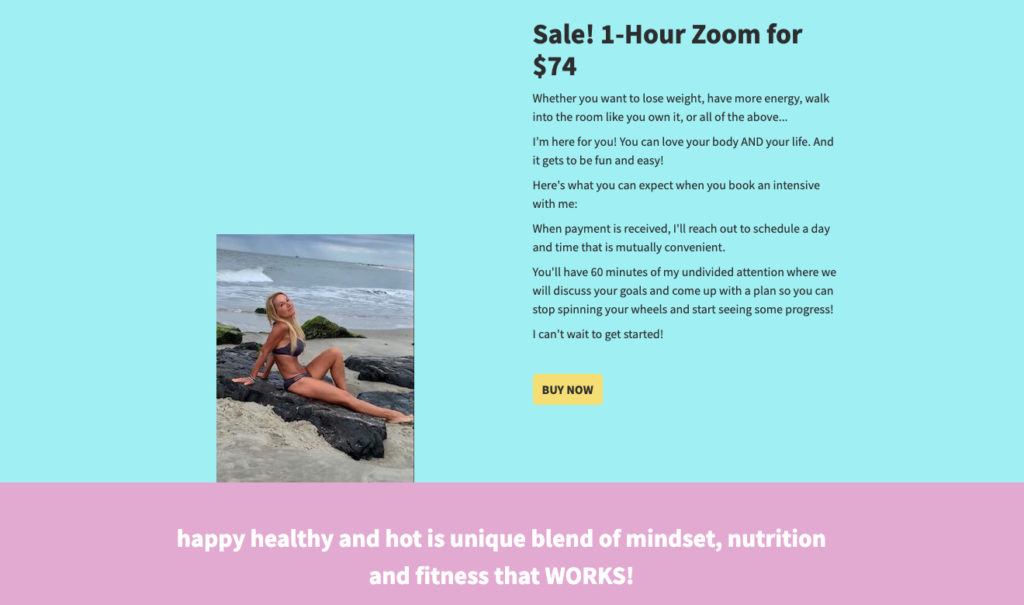
Since ecommerce landing pages are free in Elizabeth’s AWeber account, she decided to create a sale, offering a 1-hour Zoom session for $74.
Since setting up a landing page is so easy, a sale was a no-brainer for the 4th of July (it’s never too late to work on that summer body).
Elizabeth set up a sales page with her Stripe integration — and it was a roaring success. She sold more sessions than she ever imagined.
She had found a new revenue stream: Shorter sessions at a lower price. But Elizabeth didn’t have time to give one-off sessions to everyone who wanted one in the long run.
Her business was growing but she still had a problem — her time for coaching is limited.
A scalable business model
How could Elizabeth scale her new business model? With group sessions, that’s how!
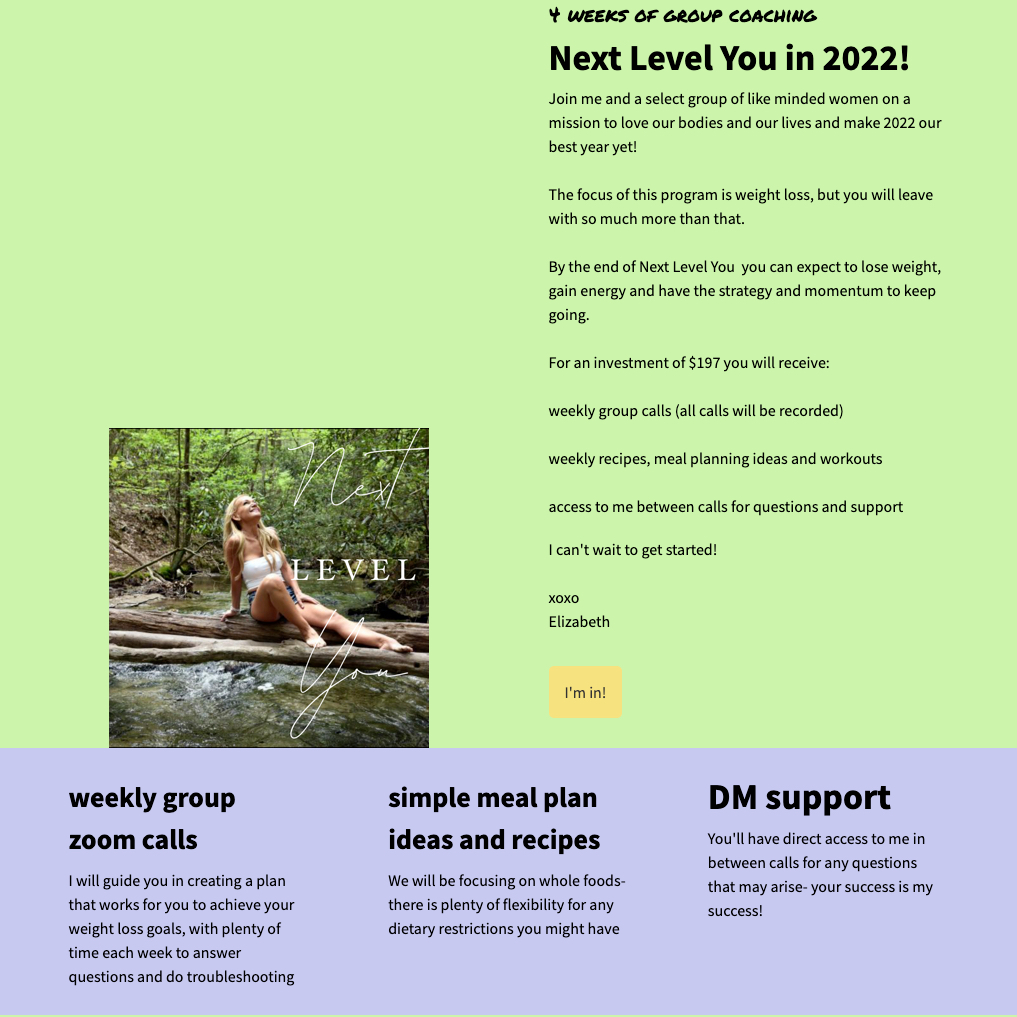
She created a new program called “Next Level You in 2022” that offers 4 weeks of group coaching. Check out the amazing sales page she made for it in AWeber:
She charges slightly less per person and offers the same great recipes, workouts, and advice in group video calls. But, better than that, the people attending her groups are able to talk amongst themselves about struggles, successes, and tips.
Elizabeth is creating a community.
By reducing individual prices, Elizabeth can now offer health and happiness to a larger audience. And, since she offers services to multiple people at a time, she is actually making more money per hour — and overall.
How can you scale your business?
Do you charge per hour for your services? Are you looking for a way to scale too?
First, try offering a sale with AWeber Ecommerce. You can set up a new landing page to offer your services at a lower price. What you might find is that you have a big audience of people who want your services, but feel more comfortable paying a lower price.
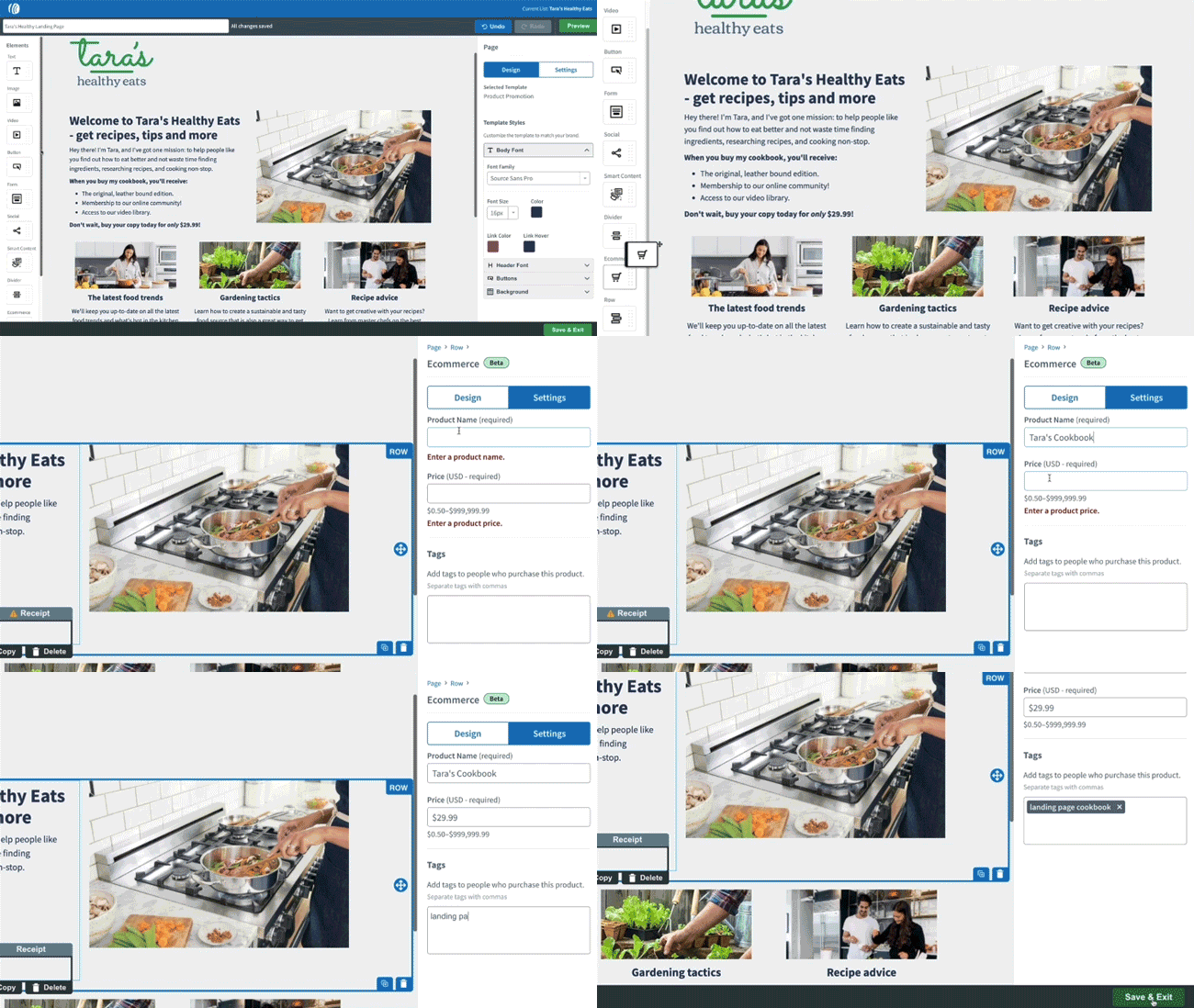
How to add a buy button to your landing page:
Then, you have two options. You could group together several similar customers or clients and offer services in bulk at a lower per-person price.
If your service doesn’t lend itself to group sessions, that’s okay! Sometimes people don’t want other people to know they need help in certain areas. Try a class, webinar, or paid video course instead (you can charge for any of these using a free AWeber landing page).
Learn from your experience and iterate. Who knows, you could find a new monetization track just like Elizabeth.
How she got started quickly
Elizebeth got her new revenue stream up and running in less than one hour. How? By starting with 3 pre-built landing page templates in her AWeber account.
These landing pages were perfect for her business.
Here are three landing pages Elizabeth uses to grow and monetize her business:
All you need to set up a sale page is a landing page and a Stripe account. Copy one of our dozens of landing page templates into your account, connect Stripe and add a purchase button, and update the page with your details.
Then click “Publish” and start promoting it. As soon as your sale is done, you can redirect the URL to another page or simply remove it.
Once someone has bought your service or course, you need to thank them — and let them know when and how they’ll receive it. You can set up an autoresponder to send them an email, but redirect them to a thank you page as well.
Let your new clients know what they’ll receive and when. You can even set up this page to include a video or course they might expect to receive.
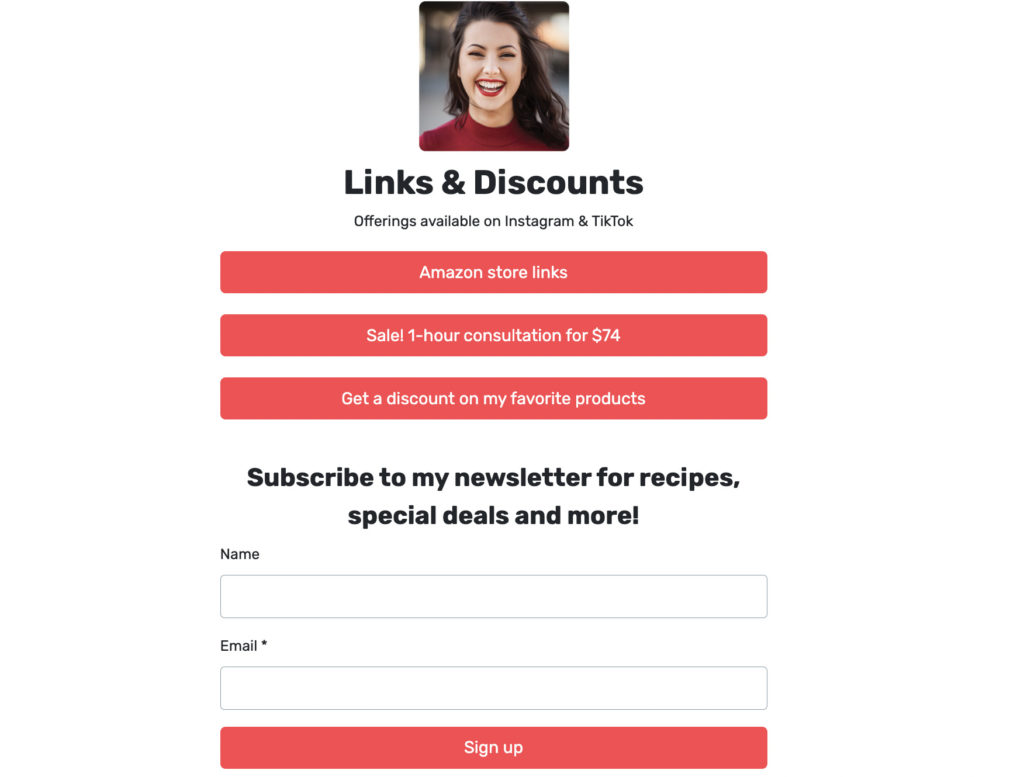
If you’re using Instagram or TikTok for your social media marketing, you know well that they only offer one link — in your bio. Set up a mobile friendly link list page. Include any affiliate links, lead magnets, your sale page(s), and, of course, a sign up form to your newsletter.
Try AWeber today
You can get access to email marketing, an autoresponder, landing pages, ecommerce, over 700 integrations and more with an AWeber account.
Plus, AWeber has over 100 landing page templates you can use for your business (completely free).
Competitive intelligence can seem more like a to-do list item than a business function. You might read analyst reports, check some CRM data, and maybe do a once-over of your competitors’ websites. From there, you might even create battle cards for the sales team and update them once a year. But strong competitive intelligence–the kind that impacts marketing and communications strategy for years to come–is more than checking a box.
For competitive intelligence to make an impact on your business, it needs to be embedded into your culture. Across departments, every employee in your organization should be a competitive analysis detective, constantly looking for clues on what’s coming up in your industry. But they also need a central team of experts to share those clues with. If competitive data is everyone’s job, it’s no one’s job.
In order to build a competitive intelligence culture that sticks, you need a team of high-achieving analysts who live and breathe your industry.
But first, what is competitive intelligence?
Competitive intelligence is the accumulation of data on what’s happening in your industry. It can be your competitors’ social media presence, brand positioning, pricing strategy, product tiers, or even their recent job postings. These individual data points paint a clear picture of who your competitors are, where they’re going and how your company needs to respond.
Friends don't let friends work for companies that aren't investing in competitive intelligence. pic.twitter.com/Sbw5xdXZ9R
Assembling a competitive intelligence team: Selecting your players
I spent five years in public relations before moving into competitive intelligence. The exciting thing about this field is that a wide variety of backgrounds make a stronger team. The key is looking for a few core traits.
Relentless researchers
Competitive data doesn’t come easy. It is a fallacy to think that all of your competitor’s key information will be readily available on the first page of Google search results. Every member of your team needs to be a little too curious and prepare to dive deep into the backlinks to find the information they crave.
Conscious communicators
It’s easier than you think to get stuck on one interesting piece of information about a competitor–especially if you have a hunch that it could be a game-changer. But competitive intelligence is a long game. Your team has to be okay with holding back information until they have the full story. You need people who are methodical and won’t jump to conclusions based on one juicy bit of intel.
Jack of all trades
Competitive analysis touches the entire business, so you need team members who can speak everyone’s language. Each member of the team needs to be just dangerous enough to understand everyone’s role—whether that’s product, sales, marketing, customer success—and what information might matter to them. They need to know the core competencies, goals and needs of the teams that they work with.
Master distillers
Simply put, you need good writers. If you’re doing competitive intelligence right, you might end up with 100 small pieces of information that tell a larger story. It’s imperative that your team is able to synthesize large amounts of data into a short memo for a busy executive. All of your research is useless if you can’t succinctly disseminate it.
The best sources for competitive intelligence
Once you have your team, it’s time to start compiling your competitive data. It’s tempting to choose every competitor in your industry, but you’ll get better results by focusing in. Especially when you’re first building out your program, hone in on your top two to three competitors and let the others go. Once you identify your targets, there are a variety of sources you can use to start building your competitive analysis library.
Your CRM
Setting up your CRM to capture who your brand goes up against is a great way to benchmark against your competitors. At Sprout, we capture the competitor products prospects currently use and who else they’re evaluating. When we win a deal, we know that we’re competitive with both their last system and the other competitors in the deal. Keeping score is a great way to measure your success and prove the ROI of your competitive intelligence team.
Your sales team
Sales calls can be a treasure trove of information about the way your prospects perceive your competitors. Listening to recordings gives you a direct line of sight into how customers feel about certain product features, brand positioning, and pricing structures compared to your competition. Plus, you can get some great pull quotes for internal briefings.
Social media
Social media happens in real-time, which makes it a great place to get up-to-the-minute information on what your competitors (and customers) are prioritizing. Checking out your competitors’ strategy and engagement metrics can give you a serious edge and help uncover new opportunities. If you pair your manual search skills with a tool like Sprout Listening, you can get detailed reports on how well your content is resonating compared to your competitors.
Creating a culture of competitive intelligence
Once you’ve built out your team and started creating your library of competitive analysis, you’ll be ready to create a culture that thrives on competitive data. Equipped with this information, you can prepare your teams to think about how your organization can beat the competition in every decision they make.
Competitive analysis is the investment that keeps paying dividends. With a solid competitive data foundation, your business will be positioned to win across every department.
Looking for the latest Pinterest stats? We’ve got you covered!
Because Pinterest doesn’t always get its due credit versus competing social media platforms.
Although it may not have the buzz of TikTok or the massive user base of Instagram, Pinterest remains a potential goldmine for marketers.
Because the platform is one-of-a-kind when it comes to its demographics and high-spending, product-hunting user base.
Thinking about revisiting Pinterest or optimizing your current presence? Your head’s in the right place.
This guide breaks down the Pinterest statistics you need to know for 2022 and beyond.
Pinterest usage statistics
If you haven’t been paying much attention to Pinterest lately, you might assume the worst in terms of its growth.
The reality, though? Activity on the platform has been surprisingly steady.
Pinterest saw a boom during the early days of the pandemic in 2020 when home shopping was at its peak. While activity has cooled off since then, there’s no denying that the platform still boasts a massively dedicated user base.
Again, Pinterest themselves acknowledged that the platform saw higher engagement and growth due to shoppers being home throughout 2020. The platform has held onto a good chunk of those new users regardless.
Although Pinterest may not reach the one billion monthly active user club alongside TikTok anytime soon, 400+ million users are nothing to scoff at. In short, Pinterest’s consistency speaks for itself.
2. Nearly50% of Pinterest’s total usersare classified as “light” users, accessing the platform weekly or monthly versus daily (with only 7.3% considered “heavy” users).
Unlike TikTok or Instagram where users are glued to the platform and checking it multiple times per day, Pinterest is a different story.
Most users check in periodically or on an as-need basis. Given the platform’s emphasis on inspirational and product-focused how-to content versus entertainment, this activity trend makes sense.
3. Pinterest’s annual user base growthslowed to 3.1%in 2021 (down from 7.8% in 2020).
The past couple of years isn’t exactly the best barometer for “normal” social media growth.
That said, Pinterest’s 3.1% growth rate is fairly consistent with similar networks (such as Instagram’s 3.7% growth). For reference, these numbers are exponentially better than even more “established” networks than Facebook (0.8%) or Twitter (0.2%).
Pinterest demographic statistics
Pop quiz: what does the “typical” Pinterest user look like?
You’d be surprised. Pinterest represents a unique network in terms of its user base and its diversity. These Pinterest stats are notable for advertisers and brands looking to target the right demographics on the platform.
4. 31% of US adultsclaim to be Pinterest users, putting the platform between Instagram (40%) and LinkedIn (28%).
As noted earlier, Pinterest is about inspiration and education versus entertainment. The platform’s popularity among adults comes from its status as a useful resource versus a place to binge content.
5. 38% of Pinterest usersare between the ages of 50 and 64, representing the largest age demographic on the platform.
Although the platform is historically popular among Millennials, the demographics of Pinterest are shifting.
Unlike competing networks, there’s less of a generational divide on Pinterest. In fact, there’s a near-even split among Gen Z, Millennials and Gen Xers on the platform.
6. Gen Z users continue to grow on Pinterest, currently making up nearly21 million users(on course to rise to 26 million Gen Z users within three years).
Gen Z is likewise having a bit of a moment on Pinterest right now. Consistent with Pinterest’s steady growth, expect to see more and more adopt the platform over time.
Surprised? According to the latest Pinterest statistics, the platform is no longer dominated solely by Millennial women. Not by a long shot.
Pinterest themselves has been talking up the rise of both male and Gen Z users over the past year or so. This signals how the platform’s identity is evolving (and still has the potential to grow).
8. 80% of men on Pinterestclaim that shopping on the platform leads them to “something unexpected” that “surprises and delights them.”
This stat highlights not only how men are using the platform, but how Pinterest at large remains a hub for product research and discovery.
What’s notable here is that the discovery process is not reserved for one demographic. Pinterest has almost become its own sort of search engine for social shoppers.
9. 45% of social usersin the US with a household income over $100K are active on Pinterest.
Pinterest’s high-earning demographics are well-documented and are often touted by the platform itself.
This speaks to why the platform is considered a not-so-hidden gem for advertisers. The popularity of content centered around high-end products (think: home goods, furniture) represents a window of opportunity for brands in the right niches.
Pinterest marketing and user behavior statistics
The way that people use Pinterest is apples and oranges versus other social platforms.
Again, entertainment isn’t what Pinterest is about. Inspiration, education and product research are the names of the game.
And if you see Pinterest as little more than a digital pinboard, you’re missing out on potential marketing opportunities.
The Pinterest stats below can help you fine-tune your marketing strategy and learn how to speak to users on the platform.
10. Compared to other social platforms, Pinterest users are 90% more likely to say they’re “always” shopping (and 30% more likely say they “love” shopping).
Pinterest isn’t shy about putting its emphasis on shopping front and center.
The platform is now a crucial part of the buyer’s journey, even if shoppers aren’t necessarily purchasing from Pinterest directly.
For up-and-coming brands, one of the best ways to use Pinterest for business is to present a sort of digital shop window and personalized experience to win over buyers who’ve never heard of you.
11. 40% of Pinterest users prefer to feel “inspired” during the shopping experience versus shoppers on competing social platforms.
Piggybacking on the points above, Pinterest is a prime place to source ideas for future purchases. For brands that want to actually “inspire” potential buyers, this means matching your photo aesthetics to your target audience.
12. According to Pinterest themselves, Gen Z users adopt new products at 3.7x the rate as Zoomers who aren’t on the platform.
TikTok may be reeling in the younger crowd, but don’t count out Pinterest just yet. This is yet another Pinterest statistic that shows how the platform has cemented itself as a product discovery platform for shoppers of all ages.
As noted earlier, people aren’t exactly as glued to Pinterest as other platforms. Even so, less frequent use doesn’t necessarily negate the network’s marketing impact on users.
While product research is huge on Pinterest, not that searches and queries aren’t necessarily seeking out brands directly.
As a result, content should feature lifestyle shots, user-generated content and people-focused photos to grab the attention of serial searchers. Keyword targeting and pin optimization matter, too.
15. 85% of Pinterest users say that Pinterest is their go-to social platform to visit when they start a new project.
This statistic showcases the importance of educational content on Pinterest. Infographics and how-to tutorials are all the rage for a reason.
16. 70% of users claim that Pinterest is where they go to find new products, ideas or services they can trust.
The takeaway here is not to just blast content onto the platform. Brands on Pinterest need to have a conscious presence that nurtures buyers, educates them and shows off products in action.
1.7 Pinterest users are 7x more likely to claim the platform is more influential than any other in the purchasing journey.
Pinterest isn’t merely the go-to platform for inspiration and product research — the platform is a huge motivator on the path to purchase.
People might see at a glance what your brand is about on Instagram or Facebook, but Pinterest is what’ll ultimately drive them to make a decision.
Pinterest advertising statistics
The effectiveness of Pinterest advertising is proven among big-box businesses and lifestyle brands alike. Let’s look at some Pinterest statistics that highlight the current state of ads on the platform.
18. Shopping ads on Pinterest drive three times the conversions and double the positive incremental return on ad spend versus competing social platforms.
Coupled with the behavioral stats above, Pinterest content serves as a place for shoppers to confirm their purchasing decision. Likewise, the fact that ads on the platform mirror organic content is a huge plus.
19. Shoppers on Pinterest spend twice as much monthly than social shoppers on other platforms.
Remember what we said about Pinterest users being big spenders? This stat confirms just as much.
20. Featuring “lifestyle” images within ads yields a 32% higher CTR than “stock” product images.
No surprises here.
Publishing Pinterest content with a human touch goes hand in hand with higher conversions. This explains the popularity of influencers and UGC on the platform.
21. Pinterest ad spending exploded to $94.7 million annually in 2021 (which tripled 2020’s total spend of $30.3 million).
But ads are booming right now in a big way. For new brands and those who’ve seen success with Pinterest ads in the past, now’s the time to rethink your budget.
22. 35% of marketers say they want to invest in influencer marketing on Pinterest (up from 29% in 2019).
TikTok and Instagram often dominate the conversation around influencers and creators but don’t count out Pinterest as part of the discussion.
23. 80% of weekly users have discovered a new brand or product on Pinterest.
This stat drives home the potential of Pinterest ads in terms of product discovery. If your ad fits seamlessly within a product search by resembling organic content, you’re golden.
24. Pinterest users are 15% more likely to purchase a new product within a week of its launch.
Beyond product discovery, consider that Pinterest is an awesome place for trendspotting. This rings true among brands and consumers alike.
What do these Pinterest stats mean for you?
Listen: if your target audience is on Pinterest, the network should remain a top priority for your brand.
These Pinterest statistics signal not only the staying power of Pinterest but its potential opportunities for brands and advertisers when it comes to social shopping.
Not sure how exactly to approach your Pinterest strategy? Want to make sure it fits with the rest of your social presence? Make sure to check out our latest guide on social media campaign management to help you wrangle all of the above!
As with most digital marketing strategies, your success often comes down to your copy. Having a good copywriter or someone with copywriting skills on your marketing team is a must.
And it’s no different when it comes to your Instagram captions.
But even the best copywriters get a brain block every now and then, which is why we’ve put together this list of 50+ Instagram caption ideas to get those gears turning and help you pump out high-quality Instagram posts time and time again.
Follow along for tips on writing awesome Instagram captions as well as a list full of ideas for your Instagram captions, regardless of what your post is about.
How to write an Instagram caption
First things first, let’s cover the basics. How do you write a good Instagram caption? You always want to keep your target audience in mind and write anything. Who are you writing for? How do you want them to feel when they see your post or read your Instagram caption? What actions do you want them to take?
Here are a few more tips for creating Instagram captions that resonate.
1. Give your audience more context
A picture might say a thousand words, but your Instagram posts need captions to provide more context. Especially when sharing branded content, you need some copy to fully explain the point you’re trying to convey.
Use your caption to:
Describe to your audience the image you shared
Explain why you’re sharing it and why it’s relevant
Give your audience an action for them to take
But more importantly, do so in a way that’s concise and to the point. Which brings me to my next point.
2. Keep captions short and sweet
Instagram captions can be a maximum of 2,200 characters, which is between 310 and 550 words. However, that doesn’t mean that every one of your captions should take up that much space.
In fact, it’s typically better to create a succinct, quick and easy-to-read caption over a large block of text—except for in rare circumstances when that space is needed to fully flesh out an offering, contest, giveaway or promotion.
3. Stick to your tone of voice guidelines
Every brand should have standardized tone of voice (TOV) or brand voice guidelines to follow. This helps your marketing team be consistent, not only in every single Instagram caption but also in your tweets, Facebook posts, blog content, email newsletters and more.
4. Incorporate hashtags, emoji, acronyms, etc.
Even for a business, Instagram is still a fun social media platform, so don’t be afraid to let loose a little. Incorporate emoji, use a bit of slang, throw in some popular acronyms (i.e., DM, IRL, IMO, FOMO) and always be sure to use Instagram hashtags.
5. Drive engagement
While someone may “like” your photo just because it’s a high-quality or well-designed photo, as a brand, you’re hoping for a bit more than that. Maybe a comment, a follow or—best-case scenario—a purchase or signup.
To further engage your audience, use your caption strategically. Ask a question or tease a new product or feature. There are a number of ways you can further drive engagement via your Instagram caption.
And to help, check out these caption ideas.
50+ Instagram caption ideas for businesses
Even the best copywriter can occasionally struggle when trying to create concise copy for Instagram and other social media captions. That’s what we’re here for—to supply you with endless inspiration for creating excellent social media content.
Instagram caption ideas for events
Join us for [event] at [venue] on [date + time]. Link in bio to register.
We’ll be in [city] for [event] on [date]. Stop by and say hello.
*One Day Only* We’ll be opening pop-up stores across town this Saturday. Link in bio to get more details.
Register for our upcoming webinar on [topic]! Join us at [date and time] to learn more. Seats are limited — sign up through the link in our bio!
Something exciting is coming your way. Watch this space. (Keep it short and mysterious when you can’t give out a lot of details about the launch yet.)
We’ve got something brewing… Hint: Think [new feature]. Get ready for an exciting announcement in the coming days.
You asked; we listened. We’re excited to announce the upcoming [product], which has [feature + benefit]! Coming to you this [month of launch].
The most innovative solution to your [pain point].
Ready to [solution to pain point]? Introducing [new feature].
Our newest drops are perfect for [solution to pain point]. Get yours today.
Because nothing this good can last forever.
It’s HERE! Introducing [product].
Did you hear? Your favorite [popular product] is now [reinvention of popular product]!
Instagram caption ideas for employee appreciation
This weekend, the [company] team took part in a marathon to raise money for [cause]. Here are some photos of our fun and fulfilling day.
Here at [company], we value [positive characteristics]. [Employee name] has been with us for [duration] and perfectly exudes those qualities. Thank you, [employee name] for being part of the [company] team!
Congratulations to [team member role and name] for [achievement]!
It takes a lot of skill, time and patience to produce even just a single piece of our [product]. We’d like to take this moment to show our appreciation for the people who make it all happen. Our production team works tirelessly to give you the quality you deserve and expect in our [product].
It’s our [team member role and name]’s birthday today! [Name] has [company achievements]. They’re celebrating with a well-deserved day off today!
[Team member’s role and name] has officially been with us for [length of employment]. Thank you for everything you do for [company name]!
Instagram caption ideas for celebrating a milestone
We did it! [Details of the achievement]
[Company] turns [age]! Thank you for joining us on our journey.
We put our blood, sweat and tears into it and we finally made it happen! [Details of the milestone]
[An adjective to describe your product] 🤝 [another adjective to describe your product].
Use #[brandedhashtag] to get featured!
Felt cute, might delete later.
Take advantage of these Instagram caption ideas
Start creating your own incredible Instagram posts with these Instagram caption ideas. Learn even more Instagram best practices to get the most out of this platform for your business. We can’t wait to see what you come up with!
It’s the start of March Madness and college basketball enthusiasts around the country are rejoicing.
Although picking the perfect March Madness bracket is nearly impossible, millions of people complete the legendary ritual each year and tune into the live games. The famous NCAA tournament draws in die-hard fans and bandwagon supporters alike.
me filling out my March Madness bracket after watching zero minutes of college basketball this year pic.twitter.com/9MWpGY7B65
And what would March Madness be without brands getting in on the hype? This year, a 30-second spot during a Final Four game is up to $2 million, with total ad spend breaking away above $1 billion.
The impressive investments mean the stakes are high. So, whose March Madness marketing strategy is enough to go all the way? And who risks being knocked out? We turned to Sprout Social’s Advanced Listening tool to find out.
Let’s dive into the results and a few tips to help your brand stay in the game.
Let the games begin
First, we wanted to uncover how many people use social media to join the March Madness conversation.
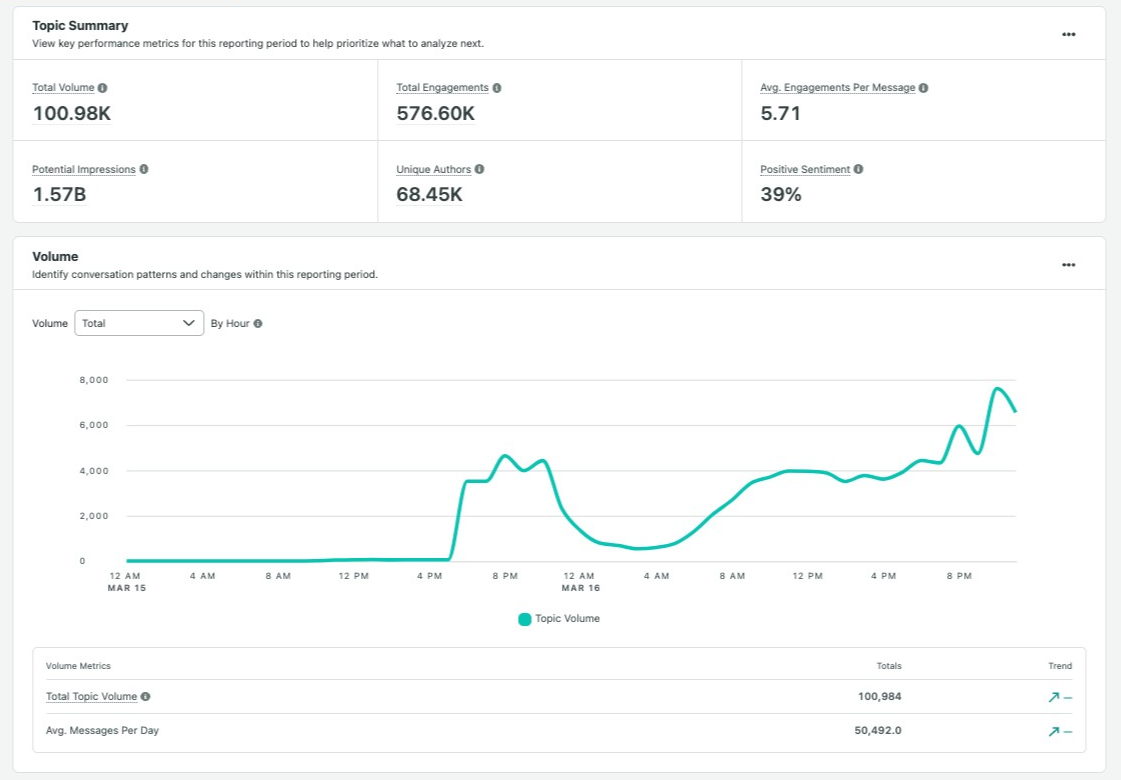
In the first two days of the tournament alone, March Madness-related topics reached over 576,000 engagements and 1.57 billion impressions on Twitter. Volume peaked after 6 p.m. CST both days while the First Four games were played.
From there, online fandom continued to intensify. By the end of the first round (March 17-18), total engagements surged to 2.3 million and potential impressions climbed to over 5.8 billion.
During the second round (and first weekend of play, March 19-20), engagements fell slightly to 1.92 million, while impressions dropped to 3.84 billion.
We also scoped out which states and regions were most active. The states with the highest total engagements from March 14-21 were New York, New Jersey, Texas, Indiana and North Carolina. Not surprisingly, the fan bases in those states align closely with the teams headed to the Sweet Sixteen.
Overall, the social performance is remarkable and reinforces the opportunity for marketers who invest in March Madness. But what did some of the best brands do to break away from the competition?
Hashtags power brands forward
To hashtag or not to hashtag? That’s the age-old question. For some marketers, hashtags are an essential part of their March Madness playbook. Different brands approach their content in unique ways—some use their own hashtags while others stick to #MarchMadness. So which strategy is the most effective?
Wendy’s: #ForTheWendys
Wendy’s created #ForTheWendys to promote their annual Twitter event, Wendy’s March Madness Pick ‘Em. They used the hashtag to remind their community to share their team picks so they can win prizes. From March 14-21, #ForTheWendys received roughly 1,000 engagements—including 934 likes—and 4.35 million potential impressions.
Hit the ❤️ if you’re hype Wendy’s Pick ‘Em is BACK!
We’ll hit you up when it’s time to make your picks for EVERY round of March Madness.
On the other hand, FanDuel used #MarchMadness to caption their Twitter posts, which have been some of the best memes of the tournament. Like Wendy’s, they received about 1,000 engagements March 14-21. But their potential impressions reached 22.29 million, super-seeding Wendy’s by several million. FanDuel also received ashout-out from their partner, the Phoenix Suns, helping them generate even more awareness.
Using hashtags maximizes your potential impressions and other key metrics by getting in on the existing March Madness action. While both brand specific and general hashtags will help connect with your community, #MarchMadness is the essential hashtag for generating impressions and creating awareness. If that’s your goal, try incorporating it into your content and focusing on posts that feature memorable tournament highlights.
Name, image, likeness (NIL): A new marketplace of influencers
A historic Supreme Court decision last summer allowed collegiate athletes to get paid for their name, image and likeness for the first time. In the past year, a multimillion dollar-industry has emerged. Student-athletes are partnering with everyone from local college town restaurants to major brands like Nike. During March Madness, brands are taking these partnerships to the next level.
Dollar Shave Club x Drew Timme
Move over influencers, here comes the “chinfluencer.” Dollar Shave Club partnered with Drew Timme—the reigning king of facial hair and power forwards—to be the spokesperson for their Noticeably Smooth promotion. The campaign parodies influencers and gives Dollar Shave Club the Drew Timme twist that his enormous fan base loves.
Dollar Shave Club used #DrewTimme on Twitter 33 times from March 16-21. With this hashtag, they were able to successfully get in on the overall conversation about the Gonzaga star. Out of the 52 million potential impressions from Tweets mentioning Timme, the brand captured 4.91 million.
#Chinfluencer, their brand specific hashtag, fell short by only generating 160,000 potential impressions—which accounts for less than 1% of impressions surrounding Drew Timme. This proves the advantages of joining existing March Madness conversations, even if you want to start your own.
Bose x NCAA athletes
With Bose noise canceling headphones, these college basketball stars can’t hear their haters—or anything for that matter. To boost their #RuleTheQuiet campaign, Bose partnered with Aliyah A. Boston, Chet Holmgren, Jalen Duren and Wendell Moore.
The campaign contributed to over 576,000 total Twitter engagements and 1.57 billion impressions about the athletes, Bose and #RuleTheQuiet from March 16-20.
Partnerships with NCAA athletes is a sure way to tap into a captivated fan base and boost your social metrics. Tagging the players and using their hashtag will catapult your success farther than relying on your brand’s hashtags alone.
How your brand can pull off the upset
With a massive event like March Madness, it’s easy to get lost in the noise. But there’s still time to adapt your strategy.
Start by keeping up with what your audience is talking about and the hashtags they’re using. Employ large-scale hashtags like #MarchMadness to improve your brand’s awareness and join conversations about the athletes (even if you don’t have a partnership—yet).