Friday, 26 January 2024

Customer retention strategies for 2024

Social media and customer retention are intrinsically linked because social has become a key player in the entire customer journey.

The average buyer’s journey is becoming more dynamic, and social customer care is a way to capture your audience’s attention when the competition is fiercer than ever.

There’s no denying that customer retention should be a top priority if you want your business to thrive long-term. The 2023 State of Social Media Report found that 88% of business leaders agree social media data and insights are critical to customer retention and delivering exceptional customer care.

Throughout this article, learn more about how social media and social listening can play a role in retaining and delighting customers, plus several proven customer retention strategies you can implement today.

What is customer retention?

Customer retention measures a business’s ability to keep customers over a given period of time. The opposite of customer retention is customer churn, a metric that shows how many customers a company has lost over that same period of time.

Customer retention rates vary by industry. For example, Statista found that businesses in the media and professional services industry have an average customer retention rate of 84% while hospitality, travel and restaurants have an average rate of 55%.

The definition of customer retention underneath a question mark and the question: what is customer retention?

How to calculate customer retention rate

The formula to calculate your brand’s customer retention rate is:

((# of Customers at End of Period – New Customers Acquired During Period) / # of Customers at Start of Period) x 100

Why is customer retention important for businesses?

It’s common knowledge that keeping existing customers is cheaper and easier than acquiring new ones. When a customer is already familiar with your brand and product or services, you don’t need to spend as much effort and costs to attain them in the first place.

This can lead to predictable revenue that sustains your business, giving your brand a solid foundation to grow from year-over-year. A high customer retention rate also increases your overall customer lifetime value. Whether customers increase their business with you over time, or refer you to their friends and family, it means more money in your pocket per customer and reduced marketing costs.

Customer retention also leads to brand loyalty, which can be a source of continued feedback and insights into what is and isn’t working.

This is why brands often put tactics in place to keep customers around for as long as possible—a few of which we’ll explore shortly.

How can social media play a role in customer retention?

Social media is a huge asset to customer retention due to its unique ability to facilitate connections between brands and their customers. Because brands and customers can communicate directly with each other, social media provides the perfect relationship-building outlet.

It’s also a virtual gathering place filled with powerful insights about what people think and feel about your brand. Using social listening, you can get an unfiltered view into how your brand is perceived and what your audience is most interested in getting from you.

Having an active presence on social media is a great way to build relationships with your customers and make them want to continue buying from your brand. A few tactics to use include:

  • Offer customer service on social media, helping clients and customers find solutions without having to leave their preferred social platform.
  • Set up social media chatbots that help customers complete actions or direct them to a live representative.
  • Engage with your audience’s social media content, liking and responding to posts that either mention your brand or are relevant to your products/services/industry.
  • Create content that your audience will enjoy and want to interact with.
  • Promote ads and social media posts that are personalized to specific segments of your audience by taking advantage of audience targeting features.
  • Share genuinely helpful and authentic content that makes your audience appreciate your brand.

How to increase customer retention

Don’t let your initial investment of time, resources and relationship-building go to waste. Below are proven customer retention strategies that encourage folks to stick around for the long haul.

1. Invest in your onboarding process and customer resources

The importance of onboarding can’t be overstated when it comes to customer retention. This is the first interaction a customer has with your business after making their purchase decision—don’t make them regret it.

This realization turns onboarding into a make-or-break process. Ask yourself: Are you empowering your customers to make the most of your product or service from the start?

Doing so requires a combination of resources. From self-service options to product videos and beyond, companies should strive to put their onboarding materials front and center in as many formats as possible. This ensures you appeal to all of your customers, not just a small set of them.

At Sprout, we give our customers a variety of resources in our Help Center, so they can learn about our product based on their needs.

Sprout's Help Center homepage with tiles and search bar for addressing any problems or questions customers have about the product.

From product release notes and support articles to on-demand webinars, we help customers fully understand our products’ features—no matter how you prefer to learn.

The process of churn reduction doesn’t happen by accident. The more guidance you’re able to give customers, the better.

2. Create a sense of community through user-generated content

Education isn’t the be-all, end-all of customer retention.

Perhaps one of the more straightforward strategies to reduce churn is simply engaging with your customers via social.

Picking their brains. Celebrating their success stories. The list goes on and on.

Sharing user-generated content (UGC) in the form of reviews and customer photos represents a way to engage your customers and build a much-needed sense of community among your buyers.

For example, brands should make a conscious effort to share shout-outs and compliments from their customers.

And if you sell a physical product, encouraging customers to share photos of your product in action is a no-brainer. Many brands make UGC a cornerstone of their content strategy.

Among our customer retention tactics, this is perhaps the lowest-hanging but most fun. Don’t be afraid to show off your personality and engage your audience.

Sprout Social x/Twitter post featuring UGC

3. Actively ask for customer feedback to improve your experience

Gathering feedback represents a win-win for businesses and customers alike.

Not only do you show your customers that you care about providing a stellar experience, but you also gather invaluable testimonials to learn how to better serve your base.

Something as simple as an email asking for a review is a good starting point, providing an open-ended avenue for customers to share their thoughts.

An example of an email from Graza, an olive oil brand, that prompts the customer to leave a review after a recent purchase

These types of messages should ideally be sent relatively early in the customer lifecycle—like right after onboarding—to keep your relationship positive.

4. Speed up and step up your social customer care

No surprises here. People overwhelmingly take to social media to speak their minds.

Whether it’s a question, complaint or compliment, you need to come up with timely, thoughtful responses.

The good news is that providing social customer care doesn’t have to mean scrambling or refreshing your X (formerly known as Twitter) feed 24/7.

Instead, take advantage of your marketing tools, such as your CRM or social media management tools. Sprout’s Smart Inbox keeps tabs on notifications and @mentions from social, so you never miss a potential crisis. Make a conscious effort to reply to each response personally or refer folks to the proper social media customer service channel to get things resolved ASAP.

Sprout's Smart Inbox where messages from across all attached social channels are funneled into one feed, making it easier for customer care teams and social teams to monitor all social messages in one hub.

5. Reward your most loyal customers

Customer retention isn’t all about righting wrongs or preventing mistakes.

It’s about being proactive. Perhaps one of the best ways to ensure your happy customers stick around is by rewarding their loyalty.

There’s a reason why loyalty and brand ambassador programs are popular among brands. For the sake of retention and keeping people from bouncing to a competitor, rewards and point systems can do the trick.

For example, check out how Smashbox encourages its satisfied customers to keep spending.

A landing page for a rewards program that Smashbox sends to customers.

This encourages long-term customers and makes your base feel like VIPs by virtue of getting better deals.

6. Listen closely to your lost customers

If you’re trying to figure out how to retain customers, look no further than the ones you’ve lost.

Whether it’s a nasty email or a good old old-fashioned roasting on social, you can’t keep 100% of your customers happy.

That said, if you want to reduce churn, you shouldn’t ignore all negative feedback concerning your brand. Listening to customer complaints clue you in on what not to do in the future. If you find that multiple customers are complaining about the same problem or concern, it’s probably time to take action.

Social listening tools like Sprout give you a detailed look at customer sentiment. You might be surprised at the common threads between your lost customers in terms of what they complain about, leading to org-wide improvements in your product or service.

The sentiment analysis summary in Sprout's Social Listening solution, showing how many positive vs. negative messages mention a brand or keywords you choose to monitor.

7. Set expectations to create a better customer experience

Customer experience matters, as does setting expectations about the experience you provide—especially if you’re in ecommerce..

For example, what does your shipping policy look like? Do you offer exchanges and returns? Any guarantees?

These policies are key to ensuring that your one-off customers return in the future. Since they provide customers with peace of mind, you shouldn’t be shy about promoting them.

For example, companies like Red Wing Shoes promote their free shipping and return policies as soon as you land on-site. Meanwhile, they clarify further on their dedicated “Support” page.

Red Wing Shoes' website where they promote free shipping and return policies as soon as you land on-site.

Coupled with a generous and explicit return policy and guarantee, customers know exactly what to expect and understand that the brand is willing to commit to their customers.

The 30-day guarantee listed on Red Wing Shoes' website.

Just make sure you can stick to whatever promises you make. Failure to do so can result in an unflattering call-out.

8. Keep customers in the loop about your latest products, launches and updates

Remember: Your customers aren’t mind-readers.

And besides, they’re likely juggling a ton of different products at any given time.

Rather than assume they’re aware of your latest update or read your most recent marketing email, you need to make an effort to keep them in the loop through social media as well. Build product launches and updates into your content calendar to make sure customers are informed and engaged.

An X/Twitter post from Otter.ai announcing Otter AI Chat.

9. Establish a follow-up frequency that keeps customers engaged

Again, staying on positive terms with your customers means being proactive.

Frequent check-ins, such as outreach emails or calls, help. But you have to walk a fine line between checking in and potentially annoying your audience.

When in doubt, think “less is more”, but be sure to establish some sort of check-in frequency. Doing so will also make the process of cross-selling and upselling easier and more intuitive.

There are likely tools in your marketing stack that can help here. For example, a CRM like Salesforce has a built-in follow-up frequency setting that remind you when to contact customers.

Adjust your settings to follow up with high-ticket customers more frequently and so on. Note-taking in your CRM is also a smart move to tweak your follow-ups with certain customers—like a particular customer or account who doesn’t want to hear from you frequently.

Also, consider how tools like Sprout help you keep track of your social interactions and conversations. Case Management within our Smart Inbox gives you a snapshot of your history with any given contact, making it easier to provide personalized service and care.

An example of how Cases appear in Sprout with the ability to see a customer's conversation and reply internally to align on how to respond.

Consider that many customer retention programs fail due to a lack of organization. With automated reminders and message-logging, you can keep better track of your relationships and follow up in a way that makes sense.

10. Regularly share engaging content on social media

Competitors, creators, family, friends and other brands are all vying for consumers’ attention. Creating and sharing engaging content is essential to capturing your audience’s attention and keeping them interested.

Offering a regular calendar of entertaining or educational content keeps your customers engaged, your brand top-of-mind and encourages them to return for more. Regularly engaging with them through content helps strengthen the bond between you and your customer, as you work to serve their needs and interests.

Plus, your social content can also lead to organic growth as your engaged customers become brand advocates, spreading the digital word about your brand to their connections.

11. Exclusive social media promotions or contests

Special social media promotions or contests can be a powerful customer retention strategy. Contests create a sense of excitement, engaging your customers in a game of chance. They become more emotionally invested as they eagerly anticipate the results. The thrill of possibly winning prizes also encourages interaction with your social content, keeping them active and engaged with your brand.

Exclusive promotions work similarly by keeping your audience continually engaged while waiting for the next sale or special code to be released. It serves as a reward for following your brand and engaging with your content by giving them exclusive access to deals.

12. Run interactive polls and quizzes on social media

This interactive content invites your audience to participate directly with you, becoming active contributors to your brand’s content. This form of engagement can foster a sense of connection because they feel involved and their contributions are valued.

Polls and quizzes also provide valuable insights into your customers’ preferences and opinions. You can then use these insights to tailor future content to your customers’ needs and interests more effectively.

Essentially, interactive social posts engage your existing customers by making their inputs important, while telling you how to better personalize your content, which leads to greater loyalty.

13. Maintain consistent branding across channels

Consistency builds trust and familiarity. When customers know what to expect from you, they are more likely to return.

Using the same branding across platforms creates a cohesive brand identity, boosting customers’ confidence by reassuring that they’re engaging with you no matter the platform they choose. Consistency also applies to how you communicate with your audience.

Being consistent in your content and how you respond to comments, customer questions, complaints or kudos reinforces your brand’s core values and promotes a seamless experience across channels.

Fostering an environment where your customers are comfortable and know what to expect strengthens your relationships with them because you create a sense of reliability and stability.

The importance of social listening in customer retention

Social listening is a strategy that revolves around the analysis of customer sentiment about a brand. Through social media tools, brands can easily monitor online mentions and conversations around their products, services, industry or the brands themselves.

Some of these conversations can even let brands in on what their target customer is looking for. Social listening—especially when used in relation to customer retention—is much more than simply monitoring the sentiment around your brand.

Instead, it’s important to analyze what your target audience is actually saying. Pay close attention to things like:

  • Issues your target audience is having with your competition. Use it to offer a better product.
  • Pain points your audience has with your product. Can you launch additional features or settings to make it a better fit?
  • Positive and negative sentiments about your brand. Get information to actively optimize your presence.

Using social listening tools to increase customer satisfaction, keep customers longer and improve brand sentiment.

What does your customer retention plan look like?

You’ve already done the hard part by winning your customers over in the first place. Now you need to make sure you’re paying attention to customer retention so they stick with you in the long run.

The good news is, you can easily roll out any combination of these customer retention strategies with the right data and tools.

To continue making informed business decisions, check out the latest Sprout Social Index™ with key social media statistics for 2024.

The post Customer retention strategies for 2024 appeared first on Sprout Social.


from Sprout Social https://ift.tt/ErsN4K6
via IFTTT

Thursday, 25 January 2024

10 metrics to track influencer marketing success in 2024

Influencer marketing has grown beyond getting a viral moment. It has become a core element of marketing and sales strategies. Our Q3 2023 Pulse Survey revealed 81% of US-based social marketers consider influencer marketing an essential part of their social media strategy. They no longer expect accidental virality by hiring an influencer.

That’s why tracking key influencer marketing metrics effectively has become crucial. Doing so enables you to benchmark your influencer campaigns against business goals, determine the ROI of your partnerships and pivot quickly based on what is and isn’t working.

In this article, we explain which influencer marketing metrics you should focus on to prove a return on investment and show an impact on your overall social and business goals.

How to choose the right metrics for influencer marketing

Choosing the right metrics for influencer marketing begins with setting specific, measurable and time-bound goals aligned with your broader social media marketing strategy. Whether aiming to enhance brand awareness, generate leads or boost sales, ensure clarity in your objectives.

Here are a few examples of influencer marketing goals:

  • Increase positive Instagram brand mentions by 20% in the next quarter using influencer partnerships.
  • Generate 500 leads within the next month through influencer marketing campaigns.
  • Achieve a 15% growth in online sales attributed to influencer collaborations in the upcoming quarter.

These goals are specific and fall within broader marketing objectives like improving brand awareness and increasing sales.

Selecting influencer marketing goals that align with your social and marketing strategies will help you set a clear benchmark for success and move the needle in terms of social performance and achieving business goals. They also enable you to effectively showcase the impact of influencer collaborations on the bottom line and secure buy-in for future campaigns.

10 influencer marketing metrics to measure

Selecting social media metrics that will best measure the impact and success of your influencer marketing initiatives is just a matter of connecting key performance indicators (KPIs) with your broader marketing objectives.

Here are ten important influencer marketing metrics based on insights from marketers, research studies and our Q3 2023 Pulse Survey.

Reach and impressions

Tracking reach and impressions in influencer marketing is one of the simplest ways to measure brand awareness. Reach refers to the number of people who saw your content. Impressions are the number of times your content was shown or viewed, regardless of whether someone interacted with it.

One person can see a post multiple times, so the impressions will always equal or exceed reach. Not all social channels tell you both reach and impressions. But using a platform like Tagger by Sprout Social where you can get in-depth reports like below, or requesting a performance report from the influencer, will enable you to gather one or both of these metrics.

Screenshot of Tagger's UI showcasing influencer marketing topic report performance scorecard

Audience engagement

The Q3 Pulse Survey showed 68% of marketers track social media engagement metrics (likes, shares and comments) and 19% look to user-generated content related to their brand or products to measure the effectiveness of influencer marketing campaigns. Monitoring audience engagement shows how well an influencer is resonating with their audience and offers a qualitative assessment of the impact and efficacy of their content in driving brand interactions.

Flannels, for example, partnered with influencers to promote its festive party wear collection on TikTok. The #PartyNeverStops campaign generated £3.68M in sales, an 18x return on ad spend, 91M video views and reached 11.9M unique users in the UK. TikTok shows #PartyNeverStops has 102.9M views.

@jxrdanhames

m.A.A.d city πŸ¦… Full look prada @flannels #PartyNeverStops

♬ Kerosene – Biig Piig

Our research also found most social marketers consider social media engagement data a vital influencer marketing metric to secure internal buy-in for influencer marketing. You can also track the engagement rate by multiplying 100 by the sum of likes, shares and comments, then dividing them by the influencer’s follower count.

To make this process faster and easier, use social media analytics platforms like Sprout Social to automatically track engagement rates for you.

Audience growth

This metric refers to an increase in the brand’s social media followers due to influencer collaborations. A growing audience signals that people are regularly interested in what you have to share, amplifying your brand’s reach and awareness.

Gymshark, for example, has grown a social media following of millions by collaborating with fitness influencers who frequently promote the brand’s products on their social handles.

@kamridiane

been using a bag I’ve had since jr high, it was definitely time to get a new one😜 #gymtok #fitness #gymgirl #gymshark #gymbagessentials

♬ original sound – Isg FITNESS πŸ‹️‍♀️

In our Pulse Survey, 41% said they measure the growth in followers/subscribers on social platforms to see if influencer marketing is working for them. Use social media management tools to track audience growth across channels. For example, use Sprout’s Instagram Profile Report feature to track followers gained during an influencer campaign alongside other key metrics.

Brand mentions

Brand mentions tell you how often your brand is discussed on social media, regardless of direct tags. A rise in mentions after or during an influencer campaign can expand your brand’s reach, indicating genuine engagement among your audience. It also shows you have a growing community doing word-of-mouth marketing.

Forty percent of marketers in the survey said they monitor brand mentions and hashtags on social platforms to measure the effectiveness of their influencer campaigns.

Social media listening tools like Sprout Social help you track brand mentions (including misspellings and untagged mentions) and identify keywords linked to your brand, enabling a nuanced understanding of whether mentions represent positive feedback, a brand breakthrough or a potential crisis.

Social media share of voice

Share of voice (SOV) measures your brand’s presence compared to competitors so you can judge where you stand in the industry. Using SOV as an influencer marketing metric during and post-campaign helps you gauge its market-wide effectiveness.

The formula to calculate share of voice is: Your brand metrics / Total market metrics.

A social listening tool automates the process of sifting through millions of online conversations and analyzing them to determine your SOV. It can also give you metrics based on your competitor’s activities.

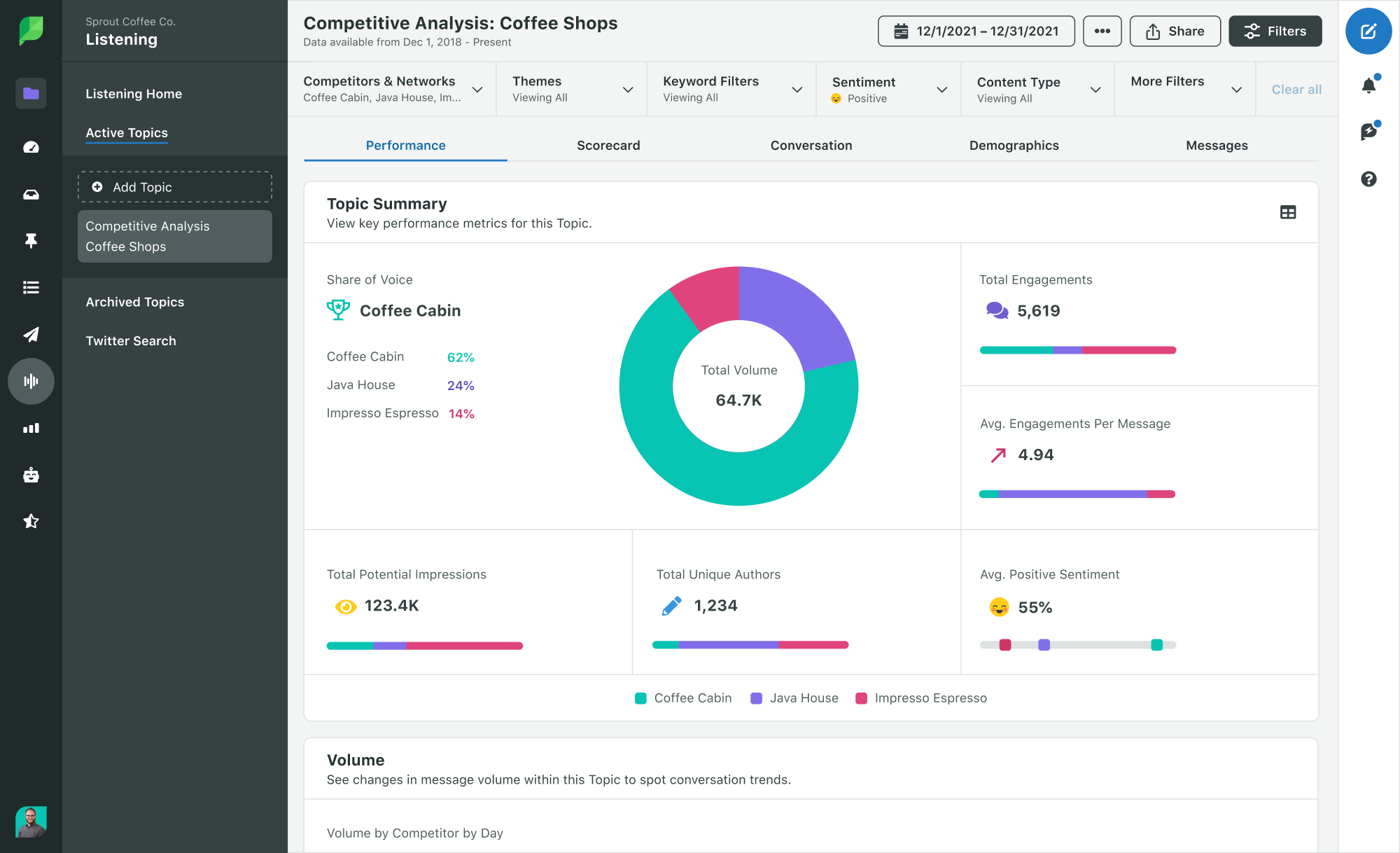
Screenshot of Sprout Social’s competitor analysis performance report showing metrics on various KPIs including topic summary, share of voice, total engagements and sentiment scores based on positive, negative and neutral emotions found in the data

Sprout’s social listening tools help you visualize the share of voice data. You can view metrics like positive sentiment and total engagement. Also use filters to segregate your social listening data, so you uncover new business opportunities and make the most of your influencer partnerships.

Website traffic from social media

Tracking website traffic from social media is paramount for illustrating the tangible impact of influencer marketing on overall business success. This influencer marketing metric links social media activities and website visits, showcasing the effectiveness of influencer campaigns in influencing potential customers to consider your brand by visiting its website.

Moreover, by monitoring website traffic, businesses can better understand the effectiveness of their marketing efforts and make informed decisions to achieve their KPIs. Home Depot, for example, partnered with the fashion blogger, The Mother Chick, to promote its products via tracked URLs.

Screenshot of fashion blogger, The Mother Chick, promoting Home Depot products on Facebook.

Using tools like Tagger by Sprout Social enhances precision in tracking website traffic. Marketers can leverage Tagger to add UTMs and platform pixels or create custom URLs. For instance, implementing UTM parameters becomes crucial on Instagram, where clickable links are limited.

In fact, 50% of marketers track link traffic from social media posts (e.g., Link in Bio) or use promotion codes, while 45% analyze increases in website traffic during/after campaigns to measure the effectiveness of their influencer marketing campaigns according to the Q3 2023 Pulse Survey.

You can also use Google Analytics for social media reporting and influencer marketing metrics. Within Google Analytics, social teams can visualize web sessions attributed to specific social channels, providing a clear day-by-day breakdown. Marketers gain insights into the effectiveness of their influencer campaigns by discerning between traffic from Instagram bio links and Instagram Stories.

A screenshot of a Google Analytics dashboard showing traffic acquisition.

Conversions

Conversion is the successful completion of a predetermined goal, signaling that the collaboration has influenced the audience to take a specific action.

Conversions can mean:

  • Sign-ups for software or a newsletter
  • Sales
  • A promo code usage
  • Filling out a lead generation form
  • Downloads of a whitepaper or ebook

You can track conversions by using tools like Google Analytics, asking users via a form how they discovered you or using influencer-specific codes during checkout.

Screenshot from Harverters on X (formerly Twitter) saying If you are booking a ride to Tafawa Balewa Square for Winepress, use the promo code "Winepress24" for a ride discount

Revenue

To accurately measure the return on investment (ROI) of influencer marketing and its impact on your overall social media ROI, brands need to calculate the revenue generated by influencer campaigns—making it one of the key influencer marketing metrics. You can determine revenue generated during and after an influencer campaign using tools like Google Analytics, promotional codes and measuring direct sales on social media.

According to our research, 73% of those surveyed said their influencer marketing budget is shared with their social budget. So, when multiple teams compete to get a share of the marketing budget, you need to show the impact of influencer marketing to senior leadership.

By tracking revenue, companies can determine which influencers offer the best ROI and adjust their strategy accordingly.

Search interest

Search interest refers to the frequency of people searching for specific terms or topics. An increase in search interest during an influencer campaign could indicate heightened curiosity or demand generated by the campaign. Quantifying audience engagement and interest helps you measure the campaign’s impact.

For instance, if an influencer promotes a new gadget and search interest for that product spikes, it indicates that the audience is actively seeking more information or looking to make a purchase. The Q3 2023 Pulse Survey showed that 24% of marketers use SEO tools (e.g., Ahrefs, SEMrush, etc.) to monitor search interest to gauge the effectiveness of their influencer marketing campaigns.

Screenshot of a LinkedIn post from Steven Bartlet who has more than 1.7 million followers on LinkedIn–a huge number to spark an interest about the brand

Earned media/press mentions

Earned media refers to the publicity a brand receives through organic channels, such as press coverage or media mentions, rather than through paid advertising. In influencer marketing, increased earned media could be a compelling indicator of brand success. The Pulse Survey revealed one-third of marketers track press or media mentions related to influencer campaigns.

Earned media is measured by equating the organic, positive buzz a brand receives to the monetary value they would’ve had to spend to receive the same recognition via paid ads.

When influencers generate positive attention from media outlets or across social, it signals that the campaign has resonated beyond the influencer’s immediate audience, reaching wider recognition.

Dove, for example, partnered with actress Gabrielle Union as part of their #detoxyourfeed campaign—an initiative meant to take action against toxic beauty standards. Union’s partnership with Dove has helped the company gain positive PR and showcase its values to a wider audience through an influencer and a hashtag rather than paying for ad placements.

@dove

πŸ“£ Listen up. It’s time to #DetoxYourFeed 🀳 #DovePartners @Gab Union & Zaya Wade have joined our #DoveSelfEsteemProject movement to tackle toxic #BeautyAdvice on social media πŸ’ͺ Join us, #DetoxYourFeeds & inspire others to do the same ✨ #Dove #DovePartner #SelfEsteem #ToxicBeauty #LetsChangeBeauty

♬ original sound – dove

Hone in on influencer marketing metrics to maximize your ROI

Influencer marketing can be a game-changer if you set strategic goals that align with your social media strategy and hire the right influencers for your target audience. And choosing the right influencer marketing metrics will help you measure the effectiveness of your campaigns and show their impact on the bottom line.

But, let’s be honest, making the most of influencer marketing is easier said than done. With so many factors at play, like changing social media algorithms and trends, finding the right influencers and effectively managing them, it can be daunting if you are not an expert at influencer marketing.

Our team has put together a detailed guide on maximizing influencer marketing ROI, so you can start making the most of your influencer campaigns today.

The post 10 metrics to track influencer marketing success in 2024 appeared first on Sprout Social.


from Sprout Social https://ift.tt/9KAn6P3
via IFTTT

19 Best fonts for blogs: How to create eye-catching, readable content

19 best fonts for blogs: How to create eye-catching, readable content

Online audiences have short attention spans, so it’s vital you make it easy for them to consume and retain the most content in the shortest possible time.

That’s why it pays to nail your choice of blog fonts.

Your chosen font should be stylish and align with your branding, while also being easy and enjoyable to read.

In this article, we’ll explain the importance of fonts, discuss key considerations for choosing the right font, and round up the 19 best fonts for blogs (plus which size to use). 

And, as an added bonus, we’ll analyze the fonts used by some of the world’s top blogs.

Let’s get into it…

Why fonts for blogs matter

Fonts play a key role in the readability of your blog posts.

One study found that adjusting font style and size can increase reading speed while maintaining comprehension. Another revealed that picking the right font can increase a reader’s speed on a screen by 35%.

At this point, you’re likely thinking: “Why should I care about reading speed? I want people to stick around on my blog, not whizz through and bounce.”

But that’s the wrong way to think.

Fact is, if reading your content feels like a grind, people aren’t going to stick around anyway. Conversely, if you create a smooth, enjoyable reading experience, there’s a good chance visitors will come back for more.

So shouldn’t we all just get our heads together, choose the single font that works best for everyone, and stick with it?

Unfortunately, it’s not that simple, because researchers also found there’s no one-size-fits-all approach when it comes to font readability.

Factors to consider when choosing fonts for blogs

So if there’s no such thing as the “perfect font” for all readers, which should you pick? Here are some key factors to consider when choosing the right font for your blog:

Choose a font that aligns with your brand

Early 20th-century editor Beatrice Warde described fonts as “the clothes that words wear”.

Just like you (probably) wouldn’t wear sweatpants to a wedding or a tuxedo to a bowling alley, different fonts work best in certain contexts — and you should choose one that aligns with your brand and niche.

For instance, tech blogs typically use slicker, more futuristic-looking fonts, like 9to5Mac’s choice of Proxima Nova…

more futuristic-looking fonts being used in 9to5Mac’s blog

…whereas mommy bloggers tend to favor fonts that are friendlier and more traditional, such as Minion Pro, the font of choice for The Overwhelmed Mommy:

The Overwhelmed Mommy blog using font Minion Pro which is friendlier and more traditional

Consider font accessibility

Another important factor in choosing the best font for your blog is accessibility.

Accessible fonts are those that don’t impair or exclude website visitors, including those with visual impairments and reading disorders.

The best fonts for accessibility have:

  • Widespread adoption. Popular fonts tend to be easier to read because we recognize the shapes they use.
  • Distinct characters. With certain fonts, it’s hard to distinguish some characters (like a capital “I” or lowercase “l”) from one another. Fonts with distinct, defined shapes for each character are more accessible.
  • Unmirrored characters. With some fonts, certain characters mirror one another when flipped horizontally (e.g. “p” and “q”), which can pose problems for some readers. Unmirrored fonts are more accessible.
  • Sufficient spacing. Fonts vary in width, and some have less space between characters than others. The more tightly packed your text looks, the less accessible it is.

Pick the right font category

The majority of popular fonts fall into one of two categories:

  • Serifs: These fonts have decorative “tails” that make individual letters more distinctive and lend your content a more traditional feel. Examples include Garamond and Times New Roman.
  • San-serifs: These fonts don’t have the fancy “tails” of their serif counterparts, creating a more contemporary look. Examples include Arial and Helvetica.

Both font categories can be applied to a wide range of use cases.

However, sans-serifs have cleaner lines and are typically best for titles and shorter text, while serif fonts — with their distinctive design flourishes — tend to be better for longer passages.

What font size is best?

It goes without saying that larger font sizes are easier to read.

Unfortunately, they also tend to look clumsier.

Plus they take up more space, which can impair other elements of your blog design.

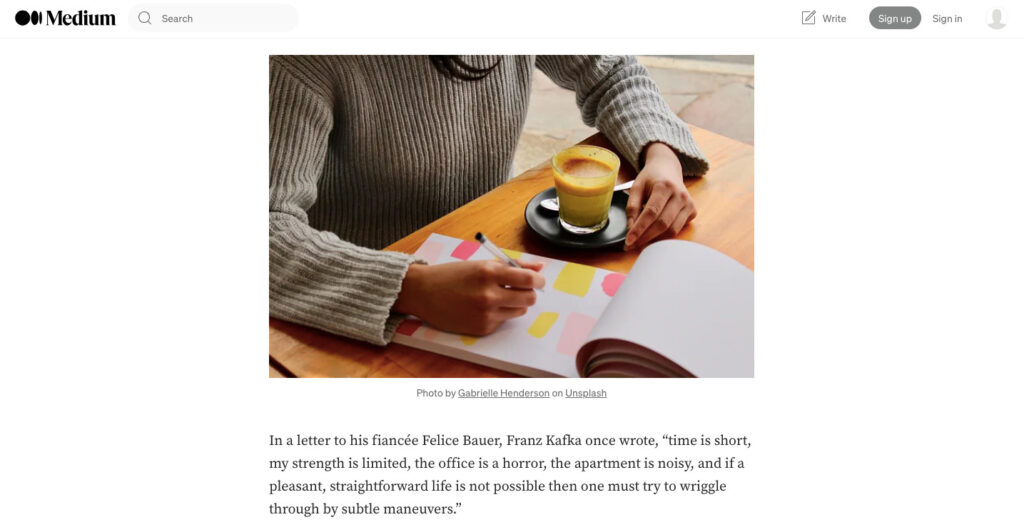
Say your blog theme looks a little like the below Medium example, with all the copy appearing in a narrow central column:

Medium blog showing all the copy appearing in a narrow central column

If your font is too big, you could end up with just 5-6 words per line, which would almost certainly look bad.

So where’s the sweet spot between tiny and unreadable and huge and ugly?

In its guide to health literacy online, government agency ODPHP gives the following advice:

“Choose a font that’s at least 16 pixels, or 12 points. If many of your users are older adults, consider using an even larger font size —19 pixels or 14 points.”

But for text-heavy pages like blogs, it might make sense to go larger still. 

After all, most people would say Medium is an attractive site, and it uses a default article text size of 21 pixels (or 16 points).

19 best fonts for blogs

Enough theory; let’s take a look at 19 of the best fonts for blogs, plus a brief explanation of what makes each so great.

Arial

Arial is the classic sans-serif font. It's familiar to everyone — in part because it’s the default font for Google Docs, Gmail, and other Google apps. It’s professional, easy to read, and won’t distract from any other design elements on your blog. On the downside, it arguably lacks a little wow factor.

Example of Arial - one of the best fonts for blogs

Helvetica

Think of Helvetica as a trendier version of Arial. As a sans-serif font with smooth lines, it has a smart, contemporary feel, while its tall x-height — the distance between the baseline and the average top line of lowercase letters — makes for easier distance reading. However, the letters are a little tightly spaced, which could get a little wearing in longer blog posts.

Example of Helvetica - one of the best fonts for blogs

Nunito

Nunito is another attractive and widely used sans-serif typeface. Available under the Open Font License, it’s featured on over 3.7 million websites, so it’s not exactly a unique look. Nunito is a good fit for bloggers seeking a clean, modern feel. And while it was primarily designed for use in headings, pull quotes, and other eye-catching elements, it doesn’t look out of place in body copy.

Example of Nunito - one of the best fonts for blogs

Tahoma

Tahoma is a sans-serif font that was designed specifically for on-screen use, as opposed to print. To the untrained eye, it looks near-identical to another popular sans-serif font, Verdana. But on closer inspection, it has a narrower body and tighter spacing than Verdana, which makes it look cleaner — but also a little less readable for longer passages of text.

Example of Tahoma - one of the best fonts for blogs

Calibri

Until recently, Calibri was the default font for Microsoft Word. As such, it has similar strengths and weaknesses to another of its sans-serif peers, Arial: it’s extremely recognizable, but perhaps a little safe. Don’t discount Calibri, though. Its rounded edges make it highly readable in both headings and body text, plus it has a pleasingly warm feel that’s lacking in some sans-serif fonts.

Example of Calibri - one of the best fonts for blogs

Gotham

Yet another sans-serif font, Gotham was designed exclusively for GQ magazine, before being released for public use in 2002. Since then, it’s been used by a wide range of brands, from Coca-Cola to Netflix to New York University. This speaks to the font’s versatility and elegance. 

Example of Gotham - one of the best fonts for blogs

Verdana

Verdana is another example of a sans-serif font that thrives in digital environments. With its distinctive letter shapes and wide spacing, it’s highly readable — even in longer chunks of text. The one downside is that Verdana maybe feels a little dated, likely because it was so heavily used in the noughties.

Example of Verdana - one of the best fonts for blogs

Times New Roman

Designed for the Times of London back in 1931, Times New Roman is arguably the world’s most recognizable font. As a serif font, it’s easier to read than most sans-serif fonts, especially in longer blog posts. Its tight spacing also allows you to squeeze a lot of text onto the screen without sacrificing legibility. However, it can feel a little dated.

Example of Times New Roman - one of the best fonts for blogs

Century Gothic

Century Gothic was created to replicate a popular font from the first half of the 20th century, making it a good fit if you’re looking for something classic. While it’s definitely usable as the main font for your blog, Century Gothic is mostly used in headlines and advertising copy.

Example of Century Gothic - one of the best fonts for blogs

Roboto

Roboto is a sans-serif font designed for high readability and content density. As Android’s default system font, it’s instantly recognizable to literally billions of web users. So it’s no surprise that Roboto is one of the most popular fonts for blogs, especially in the tech and electronics niches.

Example of Roboto - one of the best fonts for blogs

Open Sans

As its name suggests, Open Sans is a sans-serif font designed to be used anywhere and everywhere, from print to blogs to mobile apps. It’s compatible with pretty much every browser, device, and application, which makes it a solid choice for bloggers. And it’s highly legible, too, even when used as white text against a black background.

Example of Open Sans - one of the best fonts for blogs

Montserrat

A common alternative to the ever-popular Gotham, Montserrat is a sans-serif font that feels both professional and friendly. It’s more characterful than the likes of Arial and Helvetica. As an added bonus, its geometric letters look fantastic in all-caps headings.

Example of Montserrat - one of the best fonts for blogs

Trebuchet

Trebuchet was commissioned by Microsoft and is one of the tech giant’s “core fonts for the web”. It’s highly legible on-screen, thanks in part to the tall x-heights and short cross-bars of its characters. As such, Trebuchet is a solid font choice for everything from blogs to spreadsheets to user interface design.

Example of Trebuchet - one of the best fonts for blogs

Raleway

Raleway is routinely described as an “elegant” font. It can certainly bring an air of refinement to your blog, with its thin weight and sharp styling. Raleway works well in the body copy of a blog and is also well suited to standout features like headlines and logos. A real all-rounder.

Example of Raleway - one of the best fonts for blogs

Garamond

Back to the serifs. Garamond is a traditional, formal font that adds a feeling of authority and sophistication to blog content. It’s also extremely readable, with one study discovering it has the highest average reading speed of any font, at 312 words per minute.

Example of Garamond - one of the best fonts for blogs

Franklin Gothic

While Garamond might have the highest average reading speed, the same research found that Franklin Gothic had the highest speed rank — meaning more readers achieved their fastest reading speeds with Franklin Gothic than any other font. That could be because this solid sans-serif font is a better choice for weaker readers. Whatever the case, it’s clearly highly readable.

Example of Franklin Gothic - one of the best fonts for blogs

Georgia

Georgia is a serif font designed for its legibility, even at smaller font sizes. You’ve likely seen it used in books and newspapers, but it’s a popular choice online too — especially for anyone who wants their content to look authoritative and reputable.

Example of Georgia - one of the best fonts for blogs

Cambria

Designed for Microsoft Office in 2007, Cambria is easy to read and looks elegant, especially at smaller sizes. It’s a classic example of a transitional serif typeface: one that occupies a halfway house between traditional and contemporary fonts. As such, it’s highly versatile, although a little neutral for some tastes.

Example of Cambria - one of the best fonts for blogs

Palatino

Palatino was created in the 1940s and has a sophisticated, timeless feel. It’s a perfect choice for bloggers who like the style of Times New Roman but want something less generic. The only real downside of Palatino is that the bold version lacks a little impact, making it a better fit for body copy than blog headlines.

Example of Palatino - one of the best fonts for blogs

Futura

Futura is one of the most adaptable fonts. It looks fantastic in body copy — partly due to the uniformity of its stroke width, which ensures Futura remains easy to read at smaller sizes. But it’s also a fantastic fit for standout text elements and appears in countless brand logos, including Best Buy, FedEx, and Supreme.

Example of Futura - one of the best fonts for blogs

Which fonts do the world’s top blogs use?

With tens of thousands of options available, it’s easy to get overwhelmed when choosing blog fonts.

That’s why it can help to get inspiration from top blogs in your niche — because they’re clearly doing something right.

Once again, we’ve done the hard work for you by analyzing some of the world’s most popular blogs across various niches to see which fonts they use for titles and body text…

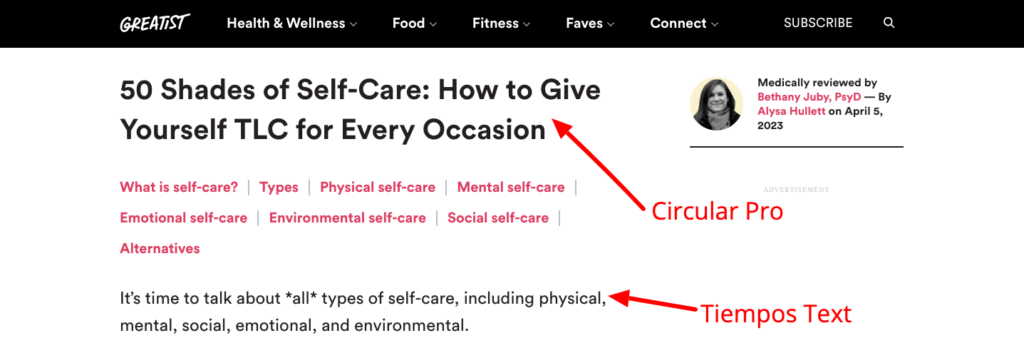
Greatist: Circular Pro and Tiempos Text

Greatist blog using two fonts, Circular Pro for the headers and Tiempos Text for the body

Health and fitness blog Greatist uses the sans-serif font Circular Pro for titles and pairs it with Tiempos Text, a serif font, for the body copy of its articles. This creates a pleasing contrast, where the title font looks contemporary and youthful, while the body text feels traditional and trustworthy — a perfect fit for a serious niche like health and fitness.

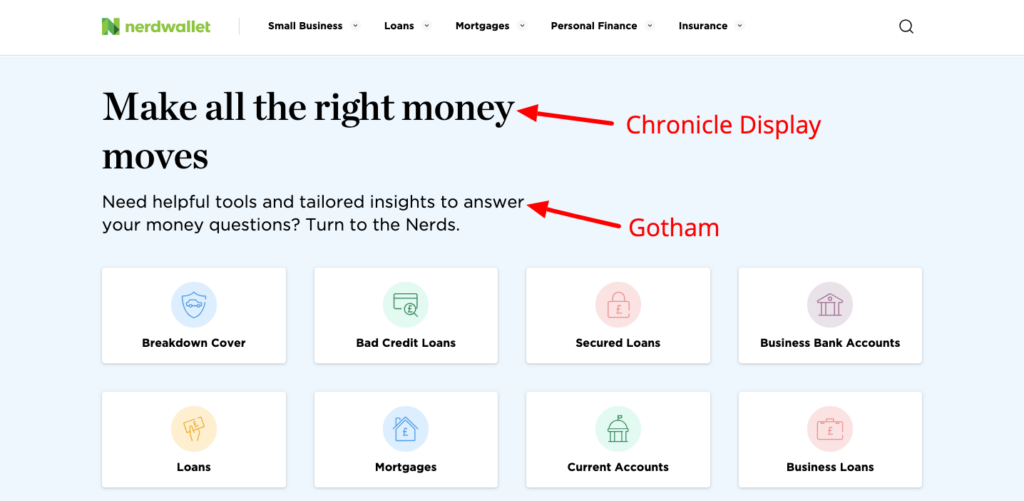
NerdWallet: Chronicle Display and Gotham

NerdWallet using two fonts in their blog, Chronicle Display for the headers and Gotham for the body

NerdWallet goes the opposite way to Greatist, using a traditional serif font — Chronicle Display — for its blog titles and the sans-serif font Gotham in the body copy. Serif fonts look stylish and highly readable at larger sizes, and combining them with a sans-serif font lends some attractive visual differentiation to your blog posts.

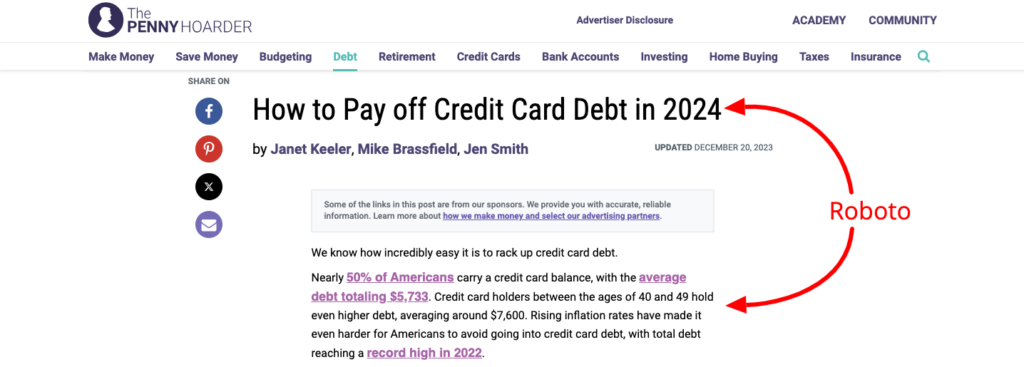
The Penny Hoarder: Roboto

The Penny Hoarder using font Roboto in their blog

Of course, there’s no reason why you have to choose contrasting fonts for body copy and titles. The Penny Hoarder goes a different way by using a single font, Roboto, for both. This creates a more consistent feel, but it’s not necessarily the most visually exciting approach.

Final thoughts on the best fonts for your blog

For many bloggers, choosing a font is an afterthought. Nothing more than clicking a drop-down menu in their CMS and picking the prettiest option (or just sticking with the default font of their blog theme).

But, as you can see, fonts have a huge role to play — not just in the readability and accessibility of your content, but in the overall design and visual appeal of your blog.

Get it right and people are more likely to keep reading.
Once you’ve picked the best font for your blog, check out our guide to the best fonts for emails to help your copy stand out in the inbox.

The post 19 Best fonts for blogs: How to create eye-catching, readable content appeared first on AWeber.


from AWeber https://ift.tt/P0NULCb
via IFTTT

Wednesday, 24 January 2024

How hashtags on Facebook still work for businesses in 2024

Organic visibility on Facebook has taken a hit in the past few years. But strategic hashtagging helps you address this challenge. Hashtags on Facebook help you categorize your content and make it easier for users to find your posts. While they may not be as popular as they are on other platforms, they’re still very effective if you use them correctly.

In this post, we take a deep dive into the world of Facebook hashtags. We show you how to use hashtags on Facebook and how your business can benefit from them. As a bonus, we even share a list of the most popular Facebook hashtags in 2024. Let’s get started.

What are Facebook hashtags?

Facebook hashtags are clickable links created by adding the # symbol to words and phrases and added to your Facebook posts. If someone clicks on a certain Facebook hashtag or searches for it, they’ll see more posts containing the hashtag. This helps them to learn more about the topic and discover more content related to it.

Do hashtags on Facebook work?

The short answer is: Yes.

Hashtags on Facebook turn into clickable links to categorize conversations on the platform. A search for #NFL will bring up Facebook posts related to the NFL. This allows people to keep up with conversations related to the league such as game commentary, predictions and more. But keep in mind that only the posts that use this hashtag will show up in this search.

Facebook search result page for #nfl showing a post from HawkMania containing the #nfl hashtag and a Seahawks player in the middle of kicking a ball

That means just posting about the topic isn’t enough to reach people who aren’t following your Page. You need to use a relevant hashtag to ensure that non-followers can discover your post and engage with it.

Following the same #NFL example, FanDuel shared a throwback video from a 2015 NFL game. The video included the #NFL hashtag along with several other relevant hashtags to bring more visibility. Naturally, it garnered tons of engagement including 900+ comments and 600+ shares.

Facebook post from FanDuel containing the #nfl hashtag and showing a Dallas Cowboys player trying to catch the ball

To see how well Facebook hashtags work for you, consider running a social media experiment. Create two similar posts with and without the hashtag and publish them when your audience is most engaged. Then see the magic happen.

How to use hashtags on Facebook

Before you start adding hashtags to your Facebook posts, it pays to know how to use them more strategically. How many should you use and in what context? How do you format them?

Let’s check out some best practices and tips on how to use hashtags on Facebook.

1. Avoid spaces in multi-word hashtags

To create a hashtag from a single word, you only need to add the # symbol to the front. For multi-word phrases, you need to join all the words, so they become a single clickable link.

Adding spaces between the words will break up the hashtag, making only the first word clickable. That means your post is unlikely to show up in front of relevant users.

If you’re worried about readability, capitalize the first letter of each new word to make it easier to read. So #tacotuesday becomes #TacoTuesday.

2. Avoid all punctuations and symbols

While you can add numbers to your hashtags, skip unique characters such as symbols and punctuations. Adding these will render your hashtag useless and will not make the hashtag produce a single clickable link. That means if you want to share a hashtag containing “%,” you’ll have to spell it out as “percent.”

3. Use hashtags to categorize conversations and topics

You can technically use hashtags randomly across your Facebook posts. But if you want to get more out of your Facebook hashtags, you need to use them purposefully. Think of separate hashtag campaigns for different goals such as brand awareness, event promotion and so on.

Use hashtags to categorize conversations and topics and make it easier for users to find relevant posts. So when someone clicks on a hashtag on #BrandNameTips, they’ll discover tips related to your brand. Similarly, your brand can discover user-submitted content with a designated hashtag.

For instance, Fabletics influencers have to use the hashtag #FableticsPartner. This helps the brand categorize influencer-created posts and makes it easier to find content to repost.

A Facebook post showing the user in a purple Fabletics suit and sunglasses and a caption that includes the hashtag #fableticspartner

4. Join trending topics and conversations

From sporting events such as the World Cup to #NationalDonutDay, hashtags are totally fair game for topical content. As long as you’re posting tasteful and relevant content related to an event, you may very well score some extra attention to your post by tacking on a tag.

For example, THB Bagelry & Deli shared a post promoting #NationalBagelDay to engage their local audience for a BOGO deal that was part of a campaign to use National Bagel Day to donate a portion of their sales to a good cause.

Facebook post from The Bagelry & Deli showing two batches of bagels and a countdown to national bagel day on January 15th with a caption that includes the hashtag #NationalBagelDay

Keep in mind that the hashtag doesn’t necessarily have to be directly relevant to your business. Look for hashtags around topics and conversations that are trending at the moment. What are events or incidents that everyone’s talking about? Which hashtags are they using for these discussions?

5. Incorporate hashtags into sentences

Use Facebook hashtags naturally in your sentences whenever possible. This helps you avoid having to repeat two versions of the same word: one hashtagged and one not. And it makes your post look less spammy.

For example:

Get a chance to win a #GoProHero12

Is much cleaner and simpler than:

Get a chance to win a GoPro Hero 12. #GoProHero12

Here’s how GoPro uses the hashtag naturally in a sentence.

GoPro facebook post of a person flipping a pancake against the backdrop of a snowy mountain with a caption that says "Flippin' excited for 2024 @the_adventureaddicts are kicking off their new year in the Canadian Rockies with #GoProHERO12 Black + a $500 GoPro Award"

6. Use Facebook hashtags within reason

On a related note, be mindful of how many hashtags you add to your posts. Too many and your post will come across as messy and spammy.

SocialPilot recommends using two to three hashtags in your Facebook post.

If you want to add more, put most of them at the end of your caption instead of hashtagging every other word in a sentence. Definitely #dont #do #this in the main caption area.

Experiment with different hashtag volumes to see what works best for you. This is why it pays to keep a close eye on your social media analytics.

Hulu keeps it simple by only hashtagging the name of the show and nothing more.

Hulu Facebook post showing a scene from the "This is Us" TV show and a hashtag with the show name

Benefits of using Facebook hashtags

Many brands don’t see the need to use hashtags on Facebook. But here are some reasons why you shouldn’t ignore them.

1. Increase brand exposure

Facebook hashtags are a nice touch from a search perspective, allowing you to get more eyes on your brand’s posts. This translates to increased brand exposure, which is crucial for boosting brand awareness.

Dumpling Town uses the hashtag #StatenIslandFood in its Facebook posts. When someone searches for the hashtag, the restaurant’s posts show up in the results. This helps get the business in front of more people, adding to its brand exposure.

Facebook results for the hashtag #statenislandfood showing a post from Dumpling Town of a soupy dumpling bowl and a caption that includes the hashtag

2. Encourage audience interaction

The more people see your posts, the more likely you are to boost your engagement. That’s why hashtags positively contribute to your Facebook engagement rates.

In addition to boosting your post visibility, hashtags become links that people can click to learn more about the topic. Adding them to your posts helps you create opportunities for people to interact with your content.

3. Source questions and feedback

Since hashtags help you categorize topics and conversations, use them to organize questions and feedback. Create hashtags dedicated to this purpose and encourage your audience to use them to share their queries and feedback.

That way, you can easily find all the questions and comments people have for your business under a dedicated hashtag. This will help support your customer service efforts and guide your content ideation development.

You can even track hashtags related to your industry to look for questions and complaints not specific to your brand.

4. Create an omnichannel experience

Hashtags are vital for your omnichannel strategy. They help tie your social media posts together across multiple platforms. So you get to create a consistent omnichannel experience.

This makes it easier for your audience to engage with the campaign no matter which platform they’re using. It even improves the chances of people remembering your campaign because they’re seeing the hashtag everywhere.

Take, for example, the #DMsChallenge campaign that Dr. Martens launched not just on Facebook:

Facebook post of Dr Martens showing three different art renditions of the shoes and requesting people to share their designs using the hashtag #DMsChallenge

But also on X (formerly Twitter):

X post of Dr Martens showing three different art renditions of the shoes and requesting people to share their designs using the hashtag #DMsChallenge

And Instagram:

Instagram post of Dr Martens showing an art rendition of the shoes and requesting people to share their designs using the hashtag #DMsChallenge

Top Facebook hashtags in 2024

Earlier, we advised that you use hashtags to jump in on trending topics and conversations. But now the challenge is about “how to find the trending hashtags on Facebook.” To give you a head start, we share a list of trending Facebook hashtags at the time of writing.

30 popular hashtags on Facebook

  1. #trending – 875 million
  2. #love – 743 million
  3. #photography – 227 million
  4. #tbt – 210 million
  5. #music – 170 million
  6. #photooftheday – 159 million
  7. #dance – 147 million
  8. #viralvideo – 141 million
  9. #motivation – 134 million
  10. #luxury – 80 million
  11. #shopping – 72 million
  12. #inspiration – 66 million
  13. #funnyvideos – 66 million
  14. #dancechallenge – 60 million
  15. #nofilter – 59 million
  16. #photographer – 55 million
  17. #sunset – 52 million
  18. #football – 46 million
  19. #success – 42 million
  20. #photographychallenge – 42 million
  21. #challenge – 34 million
  22. #dogs – 34 million
  23. #night – 34 million
  24. #sky – 32 million
  25. #sports – 30 million
  26. #cats – 27 million
  27. #giveaway – 25 million
  28. #motivationalquotes – 20 million
  29. #mondaymotivation – 16 million
  30. #vibes – 15 million

Top 10 Facebook hashtags for B2B

  1. #entrepreneur – 43 million
  2. #digitalmarketing – 32 million
  3. #startup – 15 million
  4. #leadership – 15 million
  5. #contentmarketing – 6.1 million
  6. #growthmindset – 5.3 million
  7. #marketingtips – 4.4 million
  8. #businessgrowth – 4.4 million
  9. #businesstips – 3.8 million
  10. #b2b – 3.7 million

Top 10 Facebook hashtags for fashion and beauty

  1. #fashion – 359 million
  2. #beauty – 183 million
  3. #style – 174 million
  4. #skincare – 91 million
  5. #ootd – 84 million
  6. #fashionista – 34 million
  7. #skincareroutine – 18 million
  8. #skincaretips – 8.7 million
  9. #skincareproducts – 8.3 million
  10. #beautytips – 7.6 million

Top 10 Facebook hashtags for fitness

  1. #fitness – 196 million
  2. #workout – 66 million
  3. #fitnessmotivation – 43 million
  4. #gymlife – 23 million
  5. #gymmotivation – 16 million
  6. #fitnessmodel – 16 million
  7. #fitnessgoals – 5.7 million
  8. #healthandwellness – 5 million
  9. #fitnesslifestyle – 4.5 million
  10. #fitspiration – 2.9 million

Top 10 Facebook hashtags for food, beverage and restaurant

  1. #food – 170 million
  2. #foodie – 81 million
  3. #pizza – 48 million
  4. #healthyfood – 39 million
  5. #restaurant – 32 million
  6. #foodlover – 31 million
  7. #bar – 22 million
  8. #fooddelivery – 8 million
  9. #homecooking – 7.3 million
  10. #foodtruck – 5.6 million

Top 10 Facebook hashtags for technology and software

  1. #technology – 47 million
  2. #chatGPT – 13 million
  3. #gadgets – 9.7 million
  4. #artificialintelligence – 4.4 million
  5. #machinelearning – 3.5 million
  6. #technews – 3.4 million
  7. #softwaredevelopment – 1.4 million
  8. #AItools – 255k
  9. #techtalk – 131k
  10. #softwareupdate – 56k

Top 10 Facebook hashtags for travel

  1. #travel – 174 million
  2. #vacation – 38 million
  3. #travelphotography – 33 million
  4. #wanderlust – 18 million
  5. #tourism – 15 million
  6. #traveltheworld – 7.6 million
  7. #adventuretravel – 3.3 million
  8. #solotravel – 1.9 million
  9. #travelpics – 1.1 million
  10. #goexplore – 658k

The importance of hashtag analytics

If you’re not analyzing hashtags, how do you know which hashtags to use? Or whether your hashtag strategy is working?

Hashtag analytics provide you with important metrics on hashtag usage and performance. This helps you track which hashtags are popularly used in your industry, how popular they are and much more.

Understanding these and other Facebook analytics can give you the data you need to pivot or improve your campaigns for optimal engagement. Tracking your post reach and engagement can give you enough insight to understand what resonates with your audiences.

Use these insights to inform your strategy and optimize to boost your Facebook visibility and engagement.

Get more out of your Facebook hashtags

Although not the be-all, end-all of your Facebook presence, hashtags still have their time and place on the platform.

That doesn’t mean you have to add hashtags to every single Facebook post. The trick is to find the right balance between different content types and know which ones should have a hashtag.

Check out our interactive tool to find the right social media content mix for your brand.

The post How hashtags on Facebook still work for businesses in 2024 appeared first on Sprout Social.


from Sprout Social https://ift.tt/mHWz7ki
via IFTTT