In a world that moves at the speed of social, businesses need the right tools to remain competitive and grow. But keeping up isn’t just about posting more. Understanding what your audiences want and meeting market demands requires social intelligence: the ability to turn billions of daily social conversations into insights that drive decisions.
A well-crafted AI marketing strategy puts that intelligence within reach. According to the Sprout Social Index™, 86% of users will maintain or increase their time spent on social platforms in 2025, and with more time on social comes more data to inform your strategy.
With AI marketing, brands can process that data in seconds, pulling out insights at a scale and speed no team could manage on its own. By combining that capability with human intelligence, brands can build a marketing strategy that performs and truly resonates with their audience.
Read on to learn how to design an AI marketing strategy that brings the best of both together.
What is an AI marketing strategy?
An AI marketing strategy is a plan that uses AI in business to improve marketing efforts and get better results. AI tools help marketers better understand customers, develop content that appeals to their audience and optimize campaigns in real time, touching everything from research and content creation to customer experience.
For social and digital marketers, weaving social intelligence into that strategy adds another layer of depth. Social data is among the most valuable research tools available to brands today. Think of it as a worldwide focus group running 24/7, capturing what customers think, want and respond to in real time.
Leaders are taking notice as well: 60% see social as a driver of customer acquisition, and 54% believe social drives R&D and decision-making, according to the 2025 Impact of Social Media Marketing Report.

Social intelligence also plays an increasingly important role in how brands appear in AI-powered search. As tools like ChatGPT and Google’s AI Overviews pull from social conversations, Reddit threads and community forums, brands that show up consistently in those spaces are more likely to reach the audiences searching for them.
Here are some areas in which AI is helping social and digital marketers today.
- Data analysis: AI tools quickly analyze millions of data points from social networks, customer forums, social listening data and CRM tools like Salesforce to find patterns and trends. This helps brands move social insights beyond the marketing team and into the hands of customer experience, product and business development teams that need them most. Sprout’s Social Listening tool, for example, processes an average of 600 million social messages a day, giving brands a continuous view of trending topics and consumer sentiment across their industry.
- Research: Using AI in market research gives brands a sharper view of buyer personas, customer needs and competitor behavior. According to the 2025 Impact of Social Media Marketing Report, marketing leaders are increasingly looking beyond engagement metrics for deeper competitor and audience insights, performance data and intel on the latest network updates. AI enables you to find and act on those insights far faster than manual research alone.
- Content creation: Brands published an average of 9.5 social posts per day in 2024—a slight dip in volume from 2023—yet inbound engagements increased almost 20% year over year, according to the 2025 Content Benchmarks Report. The takeaway: content relevance matters more than volume. AI tools like Sprout’s Generate Posts by AI Assist help teams produce stronger, audience-aligned content faster, freeing up time for more strategic work.
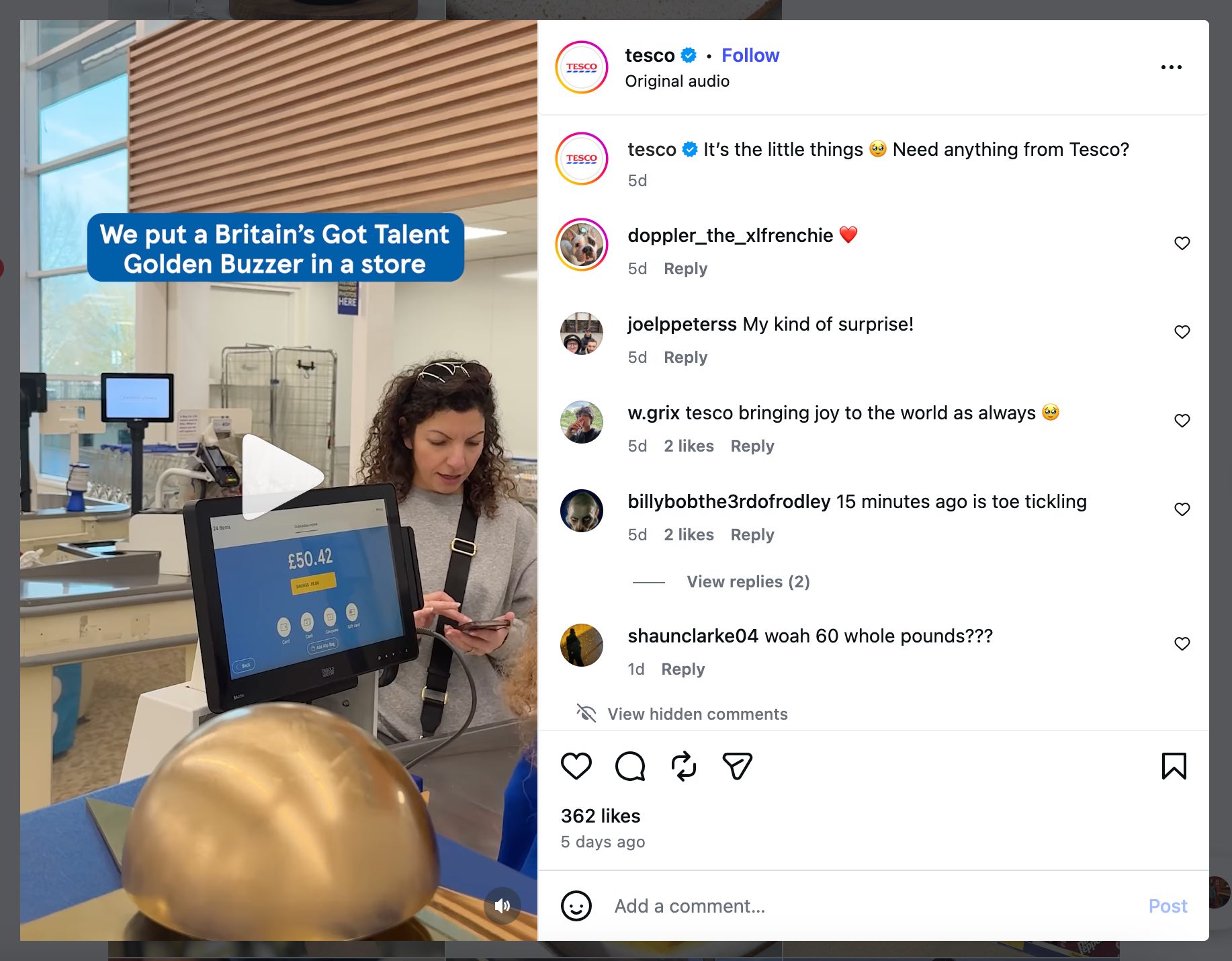
Tesco’s Britain’s Got Talent Golden Buzzer post is a good example of audience-aligned content, tapping into a cultural moment with a distinctly on-brand twist.
- Automation and chatbots: AI automation reduces time spent on repetitive tasks like drafting copy, summarizing messages and scheduling content, giving teams more bandwidth for higher-value work. Tools like chatbots can also provide instant customer support and guide users through a sales process.
- Customer experience: AI-powered customer experience analysis and social listening data help brands identify and act on what their audiences need. According to the 2025 Content Benchmarks Report, consumers say personalized customer service is their number one social media priority.
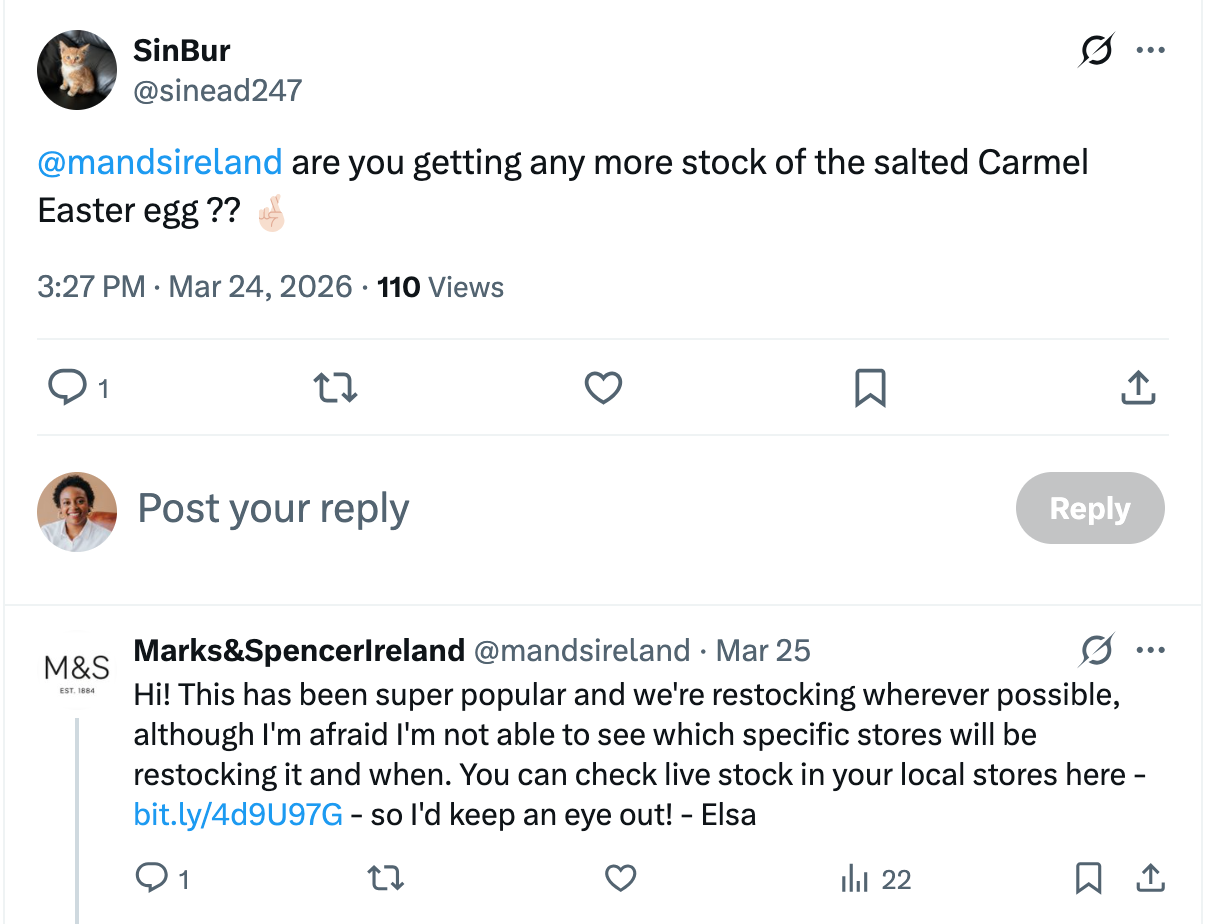
Marks & Spencer Ireland’s response to a customer query on X shows what personalized social care looks like: helpful, specific and human.
What is an AI social media marketing?
AI social media marketing is where a broader AI marketing strategy gets applied at the channel level. While AI marketing covers everything from email to paid ads, AI in social media focuses specifically on the tools and tactics that help brands show up, connect and convert on social networks.
In practice, that means using AI to create and optimize content, understand audience sentiment, manage social customer care and track performance across networks. It also extends to social commerce, where AI helps brands connect audiences with products without ever leaving the platform.
What sets it apart is the expectation for real-time responsiveness. According to the 2025 Sprout Social Index™, 73% of consumers will switch to a competitor if a brand doesn’t respond on social, making social care one of the highest-stakes applications of AI in marketing today.
How AI is transforming modern marketing
In just a few years, AI has gone from a shiny new tool to a core part of marketing operations. The question for most teams now is how to get the most out of it.
A few trends are defining this moment:
- Agentic AI is moving from concept to reality. These AI systems can proactively plan and execute complex marketing workflows (e.g., monitoring campaign performance, personalizing customer interactions) in real time with minimal human direction.
- AI-powered search is reshaping discovery. As LLM models and search engine AI overviews pull from social content, forums and brand-owned channels, brands need to think beyond traditional SEO and consider how their content appears across the entire AI-driven search landscape.
- Multimodal AI is opening up new creative possibilities, enabling AI to work across text, images, video and audio in a single workflow. For marketing teams, this means faster, more flexible content production across formats and platforms.
- Automation vs. authenticity, because as AI-generated content becomes more prevalent, audiences are getting better at spotting it and more selective about what they engage with. Finding the balance between automation and genuine human creativity is a defining challenge for marketers today.
Best practices for using AI in marketing
Getting the most out of AI in marketing comes down to how intentionally you use it. Here are some best practices to keep in mind:
- Start with clear goals. Before adopting any new tool, define what you want it to achieve, whether that’s faster content production, better audience insights or improved social care response times.
- Balance automation with human oversight. AI can generate content, analyze data and automate workflows, but human judgment is still essential for strategy, tone and brand voice. Review AI outputs before they go live.
- Prioritize quality over quantity. Use AI to understand what your audience responds to before you create. Draw on social listening data, sentiment analysis and engagement insights to inform your content rather than just using AI to produce more of it.
- Break down data silos. Social insights are most valuable when shared across the organization. Use AI tools to make marketing data accessible to customer care, product and business development teams.
- Test before you scale. Run pilot campaigns before rolling AI tools out across the organization. This gives you real performance data to work with and helps identify gaps before they become bigger problems.
- Invest in training. AI tools are only as effective as the people using them. Make sure your team has the skills and knowledge to use AI confidently and responsibly.
Why it’s important to have an ethical and transparent AI framework
AI offers real benefits for marketing teams, but its growing presence has created a trust gap that brands need to address. According to the Q1 2026 Pulse Survey, 56% of social users say they see AI slop (mass-produced, low-quality AI-generated content) often on social media, leading to social fatigue and decreased engagement. And unlabeled AI content is the top thing consumers want brands to stop doing in 2026.
Gen Z and Millennial users are the most likely to unfollow, mute or block accounts because their content feels like AI slop, making transparency not just an ethical consideration but a business one.
Building trust starts with having a clear framework in place. Consider creating a company-wide AI use policy that standardizes AI use in content creation, customer interactions and data collection. Companies also need to stay up to date with rapidly evolving regulations, such as the EU AI Act and regional legislation, which carry serious implications for how brands operate.
How to design an AI marketing and social media strategy
Here’s a step-by-step guide to designing an AI-driven social media marketing strategy that evolves with your business and helps your teams work smarter.
1. Define your goals and objectives
Identify what you want to achieve with your AI social media strategy so you have tangible goals and objectives. For example, do you want to increase brand awareness and boost engagement? Or do you want to improve your ad spend?
Having clear social media goals will help you decide where to use AI most effectively in your marketing and social media plans to achieve the best results.
2. Conduct a social media audit (value vs. noise)
Once you’ve defined your goals, it’s time to conduct a social media audit. A good audit goes beyond performance metrics to examine how your social team actually works, including where they spend their time and where the biggest opportunities and gaps lie.
According to the 2025 Content Benchmarks Report, consumer priorities are shifting from passive content consumption to active community-building. This means the bar for what brands need to deliver—faster social care, more relevant content, sharper audience insights—is only getting higher.
A social media audit helps you identify exactly where AI can close those gaps, whether that’s speeding up response times, improving content relevance or surfacing better data for your team to act on.
3. Evaluate your current tech stack and integrations
Before adding new AI tools to your workflow, take stock of what you already have. A tech stack review helps you spot gaps, identify overlapping tools and make sure your existing setup can support the AI tools you want to adopt.
It’s also a chance to think about where better tools could make the biggest difference for your team. The right content tools, for example, can speed up ideation and creation, help teams produce accessible content like subtitles and translations, and free up time for faster, more responsive social care.
And since an AI marketing strategy is only as good as the data behind it, a tech stack review is also the right time to ensure your team is collecting, storing and processing data safely.
4. Scale creativity with AI and automation
Keeping up with content demands while maintaining quality is something every social team wrestles with. Sprout’s AI and automation tools help teams maintain quality without sacrificing speed.
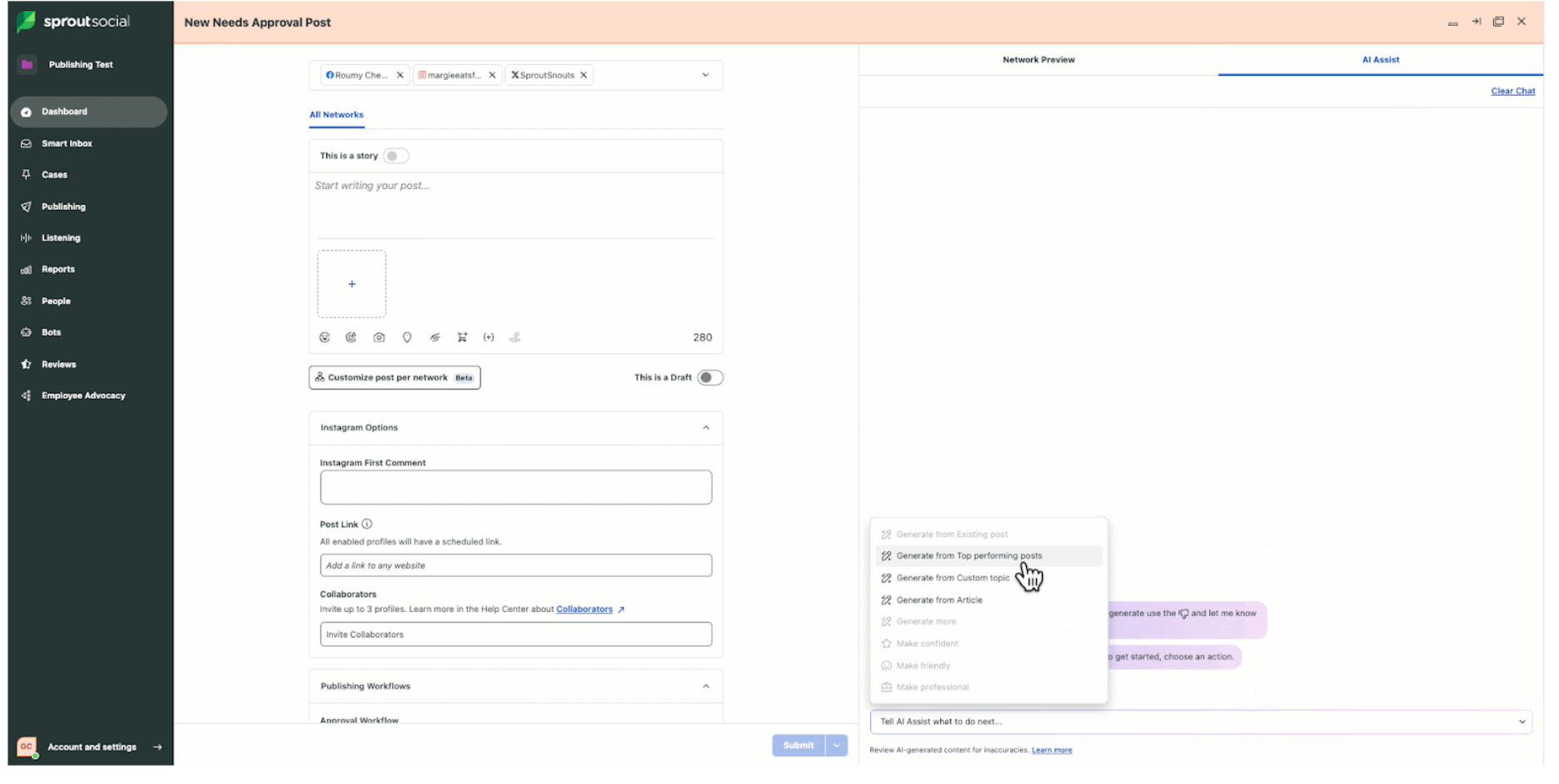
Generate Posts by AI Assist
As the 2025 Content Benchmarks Report showed, brands published an average of 9.5 social posts per day in 2024, and engagement rose when quality improved. Generate Posts by AI Assist helps teams keep creativity flowing and produce stronger, audience-aligned content faster. Teams can generate posts using top-performing posts as inspiration or create a new post about the topic of their choice.
Message Ideas by AI Assist
Employee advocacy is a powerful way to extend your brand’s reach on social, but getting employees to share content consistently can be a challenge. Message Ideas by AI Assist makes it easier by generating ready-to-share, on-brand message options that employees can post directly to their own networks.
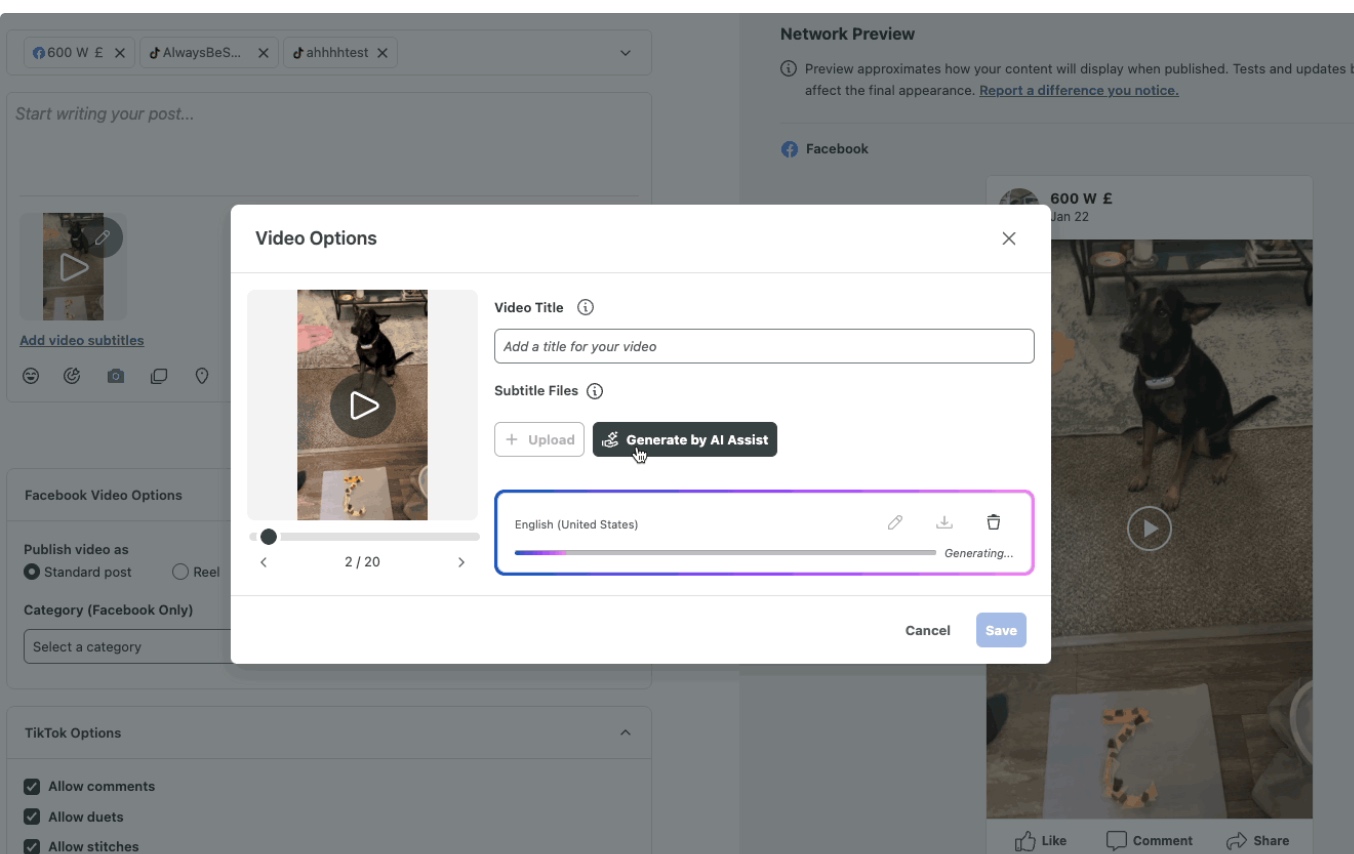
Generate Subtitles by AI Assist
As audiences shift toward active community-building, accessible content plays a bigger role in keeping them engaged. Generate Subtitles by AI Assist makes it easy to add subtitles to video content, helping brands reach wider audiences and meet growing expectations around video accessibility.
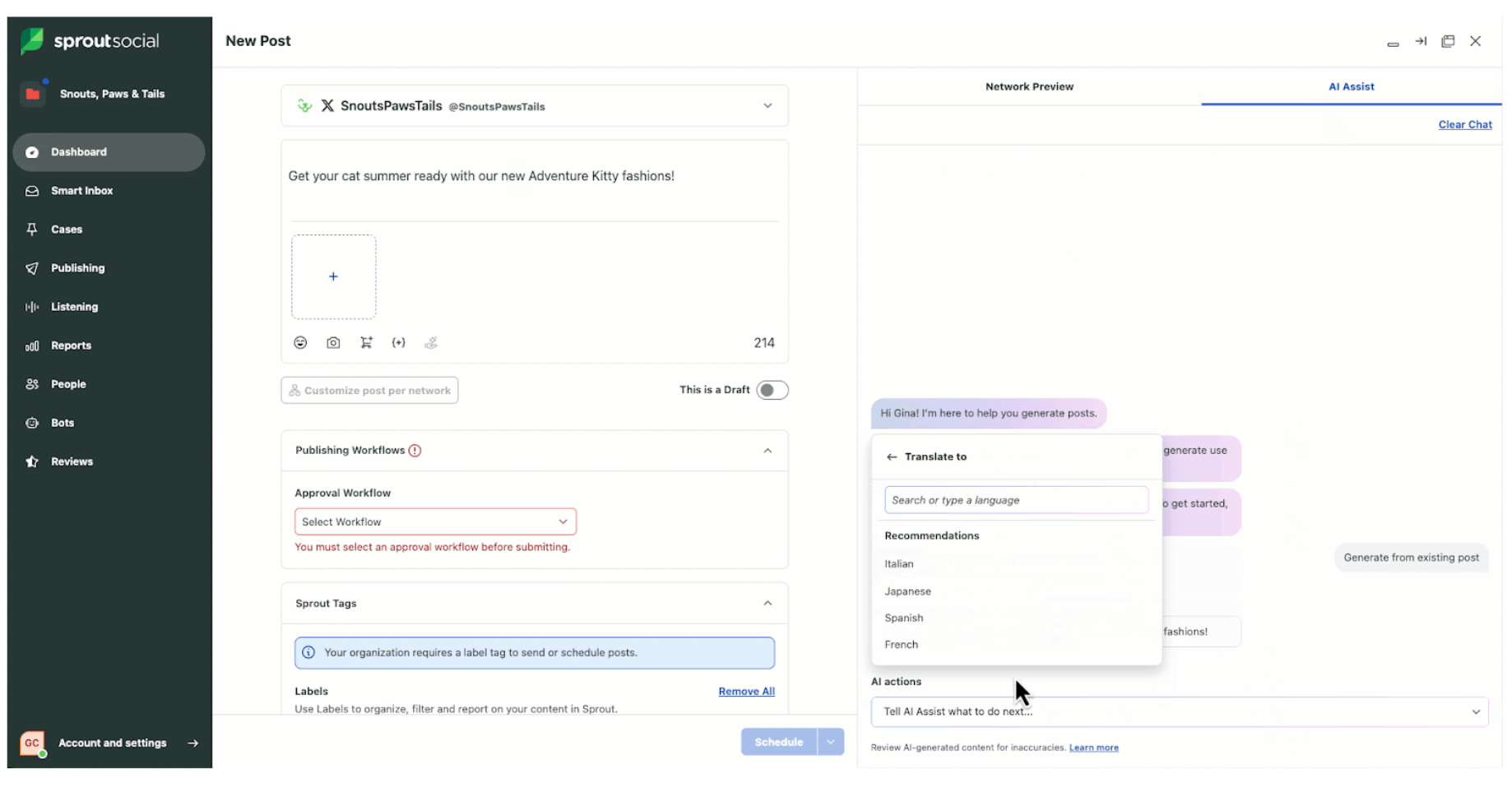
Generate Translations by AI Assist
For brands reaching audiences across multiple markets, Generate Translations by AI Assist removes a significant production bottleneck, enabling faster, easier adaptation of content to different languages without losing quality or tone.
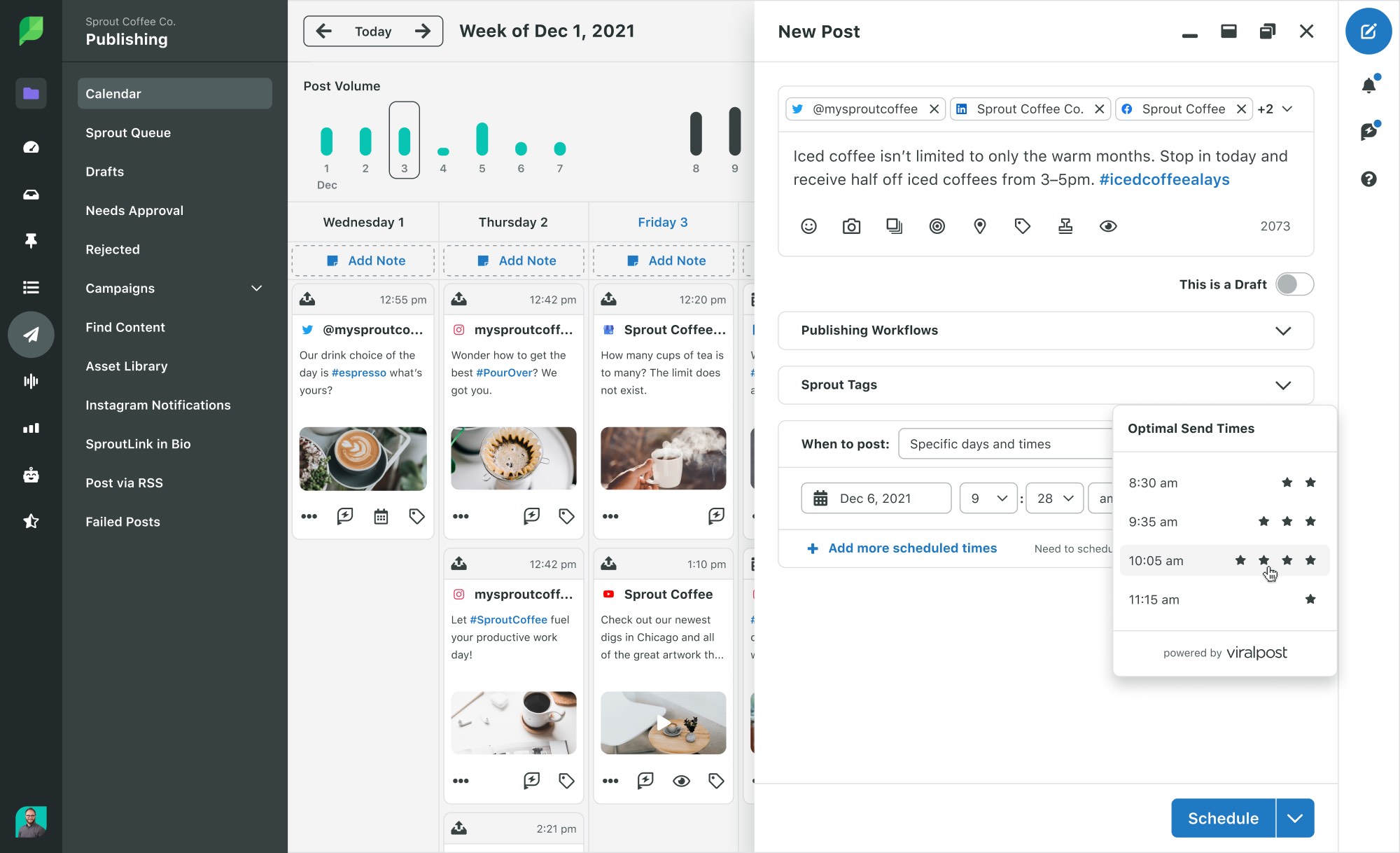
Optimal Send Times (ViralPost™)
Timing matters as much as content. ViralPost™ (now available for Bluesky and Threads) analyzes your audience’s engagement patterns to automatically schedule posts at the times they’re most likely to connect.’
5. Use AI tools to bridge social and listening data with business action
Social data has significant business value, but only if teams can access and act on it. According to the 2025 Impact of Social Media Marketing Report, most leaders are confident social drives ROI across awareness, acquisition and revenue, yet fewer than half say their teams can prove it.
Bridging that gap requires tools that connect social insights to the decisions that matter.
Here are some of the ways Sprout helps teams do that:
Listening insights
Sprout’s AI-powered social listening analyzes consumer sentiment, competitor activity and market trends across billions of conversations, giving teams the context they need to make faster, more informed decisions.
Trellis
Sprout’s agentic AI, Trellis, enables teams to ask complex questions in plain language and get actionable answers in seconds. Rather than manually sifting through data, teams can delegate research to Trellis and get clear, strategic summaries of what’s happening across their social landscape.
NewsWhip
NewsWhip by Sprout gives teams predictive media intelligence by continuously monitoring web coverage and helping brands detect emerging stories and potential reputation risks before they escalate.
Slack integration
Sprout’s Slack integration delivers real-time alerts for message spikes, task assignments and approvals directly into your team’s existing workflows, so the right people can act quickly without switching tools.
Agentforce integration
Sprout’s integration with Salesforce’s Agentforce uses conversational AI to surface social context within customer cases, empowering care teams to resolve issues faster with a fuller picture of the customer.
Message spike alerts
When conversation volume around your brand suddenly increases, Sprout’s message spike alerts notify your team in real time, helping you stay ahead of potential issues.
6. Democratize access to social insights across the org
Right now, social data tends to live with digital marketing teams. But according to the 2025 Impact of Social Media Marketing Report, leaders want those insights to reach customer experience, customer care, business development and product teams too.
Creating the right infrastructure for this could look like:
- Reporting workflows that connect social data to business outcomes like acquisition, revenue and customer retention.
- Regular social intel briefs shared with cross-functional teams
- Pulling social data into the tools that other teams already use, from CRM systems to business intelligence platforms.
Clear data governance policies are also essential. Compliance with privacy regulations protects customer data and maintains the trust that makes all of this possible.
7. Launch a pilot testing program
Now that you’ve done the groundwork, it’s time to test your AI marketing strategy with a pilot project. Start small and pick a campaign that’s straightforward to track, like a series of social posts or a campaign-specific ad set.
Define the metrics you want to measure upfront, let the test run for at least a month to get meaningful data, and document any changes you make along the way. When it wraps up, compare how the AI-assisted work performed against your baseline and use those learnings to inform your next move.
8. Implement the program and measure performance
Once your pilot has proven its value, it’s time to roll out the program across the wider team and have an AI use policy in place. Introduce the AI tools and processes you’ve put in place, and make sure everyone has the training and documentation to use them confidently. Include clear points of contact for different issues to help prevent overwhelm as your teams get up to speed.
From there, continuous measurement keeps the strategy sharp. Track the KPIs that matter most to your business, use AI insights to understand what’s working and what isn’t and make adjustments as you go. Regular monitoring also ensures that your AI tools operate within ethical boundaries and comply with compliance standards, protecting data integrity and customer trust.
9. Scale and optimize your strategy
With measurement in place, the focus shifts to scaling your successes and optimizing your approach over time. Use the insights you’ve gathered to expand your AI strategy into new areas like broadening your use of automation, extending AI tools to new teams or experimenting with new formats and platforms.
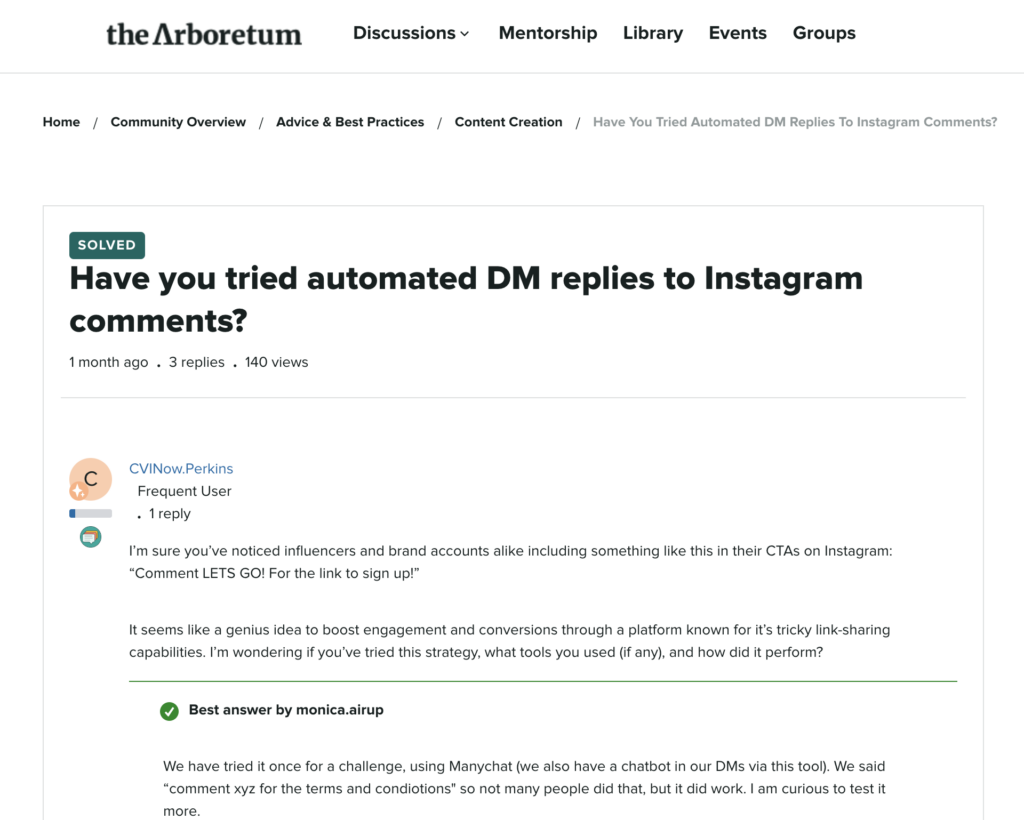
Lastly, stay current with the latest AI developments by tapping into peer communities like Sprout’s Arboretum, where more than 10,000 marketers connect to share best practices and stay informed on the latest tools and platform changes.
Harness the power of AI in your marketing strategy
Designing an AI marketing strategy isn’t a one-and-done project. The tools and audience expectations will continue to evolve. The brands that thrive keep refining their strategy. Testing, measuring and scaling what works becomes part of the routine.
Start with the goals that matter most to your business, build the right foundation around them, and let social intelligence guide where AI adds the most value next.
Ready to put it into practice? Learn how Sprout’s AI and automation tools can bring your AI marketing strategy to life.
The post Designing an AI marketing strategy for social media: An expert guide appeared first on Sprout Social.
from Sprout Social https://ift.tt/rycowRv
via IFTTT

No comments:
Post a Comment